Solar panels lose power on the hottest days of the year, not gain it. This is the single most misunderstood fact in residential and commercial solar buying decisions. People assume “more sun equals more energy,” but Solar Panel Efficiency vs Temperature is governed by physics, not intuition: heat degrades a panel’s voltage output even as sunlight intensity stays constant or rises.
This article breaks down the exact mechanism behind heat-driven power loss, quantifies it with real coefficients, and gives you actionable engineering and installation strategies to minimize it. No filler — just the data and decisions that matter.
Understanding Solar Panel Efficiency vs Temperature: The Science Behind the Drop
Photovoltaic (PV) cells convert sunlight into electricity using the photoelectric effect inside semiconductor layers, typically silicon. Two electrical properties drive output: current (amps) and voltage (volts). Temperature affects these two properties in opposite directions, but voltage loss wins out.
- Current rises slightly with heat. Higher temperatures excite more electrons, marginally increasing the short-circuit current (Isc) — typically by 0.05% to 0.1% per °C.
- Voltage drops sharply with heat. Open-circuit voltage (Voc) falls because increased thermal energy raises the semiconductor’s internal resistance and narrows the bandgap, reducing the electric potential difference. This drop is far larger than the current gain, usually 0.3% to 0.5% per °C.
Since Power = Voltage × Current, the net result is a power loss. This is the core reason Solar Panel Efficiency vs Temperature is an inverse relationship across nearly all silicon-based PV technologies.
What Is the Temperature Coefficient?
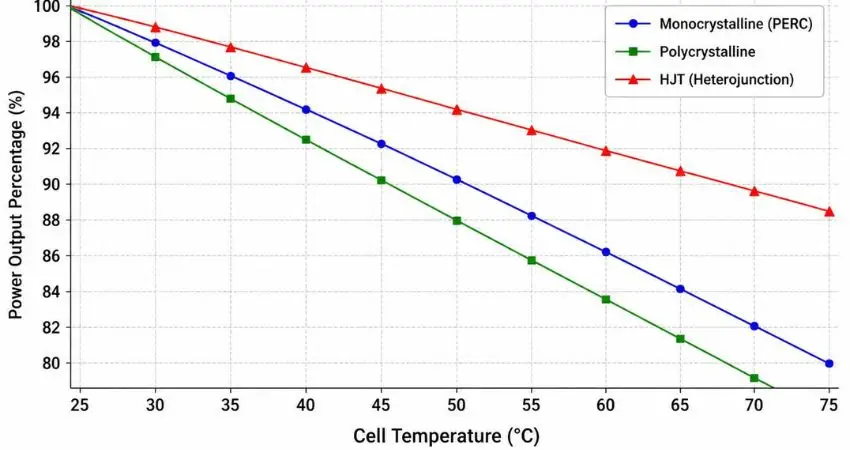
Every solar panel datasheet lists a Temperature Coefficient of Power (Pmax), expressed as %/°C. It tells you exactly how much rated power is lost for every degree Celsius above the Standard Test Condition (STC) baseline of 25°C.
Formula:
Power Loss (%) = Temp Coefficient (%/°C) × (Actual Cell Temp °C − 25°C)
Example: A monocrystalline panel rated at 400W with a coefficient of -0.38%/°C, operating at a cell temperature of 60°C:
Loss = -0.38% × (60 − 25) = -13.3%
Actual Output = 400W × (1 − 0.133) = ~347W
That’s a 53-watt loss purely from heat — with identical sunlight intensity.
Why Cell Temperature Is Not Ambient Temperature
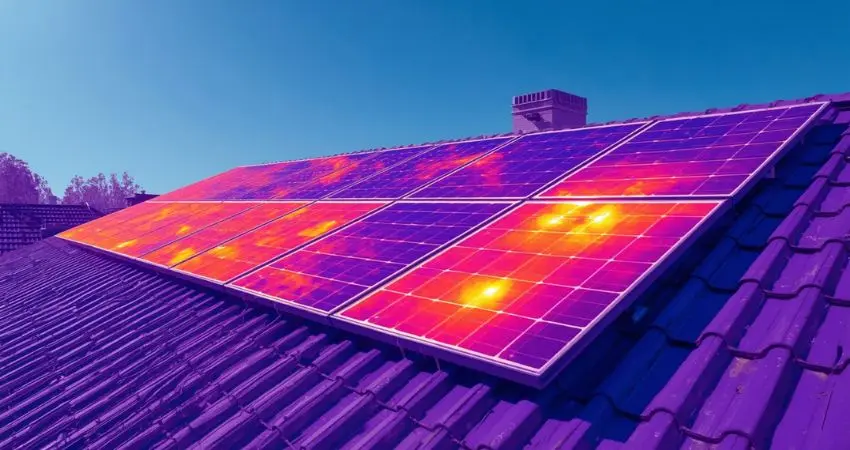
This is the detail most homeowners miss. Cell temperature is almost always 20–35°C higher than ambient air temperature because the panel surface absorbs and retains solar radiation. On a 35°C ambient day with full sun and poor airflow, cell temperature can easily exceed 65–70°C.
Manufacturers account for this with NOCT (Nominal Operating Cell Temperature) — a more realistic rating than STC. NOCT conditions simulate 20°C ambient air, 800 W/m² irradiance, and 1 m/s wind speed, typically yielding a cell temperature around 45°C. Always compare NOCT ratings, not just STC, when evaluating real-world performance.
“Keeping an eye on your overall solar system parameters is just as important as monitoring temperature. To ensure your system is running at peak performance year-round, don’t forget to follow a regular proper solar panel maintenance routine to maximize your system efficiency.”
Solar Panel Efficiency vs Temperature: Real-World Performance Data
Different PV technologies respond to heat differently. The table below compares standard temperature coefficients and projects real power loss at a common high cell temperature (65°C) — a realistic summer peak in hot climates.
| Panel Technology | Typical STC Efficiency | Temp Coefficient (%/°C) | Power Loss at 65°C Cell Temp | Best Use Case |
|---|---|---|---|---|
| Monocrystalline (Mono-PERC) | 20–22% | -0.34% to -0.40% | ~13.6% to 16% | General residential/commercial |
| Polycrystalline | 16–18% | -0.40% to -0.50% | ~16% to 20% | Budget installations |
| Heterojunction (HJT) | 21–23% | -0.24% to -0.28% | ~9.6% to 11.2% | Hot climates, premium installs |
| Thin-Film (CdTe) | 16–19% | -0.25% to -0.32% | ~10% to 12.8% | Large utility-scale desert farms |
| Amorphous Silicon (a-Si) | 6–9% | -0.18% to -0.21% | ~7.2% to 8.4% | Low-heat, flexible applications |
| Bifacial Mono | 21–23% | -0.34% to -0.39% | ~13.6% to 15.6% | Ground-mount, high-albedo sites |
Key takeaway: HJT and thin-film technologies degrade less under heat than standard monocrystalline panels, despite mono panels having higher baseline STC efficiency. In consistently hot regions (Gulf states, Australia, the U.S. Southwest, sub-Saharan Africa), this gap can erase the efficiency advantage mono panels claim on paper.
Factors That Influence Solar Panel Efficiency vs Temperature Beyond the Cell
The temperature coefficient is the only variable. Several physical and environmental factors compound or reduce heat-driven losses in practice.
Panel Mounting and Airflow
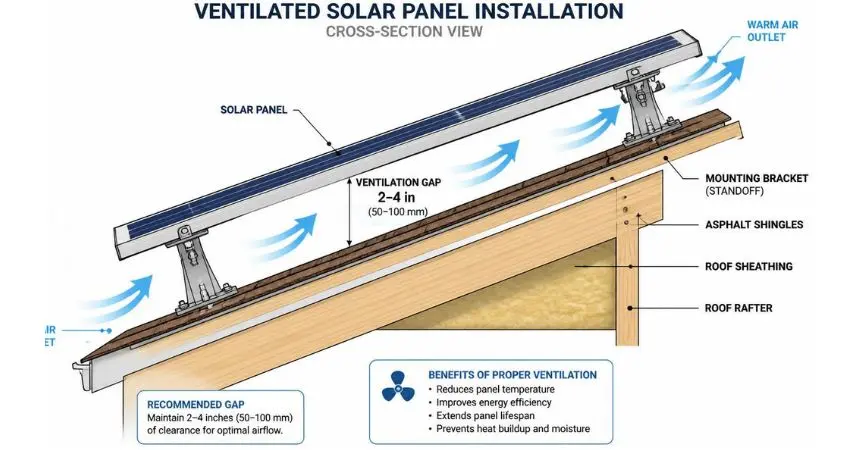
- Roof-mounted (flush) systems trap heat beneath the panel, often raising cell temperature by 5–10°C above that of well-ventilated alternatives.
- Rack-mounted systems with a 4–6 inch air gap allow convective cooling, reducing cell temperature significantly.
- Ground-mount and pole-mount systems generally run coolest due to airflow on all sides.
Panel Color and Backsheet Material
- Black backsheets and frames absorb more infrared radiation, increasing operating temperature versus white backsheets.
- Glass-glass panels (used in bifacial modules) tend to run slightly hotter than glass-polymer backsheet panels due to different thermal conductivity.
Geographic and Climate Conditions
- Desert climates: high irradiance plus high ambient temperature compounds losses — exactly the regions where thin-film or HJT often outperforms mono panels in net annual output.
- Coastal and temperate climates: wind cooling naturally offsets some heat buildup, making mono panels’ higher STC efficiency more reliably translate to real output.
- High-altitude installations: cooler ambient air and thinner atmosphere reduce heat buildup despite stronger UV exposure.
Wind Speed
Wind is a free cooling resource. A consistent 3–4 m/s breeze across a panel surface can lower cell temperature by 8–12°C compared to still-air conditions, directly improving output in line with the panel’s temperature coefficient.
How to Minimize Heat-Related Efficiency Losses
You cannot change physics, but you can engineer around it. These are the highest-impact, field-tested strategies:
- Increase mounting tilt and rear clearance. A minimum 4-inch gap between the panel and roof surface improves passive airflow and can reduce cell temperature by 5–8°C.
- Choose light-colored or reflective roofing beneath panels. Reduces radiant heat absorption from the roof surface into the panel from below.
- Select panels with a lower temperature coefficient for hot climates. HJT or premium mono-PERC panels with coefficients better than -0.30%/°C outperform standard panels in sustained heat.
- Use microinverters or power optimizers. Unlike string inverters, these isolate underperforming (overheated) panels, so one hot panel doesn’t drag down an entire string’s output.
- Avoid flush-mounted, fully enclosed installations. These traps heat with no escape path and consistently show the highest thermal losses in field studies.
- Consider active cooling for utility-scale arrays. Water-cooling or misting systems are used in some large solar farms in extreme climates (the Middle East, Australia) and have demonstrated 10–15% output recovery during peak heat hours, though added cost must be justified by scale.
- Schedule cleaning during cooler hours. Dust and grime increase heat absorption; cleaning at dawn or dusk avoids thermal shock to hot glass.
Pros and Cons of High-Temperature Solar Installations
Understanding Solar Panel Efficiency vs Temperature also means recognizing that hot climates aren’t purely negative for solar economics.
Advantages of high-irradiance, high-temperature regions:
- More total annual sunlight hours and higher peak irradiance (W/m²), which partially offset per-degree efficiency loss.
- Faster system payback in regions with high electricity demand for cooling, since solar generation often peaks alongside grid demand.
- Lower panel degradation from cold-related stress (no snow load, no freeze-thaw cycling on mounting hardware).
Disadvantages of high-temperature regions:
- Reduced real-world output relative to nameplate (STC) rating, requiring oversized systems to meet target energy needs.
- Accelerated long-term degradation of encapsulant materials (EVA) and backsheet, which can shorten usable panel lifespan by 2–4 years in extreme heat versus moderate climates.
- Increased thermal cycling stress on solder joints and junction boxes raises long-term maintenance risk.
- Inverter derating: Many inverters reduce output above 45°C ambient temperature to protect internal electronics, compounding panel-level losses.
Solar Panel Efficiency vs Temperature: Common Myths Debunked
- Myth: “Hotter weather means more solar power.” False. Irradiance (sunlight intensity) and temperature are different variables. More sun helps; more heat hurts. The two often occur together, but their effects work against each other.
- Myth: “Panel efficiency rating tells you real-world output.” False. The efficiency percentage on a datasheet is measured at 25°C STC — a lab condition rarely matched in the field. NOCT or real operating data is more predictive.
- Myth: “All panels lose efficiency the same way in heat.” False. As shown in the comparison table, temperature coefficients vary by 2x between technologies. Climate-appropriate panel selection matters as much as wattage rating.
- Myth: “Cooling solutions aren’t worth the cost.” Context-dependent. For residential rooftops, passive airflow design is usually sufficient and nearly free. For utility-scale farms in extreme heat, active cooling can be economically justified by the sheer scale of recovered output.
Conclusion
Solar Panel Efficiency vs Temperature isn’t a marginal footnote — it’s a core engineering variable that determines whether your system delivers its rated output or quietly underperforms by 10–20% during peak summer months. The mechanism is straightforward: rising cell temperature increases voltage loss faster than it increases current gain, producing a net power decline governed by each panel’s temperature coefficient.
The practical path forward is clear. Check NOCT ratings, not just STC efficiency, before buying. Prioritize panels with lower temperature coefficients if you’re installing in a hot climate. Design for airflow at every mounting stage. And remember that high irradiance and high heat are not the same thing — one helps your system, the other works against it. Understanding this relationship turns a confusing spec sheet number into a decision-making tool that directly protects your energy yield and return on investment.