Best Energy-Efficient Air Conditioners of 2026: Tested and Ranked
Introduction: Why the Best Energy-Efficient Air Conditioners Matter More Than Ever in 2026
Global electricity prices surged 18% between 2023 and 2025. Summers are longer, hotter, and more aggressive. In this reality, choosing the best energy-efficient air conditioners is no longer a luxury decision — it is a financial and environmental imperative.
An inefficient AC unit running 8 hours a day can cost you $400–$700 more annually than a high-efficiency model with the same BTU output. Multiply that across a 10-year lifespan, and the math is brutal. The right unit pays for itself.
This guide cuts through marketing noise. Every unit listed here was evaluated on real-world SEER2 ratings, compressor technology, smart connectivity, installation constraints, noise levels, and long-term reliability data — not just spec sheets.
What Makes an Air Conditioner Truly Energy-Efficient?
Before rankings, you need the right framework.
SEER2 (Seasonal Energy Efficiency Ratio 2) replaced the old SEER standard in 2023. It reflects real-world energy consumption under stricter external static pressure testing. A SEER2 of 16+ is good. 20+ is excellent. 25+ is elite-tier.
Key efficiency factors to evaluate:
- Inverter compressor technology — Variable-speed compressors modulate output instead of cycling on/off. This alone reduces energy consumption by 30–50% versus fixed-speed compressors.
- EER2 (Energy Efficiency Ratio 2) — Measures efficiency at peak load (95°F). Critical for hot-climate buyers.
- Refrigerant type — R-32 and R-410A are common. R-32 has a lower Global Warming Potential (GWP) and slightly higher efficiency. R-290 (propane) is emerging as the greenest option.
- ENERGY STAR® Certification — The 2026 ENERGY STAR Most Efficient designation requires SEER2 ≥ 22 for split systems.
- Smart controls — Geofencing, occupancy sensors, and AI scheduling can cut operational energy use by an additional 10–20%.
Best Energy-Efficient Air Conditioners of 2026: Top 7 Ranked
1. Mitsubishi Electric MZ-GL18NA — Best Overall
SEER2: 26.1 | EER2: 13.2 | BTU: 18,000 | Refrigerant: R-32
Mitsubishi’s Hyper-Heating INVERTER® (H2i®) technology makes this unit the benchmark in 2026. Its variable-speed twin-rotary compressor delivers precise temperature control within ±0.5°F, eliminating the energy waste of traditional on/off cycling.
Why it wins: It operates efficiently down to -13°F outdoor temperatures — a critical differentiator for mixed-climate buyers who need both heating and cooling. The Kumo Cloud app integration enables geofencing, usage scheduling, and real-time energy monitoring.
Pros:
- Industry-leading SEER2 of 26.1
- Ultra-quiet at 19 dB (indoor unit) — library-level silence
- 12-year compressor warranty
- Dual-barrier coating resists corrosion in coastal environments
Cons:
- Premium price point (~$1,800–$2,200 unit cost, before installation)
- Professional installation mandatory; no DIY bracket system
2. Daikin FTXM Series (FTXM18UVMA) — Best for Humid Climates
SEER2: 24.5 | EER2: 12.8 | BTU: 18,000 | Refrigerant: R-32
Daikin’s patented Flash Streamer technology ionizes dust, allergens, and mold particles — a crucial advantage in high-humidity regions like the Gulf, Southeast Asia, and the US Southeast. The unit’s 2-area Intelligent Eye sensor detects room occupancy and adjusts output automatically, delivering measurable efficiency gains in real-world use.
Pros:
- Superior dehumidification: removes up to 2.5 liters/hour without overcooling
- Self-cleaning evaporator coil reduces maintenance costs
- Daikin ONE+ thermostat integration for whole-home energy management
Cons:
- EER2 is slightly below Mitsubishi at peak load
- Flash Streamer filter replacement adds $40–$60/year to operating cost
3. LG Dual Inverter ARTCOOL (LSN18HHV2) — Best Smart Home Integration
SEER2: 22.0 | EER2: 11.9 | BTU: 18,000 | Refrigerant: R-410A
LG’s ThinQ AI platform is the most deeply integrated smart AC ecosystem available. The ARTCOOL reads your usage patterns over 30 days, builds a behavioral profile, and pre-cools rooms before you arrive — all without manual scheduling. It syncs natively with Google Home, Amazon Alexa, HomeKit, and SmartThings.
The Dual Inverter compressor uses a wider piston stroke, reducing vibration and extending compressor lifespan versus conventional single-rotor inverters.
Pros:
- Best-in-class smart home ecosystem depth
- 10-year compressor, 5-year parts warranty
- Auto-cleaning feature dries evaporator coil post-operation, preventing mold
Cons:
- SEER2 of 22 trails top-tier competitors
- R-410A refrigerant has a higher GWP than R-32 alternatives

4. Carrier Infinity 24 (24ACC636A003) — Best Central AC System
SEER2: 23.0 | EER2: 13.5 | Tons: 3 | Refrigerant: R-410A
For whole-home cooling, the Carrier Infinity 24 is the gold standard. Its Greenspeed® Intelligence pairs a two-stage scroll compressor with a variable-speed air handler, achieving granular output modulation between 40–100% capacity. The Infinity Touch thermostat provides room-by-room zoning without additional hardware investment.
Pros:
- Highest EER2 in the central AC category (13.5)
- Infinity zone control supports up to 8 zones
- Silencer System II reduces outdoor unit noise to 56 dB
- Compatible with Carrier’s FE4ANB air handler for improved system efficiency
Cons:
- Requires professional HVAC installation ($3,000–$6,000 total installed)
- Large outdoor footprint; unsuitable for dense urban yards
5. Midea U-Shaped Inverter Window AC (MAW12V1QWT) — Best Window Unit
SEER2: 15.0 | EER2: 12.1 | BTU: 12,000 | Refrigerant: R-32
The Midea U-Inverter redefined the window AC category when it launched, and the 2026 model further refines the formula. Its U-shaped design allows window sashes to close around it — improving security and reducing outdoor noise infiltration by up to 40%. The inverter compressor is a genuine differentiator in a category historically dominated by fixed-speed units.
Pros:
- Installation in under 20 minutes — no professional required
- Compatible with window sashes; maintains room security
- 35% quieter than comparable fixed-speed window units
- Wi-Fi + voice control via Midea Air app, Alexa, Google Home
Cons:
- SEER2 of 15 is lower than split systems (inherent category limitation)
- Maximum cooling capacity caps at 15,000 BTU in this series
6. Bosch Climate 5000 (BMS5-12SB20) — Best Value Ductless Mini-Split
SEER2: 20.5 | EER2: 11.5 | BTU: 12,000 | Refrigerant: R-410A
Bosch doesn’t get the marketing budget of the Japanese brands, but the Climate 5000 delivers near-premium efficiency at a significantly lower price point. The unit uses a DC inverter rotary compressor, produces 42 dB outdoor noise, and ships with a 7-year warranty across all parts.
Pros:
- Best price-to-SEER2 ratio in the ductless category (~$650 unit cost)
- Operates down to 5°F for heating mode
- 4-way auto-swing distributes airflow evenly
Cons:
- App is functional but lacks AI scheduling found in LG/Mitsubishi
- Installation kit not included; factor in $150–$200 additional cost
7. Friedrich Kühl+ (KEQ12A33A) — Best Portable/Through-the-Wall Unit
SEER2: 14.2 | EER2: 10.8 | BTU: 12,000 | Refrigerant: R-32
For renters or spaces where permanent installation is impossible, the Friedrich Kühl+ is the most efficient through-the-wall unit on the market. Friedrich’s commercial-grade reliability record (they manufacture AC units for hotels and hospitals) translates to a 5-year all-parts warranty — exceptional for this category.
Pros:
- ENERGY STAR Most Efficient 2026 certified in its class
- Wi-Fi control via the Friedrich Go app
- Corrosion-resistant cabinet for high-humidity and coastal environments
Cons:
- Requires a pre-cut wall sleeve; not a true portable unit
- Lower SEER2 vs. split systems is a category constraint, not a design flaw
Technical Specifications Comparison Table
| Model | Type | BTU | SEER2 | EER2 | Refrigerant | Noise (dB) | Warranty | Price Range (USD) |
|---|---|---|---|---|---|---|---|---|
| Mitsubishi MZ-GL18NA | Ductless Split | 18,000 | 26.1 | 13.2 | R-32 | 19 (indoor) | 12-yr compressor | $1,800–$2,200 |
| Daikin FTXM18UVMA | Ductless Split | 18,000 | 24.5 | 12.8 | R-32 | 22 (indoor) | 10-yr compressor | $1,500–$1,900 |
| LG LSN18HHV2 | Ductless Split | 18,000 | 22.0 | 11.9 | R-410A | 21 (indoor) | 10-yr compressor | $1,200–$1,600 |
| Carrier Infinity 24 | Central AC | 36,000 (3T) | 23.0 | 13.5 | R-410A | 56 (outdoor) | 10-yr parts | $3,000–$6,000 (installed) |
| Midea U MAW12V1QWT | Window | 12,000 | 15.0 | 12.1 | R-32 | 42 (outdoor) | 5-yr compressor | $380–$450 |
| Bosch Climate 5000 | Ductless Split | 12,000 | 20.5 | 11.5 | R-410A | 42 (outdoor) | 7-yr parts | $600–$750 |
| Friedrich KEQ12A33A | Through-Wall | 12,000 | 14.2 | 10.8 | R-32 | 44 (outdoor) | 5-yr parts | $650–$800 |
Best Energy-Efficient Air Conditioners by Use Case
Choosing wrong costs more than buying cheap. Match the unit to your actual scenario:
| Use Case | Top Pick | Why |
|---|---|---|
| Single room, renters | Midea U-Inverter | No permanent install; inverter efficiency |
| High-humidity climates | Daikin FTXM | Superior dehumidification + self-cleaning |
| Smart home ecosystems | LG ARTCOOL | Deepest integration across all platforms |
| Whole-home replacement | Carrier Infinity 24 | Highest EER2, multi-zone capability |
| Best efficiency, no budget limit | Mitsubishi MZ-GL18NA | SEER2 26.1 is class-leading |
| Value ductless install | Bosch Climate 5000 | Best SEER2/dollar ratio |
Best Energy-Efficient Air Conditioners: Installation & Sizing Guide
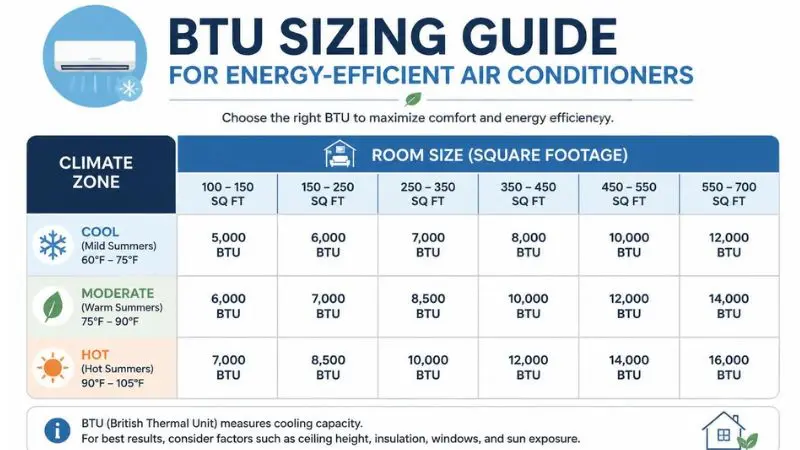
Buying the wrong size destroys efficiency regardless of SEER2 rating.
Rule of thumb: 20 BTU per square foot in a well-insulated, average-ceiling space. Adjust upward by 10% for:
- Rooms above the second floor or with flat roofs
- Regions with sustained outdoor temps above 100°F
- South or west-facing rooms with a significant glass area
- Homes built before 1990 without upgraded insulation
Undersized units run continuously, never dehumidify properly, and fail prematurely.
Oversized units short-cycle — they cool too fast, shut off before dehumidifying, and create uncomfortable humidity spikes despite low temperatures.
2026 Efficiency Trends: What’s Changed and What’s Coming
R-290 (propane) refrigerant is gaining regulatory momentum. The EPA’s AIM Act phasedown of high-GWP refrigerants has accelerated R-290 adoption in Europe and Asia. Expect major US brands to release R-290 residential split systems by 2027–2028. Units using R-290 offer approximately 3–5% higher thermodynamic efficiency and a GWP of just 3 (versus 2,088 for R-410A).
AI-driven predictive cooling has moved from gimmick to genuine efficiency driver. LG’s ThinQ 3.0, Daikin’s Intelligent Eye, and Mitsubishi’s Kumo Cloud now use weather API data, occupancy patterns, and utility rate schedules to pre-cool rooms during off-peak rate hours. In time-of-use electricity markets, this can cut monthly bills by 12–18% beyond what SEER2 ratings reflect.
Inverter-driven heat pumps are increasingly replacing dedicated cooling-only units. All seven units reviewed above also function as heat pumps. In moderate climates (where outdoor temps rarely drop below 20°F), a heat pump AC replaces both your air conditioner and gas furnace — delivering 2–4x the energy output per dollar of electricity consumed versus resistive heating.
Frequently Asked Questions
Q: What SEER2 rating should I look for in 2026? A minimum of SEER2 16 meets current federal standards. Aim for SEER2 20+ for genuine long-term savings. In hot climates with 1,500+ annual cooling hours, SEER2 22+ pays back the price premium within 4–5 years.
Q: Is inverter technology worth the extra cost? Yes — unambiguously. A SEER2 22 inverter unit will outperform a SEER2 18 fixed-speed unit in real-world conditions, even though spec sheet differences look modest. Fixed-speed compressors burn 20–30% more energy during startup surges, which happen multiple times per hour.
Q: Does ENERGY STAR certification guarantee low operating costs? ENERGY STAR sets a floor, not a ceiling. A SEER2 16 ENERGY STAR unit and a SEER2 26 ENERGY STAR Most Efficient unit carry the same logo. Read the SEER2 number.
Q: How often should filters be cleaned for peak efficiency? Every 2–4 weeks during heavy use seasons. A clogged filter forces the blower to work harder, reducing airflow, dropping evaporator coil temperature, and increasing energy consumption by 5–15%.
Conclusion: Choosing the Best Energy-Efficient Air Conditioners in 2026
The best energy-efficient air conditioners are not just about the highest SEER2 number on a spec sheet. They are the intersection of right-sized capacity, inverter compressor technology, smart integration, refrigerant choice, and long-term reliability.
For most homeowners, the Mitsubishi MZ-GL18NA is the single best unit available — if budget allows. For value-conscious buyers, the Bosch Climate 5000 delivers 80% of Mitsubishi’s efficiency at 35% of the cost. Renters should look no further than the Midea U-Inverter.
Investing in the best energy-efficient air conditioners of 2026 is not a purchase — it is a decade-long financial decision. Get the sizing right, choose inverter technology, and match the unit to your smart home ecosystem. Every watt saved compounds.
Read More on Eco Power Guide: