CHAPTER 1: Introduction – The Washer War That Affects Your Wallet & Planet
Front Load vs Top Load Washer 2026: Why Your Choice Matters More Than Ever
Let’s start with a simple question.
When was the last time you thought about your washing machine?
For most people, it sits in the corner doing its job — quietly, reliably, without much attention. You toss in your clothes, press a button, and move on with your day.
But here’s what most people never realize:
That one appliance is silently draining your wallet and your water supply — every single week.
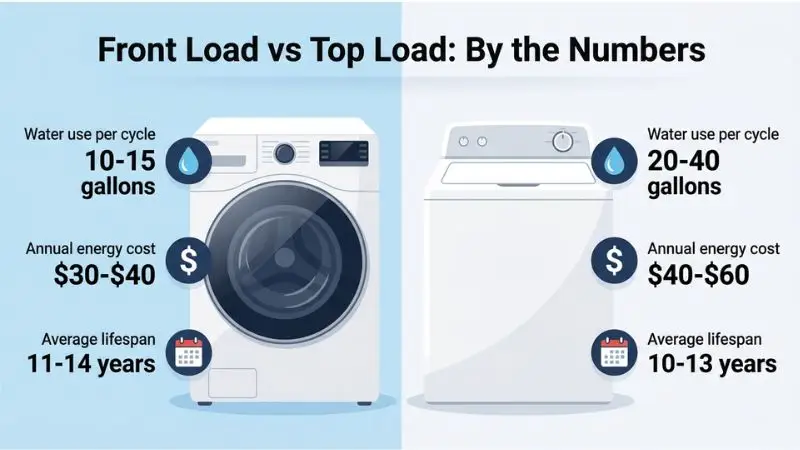
The average household runs more than 300 loads of laundry every year. That’s roughly six loads per week. Multiply that by the water, electricity, and detergent used in each cycle, and suddenly your “set it and forget it” appliance becomes one of the biggest ongoing expenses in your home.
And the choice you make — front load or top load — can mean the difference between spending $200 a year or over $500 a year just to keep your clothes clean.
That’s a real difference. And it adds up fast.
💡 DID YOU KNOW?
Washing machines account for approximately 17% of all indoor home water use — making them the third largest water-consuming appliance in the average household, right behind toilets and showers. Choosing the right washer type can save a family of four up to 8,000 gallons of water per year.
The $1,000+ Decision Most People Get Wrong
Here’s the truth that appliance stores won’t always tell you:
The sticker price is the least important number on the tag.
Most shoppers walk into a store, look at two machines side by side, and pick the cheaper one. It feels like the smart, budget-conscious choice. But what they’re really doing is ignoring the three costs that matter most over the long run:
- Water costs — How many gallons does each cycle use?
- Energy costs — How much electricity does it pull per load?
- Drying costs — How wet are your clothes when the cycle ends?
That last one surprises people the most. A washing machine that leaves your clothes wetter forces your dryer to work longer — and your dryer is one of the most energy-hungry appliances in your home.
When you add up water bills, electricity bills, and extra drying time over 10 years of ownership, the cheaper machine can easily cost you $1,000 to $1,500 more than the one with the higher upfront price.
That’s not a small rounding error. That’s a vacation. A new laptop. Or a year of grocery bills.
📦 DEFINITION:
High-Efficiency (HE) Washer A High-Efficiency (HE) washer is any washing machine — front load or top load — that is designed to use significantly less water and energy than standard models. HE washers are certified by programs like ENERGY STAR and carry a Water Factor (WF) rating to help consumers compare efficiency. They require HE-specific detergent to function properly and avoid excess suds.
This guide exists because most buying advice online stops at the surface level. It tells you which machine “feels” better or which brand people like. But it rarely shows you the real numbers — the kind that affect your monthly bills, your home’s water footprint, and yes, even the environment your children will inherit.
In 2026, with water costs rising in cities across the US, UK, Australia, and the Middle East — and with energy prices staying stubbornly high — the washing machine decision has never been more important.
What This Guide Will Teach You
This is not a typical product review. There are no affiliate rankings here. No “Brand X paid us to say this.”
This is a complete, data-driven breakdown of everything you need to know before you spend your money on a washing machine — written in plain English, for real people.
By the time you finish reading, you will know:
- Exactly how much water each washer type uses — per cycle, per year, and over a decade
- The real energy costs of front-load and top-load machines, including the hidden dryer connection
- Which machine cleans better — and for which types of clothes and stains
- The maintenance reality — including the mold problem with front loaders that manufacturers downplay
- How to calculate your personal break-even point so you know which machine actually saves you money
- What’s coming next in washer technology — including waterless machines and AI-powered laundry cycles
Whether you’re replacing an old machine, setting up a new home, or just trying to cut your utility bills, this guide will give you the honest answers you need.
How to Use This Guide (Quick Navigation Map)
This guide is built to be read cover to cover OR used as a reference tool whenever you need it.
Here’s a quick map of what each chapter covers:
| Chapter | What You’ll Learn |
|---|---|
| Ch. 2 | How each washer type actually works — the mechanics explained simply |
| Ch. 3 | Water usage deep dive — gallons, costs, and annual savings data |
| Ch. 4 | Energy efficiency and electricity costs — the 10-year picture |
| Ch. 5 | Cleaning performance — stain removal, fabric care, and allergens |
| Ch. 6 | Practical usability — space, features, cycle times, and smart tech |
| Ch. 7 | Maintenance and reliability — what breaks, what lasts, what to watch for |
| Ch. 8 | Price, value, and buying guide — how to choose confidently |
| Ch. 9 | Future trends — where washer technology is heading by 2030 |
| Ch. 10 | FAQs — 12 of the most common questions answered clearly |
You can jump directly to any chapter using the headings. But if you’re starting fresh, we recommend reading Chapters 2, 3, and 8 first — they form the core decision-making framework.
🔧 PRO TIP:
Before you read another word, do this one thing: check your current water bill. Find the line that shows your monthly gallons used. Write it down. By the time you finish Chapter 3, you’ll know exactly how many of those gallons your washing machine is responsible for — and how much you could realistically save by switching types.
Ready to find out which washer is actually right for you?
Let’s start where every good decision starts — with the facts.
CHAPTER 2: Understanding the Basics — Definitions & How Each Machine Works
Front Load Washers Explained: The Complete Definition
Before you can choose the right washing machine, you need to understand what you’re actually choosing between.In this front load vs top load washer 2026 guide, we’ll explain the mechanical differences that affect your daily life.
Not just the shape. Not just the door placement. But how each machine actually thinks about cleaning your clothes — because the approach is fundamentally different.
Let’s start with the front loader.
📦 DEFINITION:
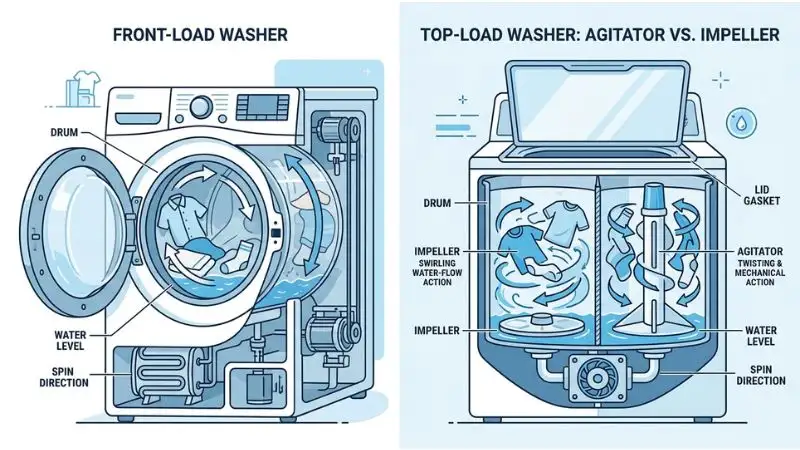
Front Load Washer A front load washer (also called a front-loading washing machine or horizontal-axis washer) is a washing machine where clothes are loaded through a door on the front of the machine. The drum sits horizontally and rotates on a side-to-side axis, repeatedly lifting clothes up and dropping them through a small amount of water at the bottom. This tumbling action — combined with less water and higher spin speeds — makes front loaders significantly more water-efficient and gentler on fabrics than traditional top load machines. They are the preferred choice in Europe, and their popularity in North America has grown steadily since the early 2000s.
How Front-Load Washers Clean Clothes (The Physics Behind It)
Here’s something most people never think about:
A front-load washer doesn’t clean your clothes by soaking them. It cleans them by dropping them.
The horizontal drum rotates continuously during the wash cycle. As it turns out, clothes are carried up to the top of the drum — then dropped back down into the shallow pool of soapy water at the bottom.
This motion is called tumble washing, and it works on a simple physical principle: gravity plus friction equals cleaning power.
Each time a clothing item drops from the top of the drum, it hits the water and other clothes with enough force to loosen and release dirt particles. The drum repeats this motion hundreds of times per cycle, working the detergent deep into the fabric without needing to submerge everything in a full tub of water.
The result?
- Cleaner clothes using up to 70% less water than traditional top loaders
- Less mechanical stress on fabric fibers
- Higher final spin speeds that extract more water before the drying cycle begins
Key Mechanical Components of a Front Loader
Understanding the parts helps you understand the maintenance and the common problems covered in Chapter 7.
A front-load washer is built around these core components:
- Horizontal drum — The rotating stainless steel cylinder where clothes go
- Door gasket (rubber seal) — The flexible rubber ring that creates a watertight seal around the front door
- Bearing assembly — Supports the drum as it spins at high RPM; the most common long-term failure point
- Pump and drain system — Removes water efficiently during and after each cycle
- Control board — The electronic brain that manages cycle timing, temperature, and spin speed
The door gasket deserves special attention. It’s the component most responsible for the mold and mildew smell that some front loader owners complain about — a problem that is entirely preventable, as Chapter 7 explains in detail.
A Brief History — Where Front-Load Technology Came From
💡 DID YOU KNOW?
Front load washers are actually the older of the two designs. Early commercial laundromats in the 1930s and 1940s used horizontal-axis drum machines almost exclusively — because they were more efficient with water and could handle heavy loads. Top load washers rose to dominance in North American homes during the post-war boom of the 1950s, largely because they were cheaper to manufacture and easier to load while standing upright. Europe never made the switch — which is why front loaders still dominate the European market today.
The timeline tells an interesting story:
- 1930s–1940s: Horizontal drum (front load) machines used in commercial laundry settings
- 1950s–1970s: Top-load agitator washers dominate the US home market due to lower cost
- 1980s–1990s: Energy crisis sparks renewed interest in water and energy efficiency
- Early 2000s: Front loaders re-enter the North American consumer market with modern features
- 2010s: High-Efficiency (HE) top loaders introduced to bridge the gap
- 2020s–2026: Smart washers, AI load sensing, and cold-wash optimization redefine both categories
Top Load Washers Explained: The Complete Definition
Now, let’s look at the machine that most North American households grew up with.
📦 DEFINITION:
Top Load Washer A top load washer (also called a top-loading washing machine or vertical-axis washer) is a washing machine where clothes are loaded through an opening on the top of the machine. The drum sits vertically and fills with water to submerge or partially submerge the laundry. Cleaning action is created either by a central agitator (a tall post with rotating fins) or a low-profile impeller (a disc or cone at the base of the drum). Top loaders are generally faster per cycle, easier to load while standing, and lower in upfront cost — but they typically use more water than front loaders.
Agitator vs. Impeller Top Loaders — What’s the Difference?
This is the detail that confuses most shoppers, because “top load washer” is actually two very different machines hiding under the same category name.
Agitator Top Loaders:
- Feature a tall central post with fins or paddles that rotate back and forth
- Work by physically moving clothes through the water in a twisting, churning motion
- Very effective at removing heavy soil and ground-in dirt
- Can be rougher on delicate fabrics due to the mechanical friction
- Use more water to keep the agitator’s motion effective
Impeller Top Loaders (HE Top Loaders):
- Feature a low-profile disc or ribbed cone at the bottom of the drum instead of a central post
- Work by creating a rolling, tumbling current of water that moves clothes in multiple directions
- Much gentler on fabrics than agitator models
- Use significantly less water — much closer to front loader efficiency levels
- Offer a larger usable drum capacity since there’s no central post taking up space
How Top Load Washers Clean Clothes (The Motion Breakdown)
The cleaning physics of a top loader is almost the opposite of a front loader.
Instead of using gravity and a small amount of water, a top loader relies on the volume of water and mechanical motion to clean.
In an agitator machine, the central post twists back and forth rapidly, dragging clothes through the water in a figure-eight pattern. The friction between the clothes, the water, and the agitator fins scrubs dirt loose.
In an impeller machine, the rotating disc at the base creates a powerful water current that flows upward through the clothes, rinsing and agitating them more gently than an agitator — but still more vigorously than a front loader’s tumble action.
Both methods work. But both require more water to function, which is the core efficiency disadvantage of the top-load design.
Traditional Agitator vs. Modern High-Efficiency Top Loaders
Here’s a comparison that puts the differences in plain numbers:
| Feature | Traditional Agitator | HE Top Loader | Front Loader |
|---|---|---|---|
| Water per cycle | 40–45 gallons | 15–25 gallons | 10–14 gallons |
| Cycle time | 35–45 min | 45–60 min | 60–90 min |
| Fabric gentleness | Low | Medium | High |
| Upfront cost | Low | Medium | Medium–High |
| Load capacity | Medium | Large | Large |
The modern HE top loader sits firmly in the middle ground — more efficient than a traditional agitator machine, but still not quite matching a front loader’s water savings.
🔧 PRO TIP:
If you’re replacing an old agitator top loader and feel nervous about switching to a front loader, a modern HE top loader is the perfect middle step. You keep the familiar top-loading convenience and faster cycle times, while cutting your water use by up to 40% compared to your old machine. It’s a meaningful upgrade without the learning curve of an entirely new machine type.
Understanding how each machine works at a mechanical level gives you a huge advantage as a buyer. You stop being swayed by marketing language and start asking the right questions — like how much water it actually uses per cycle, and what the real cleaning trade-offs are.
That’s exactly what Chapter 3 is going to show you — with real numbers, real data, and a clear picture of what each washer type costs you every single year.
CHAPTER 3: Water Consumption Deep Dive — The Numbers That Will Shock You
How Much Water Does a Front-Load Washer Use Per Cycle?
When comparing front load vs top load washer 2026 water usage, the difference is bigger than most people expect. Let’s get straight to the numbers.
A modern front-load washer uses somewhere between 10 and 14 gallons of water per cycle. Some of the most efficient ENERGY STAR certified models use as little as 7 to 9 gallons per full load.
To put that in perspective: a standard shower uses about 2 gallons per minute. One cycle in a top-loading agitator machine uses the same water as a 20-minute shower.
A front loader? More like an 8-minute shower.
That gap — multiplied across 300+ loads per year — is where the real savings live.
Front Loader Water Usage by Load Size (Small, Medium, Large)
One of the biggest advantages of a modern front loader is its load-sensing technology. The machine doesn’t just use a fixed amount of water every time. It adjusts based on how much laundry you actually put in.
Here’s what typical water usage looks like across different load sizes:
| Load Size | Approx. Weight | Water Used (Front Loader) |
|---|---|---|
| Small | 3–4 lbs | 7–9 gallons (26–34 liters) |
| Medium | 6–8 lbs | 10–12 gallons (38–45 liters) |
| Large/Full | 10–12 lbs | 12–14 gallons (45–53 liters) |
The key takeaway here: even at a full load, a front loader uses roughly the same water as a small load in an old agitator top loader. That’s not a small efficiency edge — that’s a completely different league of performance.
ENERGY STAR Certified Front Loaders — 2026 Water Benchmarks
Not all front loaders are created equal. The ENERGY STAR program sets minimum efficiency thresholds that machines must meet to earn certification — and in 2026, those benchmarks are stricter than ever.
To earn an ENERGY STAR label, a residential front-load washer must achieve:
- A Water Factor (WF) of 4.0 or below (gallons used per cubic foot of drum capacity, per cycle)
- A Modified Energy Factor (MEF) that accounts for both washing and drying energy
The best front loaders on the market in 2026 are hitting WF scores of 2.5 to 3.2 — well below the certification threshold. That means they’re using nearly 40% less water than the minimum required to earn the ENERGY STAR badge.
How Sensing Technology Reduces Water Waste in Front Loaders
Modern front loaders don’t guess how much water to use. They measure it.
Most mid-range and premium front loaders now include one or more of the following sensing technologies:
- Load weight sensors — Detect the weight of laundry before the cycle starts and adjust water volume accordingly
- Soil sensors — Measure how dirty the water is during the cycle and extend rinsing only when needed
- Moisture sensors — Used during the spin cycle to determine when clothes are sufficiently dry, preventing over-spinning
These technologies work together to eliminate wasted water at every stage of the cycle. It’s one of the main reasons why real-world water usage on a good front loader is often even lower than the rated specification.
How Much Water Does a Top-Load Washer Use Per Cycle?
Now let’s look at the other side — and where the numbers start to get uncomfortable.
Traditional Agitator Top Loaders — The Water Guzzlers
An old-school top-load washer with a central agitator is, by modern standards, shockingly inefficient with water.
To function properly, the agitator needs to be fully submerged — which means the entire drum must fill with water before the wash cycle can begin. There’s no load sensing. There’s no adjustment. Whether you’re washing one pair of jeans or a full drum of towels, the machine fills to the same level.
Typical water usage for a traditional agitator top loader:
| Load Size | Water Used (Agitator Top Loader) |
|---|---|
| Small | 30–35 gallons (113–132 liters) |
| Medium | 38–42 gallons (144–159 liters) |
| Large/Full | 40–45 gallons (151–170 liters) |
Those numbers are not typos.
A traditional top loader uses three to four times more water per cycle than a comparable front loader. If you’re still running one of these machines, this chapter alone may be worth thousands of dollars to you over the next decade.
💡 DID YOU KNOW?
Switching from an old traditional agitator top loader to a modern front loader can save a typical household more than 7,000 gallons of water every single year. Over 10 years, that’s 70,000 gallons — roughly the volume of a small backyard swimming pool. In regions where water is metered and billed per gallon, those savings translate directly into hundreds of dollars back in your pocket.
The Top Loaders: Closing the Gap with Front Loaders?
High-Efficiency top loaders — the impeller-based machines that have grown in popularity since the 2010s — tell a much better story than their agitator cousins.
By removing the central agitator and replacing it with a low-profile impeller disc, HE top loaders can reduce water usage dramatically:
| Load Size | Water Used (HE Top Loader) |
|---|---|
| Small | 12–16 gallons (45–60 liters) |
| Medium | 17–22 gallons (64–83 liters) |
| Large/Full | 20–25 gallons (76–95 liters) |
That’s a massive improvement over traditional agitator machines. But the gap between HE top loaders and front loaders still exists — typically 8 to 12 gallons per full load. Multiplied across 300 loads per year, that’s still 2,400 to 3,600 gallons of extra water annually compared to a front loader.
Water Factor (WF) Rating Explained — How to Read the Label
📦 DEFINITION:
Water Factor (WF) The Water Factor (WF) is the standard measurement used to rate how water-efficient a washing machine is. It is calculated as the number of gallons of water used per cubic foot of drum capacity, per wash cycle. A lower Water Factor score means a more water-efficient machine. ENERGY STAR requires a WF of 4.0 or below for certified washers. The most efficient front loaders available in 2026 achieve WF scores as low as 2.3 — while traditional agitator top loaders can score as high as 12.0 to 15.0.
When you’re shopping, you’ll find the WF rating on the machine’s EnergyGuide label or in the product specifications online. It’s one of the most useful single numbers for comparing water efficiency across different models and brands.
⚠️ COMMON MISTAKE #1:
Comparing water use per cycle without accounting for load size. A machine that uses 14 gallons on a large load is more efficient than one that uses 12 gallons on a small load — but the raw numbers make the second machine look better. Always compare water efficiency per pound of laundry cleaned, not just per cycle. This is exactly what the Water Factor rating is designed to help you do.
Front Load vs Top Load Water Usage: The Side-by-Side Annual Comparison
Now let’s put everything together into the numbers that actually matter to your household budget.
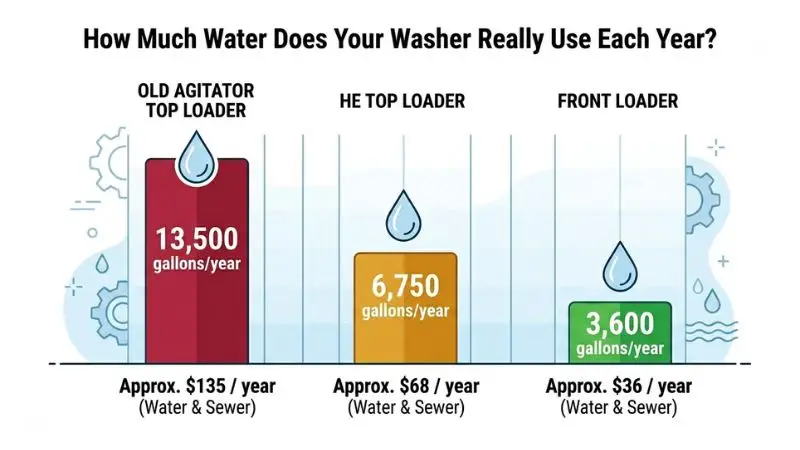
Calculating Your Annual Water Savings in Gallons
Here’s the full annual picture, based on a household running 300 wash cycles per year:
| Washer Type | Water Per Cycle | Annual Water Use | vs. Front Loader |
|---|---|---|---|
| Old Agitator Top Loader | 42 gallons | ~12,600 gallons | +9,000 gallons more |
| HE Top Loader | 22 gallons | ~6,600 gallons | +3,000 gallons more |
| Modern Front Loader | 12 gallons | ~3,600 gallons | Baseline |
The difference between an old agitator machine and a modern front loader is 9,000 gallons per year. That number alone justifies reading every word of this guide.
Water Savings Calculator Methodology (How We Crunch the Numbers)
The figures in this guide are based on the following calculation framework:
- Baseline: 300 wash cycles per year (approximately 6 loads per week)
- Water usage figures: Mid-range averages drawn from ENERGY STAR-certified product data and manufacturer specifications
- Cost calculations: Based on the average residential water rate in each region (see table below)
- Load size assumption: Medium-to-large load (the most common household load size)
Actual savings will vary depending on your local water rate, how often you run the machine, and which specific model you purchase. Use these figures as directional benchmarks, not exact predictions.
Calculate your own savings
Use our [Washing Machine Savings Calculator] to see exactly how much water and money you can save by switching from your current washer to a high-efficiency model. Enter your local utility rates and laundry habits — get personalized results in seconds.
Regional Water Cost Impact — How Your Location Affects Savings
Water costs vary enormously around the world — and that variation changes how quickly your investment in an efficient washer pays off.
| Region | Avg. Water Cost | Annual Cost (Old Top Loader) | Annual Cost (Front Loader) | Annual Savings |
|---|---|---|---|---|
| United States | $0.007/gallon | ~$88 | ~$25 | ~$63 |
| United Kingdom | $0.013/gallon | ~$164 | ~$47 | ~$117 |
| Australia | $0.016/gallon | ~$202 | ~$58 | ~$144 |
| Middle East (UAE) | $0.005/gallon | ~$63 | ~$18 | ~$45 |
Important note: These figures cover water costs only. When you add electricity savings (Chapter 4) and reduced dryer usage, the total annual savings can be two to three times higher than the water savings alone.
🔧 PRO TIP:
“When comparing washing machines, always check the Water Factor (WF) score in the product specifications — compare WF scores of 2026 models here — not just the ENERGY STAR badge.. Look for a WF of 4.0 or below as your minimum threshold, and target 3.0 or below if maximum water efficiency is your priority. A machine with a WF of 2.5 will save you measurably more water than one with a WF of 3.8 — even if both carry the ENERGY STAR label.
The water numbers make a compelling case on their own. But water is only one piece of the efficiency puzzle.
In Chapter 4, we’re going to look at the electricity side of the equation — including the hidden connection between your washer’s spin speed and your dryer bill that most people never think about.
The energy numbers are just as eye-opening. Let’s keep going.
CHAPTER 4: Energy Efficiency & Electricity Costs — The Full Picture
Energy Consumption: Front Load vs Top Load Washer 2026 Head-to-Head
Water gets most of the attention in the front load vs top load debate.
But electricity costs? They tell an equally powerful story — and for many households, they’re actually the bigger number on the utility bill.
Here’s the core truth: a washing machine uses electricity in two ways. First, to power the motor that spins the drum. Second, heat the water if you’re using a warm or hot wash cycle.
Front loaders have a structural advantage in both areas. And by the end of this chapter, you’ll understand exactly why — in numbers you can take straight to your budget.
Kilowatt-Hours Per Cycle — What the Data Shows in 2026
Let’s start with the raw electricity consumption figures.
Energy use per wash cycle varies depending on water temperature, load size, and cycle type. But here’s what the data shows for a standard medium load on a warm wash cycle:
| Washer Type | kWh Per Cycle | Annual kWh (300 cycles) | Annual Electricity Cost* |
|---|---|---|---|
| Old Agitator Top Loader | 2.8–3.5 kWh | 840–1,050 kWh | $101–$126 |
| HE Top Loader | 1.0–1.5 kWh | 300–450 kWh | $36–$54 |
| Modern Front Loader | 0.5–1.0 kWh | 150–300 kWh | $18–$36 |
*Based on the US average electricity rate of approximately $0.12 per kWh (2026)
The difference between an old agitator top loader and a modern front loader is staggering — up to $90 per year in electricity costs for washing alone, before you even factor in the dryer.
And the dryer is where the real hidden cost lives.
How Drum Design Affects Spin Speed & Drying Energy (The Hidden Cost)
This is the connection most people never make — and it’s one of the most important insights in this entire guide.
Your washing machine doesn’t just clean your clothes. It also partially dries them during the final spin cycle. The faster and more powerfully it spins, the more water it extracts from your clothes before they go into the dryer.
And your dryer — whether gas or electric — is one of the most energy-hungry appliances in your entire home.
💡 DID YOU KNOW?
Front load washers spin at up to 1,200–1,600 RPM (revolutions per minute) during their final spin cycle. Most traditional top load agitator machines max out at around 700 RPM. That difference in spin speed leaves clothes coming out of a front loader 20% drier than clothes from a top loader — which directly translates to shorter drying times, less energy used by your dryer, and lower electricity bills every single week.
Here’s how that plays out in real numbers:
- A top loader leaving clothes at 60% moisture retention may need 45–55 minutes in the dryer
- A front loader leaving clothes at 40% moisture retention may need only 30–35 minutes
That’s roughly 20 minutes less dryer time per load. At 300 loads per year, that’s 100 hours less dryer operation annually. At an average dryer energy cost of $0.45 per hour, that’s an additional $45 in dryer savings per year — on top of the washing machine electricity savings.
When you add the washing and drying savings together, the total annual energy advantage of a front loader over an old top loader can easily reach $130 to $175 per year.
ENERGY STAR vs CEE Tier Ratings — Which Label to Trust?
When shopping for an energy-efficient washer, you’ll encounter two main rating systems. Understanding the difference helps you choose the most efficient machine — not just the one with the most badges.
📦 DEFINITION:
CEE Tier Rating The Consortium for Energy Efficiency (CEE) Tier Rating is an advanced efficiency classification system that goes beyond the basic ENERGY STAR certification. While ENERGY STAR sets a minimum efficiency floor, CEE tiers rank machines into Tier 1, Tier 2, and Tier 3 categories — with Tier 3 representing the absolute highest efficiency available on the market. A washing machine can carry an ENERGY STAR label and still be significantly less efficient than a CEE Tier 2 or Tier 3 certified model. For maximum long-term savings, look for CEE Tier 2 or higher.
Here’s a quick comparison of what each label means in practice:
| Rating Label | What It Means | Who It’s Best For |
|---|---|---|
| No label | Below minimum efficiency standards | Avoid if possible |
| ENERGY STAR | Meets baseline efficiency requirements | Good starting point |
| ENERGY STAR Most Efficient | Top 25% of certified models | Better choice |
| CEE Tier 1 | Exceeds ENERGY STAR by a moderate margin | Solid efficiency |
| CEE Tier 2 | Significantly above ENERGY STAR baseline | Recommended |
| CEE Tier 3 | Best-in-class efficiency available | Best long-term value |
The takeaway: don’t stop at the ENERGY STAR logo. Look for the CEE tier on the product page or spec sheet, especially if energy savings are a top priority.
The True Energy Cost Over a Washer’s Lifetime
Purchase price is what you pay once. Operating cost is what you pay forever.
This is the single most important reframe in the entire buying decision — and it’s where the “expensive” front loader often turns out to be the cheapest choice of all.
Purchase Price vs 10-Year Operating Cost Analysis
Let’s run the real numbers over a full 10-year ownership period.
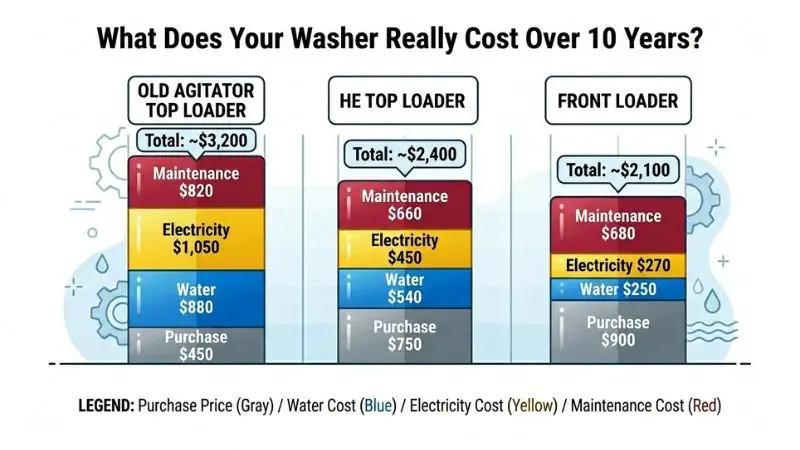
| Cost Category | Old Agitator Top Loader | HE Top Loader | Front Loader |
|---|---|---|---|
| Purchase price | $400–$500 | $700–$850 | $800–$1,000 |
| 10-yr water cost | $630–$880 | $360–$540 | $180–$250 |
| 10-yr electricity cost | $1,010–$1,260 | $360–$540 | $180–$360 |
| 10-yr maintenance | $600–$900 | $500–$750 | $550–$800 |
| 10-yr TOTAL | $2,640–$3,540 | $1,920–$2,680 | $1,710–$2,410 |
The front loader costs more to buy. But it costs significantly less to own.
Over 10 years, the average household saves $800 to $1,200 by choosing a front loader over an old agitator top loader — even after accounting for the higher upfront price.
⚠️ COMMON MISTAKE #2:
Judging energy efficiency by purchase price alone. A $400 top loader feels like a win at the checkout counter. But when you factor in water, electricity, and maintenance costs over its lifetime, that “cheap” machine can cost you $200 or more per year in excess operating expenses compared to an $800 front loader. Over 10 years, the “expensive” machine pays for its own price difference — and then keeps saving you money beyond that.
How Spin RPM Saves Money on Your Dryer Bill
We touched on this above, but it’s worth spelling out clearly because it’s so frequently overlooked.
The RPM (revolutions per minute) of the final spin cycle is one of the most underrated specs on a washing machine listing. Here’s why it matters:
- 700 RPM (typical old top loader): Clothes leave at roughly 60–65% moisture content
- 1,000 RPM (typical HE top loader): Clothes leave at roughly 50–55% moisture content
- 1,200–1,600 RPM (typical front loader): Clothes leave at roughly 38–45% moisture content
Every percentage point of moisture left in clothes equals more time in the dryer. More dryer time equals more electricity. More electricity equals a higher bill.
When shopping, look for a front loader with a minimum 1,200 RPM spin speed. Premium models at 1,400–1,600 RPM offer even greater dryer savings — especially for heavy items like towels, jeans, and bedding.
Cold Water Washing — Which Machine Does It Better?
One of the most effective ways to cut washing energy costs is simple: wash in cold water.
Heating water accounts for up to 90% of the total energy used in a warm wash cycle. Switch to cold, and you eliminate almost all of that heating cost immediately.
But not all machines handle cold water equally well:
- Front-loaders are engineered for cold water performance. Their mechanical tumbling action creates effective cleaning friction even without heat. Many 2026 front loader models include cold-water-optimized cycles that use enzyme-based detergent activation to match warm-wash cleaning results.
- Top loaders — particularly agitator models — were historically designed around warm or hot water to maximize the agitation cleaning effect. Cold water performance has improved significantly in newer HE top loader models, but front loaders still hold a measurable edge in cold-wash cleaning results.
The practical advice: if you switch to a front loader and commit to cold water washing for most loads, you can cut your washing-related electricity costs by up to 80–90% compared to a warm-wash agitator top loader.
Carbon Footprint Comparison
Energy efficiency isn’t just about your wallet. It’s about your household’s environmental footprint — and in 2026, that matters more than ever to a growing number of consumers.
Lifecycle Environmental Impact of Each Washer Type
When researchers measure the full environmental impact of a washing machine — from manufacture to disposal — water heating during use accounts for the single largest share of lifetime carbon emissions.
Estimated lifetime CO₂ emissions per washer type (based on 10-year lifespan, 300 cycles/year):
- Old agitator top loader: ~3,200 kg CO₂ equivalent
- HE top loader: ~1,400 kg CO₂ equivalent
- Modern front loader (cold wash): ~620 kg CO₂ equivalent
Switching from an old agitator to a front loader running mostly cold cycles reduces your laundry-related carbon output by roughly 80% over the machine’s lifetime.
Water Heating Energy: The Biggest Hidden Variable
Here’s the number that explains most of the carbon footprint difference:
Heating water from cold (60°F) to warm (90°F) for one full agitator top load cycle requires approximately 2.5 kWh of energy. A front loader doing the same load uses roughly 0.3 kWh — because it uses far less water to begin with, and its cold-water cycle performance means heating is often unnecessary.
That single variable — water volume multiplied by temperature rise — is responsible for the majority of energy and carbon differences between washer types.
🔧 PRO TIP:
Set your washer to run during off-peak electricity hours — typically between 9 PM and 7 AM in most regions. Many utility providers charge 20–30% less per kWh during these hours. Pair off-peak scheduling with cold water washing, and you can reduce your washing-related electricity costs by up to 50% annually — regardless of which washer type you own. Most smart washers in 2026 have a built-in delay start timer that makes this completely effortless.
Energy costs, carbon footprints, spin speeds, and dryer savings — the efficiency picture is now complete.
But efficiency alone doesn’t determine which machine is right for your home. You also need to know which one actually cleans better — because a machine that saves water but leaves your shirts stained isn’t much of a bargain.
That’s exactly what Chapter 5 is going to settle — with real cleaning performance data, fabric care comparisons, and the truth about which machine wins for your specific laundry needs.
CHAPTER 5: Cleaning Performance & Fabric Care — Which Actually Cleans Better?
Cleaning Performance Testing — How We Evaluate Washers
Efficiency numbers are important. But at the end of the day, a washing machine has one job.
It needs to clean your clothes.
No amount of water savings matters if your shirts still smell after a cycle, or your workout gear comes out with yesterday’s sweat still locked into the fibers. So in this chapter, we move past the utility bills and get into the question that most people actually care about most:
Which machine cleans better?
The honest answer is: it depends on what you’re washing. But the data points in a clear direction — and by the end of this chapter, you’ll know exactly which machine wins for each type of laundry in your home.
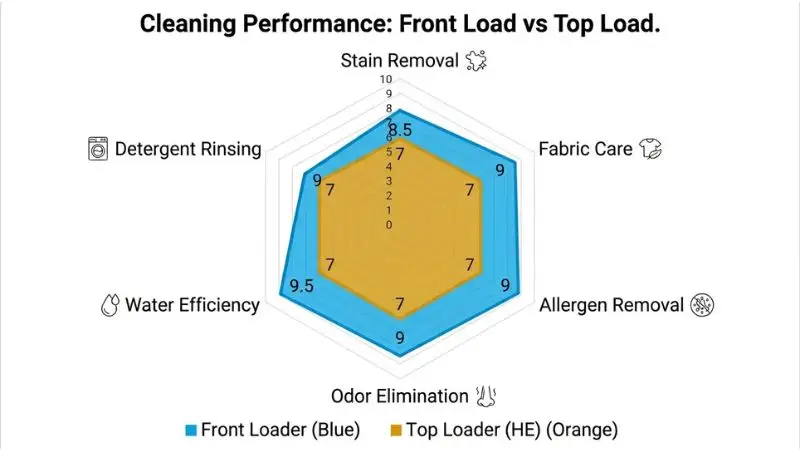
Stain Removal Scores: Front Load vs Top Load (Third-Party Data)
Independent testing organizations like Consumer Reports and Which? (UK) regularly put washing machines through standardized stain removal tests. They use controlled fabric swatches stained with specific substances — grass, grease, wine, blood, mud, and more — and measure how much of each stain is removed after a standard wash cycle.Overall, the front load vs top load washer 2026 cleaning tests show front loaders winning on delicate fabrics and sportswear.
Here’s what the data consistently shows across multiple test cycles:
- Front-loaders score higher on overall stain removal in the majority of independent tests
- The advantage is most pronounced with protein-based stains (blood, grass, sweat) and oil-based stains (grease, cooking oil, cosmetics)
- Agitator top loaders perform better than expected on heavy surface soiling — the kind that comes from outdoor work, gardening, and construction
- The top loaders land in the middle — better than agitator machines on delicate stains, but slightly behind front loaders on deep-set stains
The reason front-loaders win on most stain tests comes down to one factor: longer contact time between the detergent and the fabric. Because front-loaders use less water, the detergent concentration stays higher throughout the cycle. That concentrated solution has more time to break down stain molecules before rinsing begins.
The Role of Tumbling Action vs Agitation on Fabric Types
The mechanical action of a washer doesn’t just affect cleaning power. It directly affects how long your clothes last.
Think about it this way. Every wash cycle puts physical stress on fabric fibers. The more aggressive the mechanical action, the faster fabrics wear out — losing color, shape, and structural integrity over time.
Here’s how the two cleaning methods compare on fabric stress:
Tumbling action (front loaders):
- Lifts and drops clothes gently through a small amount of water
- Fabrics experience low mechanical friction per cycle
- Colors stay brighter longer
- Elastic and synthetic fibers maintain their shape over hundreds of washes
Agitation (traditional top loaders):
- Twists and chews clothes against the central post repeatedly
- Creates significantly more friction per cycle
- Can cause pilling, stretching, and color fading over time
- Particularly damaging to items with delicate construction — lace, embroidery, structured garments
For everyday items like t-shirts and casual wear, the difference is subtle. But for anything you care about keeping in good condition long-term, front loaders are measurably gentler.
💡 DID YOU KNOW?
Front load washers use the exact same fundamental cleaning principle as commercial dry cleaning drums — gentle tumbling action that moves fabric through a cleaning solution without harsh mechanical scrubbing. This is why front loaders are recommended by most fabric care experts for wool, cashmere, silk, and structured garments that would otherwise require hand washing or professional cleaning.
Delicates, Woolens & Silks — Which Machine Is Gentler?
For anyone who owns clothes worth protecting, this section matters.
Front-loaders are the clear winner for delicate fabrics. The combination of gentle tumbling, lower spin speeds on delicate cycles, and reduced water volume creates the ideal environment for fragile textiles.
Top-load agitator machines are the worst choice for delicates. The central post creates unavoidable friction that can snag, stretch, and damage fine fabrics — even on the “delicate” setting.
The top loaders perform reasonably well on delicates since they lack an agitator. However, the larger water volume and less controlled tumbling still create more stress on fine fabrics than a front loader’s precision drum action.
Practical recommendation by fabric type:
| Fabric Type | Best Washer Choice | Worst Washer Choice |
|---|---|---|
| Silk & Chiffon | Front Loader | Agitator Top Loader |
| Wool & Cashmere | Front Loader | Agitator Top Loader |
| Denim & Canvas | HE Top Loader or Front Loader | Either (both fine) |
| Cotton Basics | Any washer type | N/A |
| Lace & Embroidery | Front Loader | Agitator Top Loader |
| Performance Sportswear | Front Loader | Agitator Top Loader |
Specific Laundry Scenarios — Which Washer Wins?
Real households don’t just wash one type of clothing. Let’s look at the specific scenarios that matter most to different families.
Heavy-Duty Items: Jeans, Towels & Bedding
For large, heavy items — think king-size comforters, thick bath towels, and stiff denim jeans — the washing machine needs both cleaning power and sufficient drum space.
- Front-loaders handle bulky items exceptionally well. The tumbling action works particularly effectively on large items that can fully rotate through the water. High-spin RPM extracts more water from thick fabrics, cutting drying time significantly.
- Agitator top loaders struggle with oversized items. A king-size comforter can wrap around the central post, leading to uneven cleaning, excessive wrinkling, and potential mechanical strain.
- The top loaders perform well here — the agitator-free drum gives bulky items room to move, and their larger capacity handles bigger loads comfortably.
Winner for heavy-duty items: Front loader (narrowly ahead of HE top loader)
Sportswear & Synthetic Fabrics
Athletic wear is one of the fastest-growing laundry categories — and it’s also one of the most demanding.
Performance fabrics (polyester, spandex, nylon blends) trap body oils, sweat proteins, and odor-causing bacteria deep in the fiber weave. Getting them truly clean requires the right combination of mechanical action, water temperature, and detergent chemistry.
- Front loaders excel here. The extended contact time between concentrated detergent and fabric — combined with higher spin RPM that rinses fibers more completely — means odors and oils are removed more effectively per cycle.
- Top loaders often leave a detergent residue in synthetic fabrics due to the rinse cycle using the same large water volume throughout. That residue can trap odor-causing bacteria even after washing.
Winner for sportswear: Front loader
Baby Clothes & Allergen Removal Performance
For households with infants, young children, or allergy sufferers, thorough rinsing is not optional — it’s essential.
Detergent residue left in fabrics after washing can trigger skin irritation, eczema flare-ups, and allergic reactions — especially in babies whose skin is significantly more sensitive than adults.
🔧 PRO TIP:
If anyone in your household suffers from allergies, asthma, or sensitive skin, a front loader is the medically smarter choice. Front loaders rinse fabrics more thoroughly than top loaders — independent testing shows they remove up to 95% more detergent residue per cycle. That means less chemical contact with skin, fewer irritation triggers, and cleaner clothes in the truest sense of the word.
Front-loaders also score higher on allergen removal — dust mite proteins, pet dander, and pollen — because the higher spin speed and more complete rinse cycle flush these particles out more effectively than the high-volume rinse of a top loader.
Winner for baby clothes and allergen removal: Front loader (significantly)
Detergent Matters — HE vs Regular Detergent Explained
The best washing machine in the world won’t clean properly if you’re using the wrong detergent. And this is one area where many people unknowingly undermine their machine’s performance every single wash.
📦 DEFINITION:
HE Detergent HE (High-Efficiency) detergent is a specially formulated laundry detergent designed for use in high-efficiency washing machines — both front loaders and HE top loaders. Unlike regular detergent, HE formulas produce significantly fewer suds. This is critical because HE machines use less water, meaning excess suds cannot be rinsed away properly. HE detergents are concentrated, so you use less per load — making them cost-effective despite sometimes carrying a higher per-bottle price. They are identified by the HE symbol (a circle with “HE” inside) on the packaging.
Why Using the Wrong Detergent Damages Your Machine & Clothes
⚠️ COMMON MISTAKE #3:
Using regular detergent in an HE washing machine. This is one of the most common — and most damaging — mistakes washer owners make. Regular detergent produces far more suds than an HE machine’s low-water rinse cycle can handle. The result: excess foam coats the inside of the drum and pump system, reducing cleaning effectiveness, leaving residue on clothes, triggering error codes, and — over time — causing pump damage that can cost hundreds of dollars to repair. Always check the packaging and use only HE-labeled detergent in any HE front loader or HE top loader.
The damage happens gradually, which makes it easy to miss until the repair bill arrives. If your HE machine has been displaying error codes or producing an unusual amount of foam, the wrong detergent is the first thing to check.
Best Detergent Types for Each Washer in 2026
Here’s a practical guide to choosing the right detergent for your machine:
| Washer Type | The liquid or HE pod | What to Avoid |
|---|---|---|
| Front Loader | The Top Loader | Regular powder or liquid detergent |
| HE Top Loader | The liquid, powder, or pod | Regular high-sudsing detergent |
| Traditional Agitator Top Loader | Regular liquid or powder | HE-only formulas (underpowered for high water volume) |
Additional tips for 2026:
- Pods and tabs are convenient and pre-measured — but use only HE-compatible versions in HE machines
- Enzyme-based HE detergents (look for “enzyme” or “bio” on the label) perform significantly better on protein stains and work especially well in cold-water wash cycles
- Fragrance-free HE detergents are recommended for baby laundry and households with sensitive skin
Cleaning performance, fabric care, allergen removal, and detergent — you now have the full picture of what each machine does inside the drum.
But knowing how well a machine cleans is only part of the decision. You also need to know how well it fits into your daily life — your home, your routine, and your schedule.
Chapter 6 covers exactly that: space requirements, ergonomics, cycle times, and the smart features that are actually worth paying for in 2026.
CHAPTER 6: Practical Usability — Convenience, Features & Daily Life
Installation & Space Requirements
Before you decide between a front load vs top load washer 2026, make sure the machine physically fits your home. Cleaning performance and energy efficiency matter enormously. But here’s the reality: a washing machine also has to physically fit in your home, work with your plumbing, and slot into your daily routine. If it doesn’t, no amount of efficiency ratings will make it the right choice for you.This chapter is about the practical side of the decision — the stuff that affects your life every single day, not just your annual utility bill.
Let’s start with the most fundamental question of all: will it fit?
Dimensions Comparison — Which Fits Your Home?
Both front-loaders and top-loaders come in standard and compact sizes. But they have different space footprints — and different flexibility in how they can be positioned in your home.
Here’s a clear breakdown of typical dimensions across both types:
| Machine Type | Width | Depth | Height | Capacity Range |
|---|---|---|---|---|
| Standard Front Loader | 27 inches | 30–34 inches | 38–40 inches | 4.0–5.8 cu ft |
| Compact Front Loader | 24 inches | 25–28 inches | 33–36 inches | 2.2–2.8 cu ft |
| Standard Top Loader | 27–28 inches | 26–28 inches | 42–44 inches | 4.5–6.2 cu ft |
| Compact Top Loader | 24–25 inches | 26–28 inches | 40–42 inches | 3.0–3.8 cu ft |
A few key observations from these numbers:
- Top loaders are taller — which matters for countertop clearance if your machine is installed under a counter or in a low-ceiling space
- Front loaders are deeper — the door swing adds additional clearance requirements in front of the machine
- Top loaders require open vertical space above — you cannot install a low shelf or cabinet above a top loader without blocking the lid
- Compact front loaders are the go-to solution for small apartments, closet laundry spaces, and galley-style utility rooms
🔧 PRO TIP:
Before you order any washing machine, measure three things — not one. Measure your laundry room floor space. Measure the door clearance the machine needs to open fully (front loader doors swing out 150–180 degrees; top loader lids need full vertical clearance). And critically, measure every doorway and hallway the delivery team will use to bring the machine in. More washing machine returns happen because the machine fits the room perfectly but couldn’t be physically delivered through a narrow corridor or tight turn on the stairs.
Stackable Options: Front Loaders’ Hidden Space Advantage
This is one of the most significant practical advantages of a front loader — and it’s often overlooked in standard buying guides.
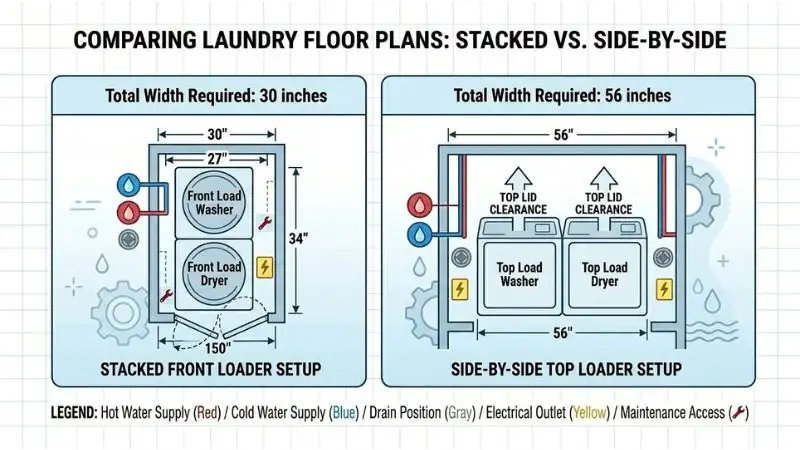
Front-loaders can be stacked vertically with a matching dryer using a purpose-built stacking kit. This configuration turns two full-size appliances into a single column that takes up the floor space of just one machine.
The space arithmetic is compelling:
- A side-by-side top loader + dryer setup requires approximately 54 inches of horizontal floor space
- A stacked front loader + dryer setup requires only 27 inches of horizontal floor space — a 50% reduction
For apartment dwellers, small homes, and anyone with a compact laundry closet, that difference is transformative. Many people who think they don’t have room for a full-size washer and dryer discover they can stack a front loader pair in a space they previously used as a storage closet.
💡 DID YOU KNOW?
One of the most common complaints about front load washers is back pain from bending down to load and unload clothes at floor level. The solution is a pedestal riser — a purpose-built drawer unit that sits under the washer and raises it 12–15 inches off the ground, bringing the door opening to a comfortable hip height. Many pedestals also include a built-in storage drawer for detergent and laundry supplies. The tradeoff: pedestals add $200–$400 to the total purchase cost and must be matched to the specific washer model.
Plumbing & Ventilation Requirements for Each Type
Both washer types connect to the same standard hot and cold water supply lines. But there are a few installation differences worth knowing:
Front Loaders:
- Require a standard drain connection (standpipe or laundry sink)
- Must be installed on a perfectly level surface — even slight tilting causes vibration, noise, and premature drum bearing wear
- Many high-spin front loaders benefit from anti-vibration pads under the feet, especially on upper floors or wooden subfloors
- Some models include built-in WiFi antennae that work best with the machine positioned away from thick concrete walls
Top Loaders:
- Slightly more forgiving with leveling — though still recommended to be level
- Lid clearance requires at least 18–20 inches of open space above the machine
- Generally produce less vibration than front loaders at equivalent load sizes
- Drain hose installation is simpler — less risk of drain hose kinking than front loaders
Ease of Use & Accessibility
Efficiency and space planning matter. But so does the daily reality of actually using the machine — loading it, unloading it, setting the right cycle, and fitting laundry into a busy schedule.
Loading & Unloading — The Ergonomics Debate
This is the most personal part of the front load vs top load comparison — because the right answer genuinely depends on your body and your habits.
Top-load washers offer a natural upright loading experience. You stand in front of the machine, reach down into the drum, and drop clothes in. No bending at the waist, no kneeling, no reaching across a door opening. For most people, this feels completely effortless.
Front-load washers require bending down to reach the drum opening, which sits close to floor level without a pedestal. For tall people, having lower back issues, or finding repetitive bending uncomfortable, this can become a genuine daily frustration.
The pedestal riser (discussed above) largely solves this problem. But it adds cost, and it’s something to plan for from the start rather than discover later.
Accessibility for Elderly & Physically Limited Users
For older adults, people recovering from surgery, or anyone with limited mobility, the ergonomic question becomes critically important.
Honest assessment of the user needs:
| User Situation | Best Choice | Reason |
|---|---|---|
| Lower back pain or arthritis | Top Loader | No bending required to load |
| Front loader with pedestal | Front Loader | Raises drum to hip height — comfortable for most |
| Wheelchair user | Front Loader + Pedestal | Side-approach loading is possible |
| Limited hand strength | Front Loader | Lighter door, simpler latch mechanisms |
| Standing fatigue | Top Loader | No door to manage, faster loading |
The nuanced recommendation: if accessibility is a priority and budget allows, a front loader with a pedestal riser at the right height is often the most versatile solution. The pedestal brings the drum to hip height and eliminates bending entirely. Without the pedestal, a top loader is the more accessible default choice.
Cycle Times Compared — Which Gets Laundry Done Faster?
⚠️ COMMON MISTAKE #4:
Choosing a front loader without accounting for cycle time. Front loaders clean more thoroughly and use less water — but their standard wash cycles run significantly longer than top loaders. A typical front loader cycle on the “Normal” setting runs 60–90 minutes. A comparable top loader cycle runs 35–50 minutes. If you do laundry in multiple back-to-back loads on a busy weekend, that extra 30–40 minutes per load adds up quickly. Plan your laundry schedule before you commit — or look for front loader models with a “Quick Wash” cycle option for lightly soiled loads.
Here’s a realistic cycle time comparison across common wash settings:
| Cycle Type | Front Loader | Top Loader (HE) | Top Loader (Agitator) |
|---|---|---|---|
| Normal/Cotton | 70–90 min | 45–60 min | 35–45 min |
| Quick Wash | 15–30 min | 20–30 min | 20–30 min |
| Heavy Duty | 90–120 min | 60–75 min | 50–60 min |
| Delicate/Hand Wash | 40–55 min | 35–50 min | 30–40 min |
| Allergen/Sanitize | 90–120 min | 60–80 min | 50–60 min |
The front loader’s longer cycle time is a genuine trade-off — not a deal-breaker, but a real lifestyle consideration worth planning around.
Smart Features & 2026 Technology Integration
In 2026, the “smart washer” category has moved well beyond novelty. The technology is genuinely useful — but only if you know which features actually add value to your daily routine.
📦 DEFINITION:
Smart Washer A smart washer is a washing machine equipped with Wi-Fi or Bluetooth connectivity that allows it to communicate with a smartphone app, a home automation system (like Amazon Alexa, Google Home, or Apple HomeKit), and in some cases, the manufacturer’s cloud service. Smart washers can send cycle notifications, receive remote commands, run self-diagnostic checks, and — in advanced 2026 models — automatically select optimal cycle settings based on load weight, fabric type, and local water quality data.
Wi-Fi Connected Washers — What’s Actually Useful?
Smart washer marketing can make it sound like your laundry will basically do itself. The reality is more measured — but several features genuinely earn their keep.
Features that are actually useful in daily life:
- ✅ Cycle completion notifications — A push notification when the wash is done prevents laundry from sitting wet in the drum for hours
- ✅ Remote start — Start a delayed cycle from your phone so laundry is ready when you get home
- ✅ Error code alerts — Get notified immediately if the machine detects a problem, with a description of the issue before you call a technician
- ✅ Energy monitoring — Track actual electricity and water usage per cycle over time
Features that sound impressive but rarely get used:
- ❌ Voice control for starting cycles (faster to just press the button)
- ❌ Manufacturer “recommended cycle” suggestions (most people use 2–3 cycles and never change)
- ❌ Social sharing features (genuinely not necessary for laundry)
App Control, Cycle Notifications & Remote Start
The most practical smart washer feature — by a significant margin — is remote monitoring with notifications.
Here’s why it matters more than people expect: front loaders with longer cycle times are prone to developing mildew odors when wet clothes sit in a closed drum for hours after the cycle ends. A cycle completion notification on your phone means you can move clothes to the dryer promptly — every time, without hovering near the laundry room.
Most major brands — Samsung, LG, Whirlpool, Bosch, and Miele — offer dedicated apps with remote start and notification features on their mid-range and premium models in 2026.
AI-Powered Load Detection — The 2026 Game Changer
The most significant technological development in washing machines for 2026 is genuinely impressive: AI-powered automatic cycle selection.
Premium front loaders from LG (ThinQ AI), Samsung (AI Wash), and Miele (TwinDos + AutoDos) now include sensor arrays that can:
- Weigh the load and adjust the water volume automatically
- Detect fabric composition using conductivity and tumble resistance sensors
- Recommend or automatically select the optimal cycle, temperature, and spin speed
- Learn your preferences over time and adapt default settings to your household’s patterns
- Connect to local water quality data (in some markets) to adjust detergent dosing for hard or soft water
The practical impact: these systems consistently use 10–15% less water and energy than the same machine running on manually selected cycles, because the AI optimizes each variable precisely rather than applying a fixed program.
Smart Feature Comparison Checklist:
| Feature | Front Loaders | Top Loaders |
|---|---|---|
| Wi-Fi connectivity | ✅ Most mid/premium models | ✅ Most mid/premium models |
| Smartphone app control | ✅ Yes | ✅ Yes |
| Cycle notifications | ✅ Yes | ✅ Yes |
| Remote start | ✅ Yes | ✅ Yes |
| AI load detection | ✅ Premium models | ⚠️ Limited availability |
| Auto detergent dosing | ✅ Premium models | ❌ Rare |
| Stackable smart pairing | ✅ Yes (with matching dryer) | ❌ No |
| Voice assistant integration | ✅ Yes | ✅ Yes |
Space, ergonomics, cycle times, and smart technology — you now have the complete picture of what daily life looks like with each washer type.
But buying a washing machine isn’t just about the first year of ownership. It’s about what happens after that — when parts wear out, problems develop, and repair bills start arriving.
Chapter 7 gives you the honest, unfiltered truth about maintenance, reliability, and long-term ownership costs — including the mold problem that front loader manufacturers don’t exactly advertise.
CHAPTER 7: Maintenance, Reliability & Longevity — The Honest Truth
Common Problems with Front-Load Washers
Let’s be direct about something most appliance retailers gloss over.
Front-load washers are excellent machines. They are also more mechanically complex than top loaders — and that complexity comes with specific maintenance requirements that owners need to understand before they buy.
The good news: virtually every common front loader problem is either preventable with simple habits or fixable without a technician if you catch it early. The bad news: if you ignore the maintenance, the repair bills can be significant.
Here’s what you actually need to watch for.
The Mold & Mildew Problem — Causes, Prevention & Fix
This is the single most talked-about front loader complaint online. Spend five minutes reading reviews, and you’ll find it everywhere: “It smells like mildew.” “There’s black stuff around the door seal.” “My clothes come out smelling worse than when they went in.”
These complaints are real. But here’s what those reviews rarely mention:
💡 DID YOU KNOW?
The number one complaint about front load washers — mold and mildew smell — is 100% preventable with one simple habit that costs absolutely nothing: leave the door ajar after every wash cycle. Front loader drums are sealed environments. When the door is closed after a wash, residual moisture has nowhere to go — creating the warm, dark, damp conditions that mold thrives in. Leaving the door open just 2–3 inches after every cycle allows the drum to air-dry completely between washes. Most mold problems in front loaders are entirely self-inflicted by owners who close the door out of habit.
Additional prevention steps that eliminate mold risk almost entirely:
- Wipe the door gasket dry after the last load of the day — takes 20 seconds
- Remove laundry immediately after the cycle ends — never leave wet clothes sitting in the drum
- Use only HE detergent in the correct amount — excess detergent residue feeds mold growth
- Run a monthly Tub Clean cycle — more on this in the Pro Tip below
If mold has already developed, it can be eliminated with a dedicated washer cleaning product or a mixture of white vinegar and baking soda run on a hot empty cycle. For severe gasket mold, the rubber seal may need to be cleaned manually or — in extreme cases — replaced.
Door Gasket Maintenance — The #1 Front Loader Issue
📦 DEFINITION:
Door Gasket The door gasket (also called the door boot seal) is the flexible rubber ring that creates a watertight seal between the drum and the front door of a front-loading washing machine. It is designed to flex and compress with every door open and close cycle while maintaining a complete water seal during operation. The gasket’s folded inner surface creates crevices where water, detergent residue, lint, and debris collect after every wash — making it the primary location for mold growth in front loaders that are not properly maintained.
Gasket maintenance is simple when done consistently:
- After each wash, fold back the gasket lip and wipe the inner crevice dry with a cloth
- Weekly: inspect for debris (coins, hair clips, small items) trapped in the gasket fold
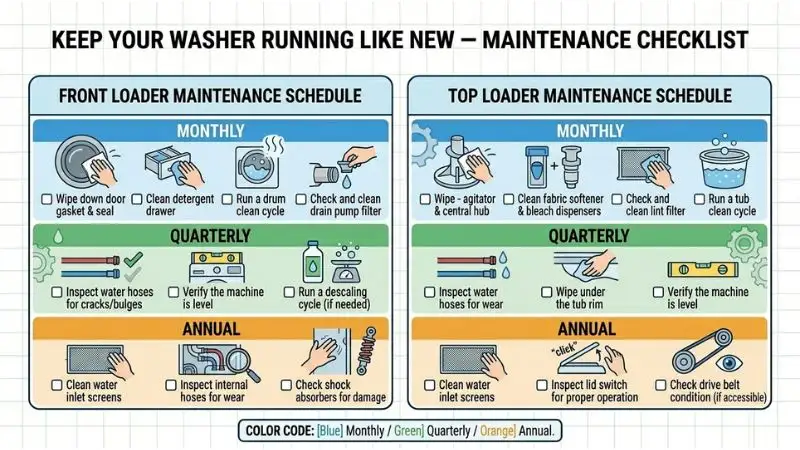
- Monthly: clean the gasket with a diluted white vinegar solution or a washer cleaning wipe
- Annually: inspect for tears or cracks in the rubber — a damaged gasket leaks water and must be replaced
Gasket replacement typically costs $80–$150 in parts plus labor if you use a technician. It’s also a manageable DIY repair for handy homeowners — video guides for most models are widely available online.
Bearing Replacement & Long-Term Repair Costs
The drum bearing is the rotating component that allows the heavy drum to spin at 1,000–1,600 RPM smoothly and quietly. Over years of use — especially in machines that are regularly overloaded — bearings wear down and eventually fail.
Signs of bearing wear include:
- A rumbling or grinding noise during the spin cycle
- Increasing vibration that wasn’t there when the machine was new
- The drum wobbles slightly when pushed by hand with the machine off
Bearing replacement is the most common front loader repair — typically $200–$400 in parts and labor. In older machines, the cost of bearing replacement can approach the value of the machine itself, making replacement the more practical decision.
⚠️ COMMON MISTAKE #5:
Overloading the drum. It feels efficient to stuff in one more towel or squeeze in an extra pair of jeans. But overloading is the single biggest cause of premature bearing failure in front loaders — and agitator damage in top loaders. An overloaded front loader drum doesn’t tumble correctly; instead, the heavy unbalanced load creates lateral stress on the bearing assembly with every rotation. Most manufacturers recommend filling the drum to 80% capacity maximum — loose enough that you can comfortably fit your hand in alongside the clothes.
Common Problems with Top-Load Washers
Top loaders have their own maintenance requirements — and their own failure points. They’re generally simpler machines than front loaders, but “simpler” doesn’t mean “problem-free.”
Agitator Wear & Fabric Damage Over Time
The central agitator in a traditional top loader is subject to constant mechanical stress. The fins and dogs (the ratcheting mechanism inside) that create the back-and-forth agitation motion wear down over the years of use.
Signs of agitator wear include:
- The agitator spins freely in one direction without resistance (failed dogs)
- Clothes wrap tightly around the post during cycles
- Increased fabric damage — snags, pulls, and stretching on items that were previously unaffected
Agitator repair is relatively affordable — $50–$120 for parts — and is one of the more accessible DIY washing machine repairs. The agitator dogs (the small plastic ratchet pieces) are the most commonly replaced component and typically cost under $20.
Lid Switch Failures & Other Mechanical Issues
Top loaders use a lid switch as a safety mechanism — the machine will not spin while the lid is open. This switch takes mechanical stress every time the lid is opened and closed, and it is one of the most common top loader failure points.
Symptoms of a failed lid switch:
- The machine fills and agitates, but will not spin
- The machine stops mid-cycle when it shouldn’t
- Intermittent operation that seems to depend on how firmly the lid is closed
Lid switch replacement is a straightforward repair — $20–$40 in parts — and is well within DIY capability for most homeowners.
Other common top loader mechanical issues include:
- Water inlet valve failure — machine doesn’t fill properly ($25–$60 in parts)
- Drive belt wear — slipping or burning smell during agitation ($15–$30 in parts)
- Pump blockage — machine doesn’t drain completely (often DIY-clearable at zero cost)
Sediment & Lint Filter Maintenance Guide
Many top loaders include a lint filter — either a self-cleaning filter on the agitator, a removable screen in the drum, or an inline filter on the drain pump. Neglecting this filter is one of the most common causes of drainage problems and reduced cleaning performance.
Monthly: Check and clean the lint filter if your model has an accessible one. Quarterly: Run an empty hot cycle to flush sediment from internal hoses. Annually: Inspect water inlet screens on the back of the machine for mineral buildup — a toothbrush and white vinegar dissolve most deposits in minutes
Reliability Data & Expected Lifespan
Average Lifespan: Front Load vs Top Load (Industry Data)
Here’s the honest picture of how long each machine type typically lasts:
| Washer Type | Average Lifespan | With Proper Maintenance |
|---|---|---|
| Traditional Agitator Top Loader | 10–12 years | Up to 14–15 years |
| HE Top Loader | 10–12 years | Up to 13–14 years |
| Front Loader (standard) | 11–14 years | Up to 15–17 years |
| Front Loader (premium/European) | 14–20 years | Up to 20+ years |
Front loaders last longer on average — but that longevity is directly tied to proper maintenance. A neglected front loader with bearing damage will underperform and fail earlier than a well-maintained agitator top loader.
The maintenance schedule in this chapter is the difference between a machine that lasts 10 years and one that lasts 17.
Most Reliable Brands in 2026 (Ranked by Repair Rates)
Based on data compiled from Consumer Reports’ annual appliance reliability surveys and J.D. Power’s Home Laundry Appliance Satisfaction Studies, here is how major brands rank on repair frequency and owner satisfaction:
| Brand | Reliability Rating | Notable Strength |
|---|---|---|
| Miele | ⭐⭐⭐⭐⭐ Excellent | Industry-leading build quality; 20-year motor warranty |
| LG | ⭐⭐⭐⭐½ Very Good | Low repair rates; strong inverter motor reliability |
| Bosch | ⭐⭐⭐⭐½ Very Good | Quiet operation; excellent European engineering |
| Samsung | ⭐⭐⭐⭐ Good | Feature-rich; improved reliability vs. earlier models |
| Whirlpool | ⭐⭐⭐⭐ Good | Wide service network; affordable parts availability |
| Maytag | ⭐⭐⭐½ Average | Solid agitator top loaders; front loader reliability mixed |
| GE Appliances | ⭐⭐⭐½ Average | Improving reliability; good value at mid-range |
Note: Brand reliability can vary significantly between product lines. Always check model-specific reviews before purchasing.
Warranty Comparison — What’s Actually Covered?
Warranty coverage tells you a lot about how much confidence a manufacturer has in their own product.
Standard industry warranty coverage in 2026:
| Component | Typical Coverage | Premium Brand Coverage |
|---|---|---|
| Parts & Labor (general) | 1 year | 2–3 years |
| Motor/Drive System | 5–10 years | 10–20 years |
| Drum/Tub | 10 years | Lifetime |
| Electronic Control Board | 1–2 years | 3–5 years |
| Stainless Drum Liner | Lifetime | Lifetime |
What warranties typically do NOT cover:
- Damage from overloading (physical abuse)
- Mold and odor problems (considered maintenance issues)
- Cosmetic damage (scratches, dents after delivery)
- Damage from incorrect detergent use
- Normal wear items (door gaskets, belts, inlet hoses)
🔧 PRO TIP:
Once a month, run an empty Tub Clean cycle using either a dedicated washer cleaner tablet ($1–$2 each) or two tablespoons of citric acid dissolved in warm water added directly to the drum. This dissolves detergent buildup, mineral deposits, and the biofilm that causes mold odors — before they become visible problems. It’s the single highest-return maintenance habit for both front and top loaders. Set a monthly phone reminder and it takes less than two minutes of actual effort.
Maintenance, reliability, and warranty coverage — you now have the honest, unfiltered picture of long-term ownership for both washer types.
The final practical question is the one that ties everything together: how do you make the actual buying decision — and which specific machine is right for your budget, your home, and your life in 2026?
That’s exactly what Chapter 8 is built to answer.
CHAPTER 8: Price, Value & Buying Guide — Making the Right Decision in 2026
Current Price Ranges: Front Load vs Top Load Washer 2026 — What You Get at Each Budget
You’ve read the efficiency data. You understand the maintenance requirements. You know which machine cleans better for your laundry type.
Now comes the practical part: what does it actually cost — and what do you get at each price point?
The washing machine market in 2026 spans an enormous price range — from bare-bones budget models at $400 to premium European machines approaching $2,500. Understanding what separates each tier helps you spend exactly as much as you need to, and not a dollar more.
Budget Tier ($400–$700) — Best Options for Each Type
This is the entry-level market — and it’s more capable than it used to be.
Five years ago, a $500 washing machine meant compromising significantly on efficiency and features. In 2026, competition among major brands has pushed solid, reliable machines well down into this price range.
What you get in the budget tier:
| Feature | Budget Front Loader ($450–$700) | Budget Top Loader ($400–$600) |
|---|---|---|
| Drum capacity | 4.0–4.5 cu ft | 4.5–5.0 cu ft |
| ENERGY STAR certified | Most models | Some models |
| Spin speed | 1,000–1,200 RPM | 700–800 RPM |
| Smart/Wi-Fi features | Rarely | Rarely |
| Cycle options | 8–12 cycles | 6–10 cycles |
| Load sensing | Basic | Basic or absent |
| Pedestal compatible | Yes (sold separately) | N/A |
Who are budget-tier machines right for:
- Renters who may not stay long-term and want to minimize investment
- Second homes or vacation properties with lighter laundry demands
- First-time buyers replacing an old machine on a tight timeline
- Anyone prioritizing a reliable workhorse over features and efficiency
What to watch for at this price point: Budget machines often skip load-sensing technology, which means they use a fixed water volume regardless of how full the drum is. For maximum water savings, you’ll need to consistently run full loads.
Mid-Range Tier ($700–$1,200) — The Sweet Spot Explained
For most households, the mid-range tier represents the best balance of upfront cost, long-term savings, and daily usability.
This is where meaningful load sensing, higher spin speeds, smarter cycle programming, and Wi-Fi connectivity enter the picture — features that directly affect your utility bills and daily convenience.
What you get in the mid-range tier:
| Feature | Mid-Range Front Loader ($750–$1,200) | Mid-Range Top Loader ($700–$1,000) |
|---|---|---|
| Drum capacity | 4.5–5.2 cu ft | 5.0–5.5 cu ft |
| ENERGY STAR certified | All models | Most models |
| Spin speed | 1,200–1,400 RPM | 850–1,000 RPM |
| Smart/Wi-Fi features | Most models | Most models |
| Cycle options | 12–20 cycles | 10–16 cycles |
| Load sensing | Advanced | Standard |
| Steam cycle | Some models | Some models |
| Auto-dose detergent | Some models | Rare |
The mid-range front loader is where the water and energy efficiency advantage becomes most pronounced. At this price point, you get advanced load sensing, higher RPM spin, and smart scheduling — the combination that delivers maximum long-term savings on utility bills.
Premium Tier ($1,200–$2,500+) — Is It Worth the Upgrade?
Premium washers are genuinely impressive machines. The question is whether the additional features justify the significantly higher upfront cost for your specific situation.
What premium tier adds over mid-range:
- AI-powered load detection — automatic cycle selection based on fabric type and load weight
- Auto-dosing systems — a machine automatically dispenses the exact right amount of detergent per load
- Heat pump drying integration — in washer-dryer combo models, dramatically reduces drying energy
- Ultra-quiet operation — particularly valuable in open-plan homes or apartments with shared walls
- Superior build quality — stainless steel components, longer-lasting seals, extended motor warranties
- CEE Tier 2/3 efficiency ratings — the absolute highest efficiency available in 2026
Who benefits most from the premium tier:
- Large families running 8–10+ loads per week (efficiency savings compound faster)
- Households with expensive or delicate garments worth protecting
- Anyone planning 15+ years of ownership (premium machines genuinely last longer)
- People in high water-cost regions where maximum efficiency translates to meaningful annual savings
For most average households running 5–6 loads per week, the mid-range tier delivers 85–90% of the efficiency benefit at 60–65% of the premium price.
The True Cost of Ownership Calculator
Smart buying isn’t about finding the lowest sticker price. It’s about finding the lowest total cost over the years you’ll own the machine.
📦 DEFINITION:
Total Cost of Ownership (TCO) Total Cost of Ownership (TCO) is the complete financial cost of purchasing and operating an appliance over its expected lifespan. For a washing machine, TCO includes the purchase price plus all water costs, electricity costs, detergent costs, maintenance expenses, and repair costs over the ownership period. TCO analysis frequently reveals that machines with higher purchase prices deliver lower total costs — because superior efficiency and durability reduce ongoing expenses significantly over time.
How to Calculate Your Personal Break-Even Point
The break-even point is the moment when a more expensive but more efficient machine has paid for its own price premium through accumulated utility savings.
Here’s a simple framework to calculate yours:
Step 1: Find the price difference between the two machines you’re comparing (Example: Front loader at $900 vs top loader at $550 = $350 price difference)
Step 2: Calculate your estimated annual savings from the more efficient machine (Using Chapters 3 and 4 data: water savings + electricity savings = estimated $130–$175/year)
Step 3: Divide the price difference by the annual savings ($350 ÷ $150/year = 2.3 years to break even)
Step 4: Compare to your expected ownership period (If you plan to own the machine 8–10 years, you’ll save money for 6–8 years after break-even)
For most households, the break-even point on a front loader vs a comparable top loader falls between 2 and 4 years — well within the average ownership period of 10–14 years.
Rebates, Tax Credits & Utility Incentives in 2026
💡 DID YOU KNOW?
In 2026, purchasing an ENERGY STAR certified washing machine may qualify you for up to $150 in federal tax credits under extended home efficiency incentive programs — on top of additional rebates offered by state governments and local utility companies. Some utility providers offer $50–$200 cash rebates for purchasing ENERGY STAR certified appliances, with higher rebates for CEE Tier 2 and Tier 3 certified models. Before you buy, spend 10 minutes checking your utility company’s website and your state energy office portal — it’s entirely possible to stack federal, state, and utility rebates to offset $200–$400 of your purchase price.
How to find available incentives in your area:
- Federal: Check energy.gov for current home appliance tax credit eligibility
- State: Search “[your state] appliance rebate program 2026”
- Utility company: Most major utilities list current rebates on their official websites under “Energy Efficiency” or “Rebates & Incentives.”
- Retailer: Many major appliance retailers run their own instant rebate programs alongside manufacturer offers — ask specifically about ENERGY STAR rebates at the point of purchase
Best Time of Year to Buy a Washing Machine (Sales Calendar)
🔧 PRO TIP:
The appliance industry follows a predictable annual pricing cycle — and knowing it can save you hundreds of dollars. September and October are the single best months to buy a washing machine. This is when manufacturers release new models, and retailers aggressively discount the outgoing year’s inventory to clear floor space. January is the second-best window — post-holiday clearance sales regularly bring 20–35% discounts on appliances that didn’t move during the holiday season. Avoid buying in spring (tax refund season drives prices up) and in June–July (summer demand peak). If your machine breaks unexpectedly, resist the emergency purchase impulse if possible — even waiting two or three weeks for the next sale event can save $150–$300.
Annual buying calendar at a glance:
| Month | Pricing | Reason |
|---|---|---|
| January | 🟢 Excellent | Post-holiday clearance |
| February–April | 🔴 Avoid | Tax refund season demand |
| May | 🟡 Fair | Memorial Day sales |
| June–August | 🔴 Avoid | Summer demand peak |
| September–October | 🟢 Excellent | New model year clearance |
| November | 🟡 Fair | Black Friday deals (variable) |
| December | 🟡 Fair | Holiday promotions |
Who Should Buy Which — The Decision Framework
Everything in this guide has been building to this moment. Let’s make the decision clear and direct.
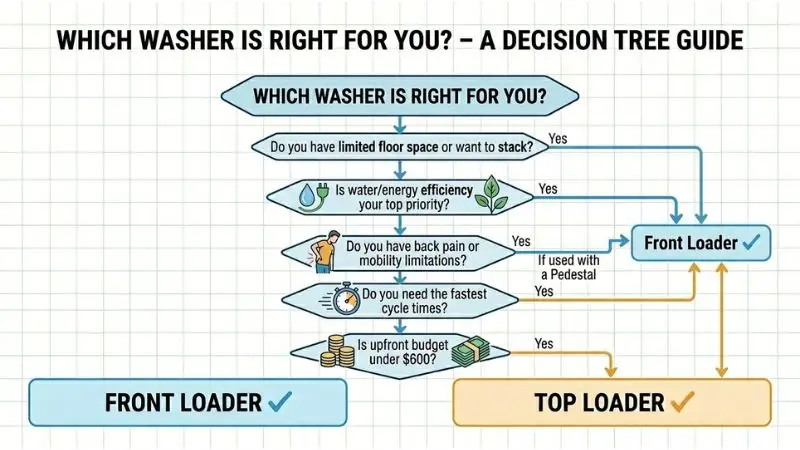
Buy a Front Loader If…
A front loader is the right choice when most of these statements apply to you:
- ✅ You want maximum water and energy efficiency — and the lower utility bills that come with it
- ✅ You have limited floor space — or want the option to stack your washer and dryer
- ✅ You wash a lot of delicates, wool, or sportswear — fabrics that benefit from gentler tumbling action
- ✅ Someone in your household has allergies or sensitive skin — front loaders rinse more thoroughly
- ✅ You’re planning to own the machine for 10+ years — the efficiency savings fully pay back the higher upfront cost
- ✅ You live in a region with high water costs — where every gallon saved translates to real dollar savings
- ✅ You’re willing to follow basic maintenance habits — leaving the door ajar and cleaning the gasket monthly
Buy a Top Loader If…
A top loader makes more sense when these factors describe your situation:
- ✅ You need faster cycle times — running multiple back-to-back loads on a schedule
- ✅ Upfront budget is the primary constraint — quality HE top loaders start at $100–$200 less than comparable front loaders
- ✅ You have back pain or mobility issues — and don’t want to invest in a pedestal riser
- ✅ You wash mostly heavy-duty items — workwear, farm clothing, heavily soiled outdoor gear
- ✅ You’re renting — and plan to move within 3–4 years before efficiency savings fully compound
- ✅ Simplicity and reliability are your priorities — fewer mechanical components mean fewer potential failure points
- ✅ You frequently need to add forgotten items mid-cycle — top loaders allow this; most front loaders do not
The 5-Question Test to Determine Your Best Washer Type
Answer these five questions honestly. Count how many times you answer A or B.
🧭 THE 5-QUESTION DECISION FRAMEWORK
Q1: How long do you plan to own this machine? A) 8+ years → Leans Front Loader B) Under 5 years → Leans Top Loader
Q2: What is your primary laundry concern? A) Saving water and energy → Leans Front Loader B) Speed and convenience → Leans Top Loader
Q3: How much floor space do you have? A) Limited — I could use vertical stacking → Leans Front Loader B) Plenty of side-by-side space → Either works
Q4: What do you wash most often? A) Delicates, sportswear, baby clothes → Leans Front Loader B) Heavy work clothes, large loads of basics → Leans Top Loader
Q5: What is your realistic budget including accessories? A) $800+ including possible pedestal → Front Loader is viable B) Under $700 total → Top Loader is the stronger value
Scoring: 4–5 A answers → Strong front loader candidate. 4–5 B answers → Top loader is your better fit. 2–3 of each → An HE top loader is likely your ideal middle ground.
⚠️ COMMON MISTAKE #6:
Choosing a machine based on drum capacity alone. A 5.8 cubic foot drum sounds impressive — and it is, when fully loaded. But most households never fill a drum that large. A machine with a massive drum running at 40–50% capacity uses more water and energy per pound of laundry than a properly loaded smaller drum with load sensing. Buy for your actual average load size, not the theoretical maximum. For most families of 2–4 people, a 4.5–5.0 cubic foot drum is genuinely sufficient.
The buying decision is now yours to make — with the full picture in front of you.
Before we reach the FAQs, there’s one more chapter worth reading: what’s coming next in washing machine technology. Because if you’re investing in a machine you plan to own for a decade, knowing where the industry is heading in the next 3–4 years could influence which features are worth paying for today.
Chapter 9 covers the future of laundry — and it’s more interesting than you might expect.
CHAPTER 9: Future Trends — Where Washing Machine Technology is Headed
2026 and Beyond — The Next Generation of Washers
Here’s something worth thinking about before you make your final buying decision.
The washing machine you purchase today will likely still be running in your home in 2034 or 2036. That’s a long time in a fast-moving technology landscape. And the appliance industry is changing faster right now than at any point in the last 30 years.
Understanding where the technology is headed doesn’t just satisfy curiosity. It helps you make a smarter purchase today — by identifying which current features are stepping stones to the future, and which machines are already built with tomorrow’s standards in mind.
Let’s look at what’s coming.
Waterless & Near-Waterless Washing Technology
The most radical development on the horizon isn’t a smarter drum or a faster spin cycle. It’s the possibility of washing clothes with little to no water at all.
Several technology pathways are currently in development or early commercial deployment:
CO₂ Washing Systems:
- Uses liquid carbon dioxide as the cleaning solvent instead of water
- CO₂ dissolves oils and dirt effectively at low temperatures
- The CO₂ is captured and recycled after each cycle — not released into the atmosphere
- Currently used in commercial dry cleaning, home-scale systems are in late-stage development
Ultrasonic Cleaning:
- Uses high-frequency sound waves to create microscopic bubbles in a tiny amount of water
- The bubbles collapse against fabric surfaces, dislodging dirt particles mechanically
- Prototype home devices already exist; full-drum integration is the engineering challenge being solved now
Polymer Bead Technology:
- Thousands of tiny reusable nylon beads tumble with clothes in minimal water
- The beads absorb and carry away stains through a physical-chemical attraction process
- Already available in commercial laundry applications; consumer versions expected before 2030
None of these technologies will replace conventional washers across the market in the next five years. But by 2030–2035, near-waterless options are expected to be available as premium consumer products — particularly for lightly soiled clothing and delicates.
AI & Machine Learning in Laundry — Smarter Than Ever
The AI features available on 2026 premium washers — load sensing, automatic cycle selection, adaptive learning — are genuinely useful. But they represent the first generation of what machine learning will eventually do in this space.
Here’s where AI in washing machines is heading by 2028–2030:
- Fabric recognition via spectral sensors — machines that can identify fabric composition (cotton, polyester, wool blend) without relying on care labels and select the perfect cycle automatically
- Predictive maintenance alerts — AI monitoring vibration, temperature, and motor current to detect bearing wear, pump blockage, or gasket deterioration before a failure occurs
- Household usage learning — machines that adapt their default settings over weeks of use to match your specific laundry patterns, water hardness, and preferred detergent
- Grid-integrated smart scheduling — washers that automatically run during the cheapest electricity windows by connecting directly to smart grid pricing data from your utility provider
The direction is clear: washing machines are becoming appliances that manage themselves — rather than appliances that wait for you to manage them.
Microplastic Filtration — The Regulation Coming in 2027
This is the environmental issue that is rapidly moving from awareness to legislation — and it will directly affect which washing machines are sold in major markets within the next 12–18 months.
💡 DID YOU KNOW?
Every time a synthetic fabric garment — polyester, nylon, acrylic, spandex — goes through a wash cycle, it sheds thousands of microscopic plastic fibers called microplastics. These particles are too small to be captured by standard wastewater treatment systems and flow directly into rivers, lakes, and oceans. A single wash load of synthetic clothing can release 700,000 to 1,000,000 microplastic fibers. In response, several EU member states — including France and Germany — have already passed legislation requiring mandatory microplastic filters on all new washing machines sold after 2027. Similar regulations are advancing in the UK, Canada, and several US states.
📦 DEFINITION:
Microplastic Filter A microplastic filter (also called a fiber filter or lint filter) is a fine-mesh filtration device installed in a washing machine’s drain system that captures synthetic microfibers before they exit the machine with the wastewater. Effective microplastic filters capture particles as small as 20–100 microns — far finer than standard lint traps. Some are built into the machine’s drain pump housing; others are external inline devices that can be retrofitted onto existing plumbing connections. Filters require periodic cleaning (typically every 1–3 months) to maintain drainage performance.
What this means for buyers in 2026:
- Some premium machines already include built-in microplastic filtration — Miele, Bosch, and several other European brands have added integrated fiber filters to their 2025–2026 model lines
- Most mid-range machines don’t yet include this feature, but many are being designed with filter-ready ports that allow retrofitting
- External retrofit filters ($30–$80) can be added to most existing machines via the drain hose connection — a practical option for machines that don’t have built-in filtration
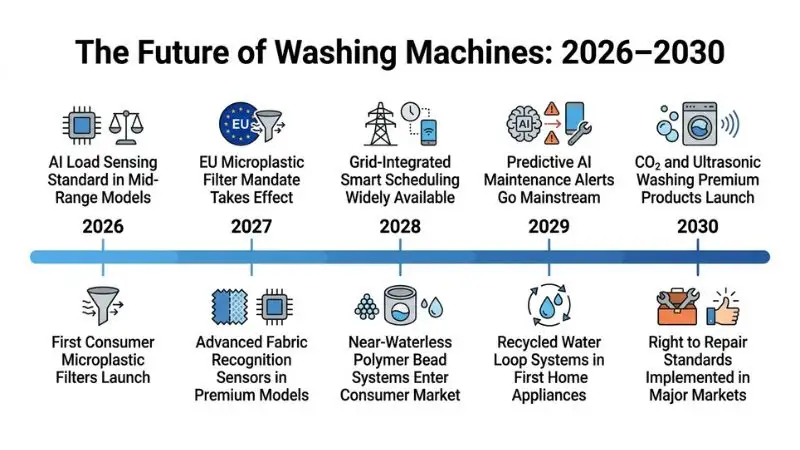
Sustainability Trends Reshaping the Industry
Environmental pressure — from regulators, consumers, and investors — is reshaping how washing machines are designed, built, and sold. These aren’t fringe trends. They’re mainstream shifts that will determine which machines are available in stores by 2028.
Cold-Water-Only Machines — Is This the Future?
As we covered in Chapter 4, heating water accounts for up to 90% of a washing machine’s energy consumption in a warm wash cycle. The most direct path to drastically reducing laundry’s carbon footprint is to make cold water washing work as effectively as warm water washing.
In 2026, this is already happening at the detergent level — enzyme-based cold-water detergents have closed most of the performance gap between cold and warm washing for everyday soiling.
The next step is happening at the machine level:
- Cold-wash optimized drum designs — longer tumbling sequences and more precise water-to-fabric contact ratios that maximize cleaning efficiency at low temperatures
- Electrolyzed water systems — technology that passes tap water through an electrolytic cell to produce a mild cleaning oxidant, reducing the need for heated water and chemical detergent simultaneously
- Ozone injection systems — introducing small amounts of ozone gas into cold wash water, which sanitizes and deodorizes fabrics at cold temperatures more effectively than hot water alone
By 2028–2030, analysts expect cold-wash-only cycles to become the default on most new washing machine models — with warm and hot cycles reserved for specific sanitization needs rather than everyday washing.
Recycled Water Loop Systems for Home Use
Municipal water scarcity is a growing reality in regions across the American Southwest, Australia, the Middle East, and Southern Europe. In response, appliance engineers are developing closed-loop water-recycling systems for residential use.
These systems work by:
- Capturing and filtering the rinse water from each wash cycle
- Running it through a multi-stage filtration and UV sterilization process
- Storing it in an integrated tank
- Reusing it as the water input for the next wash cycle
Early commercial prototypes can achieve water reuse rates of 60–70% — meaning a machine that would normally use 12 gallons per cycle effectively uses only 4–5 gallons on a net basis.
Home-integrated versions of this technology are expected to reach consumer markets in limited form by 2028–2029, initially at premium price points in water-stressed markets.
Modular & Repairable Washer Design (Right to Repair Movement)
One of the most significant sustainability shifts in the appliance industry is happening not in the drum or the motor — but in the design philosophy of the machines themselves.
The Right to Repair movement — which has gained significant legal traction in the EU, UK, and several US states since 2021 — is pushing manufacturers to design appliances that can be repaired by independent technicians and consumers, not just proprietary service networks.
What this means in practice for washing machines:
- Modular component design — motors, control boards, and door gaskets designed as standardized replaceable units rather than proprietary assemblies
- Mandatory spare parts availability — EU regulations now require manufacturers to make spare parts available for a minimum of 10 years after a model’s production ends
- Repair score labeling — France already requires an appliance repairability score (0–10) on product labels; other EU countries are following
- QR code repair guides — some 2026 models include embedded QR codes that link directly to official repair documentation
The practical benefit for buyers: machines built to Right to Repair standards will be cheaper to fix, supported for longer, and more likely to reach their full potential lifespan rather than being discarded at the first major repair.
What Brands Are Investing In Right Now
Samsung, LG, Miele & Bosch — Their 2026–2028 Roadmaps
Based on announced product pipelines, patent filings, and industry conference presentations, here’s where the major brands are focusing their R&D investment:
| Brand | Primary 2026–2028 Investment Focus |
|---|---|
| Samsung | AI Wash 2.0 — enhanced fabric recognition and grid-integrated scheduling |
| LG | ThinQ AI expansion — predictive maintenance and auto-dosing ecosystem |
| Miele | Microplastic filtration standard across all models + waterless prototype development |
| Bosch | Cold-wash optimization and recycled water loop integration |
| Whirlpool | Right to Repair modular design and extended parts availability |
| Electrolux | Ozone injection cold-wash systems and polymer bead technology licensing |
The pattern is clear: European brands are leading on sustainability and repairability, while Korean brands are leading on AI and connectivity. Depending on your priorities, that distinction may influence your choice of brand.
Startup Disruptors Challenging Traditional Washer Design
Beyond the established manufacturers, a new generation of appliance startups is challenging the fundamental assumptions of how clothes get clean:
- Tersano and similar companies are commercializing ozone and electrolyzed water technology for home laundry applications
- Xeros Technology (polymer bead washing) is licensing its technology to major manufacturers for integration into conventional drum designs
- Matter and other smart home platform companies are building appliance interoperability standards that will make brand-agnostic smart home laundry ecosystems possible by 2027–2028
These startups may not replace Samsung or LG in the near term. But their technologies are increasingly being acquired, licensed, or replicated by the major brands — meaning their innovations are likely to appear in mainstream consumer products within the next 3–5 years.
🔧 PRO TIP:
If you’re buying a washing machine in 2026 and want it to remain relevant and compliant for its full lifespan, look specifically for two future-proof features: cold-wash optimization (labeled as “Cold Wash,” “Active Water Plus,” or similar on the spec sheet) and a filter-ready drain port that can accept a retrofit microplastic filter. These two features cost nothing extra on machines that already include them — but they position your machine well ahead of incoming regulations and give you meaningful environmental and efficiency benefits from day one.
The future of laundry is more efficient, more intelligent, more sustainable — and more repairable — than anything that came before it.
That future is already beginning to arrive in 2026 models. And now you know exactly which features to look for.
This guide is reviewed and updated annually to reflect current Energy Star benchmarks, federal incentive programs, and regulatory changes across global markets. Last updated: 2026.
Yes, front-load washers are generally more water and energy-efficient than top-load models. They use less water per cycle and have higher spin speeds, which reduces drying time.
Common disadvantages include longer wash cycles, higher initial cost, and the potential for mold growth around the door seal if not cleaned regularly.
Most front loaders can handle blankets, but it depends on the drum capacity. Ensure you don’t overfill the machine to allow the blanket to tumble freely for a better clean.
A 7kg machine typically holds about 35 shirts or a medium-sized load of towels and bed sheets, making it ideal for small to medium families.
Yes, a 12kg capacity is usually sufficient to wash a king-size duvet comfortably without straining the motor or compromising the wash quality.
Front-load machines are generally better for fabric care because they use a tumbling motion instead of an agitator, which is gentler on delicate clothes.
Article sources & research references
Verified data sources, official databases and legislation for the “Front Load vs Top Load Washer Guide (2026)”.
Every link is clickable, checked and opens in a new tab →
ENERGY STAR® clothes washers overview
Official EPA/DOE resource confirming high‑efficiency washers reduce water usage up to 8,000 gallons per year for an average family.
ENERGY STAR Rebate Finder
Search by zip code / state to find local utility rebates, manufacturer offers and federal tax incentives for ENERGY STAR certified washing machines (2026).
ENERGY STAR Most Efficient 2026 criteria
Top performing washers (CEE Tier 2 / Tier 3). Provides spin speed benchmarks & energy use thresholds referenced in energy cost analysis.