Understanding Your Enemy -What is actually draining your power and how to slash your Electricity bills
To defeat a massive electricity bill, you first need to understand exactly how it is calculated. Many homeowners view their power bill as a mysterious monthly penalty. In reality, it is a highly detailed record of your daily habits and appliance choices. Once you learn to read the data hidden within your bill, you can spot the exact areas where you are losing money. Let us break down how your power company tracks your energy and how you can take back control to slash your electricity bills.
slash your electricity bills
Your electricity bill is more than just a final number at the bottom of a page. It is a breakdown of specific charges, usage tiers, and timing windows that dictate your monthly costs.
- Base Charges: This is a flat monthly fee you pay just to be connected to the grid. It remains the same whether you turn on a single light bulb or run ten air conditioners.
- Usage Tiers: Many utility companies use a tiered pricing structure. The more electricity you use, the higher the rate becomes per unit. Staying in a lower tier is the easiest way to keep costs down.
- Peak vs. Off-Peak Rates: Many modern utilities charge different rates depending on the time of day. “Peak hours” usually happen during the late afternoon and evening when everyone is home. Electricity costs significantly more during these hours.
How Utilities Calculate Your Costs
Power companies measure your energy consumption using a unit called a kilowatt-hour. Your total monthly bill is determined by multiplying the number of these units you consumed by your local utility rate.
[DEFINITION BOX]
Term: Kilowatt-Hour (kWh) A kWh is the standard unit of electricity measurement. One kWh is equal to using a 1,000-watt appliance for exactly one hour. For example, running a 1,000-watt vacuum cleaner for 60 minutes consumes exactly 1 kWh of power.
Regional Variance: Why Bills Differ Globally
Electricity costs look completely different depending on where you live in the world.
- United Kingdom: High reliance on natural gas and aggressive green energy transition fees make UK power rates some of the highest globally.
- India: Rates are heavily structured around usage tiers to protect low-income households, meaning heavy users face steep penalties.
- Canada: Massive hydroelectric infrastructure allows Canadian provinces to offer some of the cheapest, cleanest power rates in the world.
The Top 7 Household Energy Vampires
Not all appliances are created equal. A few heavy hitters in your home consume the vast majority of your monthly power budget, while smaller gadgets barely make an impact.
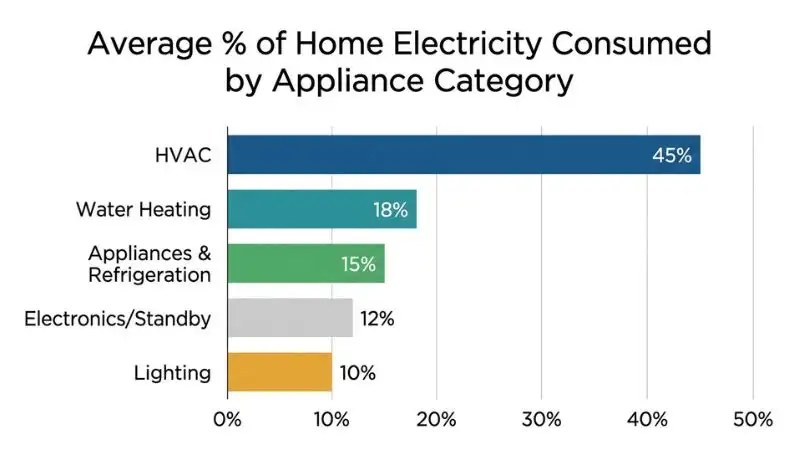
- HVAC Systems (Heating & Cooling): This is the undisputed heavyweight champion of energy drain. Heating and air conditioning typically make up 40% to 50% of your entire electricity usage.
- Water Heaters: The silent second-largest drain in your home. Keeping a massive tank of water scalding hot 24 hours a day requires an immense amount of constant power.
- Refrigerators and Freezers: Because these appliances run 24/7, even a small inefficiency adds up fast. Older models consume double the energy of modern, certified units.
- Washing Machines and Tumble Dryers: Tumble dryers require massive amounts of electricity to generate heat. Running these appliances during peak hours will destroy your budget.
- Lighting: Leaving old incandescent bulbs turned on is like pouring money down the drain. Upgrading to LEDs cuts lighting energy consumption by up to 80%.
- Standby/Phantom Loads: Many modern electronics never truly turn off. TVs, gaming consoles, and microwave clocks constantly sip power while waiting for a remote signal.
- Older, Non-Rated Appliances: Appliances built over a decade ago lack smart energy management. They pull maximum power from the wall every single second they operate.
How to Conduct a DIY Home Energy Audit
You do not need to hire an expensive technician to find the energy leaks in your home. A simple weekend DIY audit can point out the exact areas where you are wasting electricity.
- Check the Insulation: Inspect your attic and crawl spaces. Poor insulation allows heated or cooled air to escape, forcing your HVAC system to work twice as hard.
- Seal the Drafts: Walk around your home and feel for moving air near windows, doors, and electrical outlets. Use cheap weatherstripping or caulk to seal these gaps.
- Read Your Smart Meter Data: If you have a smart meter, log into your utility portal. Look at the hourly usage graphs to see if your home is consuming high power while you are asleep.
Free vs. Paid Tools
Most utility companies now offer free mobile apps that give you real-time feedback on your consumption. Many local governments also offer free energy audit checklists and incentive programs online. If you have a large home, paying for a professional thermal imaging audit can offer a massive return on investment by showing hidden insulation gaps inside your walls.
[DID YOU KNOW BOX]
According to the U.S. Department of Energy, the average household spends over $2,000 per year on energy bills — and up to 30% of that is completely wasted through easily fixable inefficiencies like air leaks and outdated appliances.
Setting Your Baseline — Tracking Consumption Before You Optimise
You cannot manage what you do not measure. Before you buy expensive smart tech or eco-appliances, you need to establish a baseline of your current energy habits.
- Use Smart Plugs: Plug your suspect appliances into a cheap smart plug that features energy monitoring. Leave it for a week to see exactly how many kWh that specific appliance pulls.
- Create a Tracking Spreadsheet: Record your monthly kWh usage from your old bills. Note down the average outdoor temperature for that month so you can track how the weather affects your usage.
- Set a Reduction Target: Give yourself a realistic, measurable goal. Aiming for a 20% reduction in your total kWh usage over the next 90 days is an excellent place to start.
💡 PRO-TIP:
Focus your energy-saving efforts entirely on your top three power-draining appliances first. Unplugging a phone charger will save pennies, but adjusting your HVAC thermostat by just 1°C can slash up to 10% off your monthly cooling costs.
Chapter 2: Smart Tech Decoded — The Devices That Actively Reduce Electricity Bills
Many people think smart home gadgets are just expensive toys for changing light colors or playing music. However, when chosen wisely, the right technology acts like a digital manager for your property. These devices actively watch your power use, eliminate waste, and make real-time decisions to reduce electricity bills without lowering your comfort.
Let us look at the smart technology stack and see which devices offer the fastest return on your investment.
What Is a Smart Home Energy Ecosystem?
A smart home energy ecosystem is a network of connected devices that work together to track and control power use. Instead of individual gadgets running on their own, a true ecosystem links everything to a central brain.
- The Smart Stack: This setup includes sensors (to detect movement or temperature), smart plugs, automated appliances, and a central smartphone app or hub to control them all.
- Device Communication: Smart devices talk to each other using wireless networks like Wi-Fi, Zigbee, or Z-Wave. Wi-Fi is common but uses more power, while Zigbee and Z-Wave create efficient, low-energy mesh networks.
- Smart vs. Connected: A “connected” device simply lets you turn it on or off from your phone. A truly “smart” device uses data, schedules, and AI to make these decisions for you automatically.
[DEFINITION BOX]
Term: Matter Protocol Matter is a universal smart home connectivity standard launched in 2022. It allows devices from different brands—like Apple, Google, Amazon, and Samsung—to communicate seamlessly with each other. This eliminates compatibility headaches and future-proofs your smart home setup.
Smart Thermostats — The #1 ROI Device in Any Home
Because heating and cooling make up nearly half of your home energy costs, a smart thermostat is the best device to buy first. Brands like Nest, Ecobee, and Tado quickly pay for themselves by fixing human forgetfulness.
- AI-Powered Learning: These devices monitor your daily routines for a week or two. They learn when you wake up, when you leave for work, and what temperatures you prefer, creating an automated schedule based on your life.
- Geofencing Technology: By connecting to your smartphone’s GPS, the thermostat knows when you leave the house. It automatically switches to an energy-saving mode while you are away and warms or cools the home just before you return.
- Proven Financial Savings: On average, installing a smart thermostat cuts heating and cooling costs by 10% to 23%. For most households, the device pays for itself in under a year.
Before buying, always check your HVAC system’s compatibility checklist, as some older heating systems or heat pumps require a special adapter or a constant 24V power wire (C-wire).
[PRO TIP BOX]
Set your smart thermostat to “eco mode” during your 8-hour sleep window. Even a small 2°C adjustment overnight can reduce your HVAC energy draw by up to 10% monthly—with absolutely zero sacrifice to your lifestyle comfort.
Smart Plugs, Power Strips, and Load Controllers
Many electronics draw a small amount of electricity even when turned off. This is called phantom or standby load, and it can add up to a massive chunk of your monthly bill. Smart plugs are the cheapest and easiest way to stop this waste.
- Targeting the Right Devices: Use smart plugs on electronics that do not need to run 24/7. Excellent options include televisions, gaming consoles, coffee machines, and phone chargers.
- Setting Schedules: You can program a smart plug to completely cut off power to your home entertainment center at midnight and turn it back on at 6:00 AM.
- Calculating the Payback Period: If a $12 smart plug cuts off a 15-watt standby load for 16 hours a day, it saves roughly 87 kWh per year. Depending on your electricity rates, the plug will pay for itself in less than 8 to 10 months.
Home Energy Management Systems (HEMS)
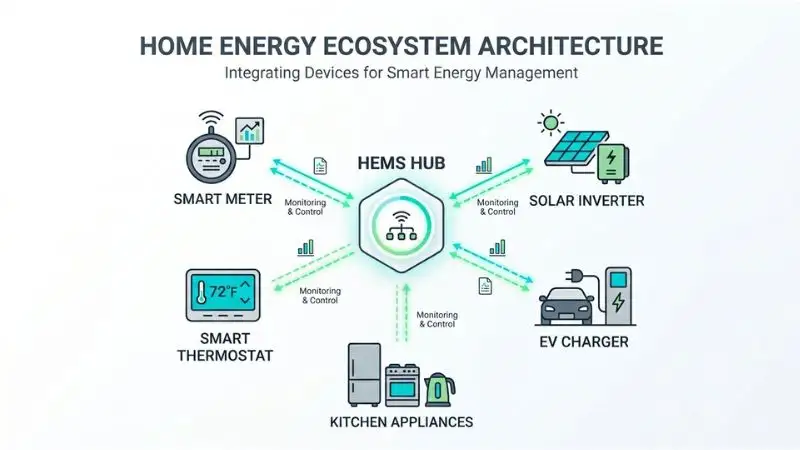
If you want a complete view of your energy usage, a Home Energy Management System (HEMS) is the ultimate upgrade. These systems connect directly to your main electrical panel to monitor your entire property in real time.
- Aggregate and Automate: A HEMS tracks the electrical signature of every appliance in your home. It can tell the difference between your microwave, refrigerator, and water heater, showing you exactly where your money goes.
- Market Leaders: Systems like the Sense Energy Monitor, Emporia Vue, or Hildebrand Glow (popular in the UK) offer detailed mobile apps with live updates.
- Green Integration: A high-end HEMS is essential if you have solar panels, home battery storage, or an electric vehicle (EV). It ensures your EV charges only when your solar panels are producing extra power or when grid rates are at their lowest.
[DID YOU KNOW BOX]
Did you know that standby power accounts for nearly 5% to 10% of a home’s total electricity use? Leaving a single modern video game console in “instant-on” standby mode can cost you upwards of $30 to $40 a year just to keep the device sleeping.
Voice Assistants and Automation Routines That Cut Waste
You do not need to buy all-new appliances to enjoy automation. You can use free routines within Amazon Alexa, Google Home, or Apple Siri to coordinate your existing smart tech.
- Simple Routines: Create a “Goodnight” routine that turns off all smart bulbs, lowers the thermostat, and cuts power to your smart plugs with a single voice command.
- Off-Peak Scheduling: Program your smart dishwasher or washing machine to start at 2:00 AM, taking full advantage of cheaper off-peak electricity rates.
- Advanced Rules: For deeper control, platforms like IFTTT (If This Then That) or Home Assistant let you build complex rules. For example, you can create a rule that says: “If the outdoor temperature drops below 18°C, turn off the smart plug connected to the AC fan.”
Chapter 3: The Eco-Appliance Buyer’s Guide — How the Right Upgrades Reduce Electricity Bills Long-Term
Upgrading your home appliances is one of the most effective ways to lower your monthly expenses. However, walking into an electronics store can be overwhelming. Every brand claims its products are green, energy-saving, and eco-friendly.
To truly reduce electricity bills, you must learn how to look past the marketing hype. By understanding global efficiency ratings and knowing which appliances consume the most power, you can make smart investments that save money for a decade or more.
Decoding Energy Efficiency Ratings — A Global Comparison
Governments around the world use standardized labels to help consumers identify true energy savers. Understanding these regional systems makes it easy to compare options, even when purchasing imported appliances.
- EU Energy Label: Revised in 2021, this system uses a strict A to G scale. The old A+, A++, and A+++ ratings are gone. Today, a modern “A” rating is reserved for groundbreaking, hyper-efficient technology.
- US ENERGY STAR: This trusted blue label certification is awarded only to appliances that beat federal efficiency standards by a significant percentage. It is a quick way to identify top-tier savers.
- Australia’s Star Rating: This system uses a 1-to-10 star scale. The more stars an appliance has, the less power it consumes compared to similar models.
- India’s BEE Star Label: Managed by the Bureau of Energy Efficiency, this 1-to-5 star system is highly visual. It lists the exact annual kWh consumption directly on the sticker.
[DEFINITION BOX]
Term: Energy Efficiency Ratio (EER) & COP EER measures how efficiently an air conditioner cools a room (a higher number means better efficiency). Coefficient of Performance (COP) measures heating efficiency for heat pumps. For example, a heat pump with a COP of 3.5 produces 3.5 units of heat for every 1 unit of electricity it draws from the wall.
Top Eco-Appliance Categories Ranked by Savings Impact
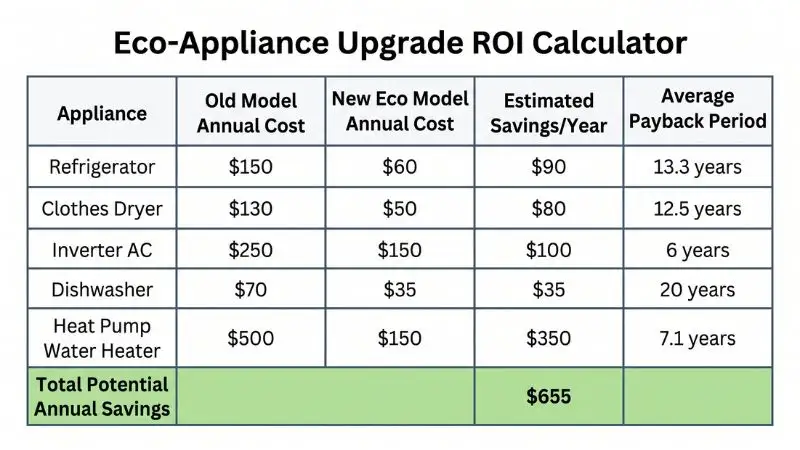
Different appliances offer different returns on your investment. Let us examine the top categories where eco-friendly upgrades yield the highest financial savings.
Refrigerators & Freezers
Because refrigerators run every single second of the year, they are prime candidates for an upgrade. Look for models featuring inverter compressors, which slow down or speed up smoothly rather than switching on and off at maximum power. Replacing a 15-year-old refrigerator with a modern, high-rated eco-model can easily chop your appliance’s annual running costs in half.
Washing Machines & Dryers
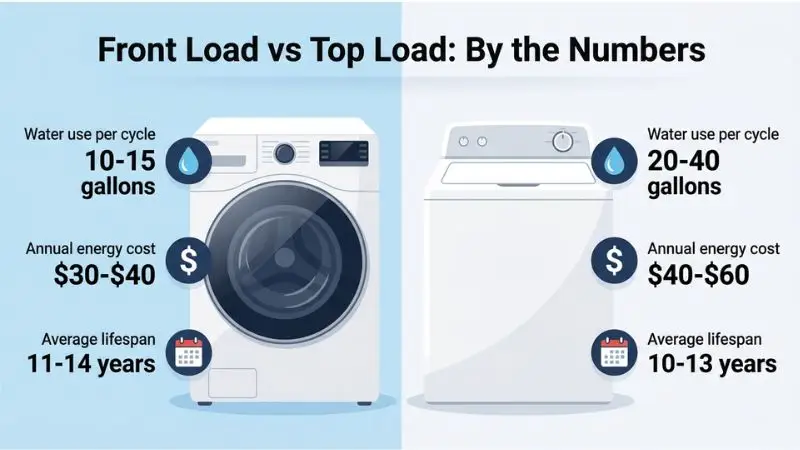
Modern washing machines feature advanced cold-wash programs that clean clothes perfectly at 20°C or 30°C. Since heating water accounts for 75% to 90% of a washer’s energy use, washing cold saves a massive amount of power. For drying, always choose a heat pump dryer over a standard condenser dryer. Heat pump models recycle warm air inside the drum, cutting laundry electricity use by up to 50%.
Air Conditioners & Heat Pumps
Traditional fixed-speed air conditioners waste power by constantly blasting at 100% capacity and then shutting off entirely. Inverter AC technology solves this by running at a low, continuous speed to maintain temperatures efficiently. If you live in a climate that requires both heating and cooling, installing a modern heat pump system provides an all-in-one climate solution with unmatched SEER2 (Seasonal Energy Efficiency Ratio) ratings.
Dishwashers
Many homeowners believe washing dishes by hand saves energy, but data prove otherwise. Modern eco-dishwashers use less water and keep that water hot inside an insulated chamber for longer periods. Their built-in Eco-Cycles use lower temperatures and extended run times to dissolve grease while drawing minimal electricity.
Water Heaters
Traditional water heaters rely on electric resistance coils, which act like a giant, power-hungry kettle inside your home. Upgrading to a heat pump water heater draws warmth from the surrounding air to heat your water, using up to 70% less power. For maximum savings, combine these units with basic timer controls to ensure they only heat water during cheap, off-peak electricity hours.
Buying vs. Waiting — When an Upgrade Makes Financial Sense
You do not need to replace every working machine in your house today. To find out if an upgrade is worth your money right now, use this simple break-even formula:
Payback Period (Years)=Estimated Annual Savings/Purchase Price of New Appliance
As a general rule of thumb, if a major appliance like a refrigerator or central AC system is over 10 years old, the upgrade economics almost always win. The monthly drop in your utility bill will quickly cover the upfront cost of the machine.
[DID YOU KNOW BOX]
Under the U.S. Inflation Reduction Act (IRA), homeowners can claim up to $2,000 in federal tax credits for qualifying heat pump installations and up to $1,200 for other energy-efficient home upgrades—significantly accelerating your investment payback periods.
Common Mistakes When Buying Eco-Appliances
Avoid these frequent pitfalls when shopping for your new energy-saving equipment:
- Buying on Purchase Price Alone: A cheap machine with a poor efficiency rating will cost you hundreds more in electricity bills over its 10-year lifespan than a slightly more expensive eco-model.
- Oversizing HVAC Units: Buying an air conditioner that is too large for your room causes “short-cycling.” The system turns on and off rapidly, which wears out parts and spikes power use.
- Ignoring Installation Costs: A poorly installed heat pump or AC system can lose 20% to 30% of its rated efficiency on day one. Always hire certified professionals.
- Skipping Government Rebate Research: Many buyers leave free money on the table by forgetting to check local utility websites for green energy cash-back programs before purchasing.
💡 PRO-TIP:
Always read the yellow or white energy guide label to look at the Estimated Annual Electricity Use (kWh) rather than just counting the stars. This gives you a hard number you can multiply by your local utility rate to calculate your exact future running costs.
Chapter 4: Installation, Setup & Integration — Making Smart Tech Work Together to Reduce Electricity Bills
Buying efficient gadgets and smart tech is only the first step. To truly reduce electricity bills, these devices must be installed correctly and configured to talk to one another. A single smart plug sitting on your counter does nothing; a network of smart plugs working alongside your thermostat and solar panels creates an automated, bill-slashing powerhouse.
Let us look at how to roll out your new technology safely, step-by-step, and get your entire home working as a single energy-saving unit.
Planning Your Smart Home Energy Rollout — A Phased Approach
Trying to upgrade your entire house in a single weekend is a recipe for frustration and wasted money. Instead, use a phased approach that funds your larger upgrades with the immediate savings from your quick wins.
- Phase 1 (Weeks 1–2): Focus on immediate, low-cost victories. Install smart plugs on standby-heavy electronics, swap out remaining incandescent bulbs for LEDs, and set up your main smart thermostat.
- Phase 2 (Months 1–3): Move to mid-tier upgrades. Install a home energy monitor (HEMS) in your electrical panel, set up advanced automated scheduling routines, and introduce smart power strips.
- Phase 3 (Months 3–12): Execute high-impact, long-term investments. This includes upgrading older, inefficient appliances, exploring solar options, and setting up electric vehicle (EV) smart charging.
Always allocate your budget based on return on investment (ROI) rather than excitement. Spend your money where the power drain is heaviest.
Smart Thermostat Installation — Step-by-Step
A smart thermostat is the anchor of your climate savings. Installing it is a highly manageable DIY project if you follow the proper safety steps.
- Turn Off the Power: Go to your main breaker panel and shut off the electricity to your heating and cooling system. Verify the screen is completely blank before touching any wires.
- Label the Existing Wires: Remove your old thermostat cover. Take a picture of the wiring setup, and use the included labels in your new kit to mark each wire (R, W, Y, G, C, etc.) before disconnecting them.
- Mount and Connect: Screw the new backplate to the wall. Insert the labeled wires into their corresponding slots on the new thermostat base.
- Power Up and Configure: Turn the breaker back on. Follow the on-screen prompts to connect the device to your home Wi-Fi and link it to your smartphone app.
During the first week, leave the thermostat in its automated learning mode so it can map your daily household movements.
[PRO TIP BOX]
Before purchasing any smart thermostat, photograph your existing thermostat’s wiring and run it through the manufacturer’s compatibility checker online. Incompatible wiring—such as lacking a 24V “C-wire”—is the number one cause of failed DIY installations.
Setting Up a Home Energy Management System (HEMS)
A Home Energy Management System (HEMS) gives your smart tech the data it needs to maximize your savings.
Hardware setup typically involves clipping a sensor around your main smart meter line or having an electrician clip Current Transformer (CT) clamps onto the main power lines inside your breaker box.
Once the hardware is safely in place, open the companion app to configure your billing settings. Input your exact utility tariff rates, including specific off-peak electricity hours. The system will immediately begin identifying individual appliance electrical signatures. You can then create smart rules, such as triggering your dishwasher to run only when your real-time data shows your home consumption is at its lowest point.
[DEFINITION BOX]
Term: Current Transformer (CT) Clamp A CT clamp is a sensor that snaps around an insulated electrical wire. It measures the magnetic field created by flowing electricity to calculate exact power usage safely without cutting or splicing any live wires.
Integrating Solar Panels with Smart Home Systems
If you have solar panels or are considering them, integrating them into your smart home network unlocks the ultimate level of energy efficiency.
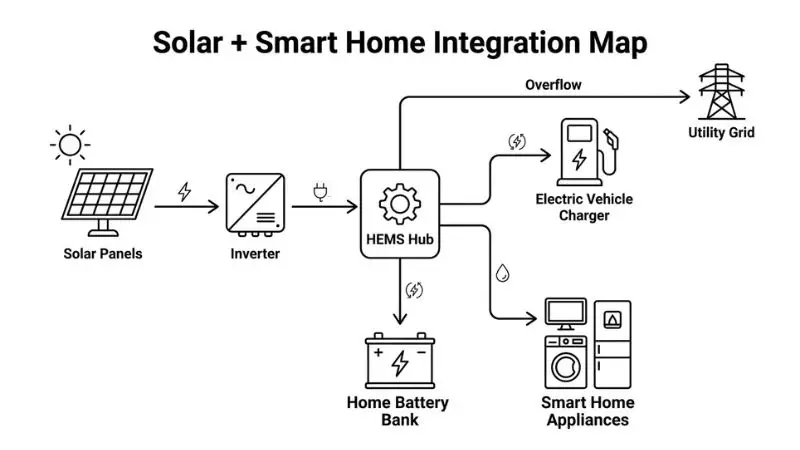
By feeding your solar inverter data directly into your HEMS platform, your home shifts from passive energy saving to active self-consumption optimization. Instead of exporting your clean solar energy back to the utility grid for a tiny credit, your HEMS can automatically turn on your highest-drawing appliances—like your heat pump water heater or washing machine—right when your solar panels are generating maximum peak power.
If you have a home battery system, the integration map ensures excess afternoon power fills your battery storage first, giving you free energy to use during expensive evening grid hours.
Troubleshooting the 5 Most Common Smart Energy Setup Issues
If your devices are not behaving as expected, use this quick checklist to resolve the issue:
- Device Not Connecting to Hub: Most smart tech operates only on a 2.4GHz Wi-Fi frequency. If your router uses a combined 5GHz/2.4GHz network, split the bands in your router settings so your smart devices can find the correct channel.
- Thermostat Showing Inaccurate Temperature: If your thermostat is mounted near a sunny window, drafty door, or kitchen appliance, it will read false temperatures. Move it to a central, shaded hallway for accurate operation.
- HEMS Not Detecting Appliances: If your monitoring dashboard looks scrambled, verify your CT clamps are snapped completely shut and facing the correct direction on the main wires.
- Automations Not Triggering: Check the time zone and Daylight Saving Time (DST) configurations inside your smart home app. A one-hour time mismatch will cause your off-peak routines to run during expensive peak hours.
- Smart Plug Reporting Zero Load: Ensure the physical power switch on the appliance itself is turned completely to the “On” position. If the appliance is switched completely off, the smart plug cannot deliver power or monitor standby data.
[DID YOU KNOW BOX]
Did you know that running your home appliances directly from your own solar panels is up to three times more financially rewarding than exporting that power back to the grid? Maximizing your self-consumption is the fastest way to drive your net power bill down to zero.
Chapter 5: The Future of Energy Efficiency — Trends That Will Further Reduce Electricity Bills Beyond 2025
The world of home energy management is changing at an incredible pace. While simple scheduling and efficient appliances offer great savings today, tomorrow’s technology will take things much further. In the coming years, homes will shift from being simple energy consumers to active, intelligent participants in a global smart grid.
Understanding these upcoming changes allows you to future-proof your home today. Let us explore the massive trends and cutting-edge technologies that will continue to reduce electricity bills over the next decade.
AI-Driven Energy Management — From Reactive to Predictive
Current smart tech relies heavily on rules you set yourself, like programming a plug to turn off at midnight. The future, however, belongs to predictive artificial intelligence that makes decisions entirely on its own.
- Predictive Behavior: New machine learning models do not just wait for you to act. They analyze weather forecasts, local grid conditions, and your personal daily habits to predict your energy needs hours before you even turn on an appliance.
- Grid-Responsive AI: Future appliances will talk directly to the power grid. If the grid experiences high stress or carbon intensity, your AI assistant will subtly lower your power usage without you ever noticing.
- Smart Dynamic Tariffs: Dynamic pricing models, like Octopus Energy’s Agile Tariff in the UK, are spreading globally. These programs change electricity prices every 30 minutes based on wholesale costs, and smart AI platforms automatically shift your heaviest energy use to the cheapest slots.
[DID YOU KNOW BOX]
The UK’s National Grid ran for over 5,000 hours without coal power in 2024. AI-driven demand-response programs—which pay households to reduce consumption during grid stress events—are now being piloted in 14 countries, turning your smart home into an active asset for the grid.
Vehicle-to-Home (V2H) and Vehicle-to-Grid (V2G) Technology
If you own or plan to buy an electric vehicle (EV), you are not just buying a car; you are purchasing a massive, mobile home battery backup system.
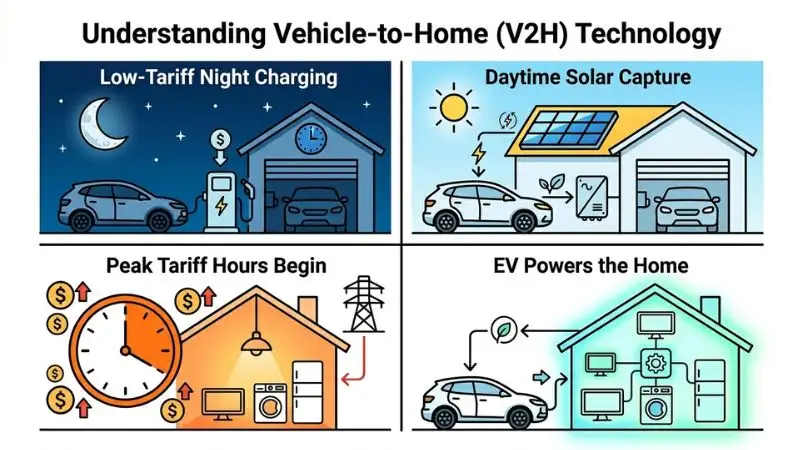
Traditional EV chargers only push power in one direction: from the house into the car. New bidirectional charging technology allows electricity to flow both ways. With a Vehicle-to-Home (V2H) setup, your car becomes an emergency generator.
The economic benefit is immense. You can program your EV to charge its battery overnight when electricity tariff rates are at their absolute lowest. Then, during the expensive evening peak hours, your car can discharge its stored energy to run your home appliances, completely shielding you from high utility rates.
Next-Generation Eco-Appliances on the Horizon
Appliance manufacturers are pushing the absolute limits of physics to build the next generation of ultra-efficient home equipment.
- Hydrogen-Ready Boilers: As gas grids slowly transition away from fossil fuels, manufacturers are building heating boilers that can seamlessly switch to clean hydrogen power.
- Hyper-Efficient Dryers: Next-generation heat pump clothes dryers currently in development are targeting a Coefficient of Performance (COP) greater than 5, making them incredibly cheap to operate.
- Smart Electrochromic Windows: These advanced glass windows feature built-in dynamic tinting. They automatically darken during intense midday heat, blocking out solar radiation and cutting your cooling costs by up to 20%.
- Predictive AI Refrigerators: Future refrigerators will use internal cameras and sensors to track your usage, scheduling their compressor cooling cycles only during times they know the door will stay closed.
Policy, Incentives, and Grid Evolution Globally
Governments and utility companies around the world realize that reducing residential energy strain is much cheaper than building new multi-billion-dollar power plants.
Because of this, time-of-use (TOU) tariffs are rapidly becoming the mandatory global standard rather than an optional choice. Additionally, many neighborhoods are experimenting with community microgrids and peer-to-peer energy trading platforms. These networks allow you to sell excess solar power directly to your next-door neighbor using automated smart contracts, keeping energy local and avoiding corporate utility fees entirely.
[DEFINITION BOX]
Term: Vehicle-to-Home (V2H) V2H is a bidirectional charging technology that enables an electric vehicle to act as a residential battery system. It allows the car to feed stored DC battery power back through a specialized home inverter to supply electricity to your property.
Building Your Long-Term Energy Resilience Strategy
To maximize these upcoming innovations, you need a long-term plan. Do not view energy efficiency as a single, one-time project. Instead, treat it as a continuous rolling upgrade strategy.
Every year, perform a quick audit of your utility data. Use the savings from your initial smart thermostats and plugs to fund your next mid-tier upgrades, like heat pump water heaters or solar integration. Finally, make sure to keep a neat folder detailing your home’s smart energy profile. Documenting your automated systems, eco-appliances, and low annual kWh usage adds significant hidden resale value to your property and can even help lower your home insurance premiums.
💡 PRO-TIP: Sign up for your utility provider’s demand-response or “smart export” program right now—even if you do not have solar panels yet. These programs are expanding rapidly across the globe, and early enrollees often lock in the highest incentive rates and first access to grid payouts.