Chapter 1: The Anatomy of Modern Power: Understanding Inverter Technology
Inverter energy savings start with understanding how your appliances actually use power. Electricity is the lifeblood of the modern home. Yet, most of us never stop to think about how that power moves through our devices. We just plug them in and expect them to work. However, if you are looking to slash your energy bills in 2026, knowing the “how” behind your power is the first step toward saving thousands.
In this chapter, we are going to pull back the curtain on Inverter Technology – the true engine behind inverter energy savings.
What is Inverter Technology? (The Foundation)
At its simplest level, inverter technology is about control. In the past, electrical appliances were “dumb.” They were either 100% on or 100% off. Imagine driving a car where you could only floor the gas pedal or hit the brakes, with no way to just cruise at 40 mph. That is how traditional appliances work, and it is incredibly inefficient.
Inverter technology introduces a “brain” to the system. This brain allows the appliance to adjust its power usage based on what is actually needed. Instead of wasting energy by running at full blast all the time, an inverter-equipped machine scales its effort up or down.
Definition: Breaking down the AC-to-DC-to-AC conversion
To truly understand an inverter, we have to look at the “Three-Step Dance” of electricity. The power that comes out of your wall socket is AC (Alternating Current). However, to control the speed of a motor precisely, the appliance needs to manipulate that power.
- The Rectifier Stage (AC to DC): First, the incoming AC power is converted into DC (Direct Current). Think of DC as a steady, flat pool of energy.
- The Smoothing Stage: The DC power is cleaned up using capacitors to remove any “noise” or fluctuations.
- The Inverter Stage (DC to AC): This is where the magic happens. The “brain” converts that DC power back into AC, but with a twist. It can now control the frequency and voltage of this new AC power.
By changing the frequency (measured in Hertz), the inverter can tell the motor exactly how fast to spin. If the room is almost cool enough, the inverter drops the frequency, and the motor slows down to a whisper.
Definition Box: Frequency (Hz)
In the context of inverters, Frequency refers to the number of times the electrical current switches direction per second. By adjusting this frequency, the inverter controls the RPM (Rotations Per Minute) of a motor or compressor, allowing for variable speeds.
Non-Inverter vs. Inverter: The “On-Off” Cycle vs. Variable Speed
To understand why your old appliances are “money pits,” we need to compare them to the new inverter standard.
The Old Way: The “On-Off” Struggle
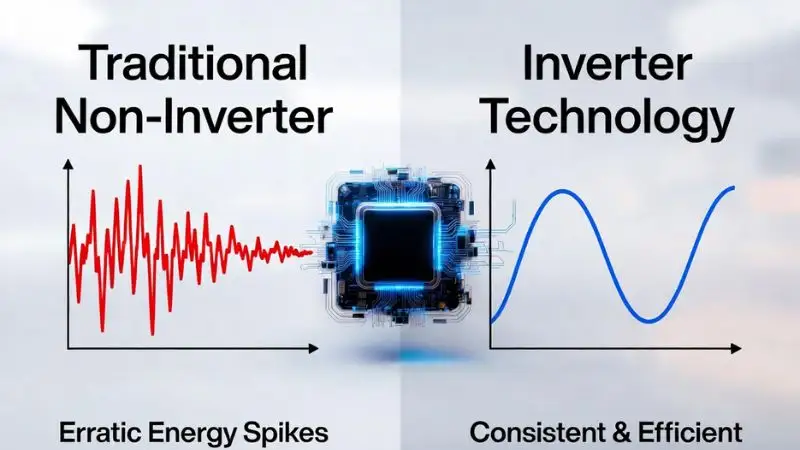
Traditional (Non-Inverter) appliances use a fixed-speed compressor. Let’s take an air conditioner as an example. When you set it to 24°C, the compressor starts at 100% power. Once the room reaches 24°C, the compressor shuts off completely.
Then, the room starts to warm up. Once it hits 26°C, the compressor kicks back in with a massive “surge” of electricity to get the temperature back down. This constant stopping and starting is where the most energy is wasted. It’s like a marathon runner who sprints for 100 meters, stops to catch their breath, and then has to sprint again.
The New Way: The Variable Speed Advantage
An inverter appliance never truly stops. Instead of shutting down, it slows down. When your room reaches the target temperature, the inverter motor drops to a very low speed. It uses just enough energy to maintain the temperature.
This eliminates the “start-up surge,” which is often when appliances consume 3 to 5 times their normal running current. By staying in a “cruising” state, the inverter uses significantly less total power over 24 hours.
The Hidden Benefits of the “Smooth Wave”
Because the inverter provides a smooth, consistent flow of power, the benefits go beyond just your electricity bill.
- Durability: Because the motor isn’t constantly jerking to life and shutting down, there is less mechanical wear and tear. This is why many inverter appliances come with 10-year warranties on the motor.
- Precision: Inverter systems can maintain temperatures within 0.1°C of your goal. Traditional systems often have swings of 2 or 3 degrees.
- Quiet Operation: Since the motor isn’t always running at its maximum RPM, inverter appliances are significantly quieter. You might not even notice your fridge or AC is running.
Did You Know Box: The PWM Secret
The “brain” of the inverter uses a technique called Pulse Width Modulation (PWM). This technology was originally perfected for industrial robotics and high-speed trains. It works by “chopping” electricity into tiny bits to simulate different voltages. Today, this same space-age tech is what keeps your washing machine quiet!
Practical Implementation: Making it Work for You
Now that you know the science, how do you apply this to save money? Not every “Inverter” label is created equal. In 2026, some brands use “Digital Inverters” while others use “Dual Inverters.”
The core science remains the same: you are paying for the ability to avoid the “On-Off” cycle. When shopping, always look for the Weighted Power Consumption rather than just the peak wattage. This tells you how much energy the device uses while it is “cruising,” which is where 80% of your savings will come from.
Pro-Tip: The “First Hour” Rule
To get the most out of an inverter AC, don’t turn it on and off throughout the day. Inverters are most efficient when left running. If you are leaving the room for only 30 minutes, leave the AC on. The energy used to “restart” the cooling cycle later will actually cost more than the tiny amount of power the inverter uses to maintain the temperature while you are gone.
Why This Matters for the Global Audience
Whether you are in a hot climate like Pakistan or a temperate region in Europe, energy prices are rising globally. In 2026, “Green Energy” isn’t just a trend; it’s a financial necessity.
By choosing an inverter, you are essentially “future-proofing” your home. As power grids become more stressed, appliances that can operate on low, steady voltages will be the ones that stay running during brownouts and keep your monthly budget from exploding.
In the next chapter, we will dive deeper into the actual numbers. We will prove—using real-world math—exactly how that 50% saving is calculated and why the initial higher price tag of an inverter appliance is actually the best investment you’ll make this year.
Chapter 2: The “50% Savings” Myth vs. Reality
If you have spent any time looking at new appliances lately, you’ve seen the stickers. “Save up to 50% on electricity!” “Cut your bills in half!” These are bold claims. But in the real world, does an inverter actually deliver on that promise?
The short answer is: Yes, but with conditions.
In this chapter, we are moving past the marketing slogans. We are going to look at the cold, hard numbers and the science of how those savings are calculated. Understanding the difference between “peak efficiency” and “real-world usage” is what separates a smart consumer from someone who just spends extra money on a fancy label.
Calculating Your ROI (Return on Investment)
When you buy an inverter appliance, you are usually paying a “premium” upfront. It costs more than a standard model. To see if it’s worth it, you have to calculate your Return on Investment (ROI).
ROI is simply the amount of time it takes for the electricity savings to pay back the extra cost of the machine. For example, if an inverter AC costs $200 more than a regular one, but saves you $50 a month in summer, your ROI is achieved in just four months of heavy use. In the world of 2026 energy prices, the ROI for inverter tech has never been faster.
Factors that Influence Efficiency: Insulation, Ambient Temperature, and Usage Patterns
The “50% savings” mark is not a magic switch. It depends heavily on how and where you use the device. If the conditions aren’t right, an inverter might only save you 10% or 20%.
- Home Insulation: If your windows are drafty or your walls aren’t insulated, your inverter AC will have to work at 100% speed all day just to keep up. Remember, inverters save money when they slow down. If they never get to slow down, you won’t see the savings.
- Ambient Temperature: Every machine has a breaking point. If it is 50°C outside, even the best inverter compressor will struggle to reach “cruising speed.” Savings are highest when the machine can reach the target temperature and then “hover” there.
- Usage Patterns: Inverters are designed for long-term operation. If you only turn your appliance on for 15 minutes at a time, you are wasting the technology. The savings happen during the second, third, and fourth hours of continuous running.
Definition Box: ROI (Return on Investment)
In home appliances, ROI is the period of time it takes for the cumulative energy bill savings to equal the initial extra cost spent on the more efficient technology.
The Science of Part-Load Efficiency: Why Inverters Excel at Less Than 100%
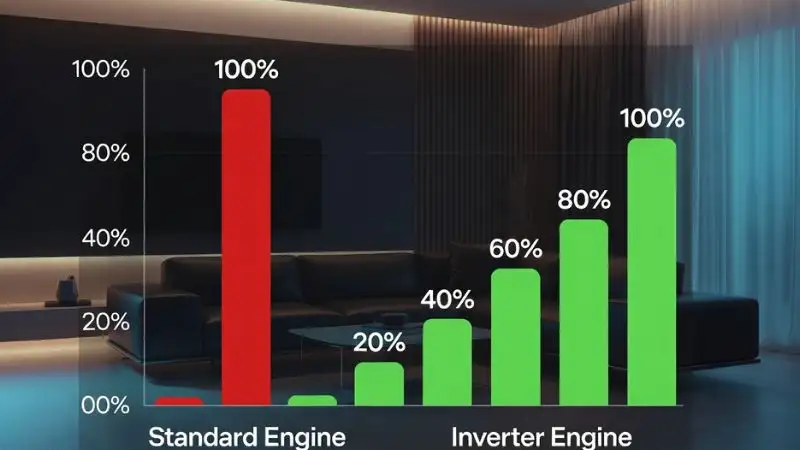
This is the “Hidden Science” mentioned in the title of this guide. Traditional appliances are designed to be efficient at Full Load (100% power). But how often is it actually hot enough to need 100% power? Usually, only for the first 20 minutes of cooling.
Part-Load Efficiency is the ability of a machine to maintain high efficiency while running at 20%, 30%, or 50% capacity.
Think of it like a light dimmer switch. A traditional AC is a standard switch—on or off. An inverter is a dimmer. The science shows that motors are actually more efficient when they run slower. When a compressor runs at half speed, it doesn’t just use half the power; it often uses even less because there is less heat friction and less pressure stress on the system.
Navigating the 2026 Energy Standards
The way we measure efficiency has changed. In 2026, the old “EER” labels will be replaced or updated by more accurate seasonal ratings. To stop wasting money, you need to know exactly what these letters mean on the box.
Understanding SEER2 and EER in 2026
- EER (Energy Efficiency Ratio): This measures how efficient the unit is at a specific, very hot temperature (usually 35°C). It’s a “snapshot” of performance.
- SEER2 (Seasonal Energy Efficiency Ratio 2): This is much more important. It measures efficiency over an entire season with varying temperatures. Since 2023, the “SEER2” standard has become the global benchmark because it uses higher “static pressure” testing, which mimics real home ductwork much better than the old SEER.
In 2026, a “good” SEER2 rating for a home air conditioner is typically 16 or higher. Units with a SEER2 of 20+ are considered elite and will yield that legendary 50% saving in most climates.
Did You Know Box: The “Surge” Cost
A traditional non-inverter motor requires a “Start-Up Current” that can be 6 times higher than its running current. If your AC clicks on and off 10 times an hour, you are paying for 10 massive spikes in electricity. Inverters eliminate these spikes entirely by starting at a very low voltage.
Common Mistakes: The “Bigger is Better” Trap
One of the biggest mistakes consumers make is buying an oversized unit. You might think, “If a 1.5-ton AC is good, a 2.0-ton AC will be even better and cool faster!”
This is a total myth.
If an inverter unit is too big for the room, it will reach the target temperature too fast. Even at its lowest speed, it might provide too much cooling, causing it to shut off completely. This forces the inverter back into a “Start-Stop” cycle, which is exactly what the technology was designed to avoid.
When an inverter unit “short-cycles” like this:
- It fails to remove humidity properly, leaving the room feeling “clammy.”
- It wastes the energy-saving benefits of the variable-speed motor.
- It puts unnecessary stress on the electronics.
Pro-Tip: Use a BTUs Calculator
Before buying, always calculate the exact British Thermal Units (BTUs) needed for your room size. In 2026, many manufacturer websites offer “Smart Calculators” that factor in your window size and sun exposure. Never guess your unit size—measure it!
The Reality Check: Is 50% Guaranteed?
While the science supports a 50% reduction in power consumption, you should view it as a “Potential Peak.” In a perfectly insulated room, running for 8 hours a day, at a moderate temperature setting (like 24°C), you will likely hit that 50% mark compared to an old-fashioned unit. However, if you set your AC to 16°C in a room with an open door, your savings will likely drop to 0%.
The “Reality” of the myth is that The Inverter provides the opportunity to save, but the user provides the discipline. By understanding Part-Load Efficiency and avoiding the “Bigger is Better” mistake, you are no longer just guessing. You are strategically managing your home’s energy. In the next chapter, we will look at how this technology is specifically changing the HVAC industry and how AI is starting to take the guesswork out of these settings for you.
Chapter 3: Inverters in HVAC: The Air Conditioning Revolution
Heating, Ventilation, and Air Conditioning (HVAC) systems consume more energy than any other system in a standard home. For decades, we accepted high summer bills as an unavoidable tax on comfort. But the “Inverter Revolution” has changed the math.
In this chapter, we explore how air conditioners have evolved from simple “blowers” into highly intelligent climate control systems. By focusing on how these machines handle air, we can see exactly why the move to inverter HVAC is the single most effective way to stop wasting money in 2026.
Maximizing Cooling Efficiency
When we talk about cooling efficiency, we aren’t just talking about how cold a room gets. We are talking about how much electricity was “sacrificed” to remove the heat. In a world of rising temperatures, efficiency is no longer a luxury—it’s a survival strategy for your bank account.
The secret to modern efficiency isn’t just a better fan or a colder gas; it is the ability of the system to adapt to the environment. In 2026, air conditioners are no longer passive machines; they are active learners.
The Role of the Variable Speed Compressor
The heart of any air conditioner is the compressor. Its job is to squeeze the refrigerant gas, which allows it to absorb and release heat. In a traditional AC, this heart only has two speeds: 0% and 100%.
The Variable Speed Compressor is different. It acts more like a dimmer switch for your cooling. Instead of a violent “jerk” to life every time the temperature rises by one degree, it gently ramps up.
When you first turn on the unit, the compressor might run at 90% capacity to bring the room down to your desired temperature quickly. Once it hits that mark, it doesn’t shut off. It drops down to 10% or 20% capacity. It stays there, quietly sipping electricity, just to offset the heat trickling in through the windows. This constant, low-level operation prevents the massive energy spikes associated with “hard starts.”
Definition Box: Variable Speed Compressor
A compressor driven by an inverter drive that can vary its rotational speed to control the flow of refrigerant. This allows the system to meet the cooling or heating demand of a space precisely without cycling on and off.
Eco-Mode and Smart Sensors: How 2026 Models Use AI
As we move through 2026, “Inverter” tech is merging with Artificial Intelligence (AI). Modern units are now equipped with infrared “Eye” sensors and occupancy detection.
- Occupancy Sensing: If you leave the room to go to the kitchen, the AC detects the lack of heat signatures (people). It automatically enters a deep “Eco-Mode,” slowing the compressor to its absolute minimum. When you return, it senses your presence and gently ramps back up.
- Climate Learning: AI algorithms now analyze the outdoor humidity and temperature trends over a week. If the AC knows that 4:00 PM is always the hottest part of your day, it will pre-cool the room slightly at a very efficient, low speed at 3:30 PM to avoid a high-power “surge” later.
- Auto-Cleaning Features: Efficiency drops when dust builds up on the coils. 2026 inverter models often include self-cleaning cycles that use frost and heat to strip away dirt, ensuring the motor never has to work harder than it should.
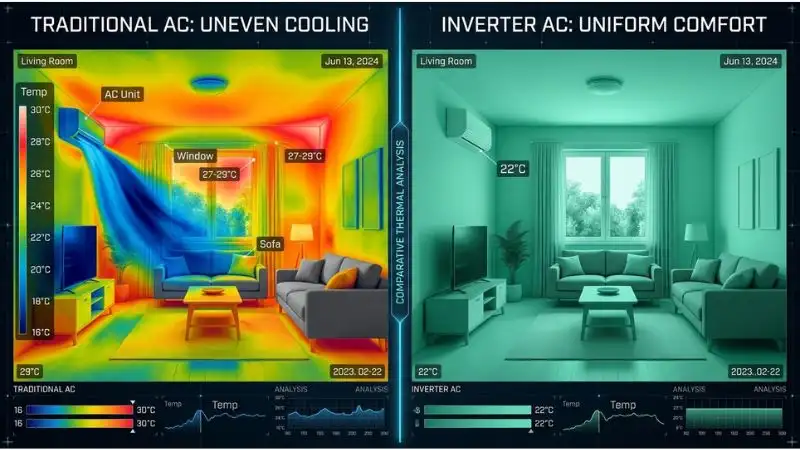
The Science of Consistent Comfort
One of the biggest complaints about old HVAC systems was the “Swing.” You would feel freezing for ten minutes, then the AC would turn off, and five minutes later you would feel sweaty. This is called “Temperature Hunting.”
Because an inverter compressor is always running at a variable speed, it eliminates this swing. It creates a “thermal steady state.” This isn’t just better for your skin; it’s better for your electronics, your furniture, and even your indoor plants, which thrive in stable environments.
Did You Know Box: The Humidity Factor
An inverter AC is actually better at “drying” your air than a standard AC. Because the inverter runs for longer cycles at a lower speed, the air spends more time passing over the cold coils. This removes significantly more moisture from the air, making a 26°C room feel as cool as a 23°C room!
Avoiding the “Cold Blast” Mistake
Many users treat their remote like a racing car throttle. They walk into a hot room and set the AC to 16°C, thinking it will cool the room faster.
In an inverter system, this is a mistake.
Setting the AC to 16°C does not make the air coming out any colder. It only tells the machine to stay at 100% power for a longer time. This forces the inverter to operate in its least efficient zone. By the time the room hits 16°C, you are shivering, and you’ve wasted a massive amount of energy.
The most efficient way to use a 2026 HVAC system is to set it to a comfortable, realistic temperature and let the “Smart Sensors” do the work. The “brain” of the AC is much better at calculating the cooling curve than a human with a remote control.
Pro-Tip: The “24°C Sweet Spot”
For maximum inverter efficiency, set your thermostat to 24°C (75°F). In most modern inverter units, this is the “Golden Ratio” where the compressor can maintain the lowest possible RPM while still removing enough humidity to keep you comfortable. Every degree you go below 24°C can increase your energy consumption by 6% to 10%.
Maintenance: The Silent Efficiency Killer
Even the most advanced 2026 AI-driven inverter will fail to save you money if the filters are clogged. When air cannot flow freely, the “Variable Speed” compressor is forced to spin faster to compensate for the resistance.
In a traditional AC, a dirty filter just meant less air. In an inverter AC, a dirty filter actively confuses the sensors, causing the system to run at higher power levels than necessary.
- Monthly Filter Rinse: In high-dust areas, a 5-minute rinse of the plastic mesh filters can improve efficiency by 15%.
- Outdoor Unit Clearance: Ensure the outdoor compressor unit has at least 2 feet of clear space around it. If the “heat” can’t escape the unit, the inverter cannot drop into its low-power “Eco” state.
Summary of the HVAC Revolution
The shift from “On-Off” cooling to “Smart Variable” cooling is the most significant change in home technology this decade. By allowing a machine to “think” about the temperature rather than just reacting to it, we have unlocked a level of comfort that is actually cheaper to maintain than the discomfort of the past.
As we move into the next chapter, we will see that this technology isn’t just for cooling our air—it is also quietly revolutionizing our kitchens and laundry rooms. From refrigerators to washing machines, the “Smooth Wave” of inverter power is everywhere.
Chapter 4: Beyond Cooling: Inverter Tech in Household Appliances
When most people hear the word “inverter,” they immediately think of air conditioners. While HVAC systems are the biggest energy consumers, the inverter revolution hasn’t stopped at your living room wall. It has moved into the kitchen and the laundry room, changing how our most essential appliances behave.
In 2026, the distinction between a “standard” appliance and an “inverter” appliance is the difference between a machine that wears out and one that lasts. In this chapter, we explore how this variable-speed magic is applied to washing machines and refrigerators to save you money every single day.
Washing Machines and Refrigerators
Unlike an air conditioner, which you might only run during certain seasons, your refrigerator runs 24 hours a day, 365 days a year. Your washing machine, on the other hand, deals with heavy physical loads and high-speed spinning.
Both of these machines rely on motors. In the old days, these motors were basic. They used belts, pulleys, and “all-or-nothing” power settings. By introducing inverter technology, manufacturers have solved the two biggest problems with home appliances: mechanical friction and energy spikes.
Inverter Direct Drive Motors: Why Fewer Moving Parts Mean Less Energy Waste
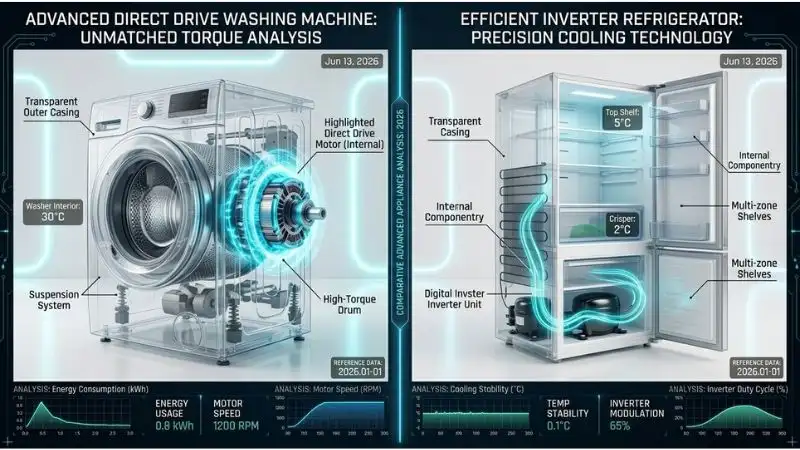
Traditional washing machines use a motor connected to the drum via a rubber belt. Think of it like a bicycle chain. When the motor turns, the belt pulls the drum. This creates two major issues: noise and energy loss through friction.
Inverter Direct Drive (IDD) technology changes the game. In this system, the motor is attached directly to the center of the washing drum. There is no belt. There is no pulley.
How It Saves You Money:
- Zero Belt Slippage: In old machines, the belt can slip or stretch, wasting energy as the motor spins without moving the clothes effectively. Direct drive eliminates this waste.
- Variable Motion: Because the motor is an “inverter” type, it can change how it spins based on the weight of your laundry. It doesn’t use the same power for two shirts as it does for a heavy duvet.
- Extreme Durability: Fewer moving parts mean fewer things to break. This is why you will see “10-Year Warranty” stickers on almost every inverter washing machine in 2026.
Definition Box: Direct Drive
A motor design where the power is transmitted directly from the motor to the moving part (like a laundry drum) without using intermediate belts, chains, or gears.
Digital Inverter Compressors in Fridges: Keeping Food Fresh with 0.5-Degree Precision
Your refrigerator is the “marathon runner” of your home. A traditional fridge compressor works on a simple thermostat. When the temperature inside rises, the compressor kicks on with a loud thump, runs at max speed until it’s cold, and then shuts off.
A Digital Inverter Compressor is much smarter. It is always on, but it moves at different speeds. If you open the fridge door to grab a snack, the compressor senses the tiny temperature rise and speeds up slightly. Once the door is closed, it slows back down to a “whisper mode.”
Why This Matters for Your Groceries:
- Thermal Stability: Traditional fridges have a “see-saw” temperature. It gets very cold, then warms up, then gets very cold again. This temperature swing causes food (especially milk and leafy greens) to spoil faster.
- Humidity Control: Inverters help maintain a steady humidity level. This prevents your carrots from wilting and your cheese from drying out.
- Lower Bills: Since the fridge never has to perform a “cold start” from zero, it uses significantly less electricity over a 24-hour cycle.
The Hidden Benefit: The “Quiet Home” Effect
One of the most underrated reasons to switch to inverter appliances isn’t found on your electric bill—it’s found in the silence of your home.
In the past, doing laundry meant a house-shaking “vibration” during the spin cycle. Refrigerators used to hum and click throughout the night. Inverter technology has almost entirely eliminated this. Because the motors can ramp up and down smoothly, they don’t create the violent vibrations associated with old-school motors.
Did You Know Box: The Silence of Science
Inverter washing machines can reduce noise levels by up to 30% to 40% compared to traditional belt-driven models. In fact, many modern inverter washers stay below 50 decibels—that is quieter than a normal conversation!
Practical Advice for the Modern Buyer
In 2026, almost every “premium” appliance claims to be an inverter. But how do you know if you are getting the real deal?
Check the “Load Sensing” Capability
A true inverter washing machine should have an “Auto-Weight” or “Load Sensing” feature. When you start a cycle, the drum should rotate slowly for a few seconds without water. This is the inverter motor “feeling” the weight of the clothes, so it can calculate the exact amount of power and water needed. If a machine doesn’t do this, it might not be a “True” inverter.
Look for the 0.5°C Symbol
On refrigerators, look for marketing that mentions “Precision Cooling” or “0.5°C Fluctuations.” This is a hallmark of a high-quality digital inverter compressor that can micro-adjust its speed.
Pro-Tip: Don’t Overstuff the Fridge
Even the smartest inverter fridge needs air to circulate. For maximum efficiency, keep your fridge about 70% full. If it’s too empty, you lose cold air every time you open the door. If it’s too full, the air can’t move, and the inverter motor will be forced to run at higher speeds to keep the back of the fridge cold, wasting the energy-saving benefits.
Summary: A Smart Investment for 2026
While these appliances cost more upfront, the math in 2026 is clear. Between the 10-year motor warranties and the monthly savings on your utility bill, an inverter washing machine or fridge usually pays for itself within 2 to 3 years.
Beyond the money, the peace of mind that comes from a quieter home and fresher food makes this technology a “no-brainer” for any modern household. In the next chapter, we will take a step further and look at how inverters are actually helping us generate our own power through solar energy systems.
Chapter 5: Solar Inverters: The Heart of Renewable Energy
In the previous chapters, we looked at how inverters save energy in your appliances. But what if you want to stop buying energy entirely? This is where solar power comes in. However, a solar panel on its own is actually useless to your home.
Solar panels produce DC (Direct Current) electricity. As we learned in Chapter 1, your home runs on AC (Alternating Current). Without a solar inverter to bridge the gap, those expensive panels are just shiny decorations on your roof. In 2026, the inverter is widely considered the “brain” of the entire solar system.
Converting the Sun into Savings
The primary job of a solar inverter is conversion. It takes the raw, fluctuating energy from the sun and “tames” it into a steady 230V or 120V stream that your TV, fridge, and lights can use.
But modern inverters do much more than just convert power. They act as a traffic cop. They decide when to use solar power, when to pull from the grid, and when to charge their batteries. If the inverter is inefficient, you lose money—even if the sun is shining brightly.
String Inverters vs. Micro-Inverters: Which is Right for Your Home?
When you start shopping for solar in 2026, you will find two main ways to set up your system. Choosing the wrong one can lead to a 20% to 30% loss in potential savings.
1. The String Inverter (The Classic Choice)
In this setup, all your solar panels are connected like a string of Christmas lights. This “string” goes into one large inverter box on your wall.
- Pros: It is the most affordable option and easy to maintain because the electronics are all in one place.
- Cons: It has a “weakest link” problem. If one panel is covered by shade or a fallen leaf, the performance of every other panel in that string drops to match the shaded one.
2. Micro-Inverters (The Modern Standard)
Instead of one big box on the wall, you have a tiny inverter attached to the back of every single panel on your roof.
- Pros: They are incredibly efficient. If one panel is shaded, the rest of the panels keep producing at 100% power. You can also track the performance of every individual panel on your smartphone.
- Cons: The upfront cost is higher, and if one fails, a technician has to climb onto your roof to fix it.
Definition Box: MPPT (Maximum Power Point Tracking)
This is a digital technique used in modern solar inverters to extract the maximum possible power from solar panels as the sun moves and intensity changes. It’s like a “tuning knob” that constantly finds the sweet spot for energy production.
Hybrid Inverters: Managing Battery Storage and Grid-Tie Systems
In 2026, the “Standard” inverter is quickly being replaced by the Hybrid Inverter. As energy prices fluctuate throughout the day, simply sending power back to the grid is no longer the most profitable move.
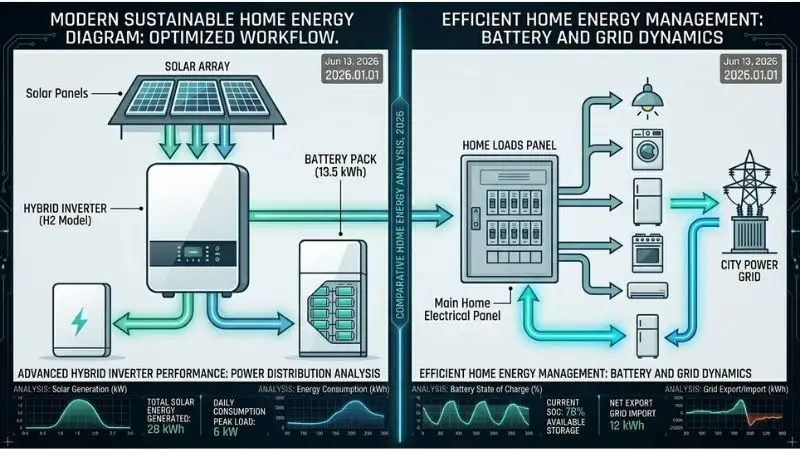
A Hybrid Inverter is a “three-way” system. It connects to your solar panels, your home battery (like a Tesla Powerwall or similar), and the city power grid all at once.
- During the day, it powers your home and uses any “extra” sun to fill your batteries.
- During the evening, instead of buying expensive electricity from the grid, the hybrid inverter pulls the stored energy from your batteries.
- During a Power Outage: While your neighbors are in the dark, a hybrid system can “island” your home, keeping your essential appliances running using stored battery power.
The Science of Clipping: Why Inverter Size Matters
A common mistake in solar planning is “oversizing” or “undersizing” the inverter. If your panels can produce 5kW of power, but your inverter can only handle 4kW, you experience what engineers call “Clipping.” This means that during the brightest part of the day, your inverter literally throws away the extra energy because it can’t process it. In 2026, smart SEO strategies for solar installers focus heavily on “Right-Sizing.” You want an inverter that can handle your peak production but is efficient enough to run during cloudy mornings.
Did You Know Box: The “Night Consumption” Fact
Even when they aren’t producing power, solar inverters stay “awake” to monitor the grid. Old, cheap inverters could actually “drain” a small amount of electricity at night just to keep their sensors on. Modern 2026 high-efficiency inverters have a “Deep Sleep” mode that uses less than 1 watt during the night!
Practical Advice for 2026 Solar Buyers
If you are looking to install a system this year, don’t just look at the brand of the panels. The panels are just “glass and silicon.” The inverter is where the technology lives.
- Check the Efficiency Rating: In 2026, you should not settle for anything less than 97% efficiency. This means only 3% of the sun’s energy is lost as heat during the conversion process.
- Look for “Fanless” Designs: High-quality inverters use large heat sinks rather than loud cooling fans. Fanless designs last longer because there are no moving parts to get clogged with dust or wear out.
- Warranty Check: Most panels have 25-year warranties, but many inverters only have 5 or 10. Always look for brands that offer “Extended Warranty” options for the inverter, as it is the part most likely to need service after a decade.
Pro-Tip: The “Cool and Dry” Rule
To maximize the life of your solar inverter, never install it in direct sunlight. Even if it is rated for outdoor use, the extreme heat of the sun will age the internal capacitors faster. Install it in a garage, a shaded porch, or on a north-facing wall to keep it cool and running at peak efficiency.
Why Solar Inverters are the Ultimate Money-Savers
The math of 2026 is simple: Energy independence is the best way to stop wasting money. By choosing a high-quality Hybrid or Micro-inverter system, you aren’t just “helping the environment.” You are essentially pre-paying for 20 years of electricity at a fixed, low price.
As we move into Chapter 6, we will go even deeper into the “invisible” side of this technology. We will discuss Power Factor Correction and how inverters actually protect your expensive computers and TVs from “dirty” electricity. It’s one thing to save money on your bill; it’s another to save money by preventing your electronics from blowing out!
Chapter 6: The Hidden Science: Power Factor Correction (PFC)
Up until now, we have focused on how inverters save you money by slowing down motors. But there is another way inverters save you money—one that is almost completely invisible. It has to do with the quality of the electricity moving through your walls.
In the world of electrical engineering, not all power is “clean.” In fact, much of the electricity in our homes is “dirty,” filled with electrical noise and inefficiency. In this chapter, we are going to explore the hidden science of Power Factor Correction (PFC) and how inverter technology acts as a high-tech filter for your home.
Why “Dirty Power” Costs You Money
Imagine you are buying a glass of soda. You pay for a full glass, but when it’s poured, half of it is foam. You still pay for the full glass, even though you can only drink the liquid part.
“Dirty power” is exactly like that foam. In electrical terms, this is called Apparent Power vs. Real Power.
- Real Power is the electricity that actually does work (spinning the fan, cooling the fridge).
- Reactive Power (the foam) is electricity that bounces back and forth in the wires without doing any work.
If your home has a poor “Power Factor,” your appliances have to pull more current from the grid to get the same amount of work done. This heats your wires, stresses your circuit breakers, and in many regions, can actually lead to higher utility charges or penalties.
Understanding Total Harmonic Distortion (THD)
To understand why power gets dirty, we have to look at Total Harmonic Distortion (THD).
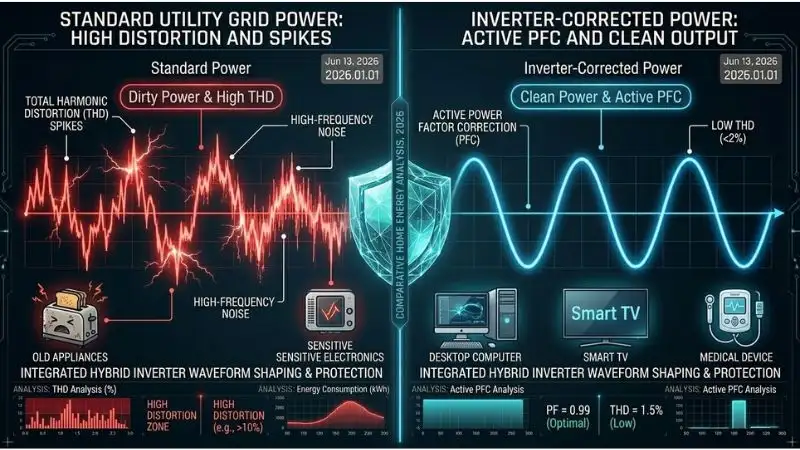
Traditional appliances, especially those with cheap motors or old-fashioned power supplies, don’t pull electricity in a smooth wave. They pull it in “gulps.” This erratic pulling creates ripples in your home’s electrical system, much like throwing a rock into a smooth pond.
These ripples (harmonics) distort the electricity. High THD is dangerous because it causes:
- Overheating: Motors and transformers run hotter than they should.
- Vibration: You might hear a “hum” in your walls or appliances.
- Data Errors: High THD can cause your Wi-Fi routers to reset or your computers to glitch.
Definition Box: Power Factor (PF)
Power Factor is a ratio (from 0 to 1) that measures how effectively electricity is being used. A PF of 1.0 is “perfect” efficiency (all liquid, no foam). Most old appliances have a PF of 0.6 or 0.7, meaning 30% to 40% of the power is being wasted.
How Inverters Clean Your Electricity: Protecting Sensitive Electronics
This is where modern inverter technology shows its true value. Most high-end inverter appliances today come with built-in Active Power Factor Correction (Active PFC).
Instead of just taking whatever “dirty” power comes from the wall, the inverter’s “brain” reshapes the electricity. It uses capacitors and smart switching to ensure that the appliance pulls current in a smooth, perfect sine wave that is perfectly in step with the voltage.
The Protection Benefit:
Because the inverter is already converting AC to DC and back to AC (as we learned in Chapter 1), it acts as a buffer. If there is a small spike or “noise” on the city power line, the inverter’s DC stage soaks it up.
The motor inside your inverter AC or fridge never “sees” the dirty power from the street. It only receives the clean, reconstructed power from the inverter. This is why inverter appliances often survive voltage fluctuations that would burn out a standard motor.
The Financial Impact of Clean Power
You might be wondering: “If I’m a residential user, do I really pay for the ‘foam’?”
In 2026, the answer is increasingly yes. Many modern “Smart Meters” installed by utility companies are now capable of measuring Reactive Power. Even if your current bill doesn’t show it, dirty power is costing you in other ways:
- Reduced Appliance Life: Heat is the number one killer of electronics. Dirty power creates extra heat.
- Ghost Usage: High THD can sometimes cause older electric meters to spin slightly faster than they should.
- Stability: Clean power means fewer “mysterious” appliance failures.
Did You Know Box: The Lightbulb Flicker
Have you ever noticed your LED lights flicker when the vacuum cleaner or an old fridge turns on? That is caused by a massive “Voltage Drop” and poor power factor. Switching to inverter-based appliances eliminates this “flicker” because they don’t have those sudden, dirty power draws!
Common Mistakes: Using Low-Quality Stabilizers
One of the most common mistakes people make is trying to “protect” their expensive inverter appliance with a cheap, old-fashioned Voltage Stabilizer.
Standard stabilizers use “Relay” technology. When the voltage changes, you hear a click-click sound. This clicking creates a tiny electrical spark and a momentary “break” in the power.
Why this is bad for Inverters: Modern inverters are already stabilizers. They are designed to handle a wide range of voltages (often from 120V to 260V). When you put a cheap relay-based stabilizer in front of a high-tech inverter:
- The “clicks” from the stabilizer can actually confuse the inverter’s sensitive AI sensors.
- The stabilizer itself often has a very poor Power Factor, adding “dirty” foam to the electricity before it even reaches your appliance.
- You are wasting energy running the stabilizer’s own transformer, which stays hot 24/7.
Pro-Tip: Skip the Cheap Stabilizer
If you have a high-quality 2026 inverter appliance, you likely do not need an external stabilizer unless your local power grid is extremely unstable (frequent surges above 280V). If you must use one, ensure it is a “Servo-Motor” type or a “Solid State” stabilizer, which provides smooth voltage adjustment without the “clicks.”
Summary: The Invisible Guardian
Power Factor Correction is the “unsung hero” of the inverter world. It’s the reason your modern home feels quieter, your lights stop flickering, and your sensitive computers last longer. It’s not just about the 50% savings on the compressor; it’s about the 100% protection of your electrical ecosystem.
By choosing appliances with “Active PFC,” you are making your entire home more efficient. You are reducing the heat in your wires and ensuring that every cent you pay to the utility company is going toward “liquid” electricity, not “foam.”
In the next chapter, we will look at how this “Hidden Science” is becoming even smarter. We will explore how the Internet of Things (IoT) allows your inverter to talk to your smartphone, giving you real-time data on exactly how much “clean power” you are using.
Chapter 7: Smart Integration: Inverters in the IoT Era (2026 Trends)
For a long time, inverter technology was like a silent worker in the background. You knew it was saving you money, but you couldn’t really see it happening until the monthly bill arrived. In 2026, that has completely changed.
The “Internet of Things” (IoT) has merged with power electronics. Now, your inverter isn’t just a machine—it’s a data-sharing hub. In this chapter, we will explore how smart integration allows you to watch your savings in real-time and how your home now “thinks” about its own energy consumption.
H2: Real-Time Energy Monitoring
In the past, understanding energy usage was mostly guesswork. You would turn off a light and hope it made a difference. Today, smart inverter integration provides transparency.
Real-time monitoring means your appliances are constantly “talking” to your Wi-Fi network. They report exactly how much power they are drawing, the health of the motor, and even the ambient conditions of the room. This data is no longer just for engineers; it is designed for you, the homeowner, to take full control of your budget.
App-Based Tracking: Seeing Your Hourly “Watts Saved” on Your Phone
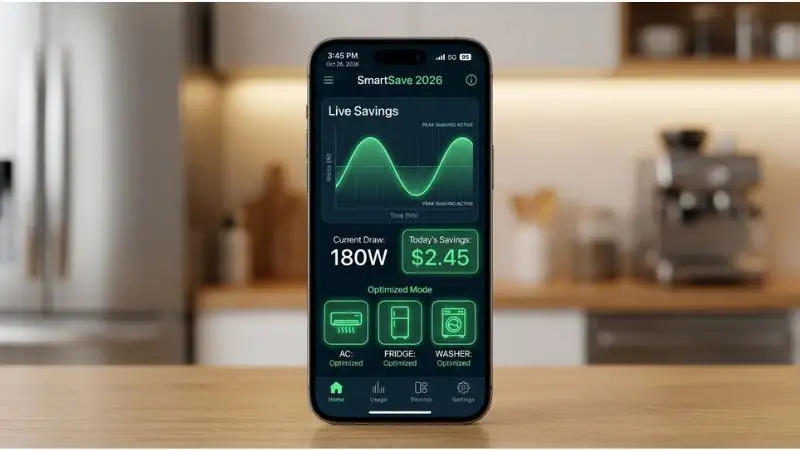
The most visible part of this 2026 trend is the smartphone app. Modern inverter brands now provide high-detail dashboards that turn energy saving into a visual experience.
- Live Wattage Readouts: You can see exactly how much power your AC is drawing at any moment. You’ll watch as it starts at 1,500 watts and slowly drops down to a tiny 200 watts as the room cools.
- Cost Prediction: Based on your local electricity rates, these apps can predict your monthly bill with 98% accuracy. No more “bill shocks” at the end of the month.
- Carbon Footprint Tracking: For the eco-conscious user, many apps now show how many kilograms of $CO_2$ you’ve saved by using inverter technology instead of standard motors.
Seeing the “Watts Saved” graph move upward is incredibly satisfying. It turns the “Hidden Science” we’ve discussed into a game where the prize is more money in your pocket.
Definition Box: IoT (Internet of Things)
A network of physical objects (“things”) that are embedded with sensors, software, and other technologies for the purpose of connecting and exchanging data with other devices and systems over the internet.
Dynamic Load Balancing: How Your Home Smart-Hub Prioritizes Inverter Loads
This is where the technology gets truly “science fiction.” In 2026, we are seeing the rise of Dynamic Load Balancing. This is a system where your home’s smart hub manages all your inverter appliances simultaneously to stay under a certain power limit.
Imagine you are running your inverter washing machine, your inverter fridge is active, and you decide to turn on the inverter AC. In an old home, this might trip a circuit breaker or cause a massive surge in cost.
In a smart 2026 home, the hub “negotiates” with the appliances:
- Prioritizing: The hub tells the AC to stay at 100% because the room is hot.
- Balancing: It tells the washing machine to slow down its heater for five minutes to keep the total home wattage low.
- Optimization: Once the AC reaches its “cruising speed” (low power), the hub allows the washing machine to ramp back up.
All of this happens in milliseconds without you ever noticing a change in performance. You get the comfort you want without ever hitting “peak” electricity rates.
The Rise of Predictive Maintenance
One of the biggest expenses with home appliances is the “emergency repair.” Your fridge breaks on a Sunday, you lose all your food, and you pay a premium for a technician.
In the IoT era, smart inverters use Predictive Maintenance. Because the inverter tracks every vibration and electrical ripple of the motor, it can “feel” when a bearing is starting to wear out or when a fan is getting stuck.
- Early Warnings: Your phone might ping you saying, “Your AC filter is 80% clogged, efficiency has dropped by 12%.”
- Remote Diagnosis: If something does go wrong, you can share your inverter’s data log with a technician via the cloud. They can often tell you what is wrong before they even drive to your house, saving you hours of labor costs.
Did You Know Box: The “Smart Grid” Discount
In some cities, utility companies will actually give you a discount on your bill if you allow their “Smart Grid” to talk to your inverter. During times of high city-wide demand, they can send a signal to your inverter to drop its power usage by just 5%—saving the city from a blackout and saving you extra money!
Practical Advice for Setting Up Your Smart Home
To take advantage of these 2026 trends, you don’t need to be a computer expert. However, a little bit of planning goes a long way in maximizing your “Smart Inverter” ROI.
- Unified Ecosystems: Try to buy appliances that are compatible with the same “Smart Home” standard (like Matter or Thread). This allows your fridge and AC to “talk” to each other even if they are from different brands.
- Secure Your Network: Since your appliances are on the internet, ensure you have a strong Wi-Fi password. You don’t want someone else “hacking” your thermostat!
- Automate Your Savings: Use the “Schedules” feature in your app. Tell your inverter AC to pre-cool the house at 2:00 PM when electricity might be cheaper, rather than waiting until 5:00 PM when prices peak.
Pro-Tip: Use “Energy Peak” Notifications
Most 2026 energy apps have a “Peak Hour” alert. Enable this! When electricity prices go up during the evening, your app can automatically switch all your inverter appliances into “Ultra-Eco Mode.” You won’t notice the difference in comfort, but you will notice the difference in your wallet.
Summary: Knowledge is Power (Literally)
The integration of Inverters and IoT has removed the “mystery” from your electric bill. You are no longer a passive consumer; you are a manager of your own mini-power plant.
By using real-time monitoring and dynamic load balancing, you can ensure that your home is always running at the lowest possible cost. We have moved from “Stop Wasting Money” to “Start Maximizing Every Watt.”
In the next chapter, we will shift from technology to longevity. We will discuss how to protect these expensive smart inverters, so they last for 15 years instead of 5. After all, the best way to save money is not to have to buy a new machine twice!
Chapter 8: Maintenance & Longevity: Protecting Your Investment
Buying an inverter appliance is a major financial decision. Whether it’s a high-end refrigerator or a multi-split HVAC system, you aren’t just buying a machine; you are buying years of lower energy bills. However, because inverter technology is more “intelligent” than traditional tech, it requires a different kind of care.
In this chapter, we will discuss how to ensure your inverter lasts for its full 10-to-15-year life expectancy. If you ignore maintenance, the sensitive electronics inside can fail prematurely, turning your “money-saver” into a “money-pit.” Let’s look at how to protect the “brain” of your appliances.
Why Inverters Fail and How to Prevent It
In a traditional appliance, the most common failure is mechanical—a belt snaps or a valve leaks. In an inverter appliance, the most common point of failure is the PCB (Printed Circuit Board). This is the computer that manages the power conversion we discussed in Chapter 1.
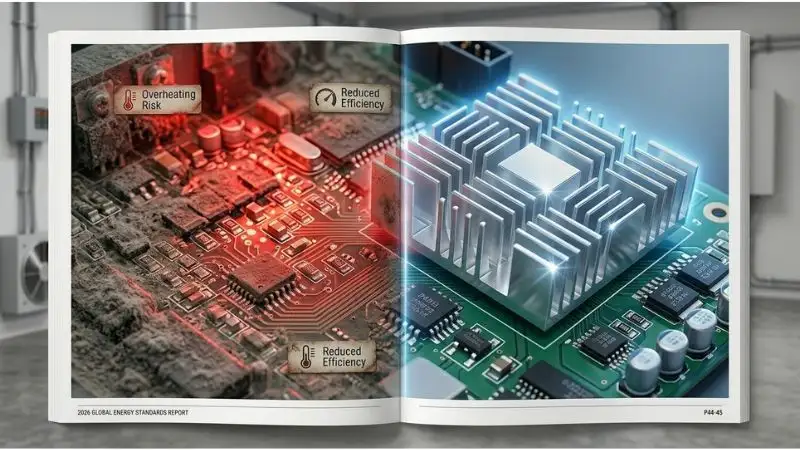
The two greatest enemies of an inverter’s circuit board are Heat and Moisture. Unlike a simple motor, a circuit board is made of thousands of tiny components that can be damaged by environmental stress. By managing these risks, you can prevent 90% of common inverter breakdowns.
Heat Dissipation: The Importance of Clean Heat Sinks and PCB Cooling
When an inverter converts electricity from AC to DC and back again, it generates heat. This is a natural byproduct of high-speed switching. To manage this heat, manufacturers install “Heat Sinks”—metal blocks with fins that pull heat away from the sensitive chips.
If dust, pet hair, or grease builds up on these heat sinks, the heat has nowhere to go. The temperature of the PCB rises, and eventually, a component will “pop” or melt. This is why “airflow” is the most important word in inverter maintenance.
- For Air Conditioners: Ensure the outdoor unit is cleaned with a soft brush or low-pressure air once every six months. If the fins are clogged, the inverter has to work twice as hard to stay cool.
- For refrigerators, pull the fridge out once a year and vacuum the dust off the coils and the compressor area. A dusty fridge compressor runs hotter and dies younger.
- For Washing Machines: Ensure the machine is in a well-ventilated area. If it’s tucked into a tiny, humid closet without airflow, the internal electronics are at higher risk of corrosion.
Definition Box: Heat Sink
A passive heat exchanger that transfers the heat generated by an electronic or a mechanical device to a fluid medium, often air or a liquid coolant, where it is dissipated away from the device.
Dealing with Voltage Fluctuations: Does an Inverter Need an External Stabilizer?
This is one of the most debated topics in 2026. Most modern inverter appliances are marketed as “Stabilizer-Free Operation.” This means the internal power supply is designed to handle a wide range of voltages (for example, between 130V and 280V).
However, “handling” a fluctuation and “surviving” a lightning strike are two different things. While the inverter can adjust to a slow dip in power, a sudden high-voltage surge can still fry the PCB.
When you DON’T need a stabilizer:
- If you live in a modern city with a stable, underground power grid.
- If your appliance specifically states it can handle the voltage range of your local area.
When you SHOULD consider a stabilizer (or Surge Protector):
- If you live in an area with frequent “brownouts” (dimming lights).
- If your area has overhead power lines prone to lightning strikes or transformer failures.
- The 2026 Advice: Instead of a cheap, clicking stabilizer, look for a High-Quality Surge Protector or a “Voltage Guard.” These devices sit silently and only cut the power if the voltage becomes dangerous, protecting the inverter without interfering with its smart sensors.
The Danger of “Short Cycling” and Poor Placement
Beyond just keeping it clean, where you put your appliance matters. Many people hide their outdoor AC units behind decorative covers or wooden slats to make their garden look better.
This is a mistake. If the hot air leaving the unit hits a fence and bounces back, the inverter senses the heat and thinks it’s 60°C outside. It will never drop into its efficient “Low-Power” mode because it’s fighting its own recycled heat.
Did You Know Box: The Insect Factor
Believe it or not, one of the leading causes of inverter PCB failure in warmer climates is lizards and ants. The warmth of the circuit board attracts small creatures, who can cause a “short circuit” by stepping on the wrong component. High-quality 2026 models now use “Conformal Coating” (a thin plastic layer) on the boards to prevent this!
A Better Way to Start: The “Soft Start” Secret
One of the reasons inverter appliances last so much longer than traditional ones is how they “wake up.”
Traditional motors use a “Hard Start.” When you turn them on, they demand a massive amount of current instantly. This is like red-lining a cold car engine the second you turn the key. Over time, this “thermal shock” weakens the motor windings.
Inverters use what is called a Soft Start. They slowly ramp up the electricity over 30 to 60 seconds. This gradual “warm-up” protects the motor, the compressor, and your home’s wiring from stress.
Pro-Tip: The “Wait 3 Minutes” Rule
Even though modern inverters are smart, you should never turn an appliance off and then immediately back on. If you turn your AC off by mistake, wait at least 3 minutes before restarting. This allows the refrigerant pressures to equalize and prevents the inverter from having to start against high “head pressure,” which saves the motor from unnecessary strain.
Annual Professional Check-ups
While you can do 80% of the maintenance yourself, once a year, it is worth calling a professional. In 2026, specialized technicians use “Inverter Checkers”—handheld computers that plug into your appliance to read the error codes and health stats of the PCB.
A professional can:
- Check Refrigerant Levels: Low gas makes the inverter run at 100% speed all day, killing your “50% savings.”
- Inspect Capacitors: These are the “batteries” on the circuit board. If they are bulging or leaking, they can be replaced cheaply before they explode and take the whole board with them.
- Tighten Electrical Connections: Loose wires cause “arcing,” which creates heat and can melt the plastic connectors on the inverter.
Summary: Maintenance is the Ultimate ROI Builder
If you spend $800 on a high-efficiency inverter but don’t clean it, you might lose $100 a year in efficiency and $400 in repair costs after five years.
By following the “Clean and Cool” philosophy:
- Keep the Heat Sinks clear of dust.
- Avoid Mechanical Obstructions around the unit.
- Protect the board from Moisture and Pests.
You aren’t just saving money on your bill; you are ensuring that your investment pays for itself three times over during its long life. In the next chapter, we will move from the “how-to” of maintenance to the “where-to” of global standards. We’ll look at how different countries rate these machines and how to read an energy label like a pro.
Chapter 9: The Global Perspective: Energy Ratings & Standards
As we move through 2026, saving money is no longer just a personal choice—it is a global movement. Countries all over the world are racing to reduce carbon emissions and stabilize power grids. For the consumer, this has resulted in a confusing “alphabet soup” of stickers, stars, and certifications on every appliance box.
In this chapter, we are going to simplify the world of international energy standards. Understanding these ratings is the key to knowing if that “Sale” price on an inverter is actually a good deal, or if you are buying outdated technology that won’t meet the new 2026 legal mandates.
International Efficiency Benchmarks
Every region has its own way of telling you how much energy an appliance uses. While the labels look different in Europe than they do in Asia or the Americas, they are all trying to measure the same thing: Efficiency.
In 2026, these benchmarks have become much stricter. An appliance that was considered “5-Star” in 2020 might only be a “3-Star” model today. This “rating creep” is designed to force manufacturers to keep innovating. If you are still looking at old reviews from three years ago, you might be getting incorrect information.
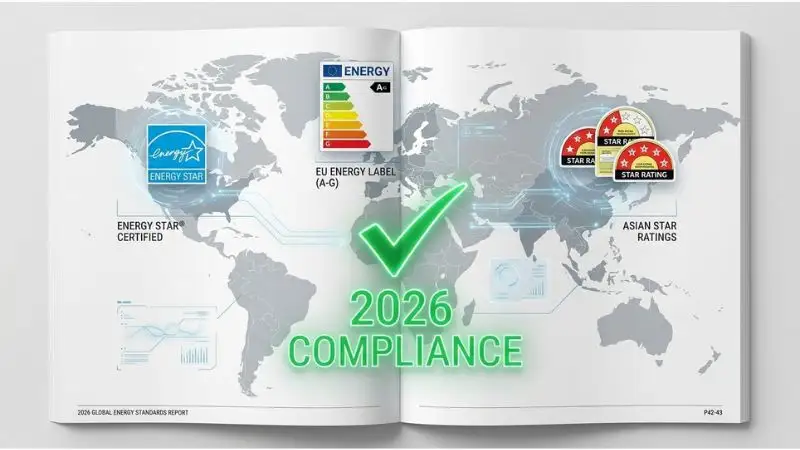
Understanding Star Ratings (1-5 Stars) across different regions
The “Star Rating” system is the most common visual guide for consumers. However, a “5-Star” rating in one country doesn’t always equal a “5-Star” rating in another.
- The Middle East and South Asia (e.g., Pakistan, India, UAE): Here, the star rating is heavily focused on the EER (Energy Efficiency Ratio). Because these regions face extreme heat, the stars tell you how well the inverter handles the “peak” of summer. A 5-star inverter in these regions is specifically designed to stay efficient even when it is 45°C outside.
- The European Union (EU): Europe uses an A to G scale. In 2026, the requirements for an “A” rating are incredibly high. Most standard inverter ACs currently sit in the “B” or “C” range. If you find a genuine “A+++” or new “Class A” model, you are looking at the pinnacle of inverter science.
- North America (USA/Canada): As we mentioned in Chapter 2, the US focuses on SEER2. Instead of stars, they use a numerical value. In 2026, the Department of Energy (DOE) raised the minimum SEER2 levels, making many non-inverter models essentially illegal to manufacture for residential use.
Definition Box: Low Voltage Startup (LVS)
This is a specialized feature in inverter appliances that allows the compressor to start and operate safely even when the incoming grid voltage drops significantly below the standard level (e.g., operating at 140V instead of 220V).
The 2026 Sustainability Mandates: What new laws mean for consumers
The year 2026 marks a turning point in energy law. Many governments have passed “Right to Repair” and “Minimum Efficiency” mandates. These laws are designed to protect you from buying “disposable” junk.
- The Ban on Non-Inverters: In several regions, laws now prevent the sale of “Fixed-Speed” compressors for central air conditioning. The goal is to force a 30% reduction in residential energy demand by 2030.
- Standby Power Limits: New 2026 laws dictate that an appliance cannot “leak” more than 0.5 to 1 watt of power while it is plugged in but turned off. This targets the “Vampire Power” we discussed in Chapter 7.
- Label Transparency: Manufacturers are now required to show the “Lifetime Cost of Ownership” on the box in some countries. This shows you not just the purchase price, but how much you will likely spend on electricity over 10 years.
The Importance of “Low Voltage Startup” in Developing Grids
While a consumer in London might never worry about the voltage in their walls, someone in Karachi, Mumbai, or Lagos knows that power is rarely a smooth 220V. In these “developing grid” environments, the inverter’s ability to handle Low Voltage Startup (LVS) is a financial lifesaver.
In the past, when the voltage dropped during a “brownout,” your AC or fridge motor would hum, heat up, and eventually burn out. You would have to buy a new compressor—a massive expense.
A 2026 inverter with LVS technology uses its internal DC conversion (the “Hidden Science” from Chapter 1) to “boost” the low voltage. It can keep your food cold and your room cool even when the city’s power is struggling. This prevents the “hidden cost” of frequent repairs and replacements.
Did You Know Box: The “Golden Sticker” Fact
In some countries, energy labels are now “Dynamic.” They feature a QR code that you can scan with your phone. It will show you exactly how that specific model performed in independent laboratory tests versus the manufacturer’s claims. Always scan the code—sometimes a 4-star unit from a top brand actually beats a 5-star unit from a budget brand!
How to Read a Label Like a Pro in 2026
When you are standing in the appliance store, don’t just look at the big numbers. Look for the fine print at the bottom of the energy label.
- Check the Test Ambient Temperature: Some brands test their efficiency at 25°C. That is easy! Look for brands that disclose their efficiency at 35°C or 46°C. That is where the real savings happen.
- Look for the Noise Rating (dB): In 2026, the energy label also includes the noise level. A quiet inverter is a sign of a well-built motor. Aim for an indoor AC unit under 30dB for a bedroom.
- Annual Kilowatt-Hour (kWh) Consumption: This is the most important number on the sticker. It estimates how many units of electricity the machine will use in a year of “average” use. Multiply this number by your local electricity rate per unit to see your true yearly cost.
Pro-Tip: Don’t Chase the “Perfect” Star
Sometimes the jump from a 4-Star to a 5-Star unit adds $300 to the price tag, but only saves you $10 a year in electricity. Always calculate your ROI (Chapter 2). If the “extra star” takes 20 years to pay for itself, the 4-star model is actually the smarter financial choice!
Summary: A Global Standard for a Greener Wallet
The global perspective on energy is shifting from “how much does it cost to buy” to “how much does it cost to run.” By 2026, the energy label will have become a document of truth. It tells you if a machine is built for the future or if it is a relic of the past.
By understanding your region’s specific benchmarks—whether it’s SEER2, A-G, or Star Ratings—you can stop being a victim of marketing and start being a master of your home’s economy.
In our final chapter, we will look forward. What comes after the Inverter? We will explore the emerging technologies of 2027 and beyond, including Gallium Nitride (GaN) and Solid-State cooling, ensuring you are prepared for the next decade of energy evolution.
Chapter 10: The Future of Inverter Technology (2027 and Beyond)
We have spent this guide looking at how inverter technology works today in 2026. We’ve seen how it slashes bills by 50%, cleans our “dirty” power, and connects to our smartphones. But technology never stands still. As we look toward 2027 and the next decade, the world of energy efficiency is about to undergo another massive shift.
The next generation of power electronics isn’t just about making things slightly better; it’s about changing the materials we use to build them. We are moving away from traditional silicon and toward “space-age” materials that make today’s best inverters look bulky and slow.
What’s Next for Energy Efficiency?
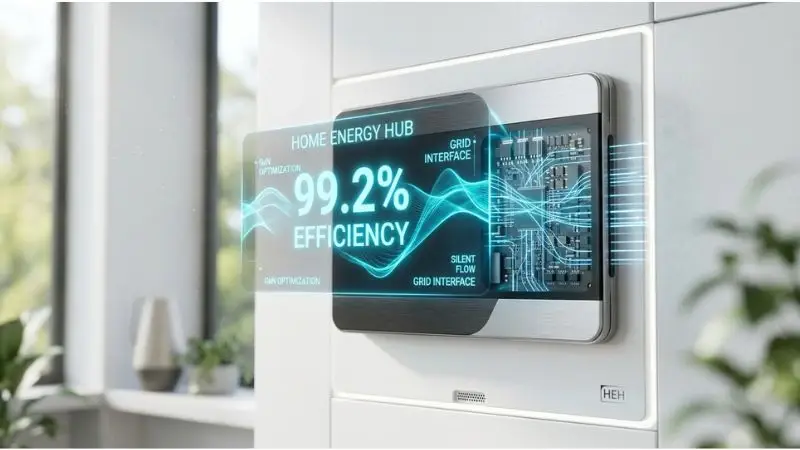
The goal for the future is “The 99% Target.” Currently, even the best inverters lose about 3% to 5% of energy as heat during the conversion process. While that sounds small, across millions of homes, it is a massive amount of wasted power.
The future of energy efficiency focuses on three main pillars: Size, Speed, and Silence. Engineers are working on systems that are ten times smaller than current units but handle twice the power. By 2027, your home’s main power inverter might be the size of a paperback book rather than a heavy suitcase.
Gallium Nitride (GaN) Inverters: Smaller, Faster, and 99% Efficient
For over 50 years, the “Silicon Chip” has ruled the world. But silicon has a limit—it gets too hot when you try to switch power through it very quickly. Enter Gallium Nitride (GaN).
GaN is a high-performance material that allows electricity to pass through it much faster than silicon. In the world of inverters, speed equals efficiency.
How GaN Will Change Your Home:
- Extreme Efficiency: GaN inverters can reach 99% efficiency. This means almost zero energy is lost as heat.
- Shrinking Appliances: Because GaN generates so little heat, we don’t need giant, heavy metal heat sinks or loud cooling fans. This will make AC units and refrigerators much thinner and lighter.
- Faster Charging: If you have an electric vehicle (EV), a GaN-based home charger will be able to fill your battery significantly faster than today’s standard chargers while taking up half the wall space.
Definition Box: Wide Bandgap (WBG) Semiconductors
These are materials (like Gallium Nitride) that allow electronic devices to operate at much higher voltages, temperatures, and frequencies than conventional silicon. They are the “secret sauce” behind the next generation of ultra-efficient power.
Solid-State Inverters: The End of Mechanical Cooling?
One of the last “weak points” in current inverter tech is that we still rely on moving parts—like fans—to keep the electronics cool. In 2027 and beyond, we are moving toward Solid-State designs.
A solid-state inverter has no moving parts at all. It uses advanced ceramic materials and vacuum-sealed components to manage power.
The Benefits of a “Solid-State” Future:
- Zero Noise: Without fans or clicking relays, the power hub of your home will be completely silent.
- 50-Year Lifespan: Moving parts wear out. Solid-state components don’t. We are approaching an era where you might buy one home inverter and never need to replace it for the rest of your life.
- Micro-Grids: These inverters will allow every house to act as its own tiny power plant, seamlessly sharing energy with neighbors without any “flicker” or power drops.
The Convergence of AI and Energy Harvesting
By 2028, your inverter won’t just respond to your commands; it will predict them. We are moving toward Autonomous Energy Management.
Imagine an inverter that checks the weather forecast, realizes a storm is coming that will block your solar panels, and automatically decides to “fast-charge” your home battery while grid prices are low. It will do this without you ever opening an app.
Did You Know Box: The Weight Difference
A traditional 5kW solar inverter made of silicon can weigh over 20 kilograms (44 lbs). A Gallium Nitride (GaN) version of the same power capacity can weigh as little as 2 kilograms (4.4 lbs)! That is a 90% reduction in weight thanks to new material science.
Practical Advice: Should You Wait for 2027 Tech?
With all this amazing tech on the horizon, a common question is: “Should I wait to buy my new AC or Solar system?”
The answer is usually “No.” Technology always improves, but the money you waste on high electricity bills today will likely cost you more than the benefit of waiting for a 2027 model. The jump from “Old Non-Inverter” to “2026 Inverter” is a massive 50% saving. The jump from “2026 Inverter” to “2027 GaN Inverter” might only be an extra 3% to 5% saving.
Pro-Tip: Buy for “Upgradability”
If you are buying a solar or HVAC system today, ask the installer if the system is “GaN-Ready” or has a modular design. Many forward-thinking companies in 2026 are building systems where you can swap out the old silicon “brain” for a new GaN “brain” in the future without replacing the whole machine.
Summary: The End of Wasted Money
We began this guide with a simple mission: Stop Wasting Money. Over these ten chapters, we have seen that inverter technology is the most powerful tool in your arsenal to achieve that goal. We’ve covered:
- The Science: How AC-to-DC conversion gives us total control.
- The Math: Why “Part-Load Efficiency” is the key to the 50% savings myth.
- The Protection: How inverters clean “dirty power” and save your electronics.
- The Future: How new materials like GaN will make energy waste a thing of the past.
As we move beyond 2026, the “Inverter” will no longer be a special feature you look for on a sticker—it will be the standard for every single device that plugs into a wall. By understanding this technology now, you are ahead of the curve. You aren’t just a consumer; you are an expert in your own home’s efficiency.
Thank you for following the Ultimate Guide to Inverter Energy Savings 2026. Your journey to a cheaper, cooler, and smarter home starts the moment you put this knowledge into action.