The average U.S. household wastes 25–30% of its energy budget on inefficiencies that a proper Home Energy Audit Report can identify and eliminate. That’s not a rounding error — it’s hundreds of dollars walking out your walls, attic, and HVAC ducts every single year.
This guide strips away the jargon and gives you a seven-step, battle-tested framework to commission, read, act on, and maximize the return from your Home Energy Audit Report — whether you’re a first-time homeowner or a seasoned property investor.

What Is a Home Energy Audit Report — and Why Does It Matter?
A Home Energy Audit Report is a certified, data-driven document that maps every energy input, loss, and inefficiency in your home. It goes far beyond a utility bill review. A professional audit uses diagnostic equipment — blower door tests, infrared thermography, combustion safety analysis, and duct pressurization — to generate a building performance baseline.
The report quantifies:
- Air leakage rate (measured in ACH50 — air changes per hour at 50 Pascals)
- Thermal envelope performance (R-values of walls, attics, floors)
- HVAC efficiency ratings (AFUE for furnaces, SEER/HSPF for heat pumps)
- Domestic hot water system losses
- Appliance and lighting energy consumption
- Indoor air quality and ventilation metrics
The output is a prioritized action list with projected savings, payback periods, and rebate eligibility — making it the single most actionable document a homeowner can possess.
Step 1: Choose the Right Type of Home Energy Audit Report
Not all audits are equal. Before spending a dollar, understand what you’re buying.
| Audit Type | Method | Cost (USD) | Best For |
|---|---|---|---|
| Utility Walkthrough | Visual inspection only | Free–$150 | Basic awareness, renters |
| Level 1 – ASHRAE | Walk-through + utility data | $100–$300 | Pre-purchase screening |
| Level 2 – ASHRAE | Blower door + IR camera + full report | $300–$700 | Most homeowners |
| Level 3 – ASHRAE | Detailed engineering analysis | $700–$2,500+ | Commercial, deep retrofits |
| BPI-Certified Audit | Building Performance Institute protocol | $350–$600 | Rebate qualification, financing |
| HERS Rating Audit | Home Energy Rating System index | $250–$550 | New builds, mortgage programs |
Expert Insight: For most residential properties, a BPI-certified Level 2 audit is the gold standard. It unlocks utility rebates, qualifies you for federal tax credits (IRA Section 25C, up to $150 back on audit costs), and provides legally defensible data for real estate transactions.
Step 2: Prepare Your Home and Data Before the Auditor Arrives
An auditor is only as good as the access and information you give them. A one-hour prep saves two hours of audit time and sharpens results.
What to gather:
- 12–24 months of utility bills (electric, gas, propane)
- Equipment documentation: HVAC model/serial numbers, water heater age and capacity, insulation installation records
- Previous renovation permits (they reveal what’s behind the walls)
- A list of comfort complaints by room (cold floors, hot second stories, humidity issues)
What to do physically:
- Unlock attic hatches, crawl spaces, and mechanical rooms
- Clear 3 feet of access around the furnace, water heater, and electrical panel
- Note any recent repairs (new windows, patched walls) — these create pressure differentials the auditor needs to account for
Pro Tip: Run your HVAC normally for 24 hours before the audit. Don’t adjust the thermostat. The auditor needs to test the system under real operating conditions.

Step 3: Understand the Core Diagnostics in Your Home Energy Audit Report
When your Home Energy Audit Report arrives, it will contain several technical sections that most homeowners skip — at their financial peril. Here’s how to decode the most critical ones.
Blower Door Test Results
This test depressurizes your home to 50 Pascals and measures how fast air infiltrates back in. Results are reported as:
- CFM50 (cubic feet per minute at 50 Pa) — raw leakage volume
- ACH50 (air changes per hour at 50 Pa) — normalized for house size
- ELA (effective leakage area) — equivalent hole size in square inches
Benchmarks:
| ACH50 Rating | Interpretation |
|---|---|
| > 10 | Very leaky — pre-1980 construction typical |
| 5–10 | Average — most homes built before 2000 |
| 3–5 | Tight — good but improvable |
| 1–3 | Very tight — modern, efficient construction |
| < 1 | Passivhaus level — mechanical ventilation mandatory |
Infrared Thermography Findings
IR images show temperature anomalies that indicate missing insulation, thermal bridges, moisture intrusion, and air bypasses. Your report should include annotated photographs, not just raw images. Each anomaly should list location, estimated R-value deficiency, and recommended remedy.
HVAC Combustion Safety and Efficiency
A BPI-certified auditor will perform a combustion analysis on gas appliances — measuring CO (carbon monoxide), CO₂, excess air, and flue draft. This isn’t optional comfort data; it’s a safety baseline. Cracked heat exchangers and backdrafting flues are life-safety issues the Home Energy Audit Report will flag.
Step 4: Read the Priority Matrix — Not Just the Recommendations
Every professional Home Energy Audit Report includes a list of recommended improvements. Most homeowners read it top to bottom and implement it in order. That’s the wrong approach.
Your report should contain — or you should request — a priority matrix that cross-references:
- Projected annual savings ($)
- Estimated installation cost ($)
- Simple payback period (years)
- Rebate/incentive availability
- Health and safety impact
- Comfort improvement score
The correct implementation sequence:
- Safety first — Combustion hazards, moisture, and IAQ issues, regardless of payback period
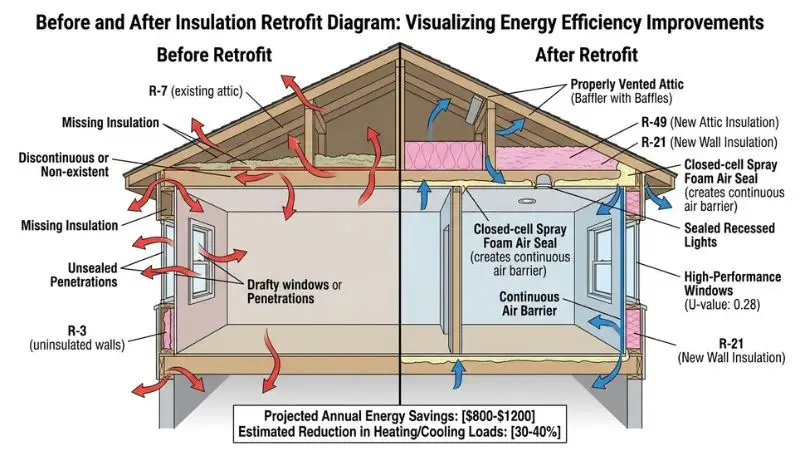
- Air sealing — Highest ROI measure in almost every report; $200–$800 investment returns $150–$400/year
- Insulation — Directly follows air sealing (never insulate before sealing; it wastes material)
- HVAC upgrades — Right-size replacements only after envelope is tightened
- Renewables — Solar PV sizing is meaningless until the consumption baseline is reduced
Never lead with solar panels. This is the single most expensive mistake homeowners make after receiving an audit report.
Step 5: Map Available Incentives to Your Home Energy Audit Report Findings
This step alone can cut your retrofit costs by 30–60%. The incentive landscape post-Inflation Reduction Act (2022) is the most favorable in U.S. history — but it expires, has income thresholds, and requires documentation that your audit report must support.
Federal Tax Credits (IRS Form 5695)
| Measure | Credit Rate | Annual Cap |
|---|---|---|
| Home energy audit | 30% of cost | $150 |
| Insulation and air sealing | 30% of cost | $1,200 |
| Heat pump (HVAC) | 30% of cost | $2,000 |
| Heat pump water heater | 30% of cost | $2,000 |
| Exterior windows/doors | 30% of cost | $600/$500 |
High-Efficiency Electric Home Rebate Act (HEEHRA)
For households at 80–150% of Area Median Income (AMI):
- Up to $8,000 for heat pump installation
- Up to $1,750 for a heat pump water heater
- Up to $1,600 for insulation and air sealing
- Up to $4,000 for electrical panel upgrades
Critical: HEEHRA rebates require point-of-sale application through participating contractors. Your Home Energy Audit Report must be completed before contractor quotes, as rebate amounts are calculated against the audit’s projected energy savings.
Utility and State Programs
Cross-reference your findings against DSIRE (Database of State Incentives for Renewables & Efficiency) at dsireusa.org. Many utilities offer on-bill financing — you repay retrofit costs through energy savings on your monthly bill with zero upfront cash.
Step 6: Vet Contractors Using Your Home Energy Audit Report as the Specification Document
Your audit report is also a technical specification. Use it as one.
When soliciting contractor bids, provide every bidder with the full report and require their proposal to:
- Reference specific report findings (page number, finding ID)
- Specify materials by R-value, product line, and installation method
- Commit to post-installation verification (blower door retest, duct leakage retest)
- List the rebate applications they will submit on your behalf
Red flags in contractor responses:
- Quoting insulation without mentioning air sealing first
- Refusing to do a post-installation blower door test
- Proposing HVAC equipment larger than the report’s Manual J load calculation
- Not being BPI or RESNET certified for rebate-eligible work
The retest is non-negotiable. A post-installation blower door result proves that air sealing work was done correctly. Without it, you have no proof of performance and no basis for rebate claims.
Step 7: Track Verified Savings After Implementing Your Home Energy Audit Report
The final — and most neglected — step is measurement and verification (M&V). Your projected savings in the report are modeled estimates. Actual savings depend on occupant behavior, weather, and installation quality.
Simple M&V Framework
Baseline period: Collect 12 months of pre-retrofit utility data (already done in Step 2).
Post-retrofit period: Collect 12 months of post-retrofit utility data.
Weather normalization: Use Heating Degree Days (HDD) and Cooling Degree Days (CDD) from your nearest weather station to normalize for year-to-year climate variation. NOAA provides this data for free at climate.gov.
Savings formula:
Verified Savings = (Baseline kWh × Price) − (Post-Retrofit kWh × Price) ± Weather Adjustment
What to do with M&V results:
- If savings exceed projections → your installation quality was excellent; document for future sale
- If savings meet projections, → implementation was successful; consider next-phase improvements
- If savings fall short by >15% → request contractor callback; possible installation deficiency or hidden air bypasses
Track non-energy benefits too. Comfort improvement, reduced humidity, better IAQ, and lower HVAC runtime hours are value drivers that don’t appear on a utility bill but significantly affect quality of life and property value.
Home Energy Audit Report: Quick-Reference Benchmark Table
| Metric | Poor | Average | Good | Excellent |
|---|---|---|---|---|
| ACH50 (air leakage) | > 10 | 5–10 | 3–5 | < 3 |
| Attic insulation (R-value) | < R-19 | R-19–R-30 | R-38–R-49 | ≥ R-60 |
| Wall insulation (R-value) | < R-11 | R-11–R-15 | R-19–R-21 | ≥ R-25 |
| HVAC SEER rating | < 13 | 13–16 | 17–20 | > 20 |
| Water heater EF | < 0.60 | 0.60–0.67 | 0.90–2.0 | > 3.0 (HPWH) |
| HERS Index | > 130 | 100 (code) | 60–85 | < 50 |
| Window U-factor | > 0.50 | 0.30–0.50 | 0.22–0.30 | < 0.22 |
Conclusion: Your Home Energy Audit Report Is a Financial Asset
A Home Energy Audit Report is not an expense — it’s an investment that pays compounding returns. The typical Level 2 audit costs $400–$600 and identifies $800–$2,500 in annual savings opportunities. With federal tax credits covering 30% of audit costs and retrofit incentives stacking to tens of thousands of dollars, the financial case is airtight.
More importantly, the Home Energy Audit Report is the single document that sequences your decisions correctly. It tells you what to fix first, what to fix last, what not to fix at all, and exactly how to prove the results when you sell your home or refinance.
Follow these seven steps in order. Don’t skip the retest. Don’t lead with solar. And don’t let the report sit in a folder — it’s only valuable when it drives action.
Your home is either generating wealth or burning it. A Home Energy Audit Report tells you which.
Frequently Asked Questions
Q: How often should I get a Home Energy Audit Report? Every 5–7 years, or after any major renovation, HVAC replacement, or addition to the home. Each of these events changes the building’s energy dynamics significantly.
Q: Can I do a DIY home energy audit? You can do a preliminary self-assessment using plug-load monitors, thermal leak detectors ($30–$80), and a utility bill analysis. But a DIY audit cannot replicate blower door pressurization, combustion safety testing, or duct leakage measurement — and it won’t qualify for rebates or tax credits.
Q: Does a Home Energy Audit Report increase home value? Studies by the National Bureau of Economic Research and Lawrence Berkeley National Laboratory consistently show that homes with documented energy efficiency upgrades (supported by an audit report) sell for 2.7–10% more than comparable non-certified homes.
Q: Who certifies energy auditors? The two primary certifications in the U.S. are BPI (Building Performance Institute) and RESNET (Residential Energy Services Network). Always verify certification before hiring.
Explore More Related Articles
If you want to further optimize your home energy efficiency and make smarter utility choices, check out these related articles:
- Front Load vs Top Load Washers: The Ultimate 2026 Guide to Saving Water & Money
- Air Fryer vs Microwave: Which is More Energy Efficient in 2026?
- The Ultimate Guide to Smart Appliances in 2026: Save Energy and Costs
- How to Read Energy Star Labels: The Ultimate Easy Guide (2026)
- Topcon vs. HJT Solar Panels Guide 2026
- Lithium Battery vs Lead Acid & Tubular: The Ultimate Guide to Lifespan and Solar Charging
- Victron EasySolar-II: The Ultimate Beginner’s Guide for 2026