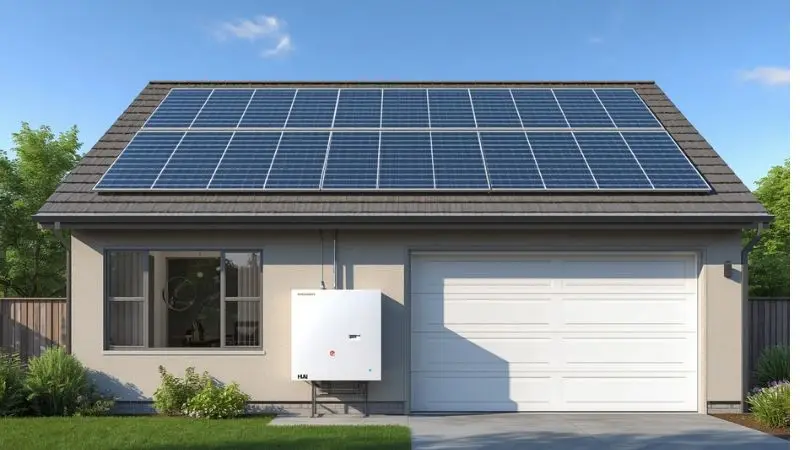
Introduction: Why Home Energy Storage Is No Longer Optional in 2026
Electricity prices have risen 34% globally since 2022. Grid outages are more frequent. And solar penetration in residential areas has crossed 22% in key markets like the US, Germany, and Australia. In this landscape, home energy storage has shifted from a luxury add-on to a foundational resilience tool.
This isn’t about “going green” as a lifestyle statement. It’s about hard economics, grid independence, and peak-demand arbitrage. Whether you’re a homeowner retrofitting an existing solar setup or building a new energy-positive home, the decisions you make about storage technology in 2026 will define your electricity costs and reliability for the next 10–15 years.
This roadmap gives you the seven most critical, often-overlooked secrets that separate high-performance home energy storage systems from expensive mistakes.
Secret #1: Home Energy Storage Chemistry Determines Everything
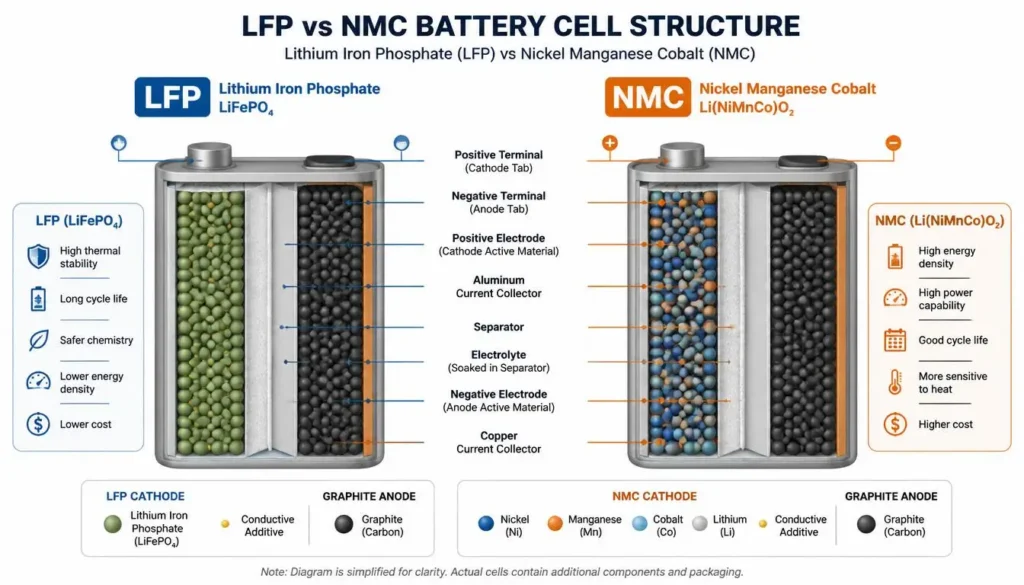
The battery cell chemistry you choose is the single biggest technical decision — and most buyers get it wrong by defaulting to brand names rather than understanding the underlying electrochemistry.
Lithium Iron Phosphate (LFP) vs. NMC: The 2026 Reality
| Spec | LFP (LiFePO₄) | NMC (Nickel Manganese Cobalt) |
|---|---|---|
| Cycle Life | 4,000–6,000 cycles | 1,500–3,000 cycles |
| Depth of Discharge | 95–100% | 80–90% |
| Energy Density | 120–160 Wh/kg | 200–250 Wh/kg |
| Thermal Runaway Risk | Very Low | Moderate–High |
| Degradation at 10 Years | 20–25% capacity loss | 30–40% capacity loss |
| Operating Temperature | -20°C to 60°C | 0°C to 45°C |
| Cost per kWh (2026 avg.) | $180–$230 | $210–$290 |
| Best Use Case | Residential cycling, hot climates | High-density installs, EVs |
The verdict: For 99% of residential home energy storage applications in 2026, LFP is the superior choice. It trades energy density (irrelevant when you have a garage wall) for longevity, safety, and total cost of ownership. NMC made sense when space was at a premium; LFP wins on every lifecycle metric.
Sodium-Ion: The 2026 Wildcard
Sodium-ion (Na-ion) batteries from CATL and BYD are entering the residential market with a bold claim: zero critical mineral dependency, and 4,000+ cycle ratings at lower production cost. Early 2026 pricing sits at $150–$170/kWh at the cell level — but inverter compatibility and installer ecosystem are still maturing. Watch this space for 2027 retrofits.
Secret #2: Sizing Is a Math Problem, Not a Salesperson’s Estimate
Oversizing wastes capital. Undersizing destroys batteries through constant full-cycle stress. The correct sizing methodology uses three hard numbers — not vague rules of thumb.
The Three-Variable Sizing Formula
Step 1 — Daily Energy Consumption (DEC): Pull your last 12 months of utility bills. Calculate your average daily kWh. Factor in upcoming loads: EV charging adds 10–15 kWh/day; a heat pump water heater adds 2–4 kWh/day.
Step 2 — Solar Offset Rate (SOR): What percentage of your daily consumption does your solar array cover? If your 8 kW array generates 32 kWh/day in peak months and you consume 30 kWh/day, your SOR is ~107% — but winter dips to 55–60%. Size storage for the worst-case seasonal deficit, not the average.
Step 3 — Backup Duration Target (BDT): Define your critical loads. A typical household running only refrigerator, lighting, router, and phone charging needs ~1.5–2.5 kWh per hour. For a 24-hour backup, that’s 36–60 kWh. For an 8-hour overnight bridge (solar to solar), 12–20 kWh covers most households.
Practical Sizing Benchmarks (2026)
| Household Size | Daily kWh | Recommended Storage | Typical System |
|---|---|---|---|
| 1–2 person apartment | 10–15 kWh | 10–15 kWh usable | 1× 10 kWh LFP unit |
| 3–4 person home | 20–30 kWh | 20–30 kWh usable | 2× 10 kWh or 1× 20 kWh |
| Large home + EV | 40–60 kWh | 30–40 kWh usable | Stacked 3–4 unit systems |
| Off-grid capable | 60–80 kWh | 60+ kWh usable | Custom multi-string |
Critical insight: Usable capacity ≠ nameplate capacity. A 13.5 kWh battery with 100% DoD is more useful than a 15 kWh battery restricted to 80% DoD. Always compare usable kWh, not nameplate.
Secret #3: Inverter Architecture Is the Hidden Performance Driver
Most homeowners focus entirely on the battery. The inverter — the brain of your home energy storage system — determines efficiency, response speed, grid interaction, and whole-home backup capability.
Three Inverter Architectures in 2026
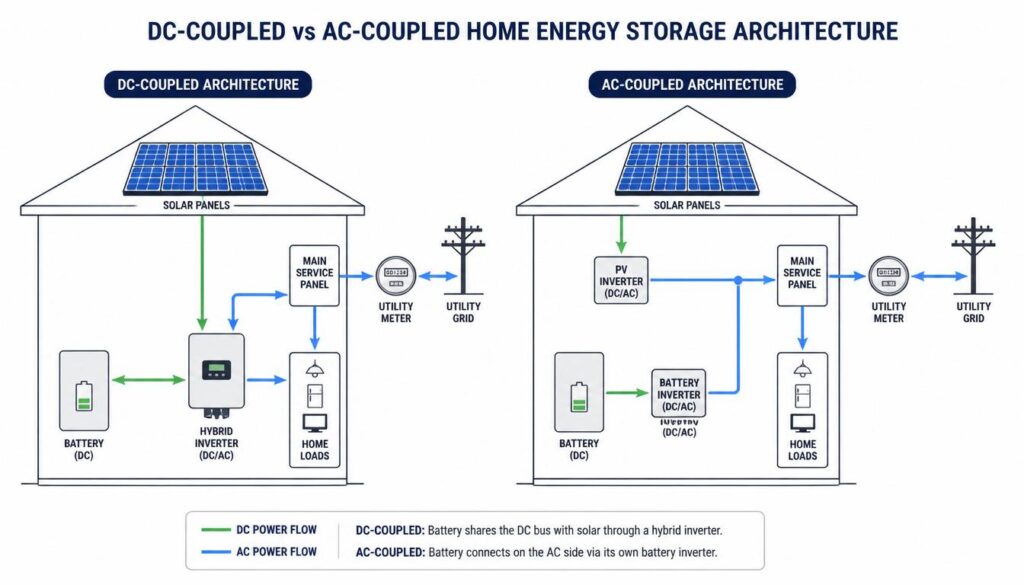
1. AC-Coupled (Retrofit-Friendly)
- Battery connects to existing solar inverter via AC bus
- Enables adding storage to any existing solar system regardless of brand
- Efficiency penalty: 2–4% per conversion cycle (solar → AC → DC → battery → DC → AC)
- Best for: retrofits where replacing the solar inverter would void warranties or add cost
2. DC-Coupled (Efficiency Champion)
- Solar and battery share a single hybrid inverter on the DC bus
- Eliminates one conversion stage; efficiency gain of 3–6% over AC-coupled
- Requires replacing or adding a hybrid inverter at install time
- Best for: new installations or full system replacements
3. Battery-Integrated Inverter (All-in-One)
- Battery, inverter, and BMS in a single enclosure
- Simplest installation; fewest points of failure
- Limited expandability; proprietary ecosystems lock you in
- Best for: simple residential installs with clear, stable storage needs
2026 Inverter Efficiency Benchmarks
| Product | Peak Efficiency | Backup Switchover | Max Continuous Output | Architecture |
|---|---|---|---|---|
| SolarEdge Home Hub | 99.0% | <20ms | 7.6 kW | DC-Coupled |
| Enphase IQ System Controller 3 | 98.2% | <2ms | 10.8 kW | AC-Coupled |
| SMA Sunny Tripower Smart Energy | 98.4% | <20ms | 10 kW | DC-Coupled |
| Fronius Symo GEN24 Plus | 98.0% | <20ms | 10 kW | DC-Coupled |
| Sungrow SH Series | 98.6% | <10ms | 11.4 kW | DC-Coupled |
Note on switchover time: If you run medical equipment, server hardware, or sensitive electronics, target inverters with <20ms switchover. The Enphase IQ’s <2ms is effectively undetectable by most loads.
Secret #4: Home Energy Storage Economics — The Real Payback Calculation
The financial case for home energy storage is more nuanced than installers let on. Simple payback periods quoted by salespeople often ignore critical variables.
The Complete ROI Model (5 Variables)
Variable 1 — Time-of-Use (TOU) Arbitrage: In markets with TOU tariffs, electricity costs $0.08–0.12/kWh off-peak and $0.35–0.55/kWh on-peak (California, UK, Australia). A 20 kWh battery charged overnight and discharged during peak hours saves $5–9/day — $1,825–$3,285/year. Payback on a $12,000 system: 4–7 years before incentives.
Variable 2 — Feed-In Tariff (FIT) Degradation: Many markets have slashed FIT rates 40–70% since 2022. Exporting excess solar at $0.03–0.05/kWh when you’re paying $0.35/kWh to import makes zero sense. Every kWh you store and self-consume is worth the retail import rate — 7–10× more valuable than export.
Variable 3 — Battery Degradation Cost: A 10 kWh LFP battery at $2,200 with 6,000 cycles to 80% end-of-life = $0.037/kWh throughput cost. At $0.30/kWh average retail electricity, you’re saving $0.263 per kWh cycled — a 710% margin. This is why LFP cycle life matters so much financially.
Variable 4 — Backup Value (Avoided Outage Cost): This is rarely quantified but is often the clincher. A 48-hour outage for a work-from-home household costs $500–$2,000+ in lost productivity, spoiled food, and hotel costs. One avoided 2-day outage per year adds $500–$2,000 to annual effective returns.
Variable 5 — Available Incentives:
- USA: Federal ITC (Investment Tax Credit) covers 30% of battery cost when paired with solar (or standalone via IRA). Many states add $500–$3,000 more.
- Germany: KfW 270 program: up to €9,000 in subsidized loans.
- Australia: VPP (Virtual Power Plant) programs pay $300–$600/year for grid-responsive dispatch.
- UK: 0% VAT on battery storage since 2023.
Realistic Payback by Market (2026)
| Market | System Cost (Net Incentives) | Annual Savings | Payback |
|---|---|---|---|
| California, USA | $8,000–$10,000 | $2,500–$3,500 | 3–5 years |
| Germany | €7,000–€10,000 | €1,200–€1,800 | 5–8 years |
| Australia | AUD $6,000–$9,000 | AUD $1,500–$2,500 | 4–6 years |
| UK | £8,000–£12,000 | £900–£1,400 | 7–10 years |
| Japan | ¥1.2M–¥1.8M | ¥150K–¥250K | 6–9 years |
Secret #5: The Battery Management System (BMS) Is the Difference Between 8 and 15 Years of Life
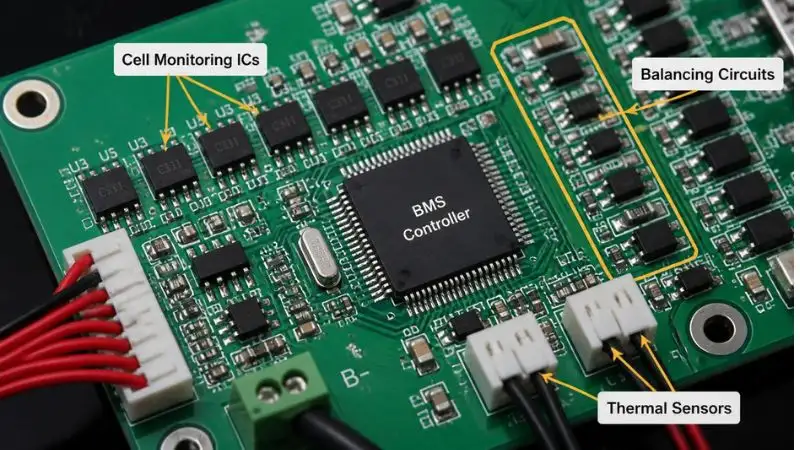
Two identical LFP batteries can deliver radically different service lives based entirely on the quality of their Battery Management System. The BMS monitors cell-level voltage, temperature, and state-of-charge — and enforces protections that prevent premature degradation.
What a Premium BMS Monitors vs. a Basic BMS
| Function | Basic BMS | Premium BMS |
|---|---|---|
| Cell voltage monitoring | Pack-level only | Individual cell level |
| Temperature sensors | 1–2 points | 4–8+ distributed points |
| Cell balancing | Passive (bleeds excess) | Active (redistributes charge) |
| State-of-Health (SoH) tracking | No | Yes, with predictive analytics |
| Overcurrent response time | 100–500ms | <10ms |
| Remote monitoring | Basic app | API access, cloud analytics |
| Firmware updates | Manual | OTA (over-the-air) |
Active cell balancing is a premium feature worth paying for. It redistributes charge from stronger cells to weaker ones, preventing the “weakest cell dictates pack capacity” problem that cripples aging battery packs. Systems with active balancing retain 10–15% more usable capacity at year 8 compared to passive-balancing systems.
Red Flags in BMS Quality
- No cell-level monitoring advertised (only “pack” specs)
- Warranty voided if battery is discharged below 20% (indicates poor low-SoC protection)
- No UL 9540 or IEC 62619 certification
- Proprietary connector ecosystem with no third-party integration path
Secret #6: Grid Services and Virtual Power Plants — The Revenue Stream Most Homeowners Miss
A properly configured home energy storage system doesn’t just save money. It can earn money by providing grid services through Virtual Power Plant (VPP) programs.
How VPPs Work
Your battery, combined with thousands of others in a network, becomes a dispatchable asset for the grid operator. When demand spikes or a large generator trips offline, the VPP aggregator dispatches stored energy from participant homes. You earn:
- Capacity payments: $50–$150/year just for enrolling and being available
- Dispatch payments: $0.10–$0.40/kWh for energy dispatched during grid stress events
- Frequency regulation: Real-time micro-dispatch earning $100–$400/year in some markets
Active VPP Programs by Market (2026)
| Program | Country | Operator | Annual Earnings | Battery Requirement |
|---|---|---|---|---|
| Tesla Powerwall VPP | USA/Australia | Tesla Energy | $200–$500 | Powerwall 3 |
| Sonnen ecoLinx VPP | USA | Sonnen | $150–$400 | Sonnen eco system |
| SA Virtual Power Plant | Australia | AGL/Origin | AUD $300–$600 | 5+ kWh LFP |
| Octopus Saving Sessions | UK | Octopus Energy | £80–£200 | Any grid-connected battery |
| Tesla Energy Plan Japan | Japan | Tesla/TEPCO | ¥20K–¥50K | Powerwall |
Critical constraint: VPP participation cedes partial control of your battery’s charge/discharge schedule to the aggregator. In most programs, you can opt out of individual events, and the grid operator guarantees a minimum state-of-charge (typically 20%) for personal backup. Read the dispatch agreement carefully — some programs have exclusivity clauses that prevent multi-VPP enrollment.
Home Energy Storage as a Grid Asset — The 2026 Paradigm
The International Energy Agency estimates that 50 GWh of residential storage capacity will be enrolled in VPP-style demand response programs globally by end-2026. Early adopters are capturing the highest capacity payments; as the market matures, per-unit payments will decline. The time to enroll is now.
Secret #7: Installation Quality and Compliance Are Where Systems Fail
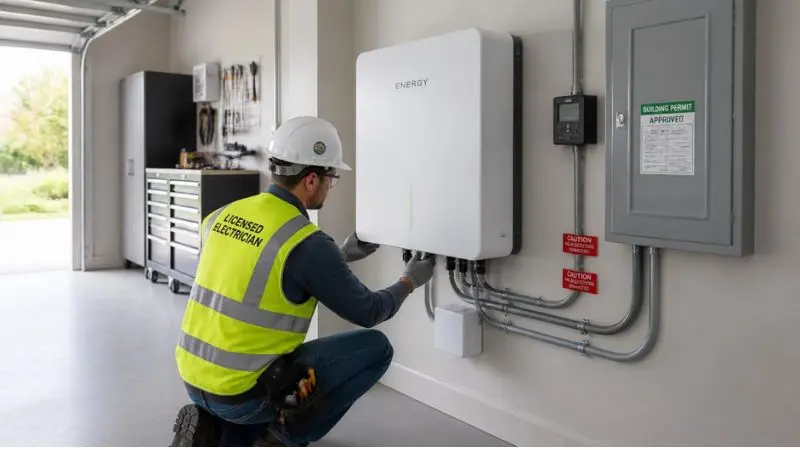
The best battery chemistry, most advanced BMS, and premium inverter can all be negated by poor installation. This is the silent killer of home energy storage ROI.
The Five Non-Negotiable Installation Standards
1. Thermal Management Compliance LFP batteries must be installed within their rated temperature range. A garage in Phoenix, Arizona hits 50°C+ in summer — above the 45°C upper operating limit of most units. Require your installer to document the installation environment’s thermal profile and provide mechanical ventilation calculations if the space exceeds rated limits.
2. Cable Sizing and Voltage Drop Undersized DC cables between the solar array and battery system create resistive losses and fire risk. At 48V nominal bus with 100A max current, cable runs exceeding 5 meters should be 35mm² or larger. Demand a voltage drop calculation in writing — it should not exceed 1.5% under full load.
3. NEC 2023 / IEC 62109 Compliance In the USA, Article 706 of NEC 2023 governs energy storage systems. Key requirements include:
- Maximum storage disconnecting means within sight of the battery
- Fire detection system for battery enclosures >20 kWh indoor
- Arc-fault circuit interrupter (AFCI) protection on DC circuits
4. Commissioning and Monitoring Setup A commissioned system should have: accurate SoC calibration, verified backup switchover under load, consumption monitoring CTs properly installed, and cloud monitoring confirmed active. Ask for a commissioning report — reputable installers provide one.
5. Permitting and Interconnection Agreement In many jurisdictions, adding battery storage to an existing solar system requires a new interconnection agreement with the utility. Installers who “skip the permit to save time” are transferring liability to you. Unpermitted systems may not qualify for incentives, VPP programs, or insurance claims.
Installer Red Flags
- No written load calculations or voltage drop analysis
- Refusal to pull permits (“it’ll take weeks”)
- No written commissioning procedure
- Quote includes no labor breakdown (materials-only pricing hides substandard hardware)
- No certification in IEC 62109, UL 9540, or equivalent local standard
Bonus: 2026 Home Energy Storage Technology Comparison Table
| System | Chemistry | Usable Capacity | Peak Output | Cycle Life | Warranty | 2026 Price (USD) |
|---|---|---|---|---|---|---|
| Tesla Powerwall 3 | LFP | 13.5 kWh | 11.5 kW | 4,000+ | 10 years/70% | $11,500 |
| Enphase IQ Battery 5P | LFP | 5.0 kWh (per unit) | 3.84 kW | 4,000+ | 15 years/80% | $4,500/unit |
| Sonnen Eco 10 | LFP | 10 kWh | 4.6 kW | 10,000 | 10 years/80% | $14,000 |
| SolarEdge Home Battery | LFP | 9.7 kWh | 5.0 kW | 6,000 | 10 years/70% | $9,200 |
| BYD Battery-Box Premium HVS | LFP | 5.1–25.6 kWh | 5.0–20 kW | 6,000 | 10 years/80% | $1,200/kWh |
| Sungrow SBR HV | LFP | 9.6–32 kWh | 30 kW (3-ph) | 6,000 | 10 years/70% | $950/kWh |
| Alpha ESS Smile-BAT | LFP | 5.7–22.8 kWh | 5 kW | 6,000 | 10 years/80% | $800/kWh |
| Generac PWRcell | NMC | 9–18 kWh | 9–11 kW | 3,500 | 10 years/70% | $1,300/kWh |
Prices are installed estimates; vary by region and installation complexity. Q2 2026 data.
Common Home Energy Storage Mistakes (Expert Summary)
- Buying by brand, not chemistry — NMC in a hot climate degrades 2× faster than LFP
- Ignoring backup load analysis — oversizing backup capability without understanding your critical load means poor TOU optimization
- Skipping VPP enrollment — leaving $200–$600/year on the table annually
- Choosing AC-coupling for a new build — DC-coupling is always more efficient when starting fresh
- Undervaluing BMS quality — a $400 premium for active balancing returns $1,500+ in extended battery life
- Hiring the cheapest installer — installation quality differences compound annually over 10+ years
Frequently Asked Questions
Q: Can I add home energy storage without solar? Yes. Standalone battery storage charges from the grid off-peak and discharges on-peak for TOU arbitrage. In markets with >$0.20/kWh peak-to-off-peak spreads, this is financially viable without solar. Many VPP programs also accept non-solar batteries.
Q: What’s the minimum battery size I should consider? For TOU savings or basic overnight bridging, a 10 kWh usable system is the practical minimum. Below 5 kWh, the economics rarely justify the installation overhead unless you’re adding capacity to a larger existing system.
Q: Is home energy storage safe indoors? LFP chemistry has an exceptional thermal stability profile — thermal runaway requires extremely rare conditions. UL 9540-certified LFP systems are approved for indoor installation in most jurisdictions. NMC systems face stricter indoor installation requirements in many regions.
Q: How long do home batteries actually last? Quality LFP systems with active BMS management consistently deliver 10–15 years to 80% capacity. The Sonnen Eco’s 10,000-cycle warranty implies ~27 years at one cycle per day. Cycle-based degradation models now favor LFP over any alternative chemistry for residential applications.
Conclusion: Home Energy Storage in 2026 Is a Decision Made Once, Paid Over 15 Years
Home energy storage is not a product purchase. It’s an infrastructure decision. The chemistry you choose today determines your system’s performance in 2035. The inverter architecture you select defines your ability to integrate future EV charging, heat pumps, and grid services. The installer you trust determines whether that system runs safely for one year or fifteen.
The seven secrets in this roadmap are not marketing talking points — they are the technical and financial levers that determine whether your home energy storage investment delivers a 3-year payback or a 12-year breakeven. Prioritize LFP chemistry. Size for seasonal worst-case, not annual averages. Demand active BMS balancing. Enroll in VPP programs. And above all, never compromise on installation quality.
The grid is changing. Electricity is expensive. The homeowners who understood home energy storage in 2026 will spend the next decade paying $40–80/month for electricity while their neighbors pay $180–240. That asymmetry is the real secret — and now you have the roadmap to capture it.
Recommended Reading
- Energy-Efficient Home Office Setup for 2026: Work Smart, Save Power
- Solar Panel Maintenance 101: The Ultimate 2026 Guide to Maximize Efficiency
- 7 Easy Steps to Master Your Home Energy Audit Report and Save Big
- Best Energy-Efficient Air Conditioners of 2026: Tested and Ranked
- Beat the Summer Heat: How to Keep Your House Cool Without Skyrocketing Electricity Bills 2026