Introduction: The Decision That Defines Your Solar System’s Future
When designing a solar energy storage system, no choice carries more weight than your battery architecture. The debate around large battery vs server rack batteries is not just about aesthetics or brand preference — it fundamentally determines your system’s scalability, maintenance overhead, cost-per-kilowatt-hour, and long-term ROI.
On one side: a single monolithic battery unit, elegantly engineered, plug-and-play, and purpose-built for residential or light commercial solar. On the other: server rack battery systems — modular, stackable, field-serviceable, and increasingly dominant in prosumer and commercial installations worldwide.
This article dissects both architectures with engineering-grade depth. By the end, you’ll know exactly which configuration fits your energy demands, budget, and growth trajectory.
Understanding the Two Architectures
What Is a Large Monolithic Battery?
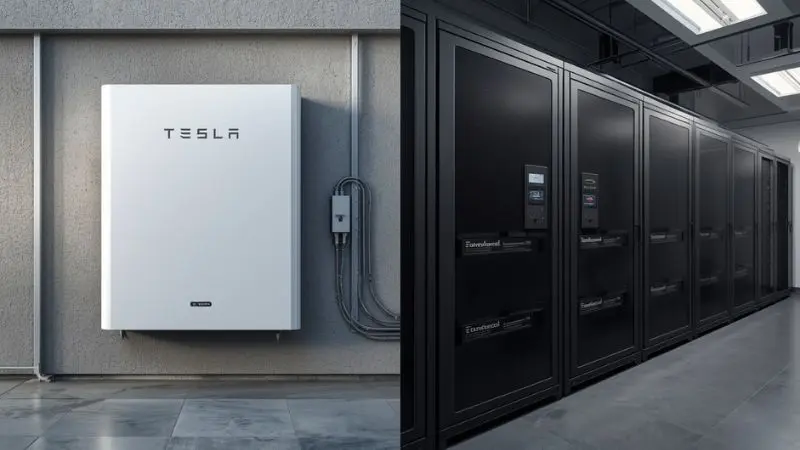
A large battery in the solar context refers to a single, self-contained energy storage unit — typically ranging from 5 kWh to 30 kWh — housed in one enclosure. Products like the Tesla Powerwall 3 (13.5 kWh), Enphase IQ Battery 5P, SonnenCore+, and LG RESU Prime represent this category.
These units integrate the battery cells, Battery Management System (BMS), inverter (in AC-coupled units), and thermal management into a single chassis. They are designed for minimal installation complexity and are typically wall-mounted.
Key characteristics:
- Fixed capacity per unit
- Integrated BMS — no external management needed
- Designed for residential or small commercial use
- Often IP55-rated for indoor/limited outdoor use
- Typically limited to 2–3 units in parallel expansion
What Are Server Rack Batteries?
Server rack batteries are modular lithium battery modules — commonly 48V, 100Ah (4.8 kWh) or 51.2V, 100Ah — designed to be stacked in standard 19-inch or 23-inch server racks. They draw from data center architecture: hot-swappable, individually monitored, and infinitely scalable.
Brands like CATL, SOK Battery, EG4, Pylontech, Deligreen, and Fortress Power dominate this segment. A single rack can house 4–16 modules, with multiple racks running in parallel to achieve systems exceeding 200+ kWh.
Key characteristics:
- Modular capacity starting at ~4.8 kWh per module
- Distributed BMS across each module, coordinated by a master controller
- Compatible with most hybrid inverters (Victron, SMA, Growatt, Deye, Schneider)
- Hot-swappable in advanced configurations
- Scalable to virtually unlimited capacity
Large Battery vs Server Rack Batteries: A Technical Deep Dive
Chemistry and Cell Quality
Both architectures commonly use LiFePO4 (Lithium Iron Phosphate) chemistry — the gold standard for solar storage due to its thermal stability, 3,000–6,000+ cycle life, and non-thermal-runaway characteristics.
However, server rack batteries offer more flexibility here. Higher-end server rack modules use Grade-A prismatic cells from tier-1 manufacturers like CATL or EVE, giving buyers transparency into cell sourcing. Many monolithic large batteries use proprietary cell configurations that are difficult to audit or replace.
NMC (Nickel Manganese Cobalt) chemistry appears in some large batteries (notably earlier Tesla Powerwall versions) — offering higher energy density but lower thermal tolerance and shorter cycle life compared to LiFePO4.
Expert Insight: For solar installations where cycles exceed 1/day (aggressive time-of-use arbitrage, off-grid systems), LiFePO4 server rack batteries with verified Grade-A cells consistently deliver better TCO (Total Cost of Ownership) over a 10-year horizon.
Battery Management System (BMS) Architecture
The BMS is the brain of any battery system. This is where the architectures diverge significantly.
Monolithic large battery BMS:
- Centralized BMS manages all cells in one unit
- Proprietary firmware — often closed-source
- Limited ability to modify charge/discharge parameters
- Vendor-dependent for firmware updates and diagnostics
- Failure of BMS = entire unit offline
Server rack battery BMS:
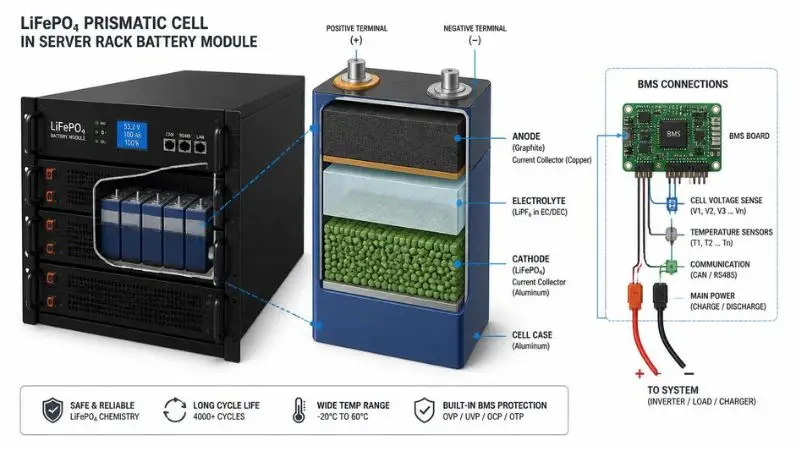
- Each module has an independent BMS
- Master-slave communication architecture (CAN bus, RS485, or RS232)
- Open protocol compatibility (SMA, Victron, Growatt, etc.)
- Module-level fault isolation — one bad module doesn’t kill the array
- Field-configurable: adjust C-rate, SOC limits, balancing thresholds
For professional solar installers and off-grid power engineers, the open BMS architecture of server rack systems is not a minor convenience — it is a fundamental operational advantage.
Large Battery vs Server Rack Batteries: Full Specification Comparison
| Parameter | Large Monolithic Battery | Server Rack Battery System |
|---|---|---|
| Typical Capacity (single unit) | 5–30 kWh | 4.8–9.6 kWh/module; unlimited stacking |
| Chemistry | LiFePO4 or NMC | Primarily LiFePO4 |
| Voltage | 48V–400V (AC-coupled) | 48V (standard); 51.2V nominal |
| Cycle Life | 3,000–6,000 cycles | 4,000–8,000 cycles (Grade-A cells) |
| Depth of Discharge (DoD) | 80–95% | 90–100% |
| Round-Trip Efficiency | 88–96% | 95–98% |
| Scalability | Limited (2–3 units max) | Virtually unlimited |
| Hot-Swap Capable | No | Yes (advanced models) |
| BMS Type | Proprietary, centralized | Distributed + Master controller |
| Inverter Compatibility | Often brand-specific | Universal (CAN/RS485) |
| Installation Complexity | Low (plug-and-play) | Medium (rack assembly, wiring) |
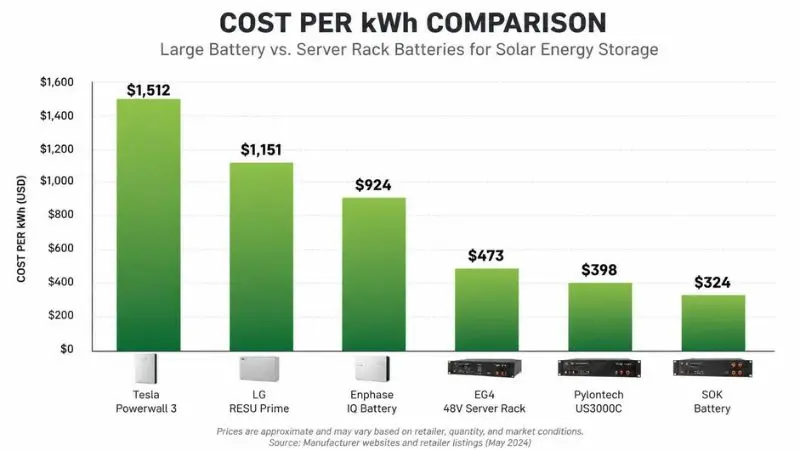
| Cost per kWh (2025 avg.) | $600–$1,100/kWh | $180–$380/kWh |
| Warranty | 10 years (typical) | 5–10 years per module |
| Field Serviceability | Low — unit replacement | High — module replacement |
| Footprint | Wall-mounted, compact | Floor-mounted rack, larger |
| IP Rating | IP55 (most models) | IP20–IP55 (rack-dependent) |
| Ideal System Size | 5–30 kWh | 10 kWh–1 MWh+ |
Cost Analysis: Where Server Rack Batteries Win Decisively in Large Battery vs Server Rack Batteries
Cost is where the comparison becomes unambiguous at scale.
A Tesla Powerwall 3 delivers 13.5 kWh at approximately $9,200 installed — roughly $681/kWh. A comparable 13.44 kWh system built with three EG4 48V 100Ah server rack modules costs approximately $4,500–$5,500 all-in, landing at $335–$409/kWh — a 40–50% cost reduction.
At a 50 kWh scale, the gap becomes enormous:
- 4× Powerwall 3: ~$36,800 installed
- 10× server rack modules (48V/100Ah): ~$12,000–$16,000 installed
That delta — $20,000+ — can fund an additional 5–8 kW of solar panels, a whole-home generator, or simply remain in the owner’s pocket.
However, this cost advantage narrows for small residential systems (under 15 kWh) where:
- Installation labor for rack systems is proportionally higher
- Monolithic batteries include the inverter (no additional cost)
- Permitting is simpler for pre-certified integrated units
Scalability: The Defining Advantage of Server Rack Systems
In the large battery vs server rack batteries scalability contest, server rack systems win with no contest.
A homeowner installing a Tesla Powerwall 3 today can expand to a maximum of 3 units (40.5 kWh) — a hard ceiling imposed by inverter architecture and BMS coordination limits. Beyond that, they need a full system redesign.
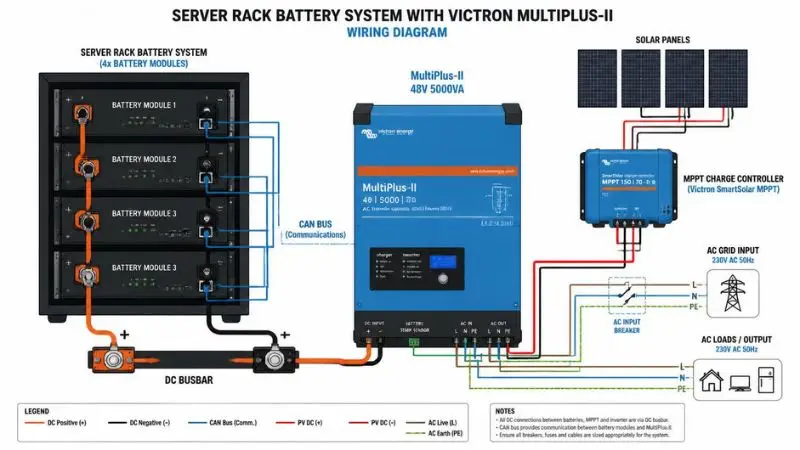
A server rack system using Victron MultiPlus-II or a Growatt SPF ES series inverter can scale by adding modules — one at a time — to the same rack or additional racks. Systems running Victron DVCC (Distributed Voltage and Current Control) can coordinate dozens of battery modules across parallel strings with zero architectural changes.
This is why server rack batteries dominate:
- Off-grid homesteads requiring 40–200 kWh
- Commercial & industrial (C&I) installations needing 100 kWh–1 MWh+
- Microgrids and community solar projects
- EV charging station backup storage
Reliability and Redundancy: Fault Isolation Matters
A monolithic large battery has a single point of failure. If the BMS trips, the inverter loses its power source, the thermal management system malfunctions, or a cell group degrades — the entire unit goes offline. In a critical off-grid scenario, this is catastrophic.
Server rack battery systems are inherently redundant. If one module develops a fault, the master BMS isolates it while the remaining modules continue operating. In a 10-module system, a single module failure reduces capacity by 10% — not 100%.
For mission-critical applications (medical equipment, remote telecom, food storage, data center UPS), this fault tolerance is non-negotiable.
Maintenance advantage: Server rack modules are field-replaceable without specialized tools or factory service contracts. A single technician with a torque wrench, a multimeter, and a laptop can swap a faulty module in under 30 minutes.
When a Large Monolithic Battery IS the Right Choice
Despite server rack batteries’ technical superiority at scale, large monolithic batteries are genuinely better in specific contexts. Honest analysis demands acknowledging this.
Choose a large monolithic battery when:
- System size is under 20 kWh and won’t grow significantly
- AC-coupled retrofit to existing grid-tied solar — Powerwall and similar units simplify this enormously
- Aesthetics matter — wall-mounted units in a finished garage beat a server rack visually
- HOA or permit restrictions require pre-certified, UL-listed integrated units
- Owner is non-technical — plug-and-play setup with app-based monitoring reduces support burden
- Rental property or short-term installation — simplified decommissioning has real value
- Grid-tied backup-only systems — where you only need 10–15 kWh for outage coverage and don’t need daily cycling
Products like the Enphase IQ Battery 5P (integrated microinverters, 5 kW continuous output) and SonnenCore+ (AI-driven energy management) deliver premium user experiences that server rack systems simply cannot match out of the box.
Inverter Compatibility: A Critical Integration Factor
Server rack batteries communicate with inverters via CAN bus or RS485 protocols using standard battery communication profiles (e.g., Pylontech protocol, SMA protocol, Victron VE.Bus). Major hybrid inverters — Victron, SMA Sunny Boy Storage, Growatt SPH/SPF, Deye, Sol-Ark, Schneider XW+ — support these protocols natively.
Large monolithic batteries often use proprietary communication layers. A Powerwall 3 requires a Tesla Gateway. Enphase batteries require Enphase microinverters. This ecosystem lock-in is a strategic liability — if you want to upgrade your inverter or switch brands in year 7, you may need to replace the entire battery system.
Server rack batteries are inverter-agnostic by design. A Pylontech stack installed with a Growatt inverter today can be migrated to a Victron system tomorrow without touching the batteries.
Safety Standards and Certifications
Both architectures undergo rigorous safety testing, but certification pathways differ:
Large monolithic batteries:
- UL 9540 (system-level)
- UL 1973 (battery system)
- IEC 62619
- Pre-certified as complete systems — simplifies permit approval in the US, EU, and Australia
Server rack batteries (varies by brand):
- UL 1973 (module-level — EG4, Pylontech, Fortress Power)
- IEC 62619, IEC 62133
- CE, UN38.3 (transport)
- Some budget brands lack UL certification — a significant risk factor for insurance and permitting
Critical Note for Installers: Always verify module-level UL 1973 certification for server rack batteries used in permitted residential or commercial installations. Non-certified modules may void homeowner’s insurance and create permitting failures.
Thermal Management: Off-Grid Desert and Cold-Climate Considerations
Lithium batteries are temperature-sensitive. Both architectures handle this differently.
Large batteries: Typically include active thermal management (liquid cooling in Tesla Powerwall 3, passive in most others). Operating range: generally -20°C to 50°C, with charging restrictions below 0°C.
Server rack batteries: Most modules are passively cooled. In hot climates (ambient >40°C), rack enclosures require forced ventilation or air conditioning. In cold climates below -10°C, low-temperature charging protection engages automatically, but self-heating modules (available in select EG4 and Deligreen models) are recommended for reliable winter performance in places like Canada, Scandinavia, or high-altitude installations.
For off-grid setups in extreme climates, thermal environment engineering is as important as battery selection itself.
Large Battery vs Server Rack Batteries: Making the Final Decision
Here is a structured decision framework to cut through complexity:
Go with a large monolithic battery if:
- Total storage need: under 20 kWh
- You want manufacturer support with a single warranty contact
- You’re AC-coupling to an existing solar system
- Permitting simplicity is a priority
- Installation is residential with aesthetic constraints
Go with server rack batteries if:
- Total storage need: 20 kWh and above
- You need system scalability over time
- You’re building a new DC-coupled or hybrid solar system
- You require redundancy and fault tolerance
- Budget optimization per kWh is a primary driver
- Off-grid, commercial, or critical infrastructure application
The hybrid answer: For sophisticated prosumers, it’s not either/or. A Powerwall 3 handles the grid-interactive, utility-facing role while a server rack system manages behind-the-meter storage for heavy loads. Few installers build this way today, but it represents the frontier of residential energy architecture.
Conclusion: The Verdict in the Large Battery vs Server Rack Batteries Debate
The large battery vs server rack batteries comparison ultimately resolves to this: purpose defines superiority.
Large batteries are brilliantly engineered for simplicity, aesthetics, and small-scale grid-tied residential use. They’re the right tool when your needs are fixed, your system is small, and you value a polished user experience over raw technical flexibility.
Server rack batteries are the undisputed choice for serious solar builds — off-grid homesteads, commercial installations, energy arbitrage systems, and any setup where scalability, cost efficiency, redundancy, and inverter independence matter. At the current cost delta of 40–60% per kWh, the financial case alone is compelling. Add in modular serviceability, open BMS protocols, and unlimited scalability, and server rack batteries represent the future of solar energy storage for all but the simplest applications.
The solar market is moving fast. Server rack battery costs have dropped 35–45% since 2022 and continue falling. Large monolithic batteries are becoming more capable (Powerwall 3’s bidirectional EV charging is a game-changer). Evaluate your system against your 10-year vision, not just today’s load profile.
Build smart. Build for tomorrow.
Frequently Asked Questions
Q: Can server rack batteries be used with a Tesla Powerwall inverter? No. Powerwall is a closed ecosystem. Server rack batteries require open-protocol inverters like Victron, Growatt, Sol-Ark, or Deye.
Q: How many server rack modules do I need to replace a 13.5 kWh Powerwall 3? Three 48V/100Ah modules (4.8 kWh each) equal 14.4 kWh — a slight capacity increase at roughly half the cost.
Q: Are server rack batteries safe for indoor installation? Yes, when using LiFePO4 chemistry with UL 1973-certified modules in properly ventilated enclosures. Always follow local fire code requirements for battery room setups.
Q: What inverter works best with server rack batteries? Victron MultiPlus-II (for off-grid and hybrid), Sol-Ark 15K (for residential), and Growatt SPH (for grid-tied) are consistently top performers with server rack battery systems.
Q: Will server rack battery warranties hold up? Reputable brands (EG4, Pylontech, Fortress Power) offer 5–10 year warranties. Verify warranty terms include capacity guarantees (typically 80% retained after rated cycles) and that the brand has a US or EU service presence.
For More Information, Check Out These Related Articles:
- Tesla Powerwall 3 Review: An Honest Guide to Price, Performance & 2026 Tech
- Anker Solix F3800 vs EcoFlow Delta Pro Ultra: Don’t Buy Until You See This Heavy-Duty Battle!
- EcoFlow Delta Pro Ultra vs Bluetti: Don’t Buy Until You See This Heavy-Duty Battle!
- Stop Wasting Money: The Ultimate Guide to Inverter Energy Savings 2026
- 7 Best Home Energy Storage Secrets: The Ultimate 2026 Roadmap