Anker Solix F3800 vs EcoFlow Delta Pro Ultra: Don’t Buy Until You See This Heavy-Duty Battle!
📋 In This Article
- Overview – What makes these two power stations stand out in 2026?
- Anker Solix F3800 vs EcoFlow Delta Pro Ultra – Head-to-head comparison
- Battery Capacity & Expandability – Which can power your home longer?
- Charging Speed & Input Options – Getting back to full, fast
- Home Integration & Smart Features – Whole-home backup capabilities
- Solar Compatibility – Off-grid performance tested
- Price & Value – Which gives you more for your money?
- Who Should Buy Which? – Our final recommendation
- FAQs – Common questions answered
- Article Sources
The Anker Solix F3800 vs EcoFlow Delta Pro Ultra debate is one of the most important buying decisions you can make for your home energy security in 2026. When the power goes out — whether from a storm, grid failure, or planned outage — the right home power station can keep your family safe, comfortable, and connected for days at a time.
Both are flagship-level machines with massive battery banks, whole-home backup potential, and smart energy management built in. But they serve slightly different users — and knowing which one fits your life could save you thousands of dollars and a lot of frustration. This in-depth Anker Solix F3800 vs EcoFlow Delta Pro Ultra comparison breaks down everything you need to make a confident decision.
Anker Solix F3800 vs EcoFlow Delta Pro Ultra: A Quick Snapshot
Before we dive deep, here’s a high-level look at the core specs of both units:
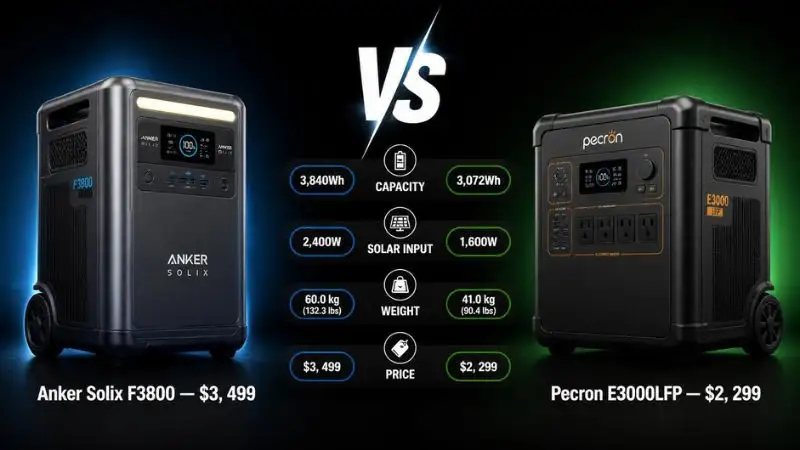
| Feature | Anker Solix F3800 | EcoFlow Delta Pro Ultra |
|---|---|---|
| Base Capacity | 3,840 Wh | 6,144 Wh |
| Max Expandable Capacity | 26,880 Wh | 21,504 Wh |
| AC Output Power | 6,000W (Surge: 12,000W) | 7,200W (Surge: 14,400W) |
| AC Charging Speed | 2,400W | 6,000W |
| Solar Input (Max) | 2,400W | 5,600W |
| Inverter Type | Pure Sine Wave | Pure Sine Wave |
| Weight (Base Unit) | 154 lbs (70 kg) | 123 lbs (55.9 kg) |
| App Control | Yes (Anker App) | Yes (EcoFlow App) |
| Home Panel Integration | Yes | Yes |
| Starting Price (2026) | ~$3,999 | ~$5,799 |
Even at a glance, you can see these are serious machines — but they target different priorities. Let’s break each category down properly.
💡 Did You Know?
The global home backup power market is projected to exceed $15 billion USD by 2027, driven by increasing grid instability, rising extreme weather events, and the explosive growth of rooftop solar installations. Power stations like the Anker Solix F3800 and EcoFlow Delta Pro Ultra are no longer niche products — they’re becoming standard household infrastructure.
Battery Capacity and Expandability
Anker Solix F3800: Modular and Scalable
The Anker Solix F3800 starts with a solid 3,840 Wh base capacity — enough to run most essential home appliances for 12 to 24 hours, depending on your load. What makes it exceptional is its modular expansion system. You can chain up to six expansion batteries, pushing the total system capacity to an impressive 26,880 Wh.
This makes the Solix F3800 one of the most scalable consumer-grade power stations on the market today. If you’re building your energy independence gradually, you can start with the base unit and expand as your budget allows.
EcoFlow Delta Pro Ultra: Raw Power from the Start
The EcoFlow Delta Pro Ultra launches with a considerably larger base capacity of 6,144 Wh — nearly double Anker’s starting point. This is a major advantage if you need substantial backup power immediately without buying add-ons. The Delta Pro Ultra supports up to two extra battery modules, capping out at 21,504 Wh.
While its maximum capacity is lower than the Anker Solix F3800, most families will never need more than 15–21 kWh in a single outage event. The EcoFlow’s larger base means fewer purchases to reach a usable level of redundancy.
Verdict: If you’re building gradually, the Anker Solix F3800 wins on scalability. If you want serious power out of the box, the Delta Pro Ultra leads.
📖 Definition Box: Wh vs kWh Explained
Watt-hour (Wh) is a unit of energy. It tells you how much electricity a battery stores. For example, a 3,840 Wh battery can theoretically power a 100W light bulb for about 38 hours. Kilowatt-hour (kWh) = 1,000 Wh. Your home electricity bill is measured in kWh. The average US household uses approximately 30 kWh per day, making a 6–10 kWh power station sufficient for partial backup during most outages.
Charging Speed and Input Options
Charging speed matters enormously when you’re dealing with real outages. The faster your power station refills — whether from the grid, solar panels, or both — the more useful it becomes.
Anker Solix F3800 Charging
- AC Wall Charging: Up to 2,400W — a full charge in approximately 1.5 hours from AC
- Solar Input: Up to 2,400W from solar panels
- Combined Input: Can accept AC + Solar simultaneously, reaching a theoretical 4,800W combined
- Dual-Channel Charging: A standout feature that allows two separate input streams at once
The Anker charges considerably fast from the wall, and its solar flexibility is impressive. However, at 2,400W AC max, it’s slower than the EcoFlow at higher-capacity configurations.
EcoFlow Delta Pro Ultra Charging
- AC Wall Charging: Up to 6,000W — a full base charge in roughly 1 hour
- Solar Input: A massive 5,600W solar input ceiling — best-in-class among consumer units
- EV Charging Port: Accepts input from an EV charging station, a unique and forward-thinking feature
- Smart Generator Support: Works with EcoFlow’s Smart Generator for automatic backup triggering
The EcoFlow Delta Pro Ultra absolutely dominates in charging speed. It’s 5,600W solar input means on a good sunny day, you can replenish the full base battery capacity in about 90 minutes — a genuinely impressive real-world figure.
Verdict: EcoFlow Delta Pro Ultra wins charging speed by a wide margin, especially for solar users.
Home Integration and Smart Features
Both power stations are designed to be more than portable chargers — they’re meant to become part of your home’s energy infrastructure.
Anker Solix F3800: Smart Home Energy Ecosystem
The Solix F3800 integrates with Anker’s Home Power Panel, which connects directly to your home’s electrical panel. This allows it to provide whole-home backup — not just USB outlets and appliances plugged directly into the unit.
Key smart features include:
- Anker App – Real-time monitoring, scheduling, and remote control
- Time-of-Use (TOU) Optimization – Charges during low-rate electricity hours and discharges during peak-rate hours, reducing your energy bills
- Solar Integration Mode – Works seamlessly with existing rooftop solar arrays
- Automatic Transfer Switch (ATS) – Switches to backup power within 20 milliseconds of a grid outage
EcoFlow Delta Pro Ultra: The Most Mature Smart Ecosystem
EcoFlow has been building its smart energy ecosystem longer, and it shows. The Delta Pro Ultra connects to the EcoFlow Smart Home Panel 2, which supports up to 10 circuits and features a remarkably clean installation.
Highlights of the EcoFlow smart platform:
- EcoFlow App – One of the most polished and feature-rich energy management apps available
- AI Energy Management – Learns your usage patterns and optimizes charging/discharging cycles automatically
- Whole-Home Backup – Powers essential circuits during outages without any manual switching
- EcoFlow PowerStream Compatibility – Feeds excess energy back to reduce grid consumption in real time
- Smart Generator Auto-Start – Automatically activates backup generators when the battery runs low
Verdict: Both platforms are excellent. EcoFlow edges ahead on app sophistication and the maturity of its broader smart energy ecosystem. Anker is rapidly closing the gap, though.
Solar Compatibility and Off-Grid Performance
For homeowners who have invested in rooftop solar or portable solar panels, compatibility matters as much as raw specs.
The EcoFlow Delta Pro Ultra’s 5,600W solar input makes it an outstanding choice for serious solar setups. If you have a large array — 20+ panels — the Delta Pro Ultra can absorb that generation efficiently, making it ideal for off-grid cabins, homesteads, or energy-independent homes.
The Anker Solix F3800, with its 2,400W solar input, is better suited for smaller to medium solar arrays — typically 6 to 10 panels. It’s a strong match for suburban homeowners with rooftop installations of 6kW or less. Its dual-input charging (AC + Solar simultaneously) does help compensate in real-world use scenarios.
Both units use MPPT (Maximum Power Point Tracking) charge controllers, which are the industry standard for maximizing solar harvest efficiency regardless of weather conditions.
Verdict: For large solar arrays and off-grid living, the EcoFlow Delta Pro Ultra is the clear winner. For typical suburban solar setups, the Anker Solix F3800 performs admirably.
Price, Warranty, and Long-Term Value
Purchase Price (2026 Market Pricing)
- Anker Solix F3800: Starts around $3,999 for the base unit
- EcoFlow Delta Pro Ultra: Starts around $5,799 for the base unit
The price gap is significant — roughly $1,800 on the base unit alone. However, the EcoFlow’s larger base capacity means you may need fewer add-on batteries to reach your target storage level, which can narrow the gap considerably in a full system build.
Warranty
- Anker Solix F3800: 5-year manufacturer warranty
- EcoFlow Delta Pro Ultra: 5-year manufacturer warranty (extendable to 10 years through their ecosystem program)
Both brands offer 5-year coverage, which is the industry standard for premium power stations. EcoFlow’s optional extension program is a notable differentiator for buyers focused on long-term investment protection.
Battery Lifespan
- Anker Solix F3800: 3,000+ charge cycles to 80% capacity (LiFePO4 chemistry)
- EcoFlow Delta Pro Ultra: 3,500+ charge cycles to 80% capacity (LiFePO4 chemistry)
Both use Lithium Iron Phosphate (LiFePO4) batteries — the safest, most thermally stable, and longest-lasting chemistry available in consumer energy storage. At daily use, both units will last well over 8 years before significant capacity degradation.
Verdict: Anker wins on upfront price. EcoFlow offers slightly better long-term value through deeper ecosystem integration and a marginally longer battery lifespan.
Who Should Buy the Anker Solix F3800?
The Anker Solix F3800 is the right choice if you:
- Want a powerful home backup solution at a lower entry price
- Plan to scale your system gradually over several years
- Have a small to medium rooftop solar array (under 2,400W input)
- Prefer a unit that offers exceptional total expandable capacity (up to 26.8 kWh)
- Are new to home power stations and want a reliable, well-supported starting point
Who Should Buy the EcoFlow Delta Pro Ultra?
The EcoFlow Delta Pro Ultra is the better fit if you:
- Need maximum power immediately without waiting to expand
- Have a large solar array and want to maximize solar self-consumption
- Value the most polished smart energy ecosystem and app experience
- Need faster grid charging — especially useful in short outage windows
- Are you building a serious off-grid or hybrid energy system for a homestead or cabin
FAQs: Anker Solix F3800 vs EcoFlow Delta Pro Ultra
Q1: Can either unit power my entire home during an outage?
Yes — but with important context. Both units support whole-home backup when paired with their respective home panel solutions. However, they will not power every appliance simultaneously forever. You’ll need to prioritize circuits. A typical home running essentials (fridge, lights, internet, fans, and phone charging) can expect 24–48 hours of runtime from either unit at base capacity.
Q2: Are these power stations safe to use indoors?
Absolutely. Both use LiFePO4 battery chemistry, which does not produce combustion gases and is considered safe for indoor installation. Unlike gasoline generators, they produce zero emissions. They can be installed in a garage, basement, or utility room without ventilation concerns.
Q3: Can I connect these to my existing rooftop solar system?
Yes, both units are compatible with existing grid-tied or off-grid solar systems via their solar input ports. You may need an AC coupling or DC coupling setup, depending on your current inverter configuration. It’s recommended to consult a licensed solar installer before integrating either unit with a professionally installed solar array.
Q4: Which has a better mobile app for remote monitoring?
Both apps are well-developed, but EcoFlow’s app is generally regarded as more feature-rich and intuitive, with AI-driven energy suggestions and more detailed historical data. Anker’s app is clean and functional, but slightly less mature in its analytical features. Both allow remote monitoring, scheduling, and control from anywhere with an internet connection.
Our Final Verdict
In the Anker Solix F3800 vs EcoFlow Delta Pro Ultra matchup, there is no single wrong answer — only the wrong choice for you specifically.
Choose the Anker Solix F3800 if budget flexibility and long-term scalability are your priorities. It offers the best total expandable capacity in its class and comes in at a more accessible starting price.
Choose the EcoFlow Delta Pro Ultra if you want the most capable out-of-the-box system, the fastest solar charging available in a consumer unit, and the most mature smart energy ecosystem on the market.
Either way, you’re investing in a product that will protect your home, reduce your grid dependence, and pay dividends for a decade or more. In 2026, that’s not just smart shopping — it’s smart living.
📚 View Article Sources
- Anker Official Product Page – Anker Solix F3800 Specifications: anker.com
- EcoFlow Official Product Page – Delta Pro Ultra Specifications: ecoflow.com
- U.S. Energy Information Administration (EIA) – Average Household Electricity Consumption Report, 2025: eia.gov
- BloombergNEF – Global Home Energy Storage Market Outlook 2026: bnef.com
- Clean Energy Reviews – LiFePO4 Battery Technology Guide, 2025 Edition: cleanenergyreviews.info
- EnergySage – Home Battery Backup Buyer’s Guide 2026: energysage.com