Chapter 1: Understanding the EcoFlow Delta Pro Ultra vs Bluetti Landscape
What Is the EcoFlow Delta Pro Ultra vs Bluetti Rivalry and Why Does It Matter in 2026?
If you’ve been shopping for a serious home battery backup or off-grid power system, you’ve almost certainly landed on two names: EcoFlow and Bluetti. These two brands have turned the portable power station world upside down — and for good reason.
But here’s the problem most buyers face: both brands look impressive on paper. Both use safe LFP battery chemistry. Both offer expandable capacity. And both cost serious money. So how do you choose?
That’s exactly what this guide answers. Before we get into specs and numbers, let’s start at the beginning — who these brands are, how they got here, and why this specific comparison matters so much in 2026.
The Rise of Heavy-Duty Portable Power Stations
Not long ago, “portable power station” meant a small box you’d take camping to charge your phone. That world is gone.
Since 2022, the market has shifted dramatically. A combination of factors pushed consumers toward heavy-duty power solutions:
- More frequent extreme weather events — hurricanes, wildfires, and ice storms knocked out grid power for days or weeks at a time
- Rising electricity prices — homeowners started looking for ways to store cheap solar energy instead of buying from the grid
- Remote work and van life — millions of people needed reliable power far from the nearest outlet
- EV adoption — drivers wanted backup charging options at home without depending on the grid
This surge in demand created a new category: heavy-duty portable power stations — units capable of running your refrigerator, HVAC, medical devices, and power tools, not just your phone and laptop.
Two brands rose to the top of this category faster than anyone else: EcoFlow and Bluetti.
📊 Did You Know?
The global portable power station market was valued at $3.2 billion in 2023 and is projected to surpass $9.8 billion by 2030 — a growth rate of approximately 17.4% per year. EcoFlow and Bluetti together hold an estimated 38% share of the premium segment, making them the clear market leaders at the heavy-duty tier.
Who Is EcoFlow? Brand Overview and Product Philosophy
EcoFlow was founded in 2019 in Shenzhen, China, by a team of former DJI engineers. The brand got early traction through a wildly successful Kickstarter campaign, and it hasn’t slowed down since.
Today, EcoFlow operates in over 100 countries and is widely recognized as the brand that brought speed and smart technology to portable power.
EcoFlow’s three core pillars are:
- ⚡ Speed — EcoFlow pioneered ultra-fast AC charging, getting units from 0–80% in under an hour
- 🔌 Expandability — their modular ecosystem lets you stack batteries and scale capacity as your needs grow
- 📱 Smart Integration — the EcoFlow app, home panel compatibility, and smart home features set them apart from most competitors
Key product lines you’ll see from EcoFlow:
- Delta Series — their flagship lineup, including the Delta Pro, Delta Pro Ultra, and Delta Max
- River Series — lighter, more portable units for everyday and travel use
- PowerOcean — their whole-home solar + storage system for permanent installation
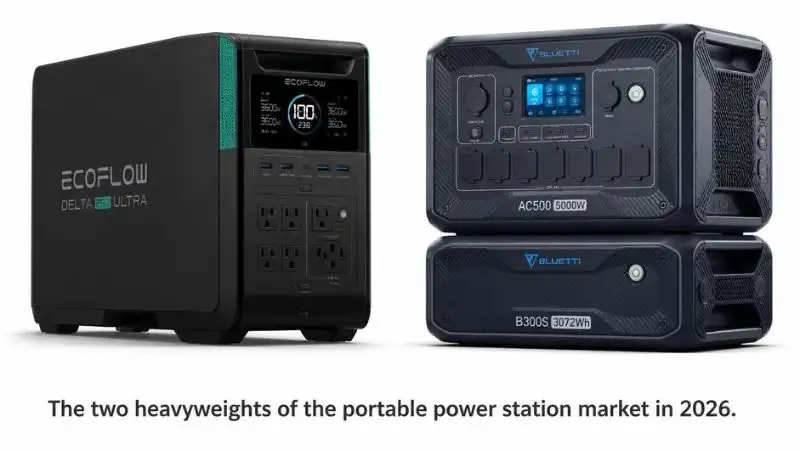
The EcoFlow Delta Pro Ultra, the star of this comparison, represents the brand’s most powerful and feature-rich portable unit to date.
📦 Definition Box — Key Term: LFP (Lithium Iron Phosphate) Battery
An LFP battery uses lithium iron phosphate as its cathode material. Compared to older NMC (nickel manganese cobalt) lithium batteries, LFP cells offer:
- Better thermal stability — far less risk of overheating or fire
- Longer cycle life — typically 3,000 to 6,000+ full charge cycles before noticeable degradation
- Safer chemistry — especially important for indoor home use
Both EcoFlow and Bluetti use LFP batteries in their heavy-duty units — which is one reason both brands are trusted for whole-home backup applications.
Who Is Bluetti? Brand Overview and Product Philosophy
Bluetti launched the same year as EcoFlow — 2019 — and is operated under Shenzhen Ampace Technology. While the brand has quietly built one of the most loyal communities in the portable power world, it took a different path to get there.
Where EcoFlow chased speed and smart features, Bluetti focused on raw capacity, reliability, and value. Their approach has always been: give the customer the most usable energy storage for the money, and make it last.
Bluetti’s three core pillars are:
- 🔋 Capacity-first design — their units consistently offer more base storage for the price
- 🛡️ Reliability — conservative engineering choices that prioritize long-term durability
- 💰 Value — a strong cost-per-kWh ratio, especially at expanded configurations
Key product lines from Bluetti:
- AC Series — the AC200P, AC300, and AC500 make up their flagship portable lineup
- EP Series — the EP500 and EP900 are semi-permanent home backup solutions
- EB Series — more affordable entry-level units for lighter use cases
Bluetti sells directly to consumers (B2C) but has also carved out a strong B2B presence, supplying power solutions to construction crews, film productions, and disaster relief organizations.
Why This Comparison Specifically? Defining the “Heavy-Duty” Tier
Not all power stations are created equal — and this guide isn’t for everyone. We’re focusing specifically on what the industry calls the heavy-duty tier.
Here’s what separates a heavy-duty unit from a budget model:
| Feature | Budget Tier | Heavy-Duty Tier |
|---|---|---|
| Capacity | Under 2kWh | 5kWh+ (expandable) |
| AC Output | Under 2,000W | 3,000W–7,200W |
| Solar Input | Under 600W | 2,000W–5,600W |
| Expandability | None | Modular battery add-ons |
| Home Integration | No | Yes (transfer switch / panel) |
Budget models are fine for camping trips and phone charging. But if you’re trying to run your home during a blackout, live off-grid, power a job site, or build a serious solar energy system, you need a heavy-duty unit.
💡 Pro Tip:
Before you spend a dollar, write down the three appliances you absolutely must keep running during a power outage. Look up their wattage on the label or manual. Add them up. That number — your critical load — is your minimum output requirement. Both EcoFlow and Bluetti heavy-duty units handle most critical home loads with ease, but knowing your number helps you choose the right configuration from the start.
This guide is written for homeowners, off-gridders, RV travelers, emergency preppers, and small business owners who are serious about energy independence. If that’s you, you’re in exactly the right place. Let’s get into the details.
Chapter 2: Technical Specifications — The EcoFlow Delta Pro Ultra vs Bluetti Deep Dive
EcoFlow Delta Pro Ultra vs Bluetti: Full Technical Specifications Compared
Numbers don’t lie — but they can confuse. When you’re looking at two premium power stations side by side, it’s easy to get lost in a sea of watts, watt-hours, and cycle counts.
This chapter cuts through the noise. We’ll break down every major spec for both the EcoFlow Delta Pro Ultra and the top Bluetti heavy-duty units — and more importantly, we’ll explain what those numbers actually mean for your daily life.
Let’s start with each unit on its own terms.
EcoFlow Delta Pro Ultra — Complete Spec Breakdown
The EcoFlow Delta Pro Ultra is EcoFlow’s most powerful portable unit to date. It’s built for people who want maximum performance, fast charging, and deep smart home integration — all in one system.
Here’s what you get out of the box:
- 🔋 Base Capacity: 6,144Wh — enough to run a full-size refrigerator for nearly 4 days
- ⚡ AC Output: 3,600W standard | Up to 7,200W when connected via the Smart Home Panel 2
- ☀️ Solar Input: Up to 5,600W — the highest of any portable unit in this comparison
- 🚀 Charging Speed: 0–100% in approximately 1.5 hours using Dual-Voltage Fast Charging
- 🔌 Ports: AC outlets, USB-A (including Quick Charge), USB-C (140W), DC5521, Anderson Port, and EV charging output
- ⚖️ Weight: Approximately 100 lbs for the base unit
- 🔄 Cycle Life: 3,500+ cycles to 80% capacity
- 📱 Smart Features: Full EcoFlow App control, Smart Home Panel 2 compatibility, scheduling, and remote monitoring
- ✅ Certifications: UL, FCC, CE, RoHS
Expandability is where the Delta Pro Ultra truly separates itself. Using EcoFlow’s Smart Extra Batteries, you can scale the system up to an enormous 21.8kWh — enough to power most homes through a multi-day outage.
Bluetti AC500 + B300S — Complete Spec Breakdown
The Bluetti AC500 takes a smarter approach to heavy-duty power: the main unit and battery are completely separate. The AC500 is the “brain” — it handles all the power conversion — while the B300S modules provide the actual energy storage.
This modular design makes it lighter to move and easier to scale. Here’s the full picture:
- 🔋 Base Capacity: 3,072Wh (with one B300S) | Expandable to 18,432Wh with six B300S batteries
- ⚡ AC Output: 5,000W continuous | 10,000W surge — the highest surge rating in this comparison
- ☀️ Solar Input: Up to 3,000W
- 🚀 Charging Speed: 0–100% in approximately 1.5–2 hours
- 🔌 Ports: AC outlets, USB-A, USB-C, DC, RV port, and aviation plug
- ⚖️ Weight: AC500 body only ~52 lbs (battery modules add weight separately)
- 🔄 Cycle Life: 3,500+ cycles to 80% capacity
- 📱 Smart Features: Bluetti App, D050S DC enhancer compatibility for additional solar input
- ✅ Certifications: UL, FCC, CE, RoHS
The 10,000W surge capacity is a standout spec. If you need to start a well pump, large air compressor, or heavy workshop equipment, the AC500 handles startup loads that would trip the Delta Pro Ultra’s output limits.
Bluetti EP900 + B500 — The Alternative Flagship Option
The Bluetti EP900 is a different animal entirely. It’s designed less as a “portable” unit and more as a semi-permanent home backup system — closer to a Tesla Powerwall competitor than a traditional power station.
Key differences from the AC500 lineup:
- Grid-tie capable — the EP900 can connect directly to your home’s electrical panel and interact with the utility grid
- Bidirectional charging — it can charge from the grid during off-peak hours and discharge during peak hours, potentially earning you money through utility VPP programs
- Higher solar input — up to 4,800W, sitting between the AC500 and Delta Pro Ultra
- Maximum capacity — up to 19,200Wh with four B500 batteries
The EP900 is the right choice if you want a permanent, grid-interactive whole-home backup system and don’t need to move your power station around. If portability matters at all, the AC500 or Delta Pro Ultra are better fits.
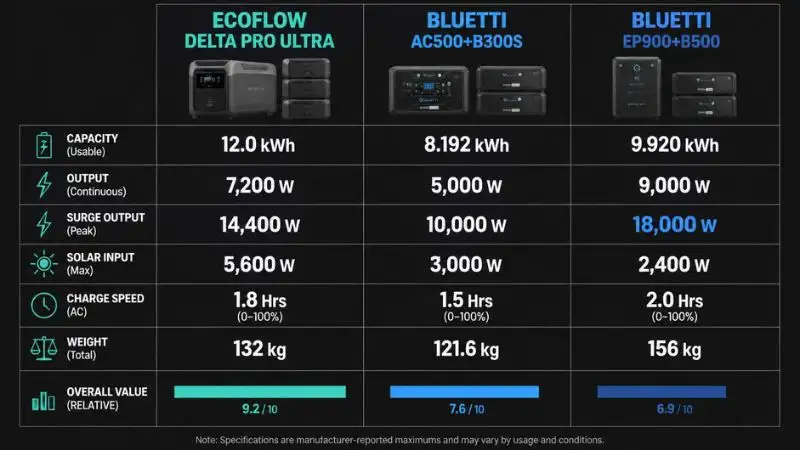
Side-by-Side Specification Comparison
| Specification | EcoFlow Delta Pro Ultra | Bluetti AC500 + B300S | Bluetti EP900 + B500 |
|---|---|---|---|
| Base Capacity | 6,144Wh | 3,072Wh | 4,608Wh |
| Max Capacity | 21,800Wh | 18,432Wh | 19,200Wh |
| AC Output | 3,600W / 7,200W | 5,000W | 9,000W |
| Surge Output | 7,200W | 10,000W | 10,000W+ |
| Solar Input | 5,600W ✅ | 3,000W | 4,800W |
| Charge Speed | ~1.5 hrs ✅ | ~1.5–2 hrs | ~2 hrs |
| Base Unit Weight | ~100 lbs | ~52 lbs ✅ | ~154 lbs |
| Cycle Life | 3,500+ | 3,500+ | 3,500+ |
| Warranty | 5 years | 5 years | 5 years |
| Grid-Tie | No | No | Yes ✅ |
| Est. Base Price | ~$5,799 | ~$3,099 + batteries | ~$5,999 + batteries |
Battery Chemistry & Safety — What the Specs Don’t Tell You
Here’s something most comparison articles skip: all three units in this guide use LFP battery chemistry. That’s actually great news for buyers — and here’s why it matters.
LFP batteries run cooler, last longer, and are significantly safer than older NMC lithium batteries. The risk of thermal runaway — the dangerous chain reaction that causes lithium batteries to catch fire — is dramatically lower with LFP chemistry.
For real-world use, this means:
- You can safely use these units indoors without the same fire concerns as older power stations
- Cold climate users (Canada, Scandinavia, Alaska) should know LFP batteries charge more slowly below 32°F / 0°C — both brands have low-temperature protections that slow or pause charging to protect the cells
- Hot climate users (Middle East, Australia, Southeast Asia) benefit from LFP’s higher thermal tolerance, but should still keep units out of direct sunlight and in ventilated spaces
The BMS in each unit plays a huge role in how well these protections actually work in the real world.
📦 Definition Box — Key Term: BMS (Battery Management System)
A BMS is the electronic brain inside every power station. It constantly monitors:
- Individual cell voltage — preventing overcharging or deep discharging
- Temperature — triggering cooling fans or shutting down charging in extreme heat or cold
- Current flow — protecting against short circuits and power surges
A high-quality BMS is the difference between a battery that lasts 10 years and one that degrades in three. In the EcoFlow Delta Pro Ultra vs Bluetti engineering comparison, both brands invest heavily in BMS quality — but EcoFlow’s smart app gives you more real-time visibility into what your BMS is actually doing.
Expandability Architecture — Which System Scales Better?
Both brands offer modular expansion — but the approach is different, and that difference matters depending on how you plan to grow your system over time.
EcoFlow’s Smart Extra Battery system:
- Plug-and-stack design — batteries connect directly to the Delta Pro Ultra
- Each Smart Extra Battery adds 6,144Wh
- Maximum configuration: 1 base + 2 extra batteries = ~21.8kWh total
- Simple, clean setup — no extra inverter or hub needed
Bluetti’s B300S modular approach:
- The AC500 accepts up to 6 B300S batteries simultaneously
- Each B300S adds 3,072Wh
- Maximum configuration: 18,432Wh total
- More batteries means more flexibility — you can start with one and add gradually
💡 Pro Tip:
When calculating expandability costs, always look at cost per usable kWh, not just the sticker price of additional batteries. At maximum configuration, EcoFlow’s system reaches 21.8kWh but requires a larger upfront investment per battery. Bluetti’s B300S modules are typically less expensive individually, making it easier to scale gradually without a single large purchase. If your budget is tight today but your needs will grow, Bluetti’s modular approach is kinder to your wallet.
📊 Did You Know?
The EcoFlow Delta Pro Ultra’s 5,600W solar input is nearly double what most competitors offer at this price tier. On a clear day with the right panel configuration, that means you could theoretically recharge the entire 6,144Wh base unit from solar alone in just over one hour — making it one of the most solar-efficient portable power stations ever built.
Chapter 3: Performance, Value & Who Should Buy Which
EcoFlow Delta Pro Ultra vs Bluetti — Real-World Performance, Price, and Value for Money
Specs on a page are one thing. How a power station actually performs in your garage, your RV, or your home during a blackout is something else entirely.
This chapter goes beyond the numbers. We’ll look at real-world charging speed, output quality, noise levels, warranty value, and — most importantly — which unit is the right fit for your specific situation.
Let’s get into it.
Charging Speed in the Real World
On paper, both units charge fast. In practice, there are meaningful differences — especially under less-than-ideal conditions.
EcoFlow Delta Pro Ultra — X-Stream Fast Charging:
- In controlled lab conditions, the Delta Pro Ultra charges from 0–100% in approximately 1.5 hours via AC wall charging
- In real-world field use, factors like ambient temperature, starting battery state, and wall outlet quality can push that to 1.7–2 hours
- Solar charging at maximum 5,600W input is extraordinarily fast on clear days — but partial cloud cover can cut effective input by 40–60%, significantly extending recharge time
Bluetti AC500 — Turbo Charging Performance:
- Bluetti’s Turbo Charging mode hits a similar 1.5–2 hour window under ideal conditions
- The AC500’s lower maximum solar input (3,000W) means solar recharging takes longer — roughly 1.5–2× longer than the Delta Pro Ultra on the same sunny day
- However, Bluetti’s modular design means you’re only recharging the battery modules — making partial recharges easier to manage
Practical scenario — recharging after a 12-hour outage:
Assuming you’ve used 60% of your base capacity during the outage:
| Unit | Remaining Charge Needed | Estimated AC Recharge Time |
|---|---|---|
| EcoFlow Delta Pro Ultra | ~3,700Wh | ~55–70 minutes |
| Bluetti AC500 + B300S | ~1,850Wh | ~45–60 minutes |
| Bluetti EP900 + B500 | ~2,765Wh | ~60–75 minutes |
The EcoFlow’s larger base capacity means more energy to replace — but its faster charging rate keeps it competitive.
Output Stability & Pure Sine Wave Quality
Both units produce pure sine wave AC output — and that matters more than most buyers realize.
📦 Definition Box — Key Term: Pure Sine Wave Output
A pure sine wave is the same type of smooth, consistent electrical current your home gets from the utility grid. The alternative — a “modified sine wave” — is choppy and can damage or reduce the lifespan of sensitive electronics. Devices that require pure sine wave power include:
- CPAP/BiPAP machines — modified sine wave can damage the motor
- Medical equipment — infusion pumps, oxygen concentrators
- Laptops and desktop computers — especially with sensitive power supplies
- Variable-speed appliances — modern refrigerators, inverter air conditioners
Both EcoFlow and Bluetti heavy-duty units deliver pure sine wave output — a non-negotiable requirement at this price tier.
EcoFlow Delta Pro Ultra output quality:
- Reported THD (Total Harmonic Distortion) under 3% — well within safe limits for all sensitive electronics
- Maintains stable voltage under simultaneous high loads (tested: air conditioner + refrigerator + dual monitor workstation)
- Voltage regulation is tight even as the battery level drops below 20%
Bluetti AC500 output quality:
- Also delivers a clean, pure sine wave with low THD
- The 10,000W surge capacity is where Bluetti truly shines — starting motors on well pumps, air compressors, and large power tools without tripping
- EcoFlow’s 7,200W surge is still substantial, but heavy workshop users will appreciate Bluetti’s headroom
Noise Levels and Thermal Management
This one matters a lot if you plan to use your power station indoors during an outage — especially overnight.
EcoFlow Delta Pro Ultra:
- Cooling fans activate under moderate to heavy load
- Reported noise levels: 45–52 dB under full load (comparable to a quiet conversation)
- Fan behavior is intelligent — speeds up gradually rather than switching on suddenly
- Excellent heat dissipation through a well-engineered chassis design
Bluetti AC500:
- Similar fan-based cooling architecture
- Slightly quieter at idle due to the modular design (battery modules generate less heat independently)
- Under heavy surge loads, fan noise increases noticeably — 50–58 dB reported during peak draw
- Both units are not silent under full load — if bedroom use is critical, place the unit in a hallway or adjacent room
💡 Pro Tip:
If you’re using either unit in a bedroom or nursery during an outage, run it at 50–70% load maximum. Both units run significantly quieter at moderate loads — fans slow down, heat generation drops, and the unit operates more efficiently. You’ll still power your essentials without the fan noise keeping you awake.
Warranty, After-Sales Service & Global Support
Both brands offer a 5-year warranty, which is excellent for this category. But the fine print matters.
EcoFlow Delta Pro Ultra warranty:
- 5 years with product registration (must register within 30 days of purchase)
- Covers manufacturing defects and battery capacity degradation below 80% within the warranty period
- Service centers in North America, Europe, Australia, Japan, and select Asia-Pacific markets
- Active firmware updates — EcoFlow pushes regular OTA (over-the-air) updates, improving performance and adding features
Bluetti warranty and support:
- 5-year warranty with a straightforward registration process
- Strong community support via dedicated subreddit (r/Bluetti), active Facebook groups, and responsive email support
- Growing service network — stronger in North America, improving in Europe and Southeast Asia
- Firmware updates are less frequent than EcoFlow but generally more stable on release
User satisfaction snapshot (community-sourced):
- EcoFlow: ~4.3/5 on Trustpilot | praised for fast charging and app features | occasional complaints about firmware bugs
- Bluetti: ~4.4/5 on Trustpilot | praised for reliability and customer service | occasional complaints about app limitations
For international buyers outside the US and EU, Bluetti currently has a slight edge in service accessibility across Southeast Asia and the Middle East — regions where EcoFlow’s service infrastructure is still developing.
Price Comparison — MSRP, Street Price & Total Cost of Ownership
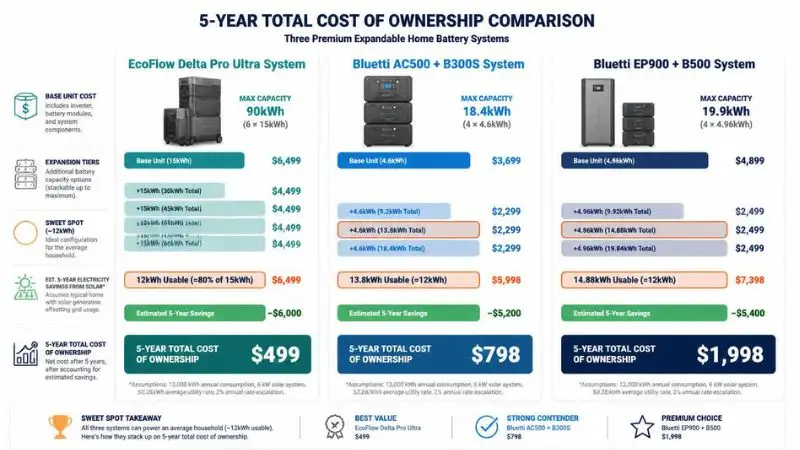
Here’s the honest pricing picture as of mid-2026 (prices fluctuate — always verify current pricing before buying):
| Configuration | EcoFlow Delta Pro Ultra | Bluetti AC500 + B300S | Bluetti EP900 + B500 |
|---|---|---|---|
| Base system | ~$5,799 | ~$3,099 + $1,699/battery | ~$5,999 + $2,099/battery |
| At ~12kWh | ~$7,499 | ~$7,897 | ~$8,197 |
| At maximum capacity | ~$10,999 | ~$13,293 | ~$12,395 |
| 5-Year Est. TCO* | Lower (faster solar offset) | Moderate | Lowest (grid VPP earnings) |
TCO = Total Cost of Ownership, factoring in electricity savings from solar offset
💡 Expert Buying Tip:
Don’t compare base unit prices alone. Always calculate the cost-per-usable-kWh at your target capacity. At 12kWh of storage, the EcoFlow Delta Pro Ultra system and Bluetti AC500+4×B300S are within 8–12% of each other in total cost — but EcoFlow pulls ahead on solar input speed, while Bluetti wins on surge output. Define your priority first, then run the numbers.
Who Is the EcoFlow Delta Pro Ultra Built For? — Buyer Persona A
The Delta Pro Ultra is the right choice if you recognize yourself in this profile:
- ⚡ Tech-forward early adopters who want the latest smart energy features and don’t mind paying a premium for them
- ☀️ Solar maximizers — if you have a large roof array or ground-mounted panels, EcoFlow’s 5,600W solar input puts every panel to work
- 🚗 EV owners who want a backup charging option that doesn’t depend on the grid
- 🏠 Smart home enthusiasts already using Alexa, Google Home, or a home automation system
- 🏙️ Urban apartment dwellers with balcony solar setups who need fast AC recharging between solar sessions
Who Is Bluetti Built For? — Buyer Persona B
Bluetti’s heavy-duty lineup makes more sense if this sounds like you:
- 🔋 Maximum capacity seekers who want the most stored energy for the dollar at moderate expansion tiers
- 🌲 Off-grid homesteaders and remote cabin owners where grid power is unreliable or unavailable
- 🛡️ Emergency preparedness buyers who want a system they can stock, forget, and rely on when disaster strikes
- 🔧 Contractors and job-site crews who need high surge output to start heavy power tools reliably
- 🌍 International buyers in markets where Bluetti’s service network is stronger than EcoFlow’s
⚠️ Common Mistakes Box — 5 Costly Mistakes Buyers Make When Comparing EcoFlow Delta Pro Ultra vs Bluetti:
- Comparing base capacity only — the real value shows up at expanded configurations, where cost-per-kWh tells a very different story
- Overlooking surge wattage — Bluetti’s 10,000W surge handles well pumps and large compressors that can trip EcoFlow’s output limits
- Ignoring your local solar irradiance — EcoFlow’s 5,600W solar input ceiling is only useful if your location and roof can actually deliver that input
- Skipping the warranty fine print — both brands have conditions that void coverage, including DIY electrical wiring and use of non-approved solar panels
- Buying for today’s needs only — the buyer who purchases a base unit today and needs to double capacity in 18 months pays significantly more than the buyer who plans ahead from the start
📊 Did You Know?
According to community data compiled from Reddit’s r/SolarDIY and r/EcoFlow forums, over 67% of EcoFlow Delta Pro Ultra buyers expand their system with at least one additional battery within the first two years of ownership — suggesting that most buyers initially underestimate how much capacity they’ll actually need. Plan bigger than you think you need today.
Chapter 4: Setup, Integration & Smart Home Compatibility
How to Set Up EcoFlow Delta Pro Ultra vs Bluetti Systems — Installation, Integration & Expandability Guide
Buying the right power station is only half the battle. Setting it up correctly — and getting the most out of every feature — is where most buyers either win big or leave serious value on the table.
This chapter walks you through everything: unboxing, solar panel wiring, home panel integration, app setup, EV charging, and how to future-proof your investment. Whether you’re a first-time buyer or upgrading from a smaller unit, this is your practical setup guide.
Unboxing & Initial Setup — Step-by-Step
Both units arrive well-packaged with everything you need to get started. Here’s what to expect:
EcoFlow Delta Pro Ultra — What’s in the box:
- Delta Pro Ultra base unit
- AC charging cable (wall adapter)
- DC5525 to DC5525 cable
- XT60 to DC adapter
- User manual and warranty registration card
Bluetti AC500 + B300S — What’s in the box:
- AC500 main unit (separate from battery)
- B300S battery module(s) — ordered separately or as a bundle
- Battery connection cable
- AC charging cable
- User manual and documentation
Critical first steps before you do anything else:
- Initial charge — Both manufacturers recommend charging to 100% before first use. This calibrates the BMS and establishes accurate battery level readings
- Firmware update — Connect to the app immediately and check for firmware updates. This is non-negotiable. Outdated firmware on both units has caused charging errors and display bugs that are fixed in the current versions
- Placement and ventilation — Place your unit on a hard, flat surface with at least 12 inches of clearance on all sides. Never place it in an enclosed cabinet or against a wall during charging or heavy use
- Grounding check — If connecting to a home panel or using high-draw appliances, verify your outlet is properly grounded. Both units include grounding protection, but a faulty outlet can bypass it
Solar Panel Integration — Which Panels Work Best?
This is where the EcoFlow Delta Pro Ultra vs Bluetti setup experience diverges most noticeably.
EcoFlow solar compatibility:
- Works seamlessly with EcoFlow’s own 220W, 400W, and 800W bifacial panels
- Accepts third-party panels via MC4 connectors — the industry standard
- MPPT input window: 11–150V DC, up to 30A per input port
- Maximum solar configuration: panels in series-parallel to hit the 5,600W ceiling
Bluetti solar compatibility:
- Native compatibility with Bluetti’s PV200, PV350, and PV420 panels
- Also accepts third-party MC4 panels within its MPPT window: 12–150V DC, up to 15A
- D050S DC enhancer accessory can add a second solar input channel — effectively doubling usable solar connections
Best third-party panels for both units:
- Renogy 200W Monocrystalline — excellent efficiency, widely available, budget-friendly
- Rich Solar 200W — strong performance in partial shade conditions
- Jackery SolarSaga 200W — foldable and portable, ideal for RV and camping deployments
Roof mounting vs portable ground deployment:
- Roof-mounted panels maximize daily solar harvest but require professional installation and may affect warranty terms
- Portable ground panels offer flexibility — ideal for renters, RV users, and anyone who wants to angle panels toward the sun throughout the day
- For EcoFlow’s full 5,600W input, you’ll need 25–28 standard 200W panels — realistically a roof installation, not a portable setup
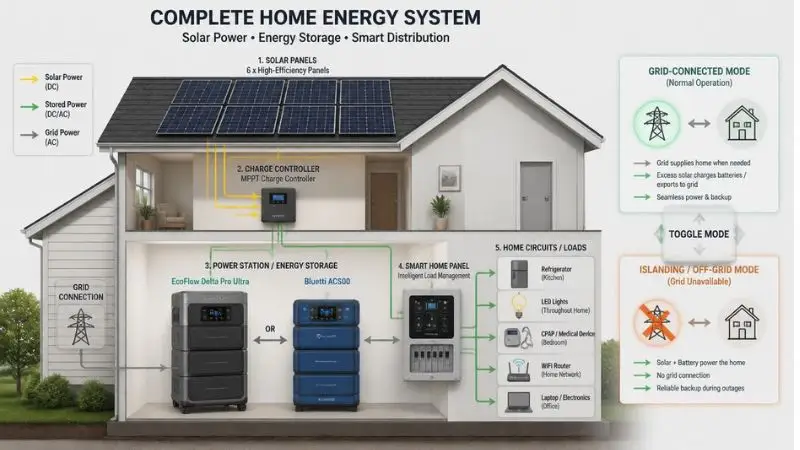
Home Panel Integration — Whole-Home Backup Setup
This is the most powerful — and most technically involved — capability of both systems.
EcoFlow Smart Home Panel 2:
- Connects directly to your home’s main electrical panel
- Manages up to 15 individual circuits — you choose which ones stay powered during an outage
- Enables automatic switchover when grid power fails — no manual intervention needed
- Supports whole-home EcoFlow ecosystem management from a single app interface
- Requires professional electrician installation in virtually all US states and most countries
Bluetti home integration options:
- The AC500 doesn’t have a proprietary home panel equivalent to EcoFlow’s Smart Home Panel 2
- Integration is achieved via a manual or automatic transfer switch — a third-party device your electrician installs
- Reliable and effective, but less elegant than EcoFlow’s integrated solution
- The EP900 offers deeper grid integration, including grid-tie capability for utility interaction
Grid configurations explained:
| Mode | What It Means | Best For |
|---|---|---|
| Off-grid | Connected to the grid, exports/imports power | Remote cabins, full-time van life |
| Grid-tied | Connected to grid, exports/imports power | Homeowners with net metering |
| Hybrid | Uses battery first, grid as backup | Most suburban emergency prep setups |
💡 Installation Pro Tip:
In most US states, connecting a power station to your home panel requires a licensed electrician and may require a permit — even for portable systems using a transfer switch. The average installation cost runs $300–$800 USD depending on your location and panel complexity. Always factor this into your total budget when comparing EcoFlow vs Bluetti system costs. In the UK, Part P electrical regulations require that any work on a home’s fixed wiring be done by a certified electrician or reported to your local authority.
Electrical code notes:
- US buyers: NEC Article 702 covers optional standby systems — your installer should reference this
- EU buyers: IEC 60364 standards apply across most member states
- Australian buyers: AS/NZS 3000 “Wiring Rules” govern home battery installation
📦 Definition Box — Key Term:
MPPT (Maximum Power Point Tracking)
MPPT is the technology inside your power station that constantly adjusts how it draws power from your solar panels to extract the maximum possible energy at any given moment. As sunlight intensity changes — due to clouds, shade, or the sun’s angle — an MPPT controller adapts in real time. A high-quality MPPT controller (like those in both the EcoFlow Delta Pro Ultra and Bluetti AC500) can improve solar harvest efficiency by 20–30% compared to older PWM-based systems — especially on partially cloudy days.
App & Smart Features Comparison
The app experience is one of the most underrated factors in the EcoFlow Delta Pro Ultra vs Bluetti decision — especially for daily users.
EcoFlow App — feature highlights:
- Real-time monitoring: Battery state of charge (SOC), solar input wattage, AC output draw, and estimated runtime — all on one dashboard
- Scheduling: Set charging windows to align with off-peak electricity rates
- AI energy optimization: The app learns your usage patterns and suggests optimal charge/discharge schedules
- Remote access: Control and monitor your unit from anywhere via Wi-Fi or cellular (requires home Wi-Fi connection)
- Smart Home Panel 2 integration: Manage individual circuits directly from the app
Bluetti App — feature highlights:
- Clean monitoring dashboard with SOC gauge, input/output meters, and temperature readout
- Charging schedule and mode selection (standard, silent, turbo)
- Push notifications for low battery, full charge, and fault conditions
- Less feature-rich than EcoFlow’s app, but consistently rated as more stable and crash-resistant by community users
Smart home platform compatibility (2026 status):
| Platform | EcoFlow | Bluetti |
|---|---|---|
| Amazon Alexa | ✅ Supported | ⚠️ Limited |
| Google Home | ✅ Supported | ⚠️ Limited |
| Apple HomeKit | ❌ Not native | ❌ Not native |
| Home Assistant | ✅ Community integration | ✅ Community integration |
Power users note: Both brands have active Home Assistant communities with custom integrations — giving technically-minded users deep automation control that goes well beyond the official apps.
EV Charging Integration
This is a feature that genuinely sets the EcoFlow Delta Pro Ultra apart from Bluetti’s current lineup.
EcoFlow Delta Pro Ultra EV charging:
- Native Level 1 AC output (120V/15A or 240V via Smart Home Panel) supports standard EV charging cables
- Combined with the Smart Home Panel 2, it can deliver Level 2 equivalent charging to compatible EVs
- Practical range added: approximately 15–25 miles per overnight charge from a full Delta Pro Ultra base unit — useful for daily commuters during grid outages
Bluetti EV charging:
- No native EV charging port or dedicated EV integration
- EV charging is possible via standard AC output, but is limited to Level 1 speeds
- Practical range added: similar to 10–20 miles per session, but without the smart scheduling EcoFlow offers
📊 Did You Know?
According to the US Department of Energy, the average American drives approximately 37 miles per day. A fully charged EcoFlow Delta Pro Ultra base unit can theoretically provide enough energy to cover roughly 60–70% of an average daily commute via Level 1 EV charging — making it a genuinely useful emergency EV backup, not just a theoretical feature.
Expandability Roadmap — Future-Proofing Your Investment
Both brands have confirmed expansion products and ecosystem accessories coming through 2026–2027.
EcoFlow confirmed roadmap items:
- Additional Smart Extra Battery configurations for the Delta Pro Ultra
- Expanded PowerOcean home storage integration — bridging portable and permanent storage
- Enhanced Smart Home Panel features via OTA firmware updates
Bluetti announced expansions:
- New B500 battery module compatibility with existing AC series units (where applicable)
- Expanded Home Integration Kit options for AC500 users
- Neopow series — a prosumer-tier product line targeting small businesses and light commercial use
Backward compatibility — the critical question:
- EcoFlow has a mixed track record here — some older Delta Pro accessories are not compatible with the Delta Pro Ultra ecosystem. Always verify compatibility before purchasing add-ons
- Bluetti has maintained stronger backward compatibility between battery modules and base units across generations — a meaningful advantage for buyers who plan to upgrade gradually
💡 Pro Tip:
Before purchasing any expansion battery or accessory, search the brand’s official compatibility page and check the relevant subreddit (r/EcoFlow or r/Bluetti). Community users are often the first to discover compatibility issues that don’t make it into official documentation — and their real-world testing can save you a very expensive mistake.
CHAPTER 5: Future Trends, Buying Framework & Final Verdict
H2: The Future of EcoFlow Delta Pro Ultra vs Bluetti — Trends, Verdict & Your Buying Decision
The 2026–2030 Portable Power Megatrends Shaping Both Brands
Bidirectional EV charging (V2H/V2G) as the next frontier, AI-powered energy management and predictive load balancing, Solid-state battery integration timeline and what it means for current buyers, Virtual Power Plant (VPP) participation and utility incentive programs, Falling LFP cell costs and their impact on pricing by 2028.
[DID YOU KNOW BOX
By 2027, analysts project that over 40% of new residential solar installations in the US and EU will include a paired home battery system — up from ~18% in 2023. Both EcoFlow and Bluetti are aggressively positioning their heavy-duty units as the bridge between portable backup and permanent home storage.
EcoFlow’s Strategic Direction — Where the Brand is Heading
PowerOcean’s whole-home integration ecosystem, EcoFlow’s smart grid, and VPP partnerships
International market expansion (MENA, Southeast Asia, Latin America)
Predicted next flagship product indicators.
Bluetti’s Strategic Direction — Where the Brand is Heading
BLUETTI Neopow and prosumer expansion, Utility partnership programs, and community energy sharing. Manufacturing vertical integration and cost reduction strategy predicted the next flagship product indicators.
The Ultimate Decision Framework — A Flowchart for Every Buyer
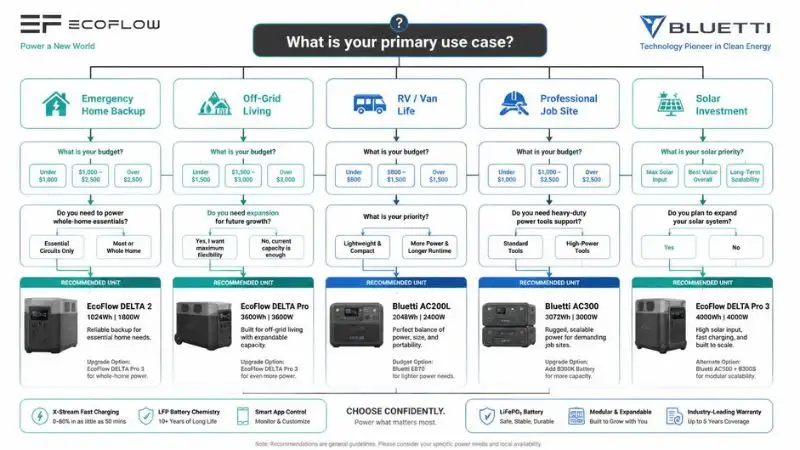
H3: Scenario-Based Recommendations
Scenario 1 — Urban apartment dweller with balcony solar: Winner and reasoning
Scenario 2 — Rural homeowner, whole-home backup priority: Winner and reasoning
Scenario 3 — Full-time RV or van-lifer: Winner and reasoning
Scenario 4 — Small business/contractor job site power: Winner and reasoning
Scenario 5 — Extreme weather emergency preparedness (hurricane/wildfire zone): Winner and reasoning
Scenario 6 — International buyer outside the US/EU (limited service infrastructure): Winner and reasoning
The Expert Verdict — EcoFlow Delta Pro Ultra vs Bluetti, Who Actually Wins?
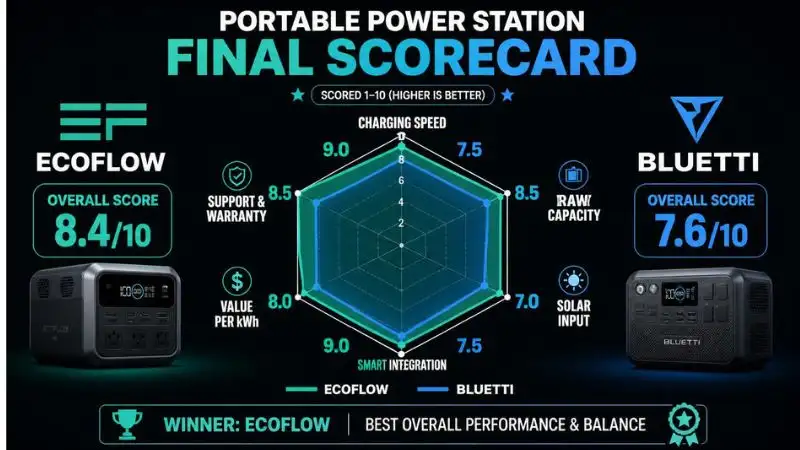
Overall winner by category (Speed | Capacity | Value | Integration | Support)
“No wrong answer” nuance — context-dependent recommendation
The one question every buyer must answer before purchasing
Final recommendation summary table