Introduction: Why Your RV’s Battery System Is Holding You Back
You drove 200 miles to a remote canyon. The sunset is perfect. Then your AGM batteries die by 9 PM — fridge warm, CPAP dead, lights out. Sound familiar?
The single most impactful upgrade any serious RV traveler can make is switching to a LiFePO4 battery upgrade kit for RV use. Not a solar panel upgrade, not a new inverter — the battery. It is the foundation every other 12V system depends on.
This article breaks down the top LiFePO4 upgrade kits available today, explains what separates a great kit from a dangerous one, and gives you the technical data you need to make a zero-regret decision. No fluff. No filler. Just the information that matters.
What Makes LiFePO4 Superior to AGM and Lead-Acid?
Lithium Iron Phosphate (LiFePO4 or LFP) is not just a chemistry upgrade — it is a fundamental shift in how energy is stored and delivered in mobile applications.
The core advantages:
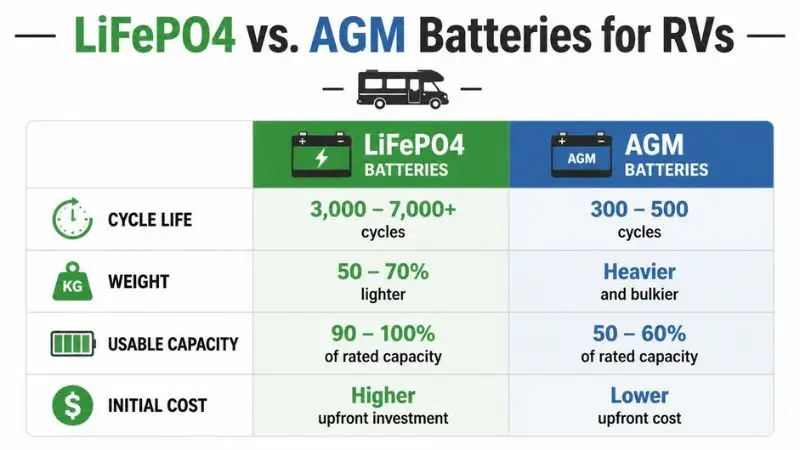
- Usable capacity: LiFePO4 delivers 80–100% of its rated capacity. AGM batteries are safely dischargeable to only 50%, meaning a 200Ah AGM bank gives you just 100Ah of real-world use. A 100Ah LFP battery matches it — at half the weight.
- Cycle life: Premium LFP cells last 2,000–5,000 charge cycles at 80% Depth of Discharge (DoD). AGM typically degrades after 300–500 cycles at 50% DoD. The math favors LFP dramatically over a 5-year ownership horizon.
- Charge speed: LFP accepts charge at up to 1C (100% of capacity per hour), versus 0.2C for AGM. A 200Ah LFP bank can fully charge in 2 hours from a 200A source.
- Voltage stability: LFP maintains a flat discharge curve (approximately 13.2–13.3V) from 10% to 90% state of charge. AGM sags to 12.0V under load well before depletion — starving inverters and appliances.
- Weight reduction: LFP is 50–60% lighter than equivalent AGM, directly improving fuel economy and payload capacity.
- No off-gassing: LFP chemistry is thermally stable and requires zero ventilation — safe for enclosed compartments.
The one honest drawback: LFP performs poorly below freezing (0°C / 32°F). Charging below this threshold damages cells permanently. Quality kits address this with internal self-heating systems — a non-negotiable feature for cold-climate RVers.
To learn more about the technical chemistry behind lithium iron phosphate cells, you can read more at Battery University.
What a Complete LiFePO4 Battery Upgrade Kit for RV Must Include
A LiFePO4 battery upgrade kit for an RV should be more than just a battery. Buying only the cells while ignoring the supporting components creates safety hazards and wasted money.
Essential kit components:
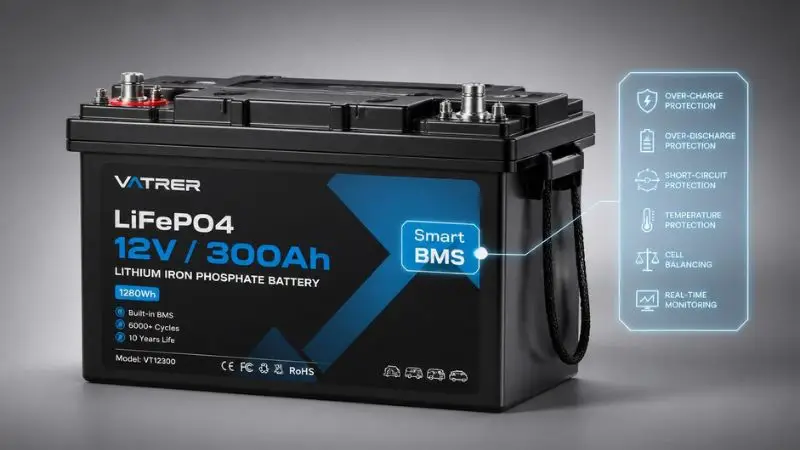
- Battery with integrated BMS: The Battery Management System (BMS) protects against overcharge, over-discharge, overcurrent, short circuit, and cell temperature extremes. Never purchase LFP cells without a quality BMS.
- Lithium-compatible DC-to-DC charger (B2B charger): Most RV alternators are not calibrated for LFP charging profiles. A B2B charger (e.g., Renogy DCC50S, Victron Orion-Tr Smart) isolates the starter battery and charges LFP correctly at 14.2–14.6V.
- Lithium-compatible battery charger/converter: Shore power converters running AGM profiles (13.6V float) will never fully charge an LFP bank. You need a converter outputting a proper bulk/absorption phase up to 14.4V.
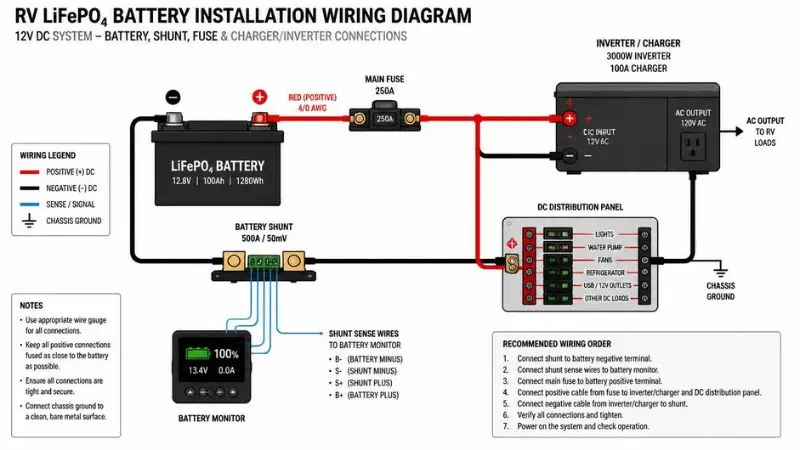
- Battery monitor/shunt: LFP’s flat voltage curve makes voltage-based SOC monitoring unreliable. A coulomb-counting shunt monitor (Victron BMV-712, Renogy 500A Shunt) is essential for accurate state-of-charge readings.
- Proper fusing and cabling: LFP can discharge at enormous instantaneous amperage. ANL fuses, appropriately sized cables (typically 2/0 or 4/0 AWG for high-capacity systems), and quality terminals are safety-critical.
Top LiFePO4 Battery Upgrade Kits for RV: Reviewed
1. Renogy 200Ah 12V Smart LiFePO4 Kit
Renogy’s packaged upgrade solution targets the mid-range RVer who wants a plug-and-play experience without proprietary lock-in.
What’s included: 200Ah Smart LFP battery (integrated 200A BMS, Bluetooth SOC monitoring), DCC50S DC-DC charger, 40A DC-DC solar charger, and Renogy One Core monitor.
Technical highlights:
- Self-heating enabled below 0°C — charges safely down to -20°C
- Supports up to 4 units in parallel (800Ah max)
- 4,000+ cycle life at 80% DoD
- Built-in Bluetooth: real-time monitoring via the Renogy DC Home app
- Weight: 47.4 lbs (vs ~120 lbs for equivalent 200Ah AGM)
Best for: Full-timers with existing Renogy solar ecosystems. The ecosystem integration is a genuine advantage — all devices communicate through the app.
Watch out for: Renogy’s proprietary protocol limits third-party BMS integration if you later expand to a mixed system.
2. Battle Born 100Ah 12V LiFePO4 Drop-In Kit
Battle Born has earned a cult following in the RV community for a reason: build quality and customer support that is genuinely exceptional.
What’s included: 100Ah 12V battery (with integrated 100A BMS), available in bundle with Victron SmartSolar MPPT and BMV-712 monitor.
Technical highlights:
- Operates from -4°F to 135°F discharge range; built-in low-temp charge protection
- 3,000–5,000 cycles at 80% DoD
- 10-year manufacturer warranty — best in class
- 2C discharge rate (200A continuous) — handles heavy inverter loads
- Modular: scalable from 100Ah to 1,200Ah by combining units
Best for: Premium buyers who prioritize longevity and post-purchase support over initial cost. The warranty alone justifies the premium for full-time RVers.
Watch out for: Premium pricing ($849–$999 per 100Ah battery). Kit cost can reach $3,000–$5,000 for a 300Ah system.
3. Ampere Time (LiTime) 300Ah LiFePO4 All-In-One Bundle
The best value proposition in the current LFP market for RVers wanting maximum capacity at minimum cost.
What’s included: 300Ah battery with 200A BMS, compatible DC-DC charger recommendations, Bluetooth monitoring, and pre-terminated cable kit.
Technical highlights:
- Grade A prismatic cells — not cylindrical cells common in budget brands
- 4,000+ cycles at 80% DoD; 2,000+ at 100% DoD
- Supports -4°F to 140°F operating range
- 100A continuous discharge; 200A BMS peak handling
- Weight: 61 lbs for 300Ah — extraordinary energy density
Best for: Budget-conscious weekenders or those building a first LFP system. Exceptional entry point without compromising cell quality.
Watch out for: BMS is rated 100A continuous, which limits use with high-draw inverters (2000W+). Pair with a 200A BMS upgrade if running large loads.
4. Victron Energy LiFePO4 Smart Battery + Ecosystem Kit
Victron is the gold standard for professional marine and RV electrical installations globally. Their LFP batteries are engineered for systems integrators, not casual upgrades.
What’s included (custom bundle): Victron LiFePO4 Smart Battery (25.6V or 12.8V options), Victron VE.Bus BMS, Orion-Tr Smart DC-DC charger, SmartSolar MPPT, BMV-712 Smart shunt, Color Control GX display.
Technical highlights:
- VE.Can / VE.Direct / Bluetooth networking — full system telemetry from a single interface
- 2,500+ cycles; rated to IEC 62619 safety standard
- Pre-programmed charge profiles for every Victron charger in the ecosystem
- Remote monitoring via VRM portal (cloud-based)
- Available in 12V, 24V, 48V configurations
Best for: Complex full-time builds, solar-heavy systems, or anyone who needs professional-grade remote diagnostics. Installers and serious DIYers building a long-term system.
Watch out for: Highest upfront cost in this roundup. Ecosystem dependency is total — mixing with non-Victron components requires careful configuration.
5. SOK 206Ah 12V LiFePO4 Battery with Self-Heating
SOK has rapidly established itself as the best value-to-specification ratio for cold-climate RVers.
What’s included: 206Ah battery with 100A BMS, built-in self-heating system, Bluetooth monitoring app, and included ANL fuse.
Technical highlights:
- Self-heating activates at 41°F (5°C) — protects cells without an external relay
- Grade A EVE cells (same supplier used by premium brands)
- Bluetooth SOC monitoring with temperature data
- 4,000+ cycles at 80% DoD
- UL component recognition
Best for: Four-season campers in cold climates (PNW, Rocky Mountains, Alaska). The self-heating at this price point is unmatched.
Watch out for: 100A BMS limits inverter size. Parallel wiring requires careful busbar configuration.
Technical Comparison Table: Top LiFePO4 Upgrade Kits for RV
| Feature | Renogy 200Ah | Battle Born 100Ah | LiTime 300Ah | Victron Smart | SOK 206Ah |
|---|---|---|---|---|---|
| Usable Capacity | 160Ah (80%) | 80Ah (80%) | 240Ah (80%) | Varies | 165Ah (80%) |
| BMS Rating | 200A | 100A | 200A peak | VE.Bus | 100A |
| Cycle Life | 4,000+ | 3,000–5,000 | 4,000+ | 2,500+ | 4,000+ |
| Self-Heating | Yes | No | No | No | Yes |
| Monitoring | Bluetooth App | App + Victron | Bluetooth App | VRM Portal | Bluetooth App |
| Warranty | 5 Years | 10 Years | 5 Years | 5 Years | 5 Years |
| Weight | 47.4 lbs | 29 lbs | 61 lbs | Varies | 44 lbs |
| Approx. Price | $699–$850 | $849–$999 | $599–$749 | $1,200–$2,500+ | $499–$599 |
| Best For | Ecosystem users | Premium/warranty | Budget/capacity | Pro builds | Cold climates |
How to Size Your LiFePO4 Battery Upgrade Kit for RV
Buying the wrong capacity is the most common — and most expensive — mistake in RV battery upgrades.
Step 1: Calculate your daily Amp-hour (Ah) consumption.
List every 12V load in your RV:
| Appliance | Watts | Hours/Day | Daily Ah (÷12V) |
|---|---|---|---|
| Refrigerator | 50W avg | 24 | 100Ah |
| LED Lighting | 30W | 5 | 12.5Ah |
| CPAP w/humidifier | 60W | 8 | 40Ah |
| Phone/Laptop | 100W | 3 | 25Ah |
| Water Pump | 60W | 0.5 | 2.5Ah |
| Total | ~180Ah/day |
Step 2: Add your buffer. Never discharge LFP below 20% regularly. For 180Ah consumption, target a bank of at least 225Ah usable → 280–300Ah rated capacity.
Step 3: Match your charge sources. A 300Ah LFP bank recharged by a single 30A converter takes 10+ hours on shore power. Size your solar or B2B charger to replenish 80% of daily consumption within daylight hours (typically 5 peak sun hours).
Critical Installation Mistakes That Kill LiFePO4 Batteries
“Even with a high-quality setup, electrical issues can sometimes occur. If you ever face unexpected power cutoffs, refer to our guide onhow to troubleshoot your power stationto diagnose the problem.”
Mistake 1: Using an AGM charger profile. AGM chargers float at 13.6V. LFP requires 14.2–14.6V bulk absorption to reach 100% SOC. Running an AGM profile chronically undercharges LFP — you’ll live at 80% capacity while thinking you’re full.
Mistake 2: No B2B charger on the alternator circuit. Connecting LFP directly to your chassis alternator causes the alternator to run at maximum output continuously, overheating and failing within months. A DC-DC charger limits current to safe alternator levels.
Mistake 3: Undersized wiring. A 200Ah LFP at 2C discharge pushes 400A. Even at 100A continuous, 10 AWG wire creates resistance, voltage drop, and fire risk. Use a wire gauge calculator for every run — no shortcuts.
Mistake 4: No low-temperature protection in freezing climates. Charging LFP below 0°C (32°F) causes lithium plating on the anode — irreversible damage. If your BMS lacks a low-temp cutoff, add a heating pad with a thermostat or buy a self-heating battery.
Mistake 5: Mixing old AGM with new LFP. LFP and AGM have different voltage profiles. Wiring them in parallel creates an uncontrolled charging scenario where LFP pulls current from AGM unpredictably. Always run separate banks.”For detailed safety protocols on battery installations, always refer to the National Fire Protection Association (NFPA) guidelines for mobile electrical systems.”
LiFePO4 Battery Upgrade Kit for RV: ROI Analysis
The sticker price shock is real. A quality LiFePO4 battery upgrade kit for RV costs 3–5× more than AGM upfront. Here is the 5-year math:
Scenario: 200Ah usable capacity, 300 cycles/year (full-time RVer)
| Metric | AGM (4×100Ah) | LiFePO4 (200Ah kit) |
|---|---|---|
| Upfront Cost | $600 | $1,400 |
| Usable Capacity | 200Ah (50% DoD) | 160–200Ah (80% DoD) |
| Cycle Life at Usage Rate | ~18 months | 6–13+ years |
| Replacements Over 5 Years | 3× ($1,800 total) | 0× |
| 5-Year Total Cost | $2,400 | $1,400 |
| Weight Penalty | 240 lbs | 47–50 lbs |
The conclusion is unambiguous: LFP is cheaper over any ownership period exceeding 2 years. The upfront premium is not a luxury — it is a long-term cost reduction.
Frequently Asked Questions
Q: Can I drop LiFePO4 batteries directly into my existing RV battery box? In most cases, yes — 12V LFP batteries are dimensionally compatible with Group 24, 27, and 31 AGM sizes. However, you must upgrade your charger, converter, and solar charge controller to lithium-compatible profiles before connecting.
Q: Do LiFePO4 batteries require a special inverter? No. LFP works with any pure sine wave or modified sine wave inverter. The advantage is that LFP’s flat voltage curve keeps inverter efficiency stable across the entire discharge cycle — unlike AGM, which triggers low-voltage shutoff prematurely.
Q: Is a 100Ah LiFePO4 battery enough for weekend camping? For a couple with LED lighting, a 12V fridge, and phone charging, a 100Ah LFP provides approximately 24–30 hours of runtime before needing a charge. With 200W of solar, it is indefinitely sustainable in most conditions.
Q: What is the minimum solar array needed to support a 200Ah LFP bank? To recover 160Ah (80% DoD) in 5 peak sun hours, you need a 200A MPPT charge rate → approximately 600–800W of solar panels with a 40–60A MPPT controller. Undersized solar creates chronic partial-state-of-charge conditions that reduce LFP longevity.
Conclusion: The LiFePO4 Upgrade Is the Single Best RV Investment
Every serious off-grid RVer eventually arrives at the same conclusion: the LiFePO4 battery upgrade kit for RV is not an optional upgrade — it is the foundation of a functional, reliable, and enjoyable mobile power system.
The kits reviewed here span every budget and use case:
- Best value: Ampere Time 300Ah for maximum capacity at minimum cost
- Best premium: Battle Born with its unmatched 10-year warranty
- Best cold-climate: SOK 206Ah with integrated self-heating
- Best ecosystem: Renogy for solar-integrated setups
- Best professional: Victron for complex, long-term builds
The true cost of staying with lead-acid is not just money — it is the discomfort of dead batteries, the anxiety of watching voltage meters, and the missed experiences that come from a power system you cannot trust.
Upgrade your LiFePO4 battery upgrade kit for RV once. Do it right. And never think about your batteries again.
“For further reading on standardized RV electrical practices, check out the RV Industry Association (RVIA) technical resources.”
Tags: LiFePO4 battery upgrade kit for RV, best RV lithium batteries, off-grid RV power, LFP battery comparison, Battle Born vs Renogy LiFePO4, RV solar battery bank, self-heating lithium battery RV
Disclaimer: Prices are approximate and subject to change. Always verify compatibility with your specific RV electrical system before purchasing. Consult a certified RV electrician for high-capacity installations.