In This Article
| Section | Description |
| 1. The Trend of Cheap DIY Expansion | Why do users try connecting 12V batteries to power stations? |
| 2. The Big Technical Problem Explained | The math behind why 12V setups cause major efficiency loss. |
| 3. Risk of Equipment Damage | How this setup overworks and overheats your solar generator. |
| 4. Professional Recommendations | Safe and efficient alternatives for expanding your off-grid power. |
| 5. Frequently Asked Questions (FAQs) | Quick answers to burning user questions. |
Introduction
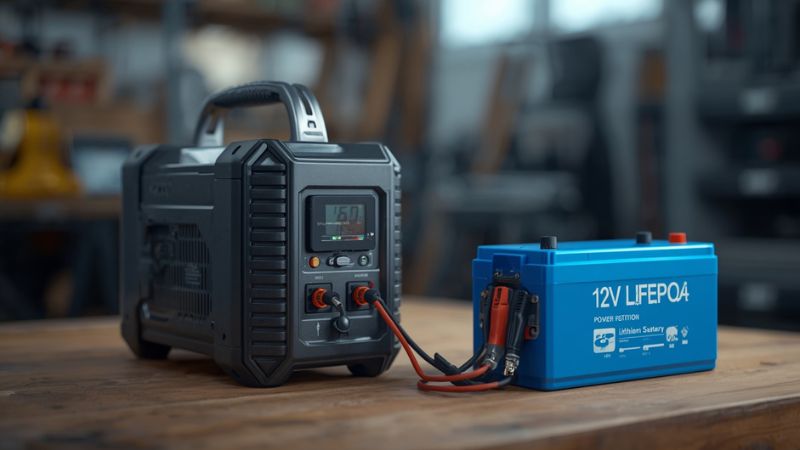
Portable power stations (also known as solar generators) have completely transformed off-grid living, emergency backup, and camping setups. However, as energy demands grow, buying official brand-name expansion battery packs can quickly become incredibly expensive. This high cost has driven a massive DIY trend online: linking a cheap, external 12V LiFePO4 battery directly to the solar charge input of a power station to boost capacity on a budget.
While it sounds like a brilliant money-saving hack on paper, hooking up a standard 12V battery directly as an expansion unit introduces a massive technical flaw. In this comprehensive guide, we break down the engineering reality, the efficiency losses, and the hidden risks of expanding your portable power station using a 12V battery.
💡 Did You Know?
Most modern portable power stations operate internally on higher voltage battery chemistry (often $24\text{V}$, $48\text{V}$, or higher). Connecting a low-voltage external power source like a 12V battery forces the internal components to work twice as hard just to process the incoming energy!
The Big Technical Problem: Voltage and Efficiency Loss
The main roadblock when connecting a 12V battery to a power station’s solar input port comes down to voltage limitations and MPPT (Maximum Power Point Tracking) behavior.
A fully charged 12V Lithium Iron Phosphate ($\text{LiFePO}_4$) battery typically sits around $13.2\text{V}$ to $13.6\text{V}$. When you plug this into the DC/Solar input charging port of a power station, the power station treats it exactly like a solar panel. However, most mid-to-large-sized power stations require a much higher minimum voltage input to reach their maximum charging speeds.
The Amp Limit Bottleneck
Most solar generators limit their incoming current (amperage) through the DC input port—usually capping it at $10\text{A}$, $12\text{A}$, or $15\text{A}$. Because electrical power is calculated as $\text{Watts} = \text{Volts} \times \text{Amps}$, plugging in a low-voltage source severely caps your total charging power.
For instance, if your power station has a strict $10\text{A}$ input limit:
$$\text{Max Power Input} = 13\text{V} \times 10\text{A} = 130\text{W}$$
Even if you connect a massive, high-capacity 12V $300\text{Ah}$ battery capable of delivering thousands of watts, your power station will painfully choke the intake down to just around $130\text{W}$. This means it would take ages to actually draw that extra power into your system, making it incredibly inefficient for real-time heavy appliance usage.
📝 Definition Box
MPPT (Maximum Power Point Tracking): An electronic system built into modern power stations that optimizes the variable voltage coming from solar panels to charge the internal battery at maximum efficiency. It is designed for fluctuating solar input, not for a constant, stiff voltage source like a lead-acid or LiFePO4 battery.
Risk of Equipment Damage and Heat Build-Up
Aside from agonizingly slow transfer speeds, forcing a power station to constantly pull power from a continuous 12V battery source generates immense thermal stress.
- Constantly Maxing Out Internal Circuitry: Solar panels naturally fluctuate in power as clouds pass by, allowing the internal charge controller to cool down. A 12V battery, however, pushes a continuous, unyielding maximum amp load into the system for hours on end.
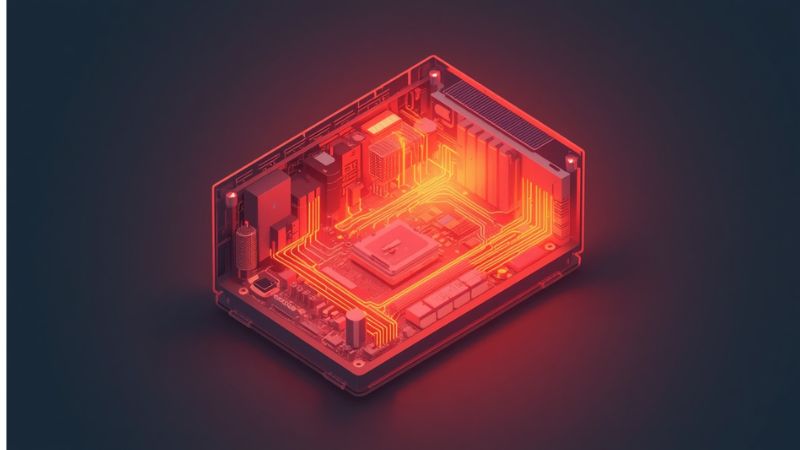
- Excessive Heat Generation: Pushing the internal MPPT controller to its absolute limits non-stop turns the internal components into a heater. Excessive heat is the number one killer of lithium cell longevity and internal circuit boards.
- Voided Warranties: Most manufacturers explicitly state in their manuals that the DC/Solar port is strictly rated for solar arrays or standard car cigarette lighters. Intentionally feeding it continuous high-current power from raw external battery banks can void your consumer warranty if the unit burns out.
Professional Recommendations: How to Expand Properly
If you need more off-grid battery capacity without ruining your equipment or experiencing extreme efficiency loss, consider these professional alternatives:
- Use Higher Voltage External Batteries: Instead of a single 12V battery, opt for a 24V or 48V battery bank if your power station’s DC input voltage range allows it (e.g., up to $60\text{V}$ or $150\text{V}$). Higher voltage dramatically increases wattage without exceeding the amp limit.
- Invest in Official Expansion Smart Batteries: While they cost more upfront, official brand expansion packs plug into dedicated, heavy-duty expansion ports that bypass the solar charge controller entirely, connecting directly to the internal battery bus safely.
- Run Parallel Dedicated Inverters: Instead of expanding one unit, use your external 12V battery with its own separate, cheap standalone inverter to power independent devices.
View Article Sources
- The Solar Lab Plus Engineering Analysis: Comprehensive real-world testing on solar generator charge ports.
- Victron Energy Guide on MPPT Charge Controllers: In-depth technical documentation covering the relationship between input voltage and charging efficiency.
Frequently Asked Questions (FAQs)
1. Will connecting a 12V battery directly damage my solar generator?
It is unlikely to cause immediate damage if the voltage stays within the unit’s rated limits, but it forces the internal MPPT controller to run continuously at its maximum amperage limit, generating excessive internal heat that can degrade components over time.
2. Why is my power station only pulling 100W to 130W from my large 12V battery?
This occurs because your power station has an internal current limit (usually $10\text{A}$ or $12\text{A}$) on its charge port. Because power equals voltage multiplied by amperage, the low $12\text{V}$ profile mathematically caps the total wattage intake.
3. Can I use a Step-Up (Boost) Converter to solve this problem?
Yes, using a high-quality 12V-to-24V or 12V-to-48V DC-DC boost converter can increase the voltage, allowing you to pull more wattage through the same amp-limited port. However, cheap converters introduce additional power conversion losses and create another failure point.