
Chapter 1: Introduction to Energy Star – Why It Matters in 2026
Welcome to the future of home management. In 2026, our homes are smarter and more connected than ever before. However, as technology advances, so does our need for power. Whether you are moving into your first apartment or upgrading a lifelong family home, one small blue sticker remains the most important tool in your pocket: the Energy Star label.
Understanding this label isn’t just for “techies” or engineers anymore. It is a fundamental skill for anyone who wants to lower their monthly bills and live a more sustainable life. In this chapter, we will break down what Energy Star looks like today and why it is your secret weapon for financial freedom.
The Global Shift Toward Energy Efficiency
The world has changed significantly over the last few years. Energy prices fluctuate, and the push for “green living” has moved from a niche trend to a global standard. Today, energy efficiency is no longer just about being kind to the planet; it is about economic survival.
Governments across the globe have introduced stricter regulations on the power consumption of refrigerators, air conditioners, and washing machines. This shift has forced manufacturers to innovate. Modern appliances are now designed to do more work while using a fraction of the electricity they required just a decade ago.
When you walk into an appliance store or browse an online retailer in 2026, you are surrounded by these efficiency ratings. The “Global Shift” means that products are now judged by their long-term value, not just their sticker price. A cheap appliance that wastes energy is actually more expensive than a premium, efficient one when you factor in five years of electricity bills.
What is Energy Star? (The 2026 Definition)
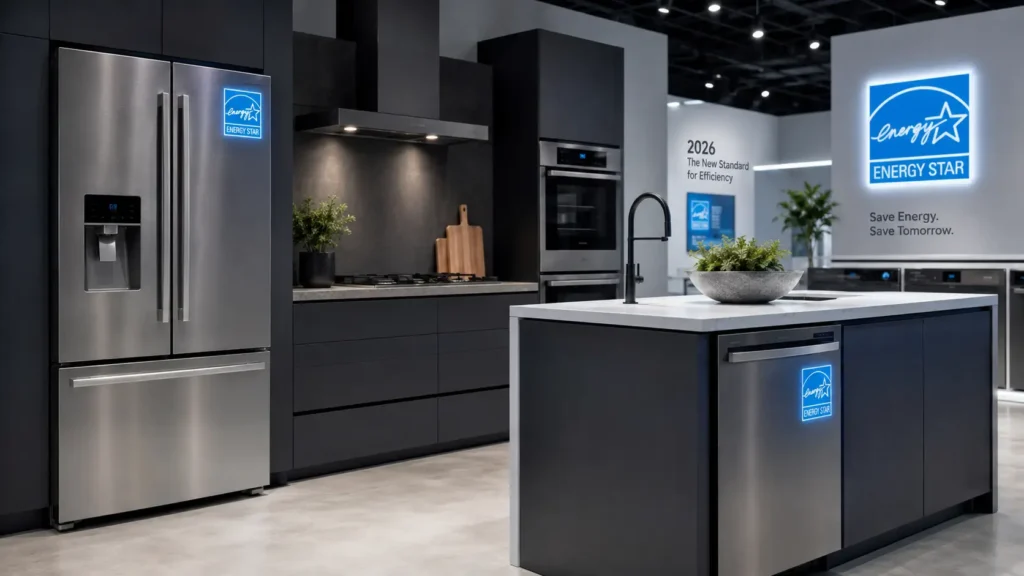
Simply put, Energy Star is a government-backed symbol for energy efficiency. It was created to help consumers identify products that save money and protect the environment without sacrificing performance.
In 2026, the definition has expanded. An Energy Star-certified product must meet rigorous climate-neutral standards. It isn’t just about how much power the machine uses while it’s running; it’s about how efficiently it manages standby power, how well it integrates with smart grids, and its overall durability.
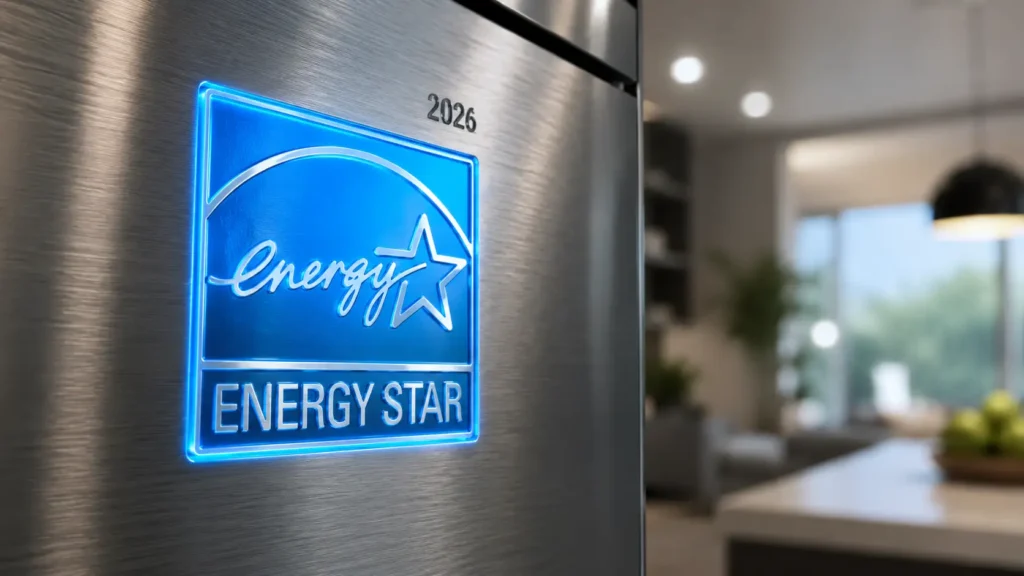
When you see that blue star, it means the product has been independently certified to use less energy than standard models. It acts as a bridge of trust between the manufacturer and you, the buyer. Without this label, you would have to take the salesperson’s word for it. With the label, you have verified data.
Definition Box
Energy Efficiency Ratio (EER) The Energy Efficiency Ratio (EER) is a measure of how efficiently a cooling system (like an air conditioner) operates. It is calculated by dividing the cooling output (in British Thermal Units or BTUs) by the power input (in watts). The higher the EER, the more cooling you get for every dollar spent on electricity.
Why understanding these labels is your best money-saving tool.
Most people focus on the price tag when buying a new dryer or dishwasher. This is a mistake. The real cost of an appliance is the Purchase Price + Operating Cost. This is where the Energy Star label becomes your financial advisor.
By learning to read the estimated yearly operating cost on these labels, you can predict exactly how much a device will add to your utility bill. In 2026, with the rise of tiered energy pricing (where electricity costs more during peak hours), having an efficient appliance can save a household between $150 to $600 per year. Over the life of the appliance, that is thousands of dollars back in your pocket.
Furthermore, Energy Star products often qualify for “Smart Rebates.” Many utility companies will actually pay you or give you a credit on your bill just for choosing a certified model. If you don’t know how to read the label, you might miss out on these “hidden” savings.
Did You Know Box
Since its inception in 1992, the Energy Star program has helped families and businesses save more than 5 trillion kilowatt-hours of electricity. This massive saving has prevented over 4 billion metric tons of greenhouse gas emissions from entering our atmosphere—the equivalent of taking 800 million cars off the road for a year!
How to Approach Your 2026 Energy Strategy
To get the most out of this guide, you should stop viewing appliances as “static” objects. Think of them as “energy consumers” that live in your house. Some are “hungry” and eat a lot of power, while others are “lean.”
The Energy Star label tells you exactly how much “food” (electricity) that appliance needs to stay healthy and do its job. In 2026, many labels will include a QR code that connects directly to your smartphone, showing you real-time energy prices in your specific city.
Pro-Tip: The “Golden Rule” of Upgrading
If your current major appliance (fridge, AC, or washer) is more than 10 years old, replacing it with a 2026 Energy Star certified model will usually pay for itself in energy savings within 3 to 5 years. Always check your local utility website for “Instant Rebates” before you buy!
Summary of Why We Use Labels Today
As we move into the next chapters, keep these three goals in mind:
- Transparency: Labels stop companies from making false claims about being “eco-friendly.”
- Comparison: Labels let you compare a Samsung fridge to an LG fridge using the same metrics.
- Future-Proofing: Energy-efficient homes have a higher resale value. A house filled with Energy Star appliances is much easier to sell than one filled with “power-hungry” older models.
In the next section, we will look at the actual “Anatomy” of the label. We will go beyond the blue star and look at the yellow “EnergyGuide” sticker to find the hidden numbers that truly matter.
Chapter 2: Decoding the Anatomy of an Energy Star Label
Now that we understand why energy efficiency is the gold standard in 2026, it is time to get practical. When you stand in front of a new washing machine or refrigerator, you are usually greeted by two main things: a bright yellow sticker and a small blue logo.
To the untrained eye, these look like boring legal requirements. But to someone who knows how to read them, they are a roadmap to savings. In this chapter, we are going to perform “surgery” on these labels. We will break them down piece by piece so you know exactly what every number and symbol means for your bank account.
Breaking Down the Yellow and Blue Stickers
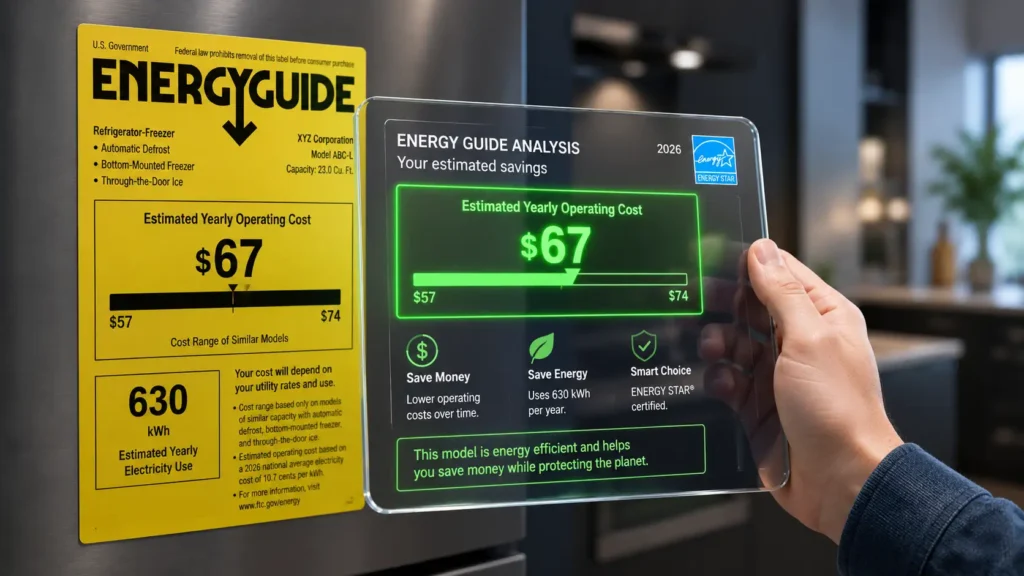
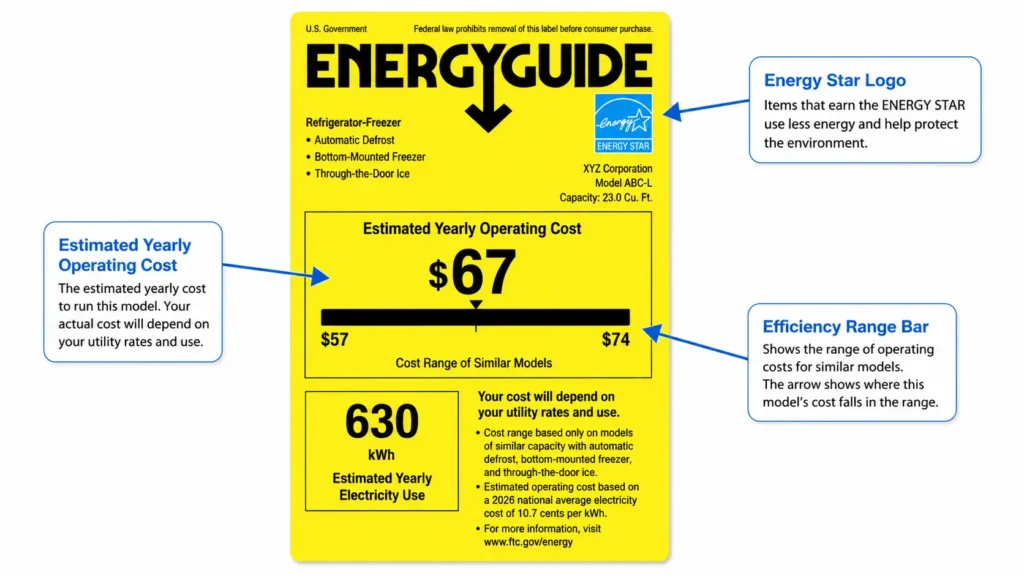
The first thing you need to realize is that the yellow sticker (the EnergyGuide) and the blue logo (Energy Star) are partners, but they do different jobs. The yellow sticker gives you the raw data—the numbers and the math. The blue logo is the seal of approval that tells you this specific model is among the best in its class.
In 2026, these stickers have become even more detailed. They now account for smart features and “always-on” connectivity that older appliances didn’t have. Understanding how these two work together is the first step to becoming a savvy shopper.
The Logo: What the “Blue Star” actually certifies.
The Energy Star logo is more than just a pretty design. When you see that blue star, it means the appliance has passed a series of strict tests. It isn’t just about using less electricity; it is about maintaining high performance while doing so.
For example, a “certified” dishwasher cannot just use less water; it must also get your dishes perfectly clean. If a machine saves energy but doesn’t do its job, it won’t get the star. In 2026, this certification also ensures that the product’s “Standby Mode” (when the machine is off but plugged in) uses almost zero power.
When you spot the logo, you are looking at a product that is typically 10% to 20% more efficient than the government minimum standard. It is the quickest way to filter out “power-hungry” models during your search.
Definition Box:
EnergyGuide Label This is the bright yellow tag required by law to be displayed on most household appliances. It shows the estimated annual energy consumption and operating cost so consumers can compare the efficiency of different models before buying.
Estimated Yearly Operating Cost: Reading the fine print.
Right in the center of the yellow label, you will see a large dollar amount. This is the Estimated Yearly Operating Cost. Most people look at this number and think it is exactly what they will pay. However, there is some “fine print” you need to understand.
This cost is calculated based on a national average electricity rate. If you live in a city where power is expensive, your actual cost will be higher. If your electricity is cheap, it will be lower.
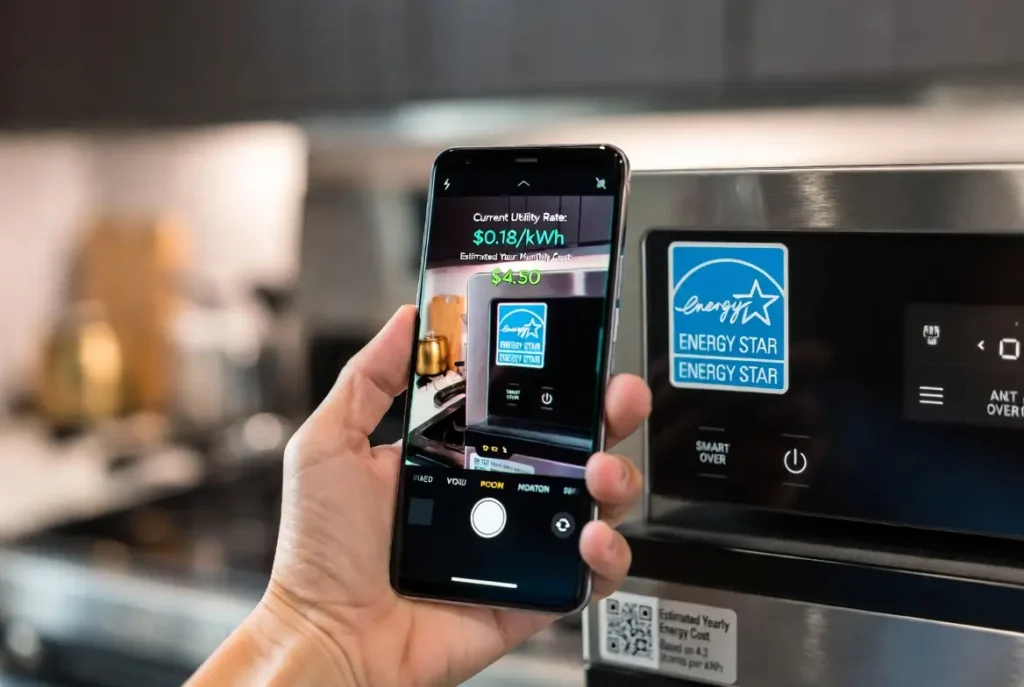
In 2026, many manufacturers have added a small QR code next to this dollar amount. When you scan it, you can input your specific zip code, and it will calculate the cost based on your local utility’s current rates. This is a game-changer for accuracy!
Did You Know Box
The yellow color of the EnergyGuide label was chosen specifically because it is one of the most eye-catching colors to the human brain. It was designed to ensure that even in a crowded, brightly lit store, your eyes would be drawn to the energy facts before you looked at the price tag.
Understanding the Efficiency Scale
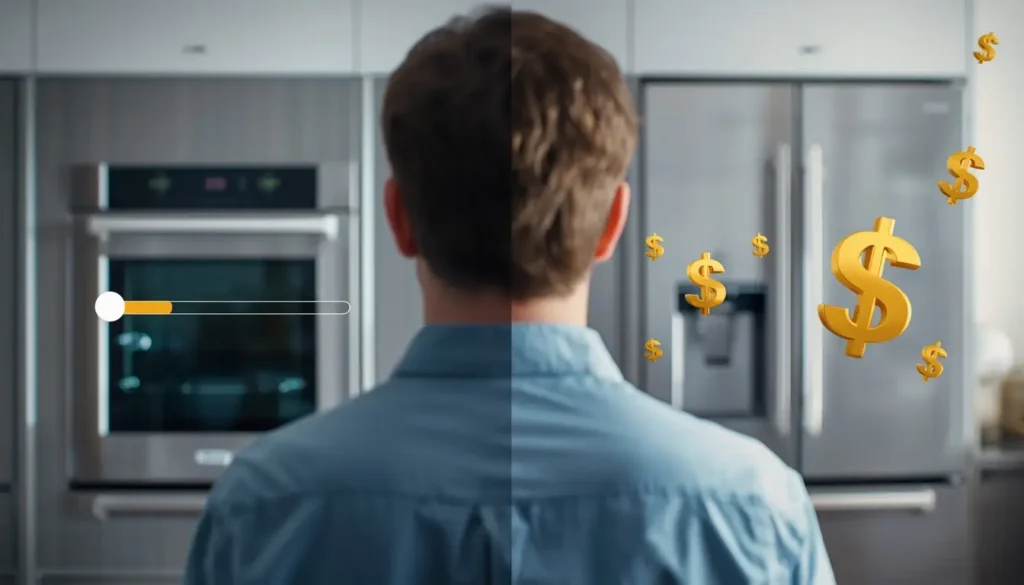
Below the yearly cost, you will see a long horizontal bar with a slider. This is called the Efficiency Scale or the Range of Cost. This is perhaps the most misunderstood part of the entire label, yet it is one of the most valuable.
This scale doesn’t just look at one machine. It shows you the “neighborhood” of similar appliances. It tells you the lowest operating cost and the highest operating cost for all models of the same size and type.
How your appliance compares to similar models.
Imagine you are looking at a 25-cubic-foot refrigerator. The scale will show you that the most efficient model in the world costs $40 a year to run, while the least efficient costs $90.
If the model you are looking at is toward the left side of the bar (the lower cost side), you are looking at a winner. If it is in the middle or toward the right, it means there are many better options available for the same size.
In 2026, the scale has been updated to include “Smart Integration” tiers. This means it now compares how well the appliance works with solar panels and home battery systems. A model that can “talk” to your smart home to run only when electricity is cheapest will be positioned further to the left on this scale.
The “kWh” Mystery
Finally, you will see a number followed by kWh/year. This stands for Kilowatt-hours per year. While the dollar amount is an estimate, the kWh is the actual “physical” amount of electricity the machine uses.
As we move toward 2030, many people are looking at this number more than the dollar amount. Why? Because electricity prices change, but the kWh usage of a machine stays the same. If you know you use a certain amount of power, this number helps you balance your total home “energy budget.”
Pro-Tip: Always check the “Range of Cost” bar
Never look at the dollar amount in isolation. Always look at the “Range of Cost” bar below it. A fridge might say “$50/year,” which sounds cheap, but if the bar shows that other similar fridges cost “$35/year,” you are still looking at an inefficient model for its class.
Why Decoding Matters for Your 2026 Goals
By the time you finish reading this chapter, you should feel like you have “X-ray vision” in the appliance aisle. You are no longer just looking at a white box with a price tag. You are looking at:
- The Certification: Does it have the Blue Star?
- The Cost: What is the estimated yearly spend?
- The Comparison: Where does it sit on the efficiency scale compared to its peers?
When you combine these three pieces of information, you stop being a “shopper” and start being a “smart investor.” Your home is an asset, and the appliances inside are the engine that keeps it running.
In the next chapter, we are going to dive deeper into the world of Kilowatt-Hours (kWh). We will show you the simple math to turn those confusing numbers into real-world currency so you can predict your utility bills with 99% accuracy.
Chapter 3: Kilowatt-Hours (kWh) Explained for Beginners
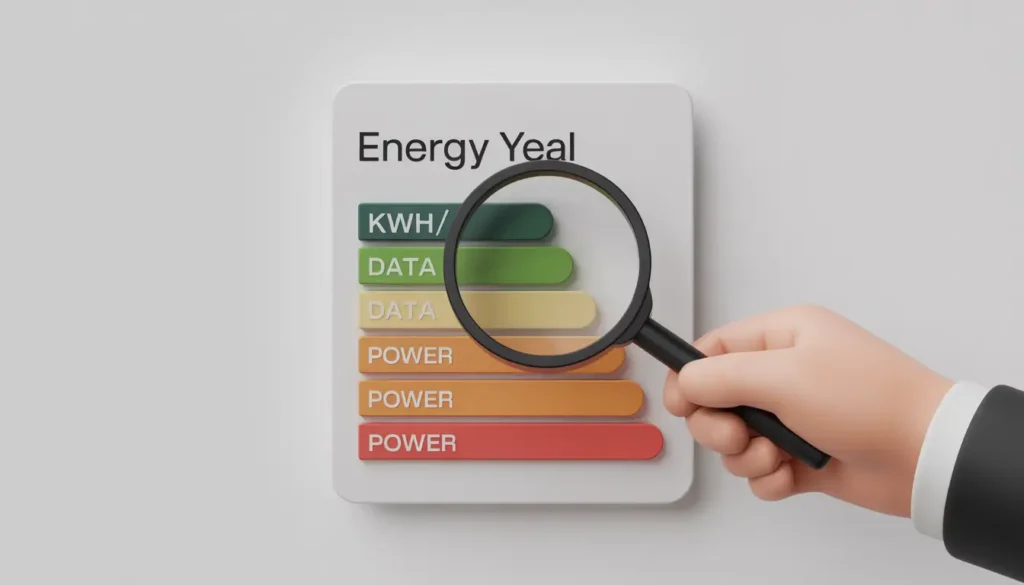
When you look at a yellow EnergyGuide label, your eyes probably jump straight to the big dollar sign in the middle. While that number is helpful, it is actually just an estimate. If you want to master your home’s energy budget in 2026, you need to look at the smaller number located at the bottom of the label: the Kilowatt-Hour (kWh).
This number is the pulse of your appliance. It tells you exactly how much “fuel” the machine consumes, regardless of whether electricity prices go up or down. In this chapter, we are going to strip away the technical confusion and explain the math of your monthly bill in a way that actually makes sense.
The Math Behind Your Monthly Bill
Understanding your electricity bill shouldn’t require a degree in mathematics. Most of us just pay the total at the end of the month without knowing why the price changed. The secret lies in how your utility company tracks your usage.
Every appliance in your home—from the smallest toaster to the largest central air system—pulls energy from the grid. The more “work” an appliance does, the more energy it pulls. In 2026, with smart meters becoming the standard, tracking these numbers has become more precise. If you know the kWh rating of your appliances, you can predict your bill before it even arrives in your inbox.
What is a Kilowatt-Hour (kWh)?
To understand a kilowatt-hour, let’s break the word apart. A “watt” is a measure of power. A “kilowatt” is simply 1,000 watts. The “hour” part describes how much of that power is used over 60 minutes.
Think of it like a car’s fuel tank. If a “watt” is how fast you are burning gas, a “kilowatt-hour” is the total amount of gas you used to drive for an hour. It is the standard unit of measurement used by utility companies worldwide to charge you for electricity.
On an Energy Star label, the number you see (e.g., 630 kWh) represents the Estimated Yearly Electricity Use. This is the total amount of “fuel” the government expects that specific appliance to consume over 365 days of typical use.
Definition Box:
Kilowatt-Hour (kWh) A kilowatt-hour is a unit of energy equivalent to using 1,000 watts of electricity for one hour. It is the standard unit used by utility providers to calculate your monthly energy consumption and billing.
Converting kWh on the label to actual currency.
This is where the magic happens. Since the dollar amount on the yellow label is based on a national average (which might be higher or lower than your actual rate), you should do your own quick “napkin math.”
To find out what an appliance will actually cost you:
- Step 1: Look at your most recent electricity bill and find your “Rate per kWh” (e.g., $0.15 or $0.22).
- Step 2: Find the kWh number on the appliance’s EnergyGuide label.
- Step 3: Multiply those two numbers together.
For example, if a refrigerator uses 600 kWh per year and your local rate is $0.20 per kWh, your actual cost is $120 per year ($10 per month). In 2026, many people are finding that their local rates are much higher than the old national averages, making this calculation essential for avoiding “bill shock.”
Did You Know Box
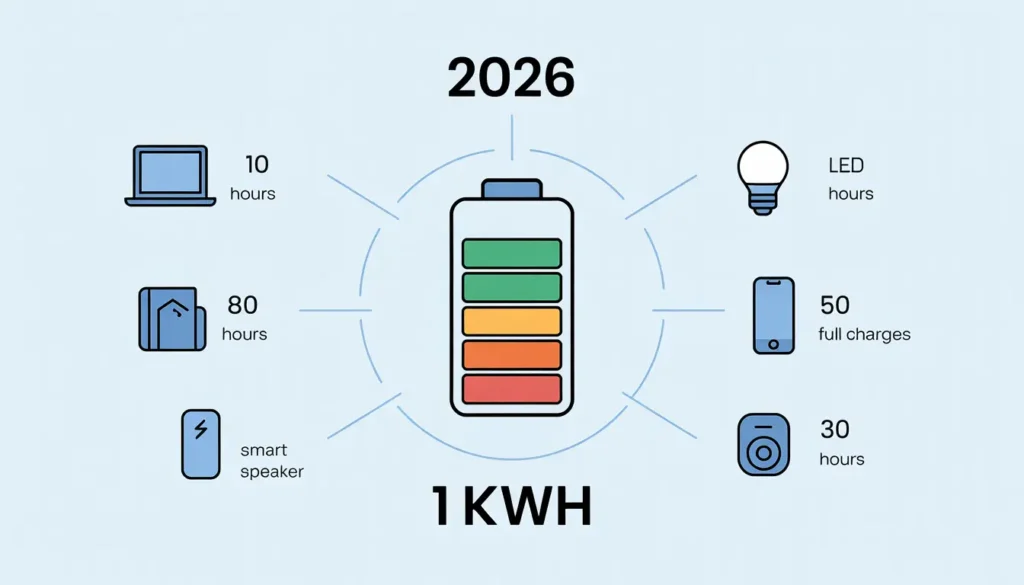
One single kilowatt-hour (1 kWh) is enough energy to power a modern, high-efficiency LED light bulb for over 80 hours! Alternatively, it can power a standard laptop for about 10 hours of continuous work.
Why “Low kWh” isn’t always the full story.
You might be tempted to just run into a store and grab the appliance with the lowest kWh number. While a lower number is generally better, you have to consider the “Value vs. Use” ratio.
For instance, a tiny, compact refrigerator will always have a lower kWh rating than a massive, French-door family refrigerator. However, the compact fridge might be very inefficient for its size, while the large one might be an “Energy Star Most Efficient” model that uses very little power for its massive capacity.
In 2026, we also have to account for “Smart Grid” features. Some appliances might have a slightly higher kWh rating on paper, but they have the ability to shift their power usage to nighttime when electricity is cheaper. This means that even though they use the same amount of “energy,” they cost you less “money.”
Common Mistakes: Ignoring the “Estimated Yearly Electricity Use” box.
The biggest mistake shoppers make is looking only at the “Range of Cost” bar and ignoring the actual kWh box. The range bar compares the model to similar models, but it doesn’t tell you the total impact on your specific home’s power grid.
If you are upgrading multiple appliances at once, those kWh numbers add up quickly. If you add three new “average” appliances, you might accidentally push your home into a higher “usage tier” with your utility company, where every kilowatt-hour becomes more expensive. Always keep a running total of the kWh ratings when planning a kitchen or laundry room renovation.
Pro-Tip: Use a Plug-in Monitor
If you want to see how many kWh your current old appliances are using before you buy new ones, use a simple plug-in energy monitor (like a Kill-A-Watt meter). You might discover that your 15-year-old “energy vampire” fridge is using 3 times more kWh than a new Energy Star model!
How kWh Connects to Your 2026 Lifestyle
In the world of 2026, energy isn’t just a bill; it’s a resource. Many homeowners are now using solar panels or home batteries. When you understand kWh, you can size your solar system perfectly.
If your home’s total appliance load is 8,000 kWh per year, you know exactly how many solar panels you need to produce that energy. By choosing Energy Star appliances with lower kWh ratings, you can actually buy a smaller and cheaper solar power system. Efficiency is the first step toward energy independence.
In the next chapter, we are going to take these lessons into the kitchen. We will look specifically at refrigerators and dishwashers—the two appliances that usually work the hardest and eat the most kilowatt-hours in your home.
Chapter 4: Energy Star for Kitchen Appliances
The kitchen is the heart of the home, but in 2026, it is also the headquarters of your energy consumption. Unlike a vacuum cleaner or a toaster that you use for a few minutes, kitchen appliances like refrigerators run every second of every day. This makes the Energy Star label in this room more valuable than anywhere else in your house.
In this chapter, we are going to look specifically at the heavy hitters: refrigerators, freezers, and dishwashers. We will explore how new technology has changed what you should look for on the label and how to pick a winner for your kitchen.
Refrigerators and Freezers: The 24/7 Power Users
Because your refrigerator never takes a break, even a tiny difference in efficiency can add up to huge savings over ten years. In the past, refrigerators were simple cooling boxes. Today, they are sophisticated machines that manage humidity, temperature zones, and even your grocery list.
When you look at a refrigerator label today, you aren’t just looking at how much cold air it makes. You are looking at how intelligently it manages that cold air. Newer models are designed to stay sealed more tightly and recover their temperature faster after you open the door to grab a snack.
Reading labels for Smart Fridges with AI cooling.
In 2026, many high-end refrigerators will come equipped with AI-driven cooling systems. These systems learn your habits. For example, if the fridge knows you usually make dinner at 6:00 PM, it might pre-cool the interior slightly before you start opening the door frequently.
On the Energy Star label for these smart models, you will notice that the “Estimated Yearly Electricity Use” is often lower than that of traditional models of the same size. This is because the AI reduces “cycling”—the process of the motor turning on and off constantly. By running more smoothly, these fridges save wear and tear on the parts and save you money on your bill.
Definition Box:
AI Cooling Integration This refers to internal sensors and software that monitor usage patterns and external temperatures to adjust the compressor speed. This prevents energy spikes and maintains a more consistent internal environment using less power.
Did You Know Box
Modern Energy Star refrigerators use less energy than a 60-watt light bulb did a few decades ago. Even though they are larger and have more features than old models, they are incredibly efficient.
Understanding Freezer Configurations
The layout of your fridge actually affects the energy label. Generally, models with the freezer on the top are the most energy-efficient. Side-by-side models often use more power because they have more surface area that needs to be kept cold.
When you compare labels in the store, make sure you are comparing “apples to apples.” Only compare a French-door model against another French-door model to see which one truly wears the Energy Star crown.
Dishwashers: Water vs. Energy Efficiency
Many people think that washing dishes by hand saves energy, but in 2026, that is officially a myth. A certified Energy Star dishwasher is actually much more efficient than a human at a sink. It uses less water and heats that water more effectively.
When reading a dishwasher label, you are looking at a balance of two things: electricity and water. The label will tell you the estimated yearly energy use in kWh, but it also includes a rating for water gallons per cycle.
Soil Sensors and Modern Cycles
Today’s dishwashers use “soil sensors” to test how dirty the water is during the wash. If your plates are already mostly clean, the machine will shorten the cycle and use less water. This “intelligence” is reflected in the lower kWh numbers you see on the labels of top-tier models.
If you see a dishwasher with a very low yearly operating cost, it likely features a “condensation drying” system. Instead of using a high-heat electric element to bake the dishes dry, these models use a stainless steel interior to pull moisture off the dishes naturally. This saves a massive amount of electricity.
Pro-Tip: Look for the “Most Efficient” designation
For the absolute best savings, look for the “Energy Star Most Efficient” badge on the label. This is a special category for products that deliver cutting-edge energy efficiency and the latest in technological innovation. It is the “gold medal” of the energy world.
Why Capacity Matters on the Label
When you look at the dishwasher label, check the “capacity” section. Some “compact” models might have a lower yearly cost, but if you have a large family, you will end up running it twice as often.
Always choose the size that fits your lifestyle. A standard-sized dishwasher that you run once a day is almost always better than a compact one that you run three times a day. Efficiency is about the total amount of energy used to get the job done, not just the number on the sticker.
Investing in Your Kitchen’s Future
Updating your kitchen appliances is one of the fastest ways to lower your home’s total carbon footprint and your monthly expenses. In 2026, the gap between a “standard” appliance and an Energy Star “Most Efficient” appliance has never been wider.
By choosing appliances that sit on the left side of the efficiency scale, you are essentially giving yourself a monthly raise. That extra $20 or $30 you save on your utility bill every month is money that stays in your pocket for years to come.
In the next chapter, we are going to move out of the kitchen and into the laundry room. We will talk about washers and dryers—the appliances that handle the most “heavy lifting” and how to find the ones that won’t shrink your clothes or your bank account.
Chapter 5: Laundry Room Efficiency: Washers & Dryers
Moving your energy-saving mission from the kitchen to the laundry room is one of the smartest moves you can make in 2026. While a refrigerator runs constantly, laundry appliances are “heavy lifters” that pull massive amounts of power and water in short, intense bursts.
If you are still using a washer or dryer from a decade ago, you are likely spending twice as much as you need to per load. In this chapter, we are going to look past the simple dollar signs on the label and dive into the specific metrics that define a truly efficient laundry pair in 2026.
IMEF and IWF: The Hidden Metrics
When you look at the Energy Star label for a washing machine, you will see the familiar kWh number we discussed in Chapter 3. However, washing machines are unique because they deal with both electricity and water. To give you a complete picture of efficiency, experts use two specific ratings: IMEF and IWF.
In 2026, these metrics will have become the industry standard for comparing high-performance machines. While they might sound like alphabet soup, understanding them is the key to finding a machine that cleans your clothes without draining your bank account.
Integrated Modified Energy Factor (IMEF) explained.
The IMEF is a number that tells you how much energy the clothes washer uses throughout its entire cycle. This isn’t just about spinning the drum; it accounts for the energy used to heat the water and even the energy used to pull moisture out of the clothes during the final spin.
A higher IMEF number is what you want to see. It means the machine is getting more “work” done for every bit of electricity it consumes. In 2026, the most efficient front-loading machines often have an IMEF that is significantly higher than older top-loading models.
Why water factor matters for your utility bill.
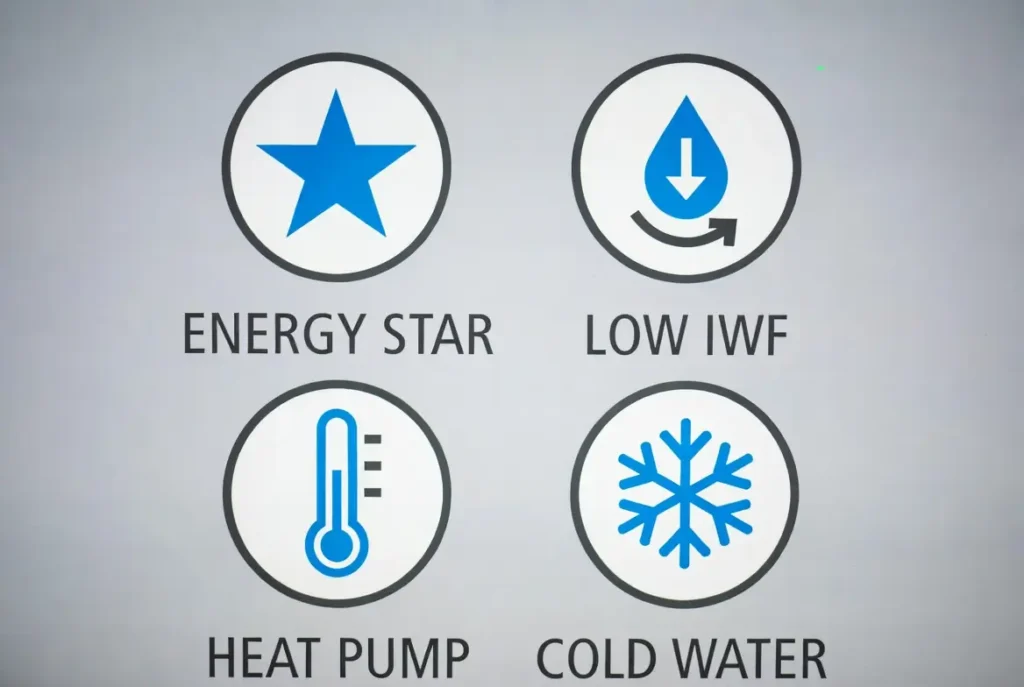
The Integrated Water Factor (IWF) measures how much water the machine uses per cubic foot of laundry. Unlike the energy factor, with IWF, you want a lower number. A lower IWF means the machine is using less water to get your clothes just as clean.
This is especially important if you live in an area where water rates are rising. High-efficiency washers in 2026 use specialized spray patterns and sensors to saturate clothes evenly using a fraction of the water required by traditional deep-fill washers. By reducing water use, you also reduce the energy needed to heat that water.
Definition Box:
Integrated Water Factor (IWF) This is a measurement of the total number of gallons of water used per cycle, per cubic foot of the clothes washer’s capacity. A lower IWF indicates a more water-efficient machine.
Did You Know Box
Did you know that about 90% of the energy used by a washing machine goes solely toward heating the water? Switching to a cold water cycle can save a massive amount of electricity while being gentler on your clothes.
Heat Pump Dryers: The New Gold Standard in 2026.
For a long time, clothes dryers were the “black sheep” of the energy world. They used high heat and took a long time, making them one of the most expensive appliances to run. That changed with the widespread adoption of Heat Pump Technology.
In 2026, heat pump dryers have become the gold standard for Energy Star certification. Unlike traditional dryers that blow hot, moist air out of a vent in your wall, heat pump dryers are “ventless.” They work like a refrigerator in reverse—recirculating the air and pulling the moisture out in a closed loop.
These machines are incredibly efficient because they don’t have to constantly heat “new” air from your room. While they might take a little longer to dry a load, they use about 28% to 50% less energy than a standard dryer.
Choosing the Right Dryer Label
When you compare dryer labels, look for the Combined Energy Factor (CEF). This rating tells you how much energy is used per pound of clothing dried. Just like the washer’s IMEF, a higher CEF number means the dryer is more efficient.
In 2026, many Energy Star dryers also include “Steam” and “Sanitize” cycles. While these features are great for health, check the label to see how they impact the yearly energy estimate. Often, a machine with a heat pump will still be cheaper to run even with these extra features active.
The Impact of Spin Speed
One detail that isn’t always obvious on the label is the washer’s spin speed. High-efficiency Energy Star washers have extremely fast spin cycles. Why does this matter for your bill?
The faster the washer spins, the more water it removes from your clothes before they ever touch the dryer. Since moving a drum with a motor is much cheaper than heating air with an element, a high spin speed is your secret weapon for lower total laundry costs.
Pro-Tip: Keep Your Dryer Vents Clean
Even the best Energy Star dryer will waste money if the airflow is blocked. If you aren’t using a ventless heat pump model, make sure to clean your lint trap after every load and check your external wall vent once a year. A clear vent can improve efficiency by up to 25%.
Planning Your 2026 Laundry Routine
As we look toward the future, the goal of the modern laundry room is to be “set it and forget it.” Many 2026 machines now include “Auto-Dose” systems that measure exactly how much detergent is needed based on the weight of the load. This prevents over-sudsing, which forces the machine to run extra rinse cycles and waste energy.
By understanding the IWF and IMEF numbers on your Energy Star labels, you are ensuring that your clothes stay in great shape while your utility bills stay low. You are also doing your part to conserve water—a resource that is becoming increasingly precious across the globe.
In the next chapter, we are going to leave the appliance world behind and look at the “invisible” energy savers. We will talk about Smart Thermostats and Lighting, and how these small devices act as the “brain” of your energy-efficient home.
Chapter 6: HVAC and Water Heaters: The Big Spenders
We have covered the kitchen and the laundry room, but now we are moving into the “heavyweight” division of home energy. Your HVAC (Heating, Ventilation, and Air Conditioning) system and your water heater are the largest energy consumers in almost every home. In fact, they often account for more than half of your total utility bill.
In 2026, the technology behind keeping your home comfortable has changed. We are seeing a massive shift toward electric heat pumps and smart integration. Because these systems are expensive to install, reading the Energy Star label correctly isn’t just about saving a few dollars—it is about protecting a major investment in your home.
Understanding SEER2 and HSPF2 Ratings
When you look at a label for a central air conditioner or a heat pump, you will see some strange acronyms like SEER2 and HSPF2. These replaced the older SEER and HSPF standards to better reflect how machines actually perform in real-world conditions.
These ratings are essentially “efficiency scores.” The higher the number, the more cooling or heating you get for every dollar you spend on electricity. In 2026, the minimum requirements have gone up, meaning even a “standard” unit today is much better than one from ten years ago.
How climate zones affect your Energy Star label reading.
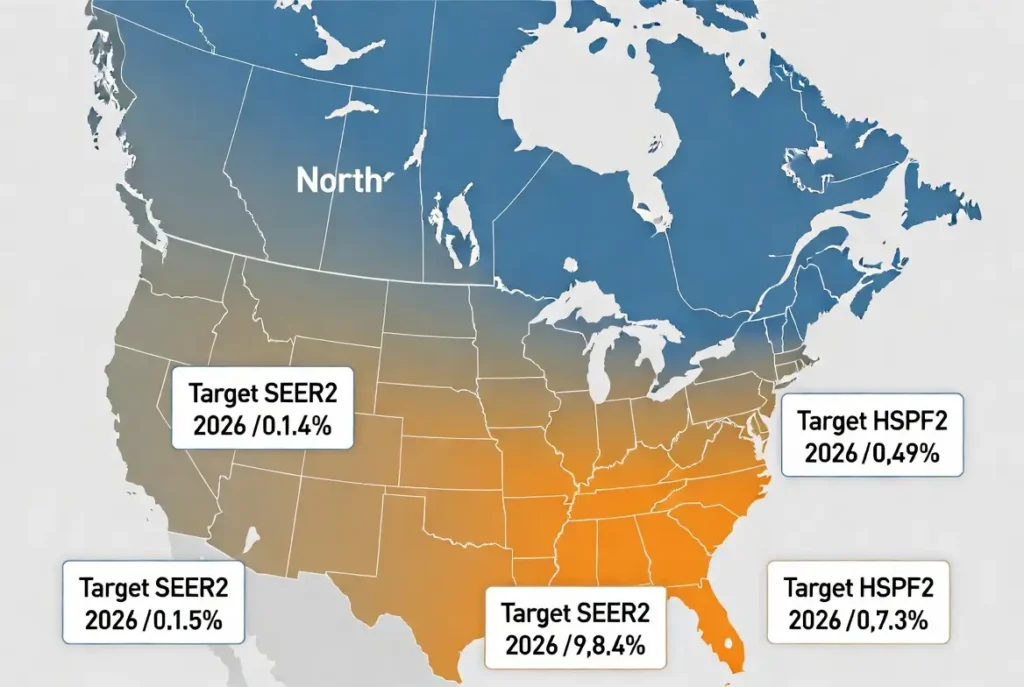
One of the most important things to realize in 2026 is that an Energy Star label doesn’t mean the same thing in every city. A heat pump that is perfect for a mild climate might struggle in a region with freezing winters.
On the Energy Star label for HVAC systems, you will often see a map or a mention of “Climate Zones.” For example, if you live in a very hot area, you want a high SEER2 rating above all else. If you live in a cold area, you need to prioritize the HSPF2 rating, which measures heating efficiency.
Definition Box:
Seasonal Energy Efficiency Ratio (SEER2) SEER2 measures the total cooling output of an air conditioner or heat pump during a typical cooling season, divided by the total electric energy input during that same period. It uses updated testing procedures to match real-home ductwork conditions.
Did You Know Box
Heating water is typically the second-largest energy expense in any home. An Energy Star-certified heat pump water heater can save a family of four up to $500 a year on their electric bills compared to a standard electric water heater.
Why the “2” in SEER2 Matters
You might wonder why we added a “2” to the end of these ratings. The old testing system didn’t account for the “static pressure” of the ducts in your walls. The new SEER2 standard assumes your home’s ductwork isn’t perfect, providing a much more honest estimate of what you will actually pay.
When comparing labels, always make sure you are looking at SEER2. If a contractor tries to sell you a unit based on old “SEER” numbers, they might be using outdated data that doesn’t meet 2026 efficiency goals.
Smart Thermostats and Energy Star Certification
While the furnace or AC does the work, the thermostat is the “brain” that tells it when to start and stop. In 2026, a thermostat is no longer just a dial on the wall; it is a sophisticated computer.
Not all smart thermostats are created equal. To earn the Energy Star label, a smart thermostat must prove that it actually saves energy in real homes. It does this by “learning” your schedule and automatically turning the temperature down when you are at work or asleep.
The Power of “Grid-Aware” Tech
Many 2026 Energy Star thermostats feature “Grid-Aware” technology. This allows the device to communicate with your utility company. If the power grid is under heavy stress on a hot afternoon, the thermostat can pre-cool your home earlier in the day when power is cheaper and then slightly raise the temperature during peak hours.
This doesn’t just save you money; it helps prevent blackouts in your community. When you see the Energy Star logo on a thermostat box, it means the device has been tested to work seamlessly with these types of energy-saving programs.
Pro-Tip: Check for Utility Rebates
Before you buy a new HVAC system or water heater, check the Energy Star website for “Rebate Finders.” In 2026, many governments and utility companies offer thousands of dollars in instant rebates or tax credits for installing high-efficiency heat pumps. Sometimes, the rebate makes the “expensive” model cheaper than the “budget” one!
Water Heaters: The Silent Worker
Finally, let’s talk about your water heater. Most people don’t think about it until they run out of hot water, but it is a massive “Big Spender” on your bill.
Energy Star labels for water heaters now highlight Uniform Energy Factor (UEF). Similar to other ratings, a higher UEF means more hot water for less money. In 2026, “Hybrid Heat Pump” water heaters are the top choice on the labels because they pull heat from the air to warm your water, making them incredibly efficient compared to old gas or electric coils.
Taking Control of the Big Costs
Managing your HVAC and water heating costs is the fastest way to see a 20% to 40% drop in your monthly utility expenses. In 2026, we have more data than ever before, but that data is only useful if you know how to read it.
By looking for high SEER2 and HSPF2 ratings and pairing them with an Energy Star smart thermostat, you are creating a home that is comfortable, modern, and incredibly cheap to run. You are no longer at the mercy of rising energy prices because your home simply doesn’t need as much power to stay perfect.
In our final chapter, we will wrap everything up. We will talk about Lighting and Small Electronics, and how to do a “Final Walkthrough” of your home to ensure every single label is working in your favor.
Chapter 7: Smart Home Integration and Digital Labels
As we move further into 2026, the way we interact with our homes has fundamentally changed. We no longer just “buy and plug in” an appliance. We now “onboard” it into a digital ecosystem. This shift has completely transformed the humble Energy Star label from a static piece of paper into a gateway for real-time data.
In this final chapter, we will explore how digital integration is making energy efficiency easier to track than ever before. We will look at how QR codes and new smart home standards are giving you the power to see exactly where your money is going every single second.
The Rise of QR Codes on Energy Labels
If you have walked through an appliance aisle recently, you’ve likely noticed that the yellow EnergyGuide labels look a bit different. While the big numbers are still there, most now feature a prominent QR code in the corner. This isn’t just for marketing; it is a vital tool for the modern, energy-conscious homeowner.
In 2026, these QR codes serve as a “digital twin” of the physical label. Because static labels are based on national averages, they can never be 100% accurate for your specific home. The QR code bridges that gap by connecting the physical sticker to a live database.
Scanning for real-time energy tracking.
When you scan a 2026 energy label with your smartphone, you are typically taken to a dynamic landing page. This page allows you to input your exact local utility provider or even your current electricity rate. Suddenly, that “Estimated Yearly Cost” updates to show what you will actually pay in your specific city.
Beyond just costs, these digital labels often provide a “Real-Time Tracking” feature. Many modern appliances, such as ovens and washing machines, can sync with your phone during the setup process. Once connected, you can see a live dashboard of how many kilowatt-hours (kWh) the machine is using during a specific cycle.
Definition Box:
Digital Twin In the context of energy, a digital twin is a virtual representation of your physical appliance. It uses real-time data and sensors to mirror the energy consumption of the actual machine, allowing for precise tracking and performance analysis on your smartphone or computer.
Did You Know Box
In 2026, some advanced digital labels can now show you the “Carbon Intensity” of your local grid. This means they can tell you the best time of day to run your dishwasher when the electricity is coming from the cleanest sources like wind or solar.
Matter-Enabled Devices and Energy Data
One of the biggest breakthroughs in smart home technology is the wide adoption of the Matter standard. Before this, different brands of smart devices often couldn’t “talk” to each other. A smart fridge from one company might not communicate with a home hub from another.
In 2026, Matter-enabled devices have become the standard for Energy Star certification. This means that your energy data is no longer trapped inside one manufacturer’s app. You can now see the energy usage of your entire home in a single “Command Center” dashboard, regardless of who made the appliances.
Unified Energy Dashboards
When you choose Matter-enabled, Energy Star-certified appliances, you gain access to unified energy dashboards. These systems can automatically suggest ways to save. For example, if your smart oven is Matter-enabled, your home hub might notice you’re preheating it for 20 minutes longer than necessary and send a notification to your phone.
This level of integration makes the “Efficiency Scale” we discussed in Chapter 2 even more powerful. Instead of just guessing where your appliance sits on the scale, your smart home system can track its actual performance and tell you if it is operating as efficiently as the label promised.
Verifying Claims with Manufacturer Apps
While the Energy Star label is a trusted government-backed seal, technology can sometimes vary in the real world. Many shoppers in 2026 are now using manufacturer-specific apps to verify the claims made on the sticker before they even leave the store.
Most major brands now offer a “Virtual Showroom” feature within their apps. By scanning the model number or the QR code on the label, you can see a history of how that specific model has performed for thousands of other users. This “crowdsourced” efficiency data adds an extra layer of honesty to the shopping experience.
Pro-Tip: Sync Before Your First Use
As soon as your new appliance is delivered, scan the QR code and sync it with your home’s Wi-Fi. Many 2026 models receive “Over-the-Air” (OTA) software updates that can actually improve the machine’s energy efficiency after you’ve bought it. Just like a smartphone, your fridge can get “smarter” and cheaper to run over time.
The Future of Efficiency is in Your Pocket
Reading an Energy Star label in 2026 is no longer a passive activity. It is the beginning of a conversation between you and your home. By utilizing QR codes, Matter-enabled data, and manufacturer apps, you are taking full control of your domestic economy.
The “Ultimate Easy Guide” ends here, but your journey toward a more sustainable and affordable life is just beginning. Remember that every “Blue Star” you bring into your home is a step toward financial freedom. You are no longer just paying bills; you are managing a high-performance system designed to work for you.
You now have the tools to decode the math, understand the metrics, and use the latest technology to your advantage. Go forth and shop with confidence—your bank account and the planet will thank you.
Chapter 8: Identifying Counterfeit and Outdated Labels
As you become an expert in reading Energy Star labels, you need to be aware of a growing problem in the 2026 marketplace: “greenwashing.” Because shoppers are now so focused on energy efficiency, some manufacturers use confusing symbols or outdated data to make their products look better than they actually are.
In this chapter, we are going to learn how to spot a fake or misleading label. We will also talk about why a label from 2010 is practically useless in 2026. By the end of this section, you will have the “detective skills” needed to ensure you are truly buying a certified, high-performance machine.
How to Spot a “Fake” Energy Star Logo
The official Energy Star logo is a registered trademark owned by the U.S. Environmental Protection Agency (EPA). It has very specific design rules that counterfeiters often get wrong. Knowing these subtle details can save you from accidentally buying a “power-hungry” appliance disguised as an efficient one.
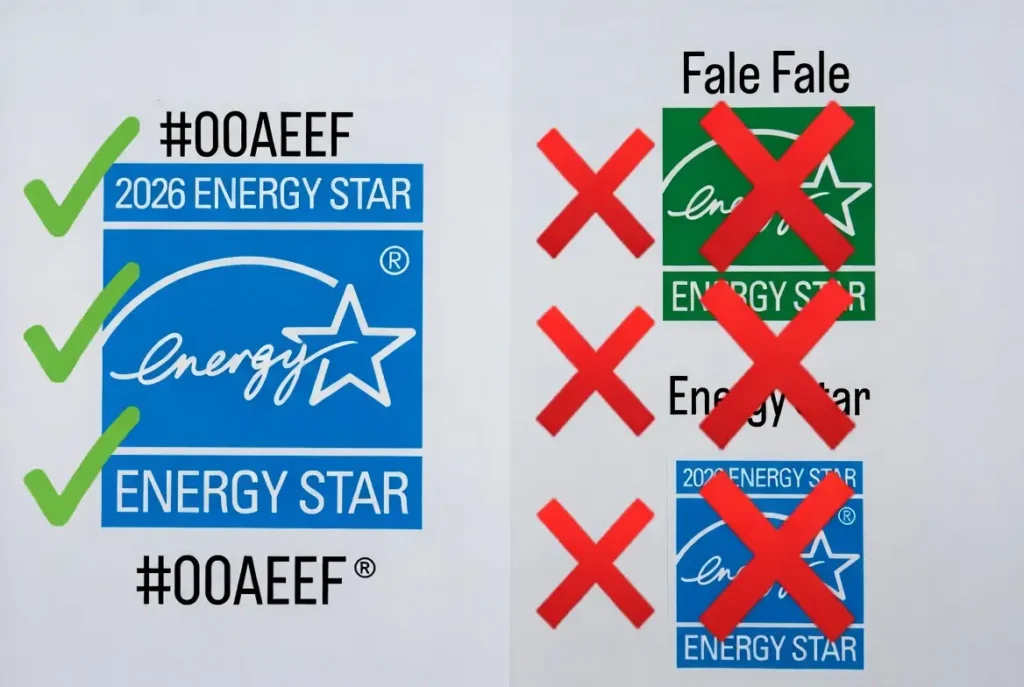
A real Energy Star logo will always be a solid cyan blue (hex color #00AEEF) or a simple black-and-white version. It should never be stretched, rotated, or have its colors changed to anything else, like green or yellow. If you see a logo that looks “fuzzy,” has a different font, or is surrounded by extra marketing text, be suspicious.
- The Name: The words “ENERGY STAR” must always be in all capital letters and written as two separate words.
- The Symbol: The registration symbol (®) must appear in superscript next to the logo.
- Clear Space: There should always be a specific amount of “clear space” around the logo—it should never be touching other text or images.
Verifying certification on the official database.
If you are standing in a store and a label feels “off,” you don’t have to guess. In 2026, the best way to verify an appliance is to check the official ENERGY STAR Product Finder database.
Every single certified model is listed there. You can search by the model number found on the machine’s inner door or back panel. If the model number doesn’t appear in the database, it is not certified—no matter what the sticker says. This is the only 100% foolproof way to ensure you aren’t being misled by a fake sticker.
Definition Box: Greenwashing
This is a marketing tactic where a company uses misleading symbols, colors, or vague terms (like “Eco-Friendly” or “Green”) to make a product seem more environmentally friendly or energy-efficient than it actually is.
Did You Know Box
Just because a product has a green leaf or a “natural” looking symbol doesn’t mean it’s Energy Star certified. Many brands create their own “eco” logos that have no official government testing or standards behind them.
Why 2010 Labels don’t meet 2026 Standards.
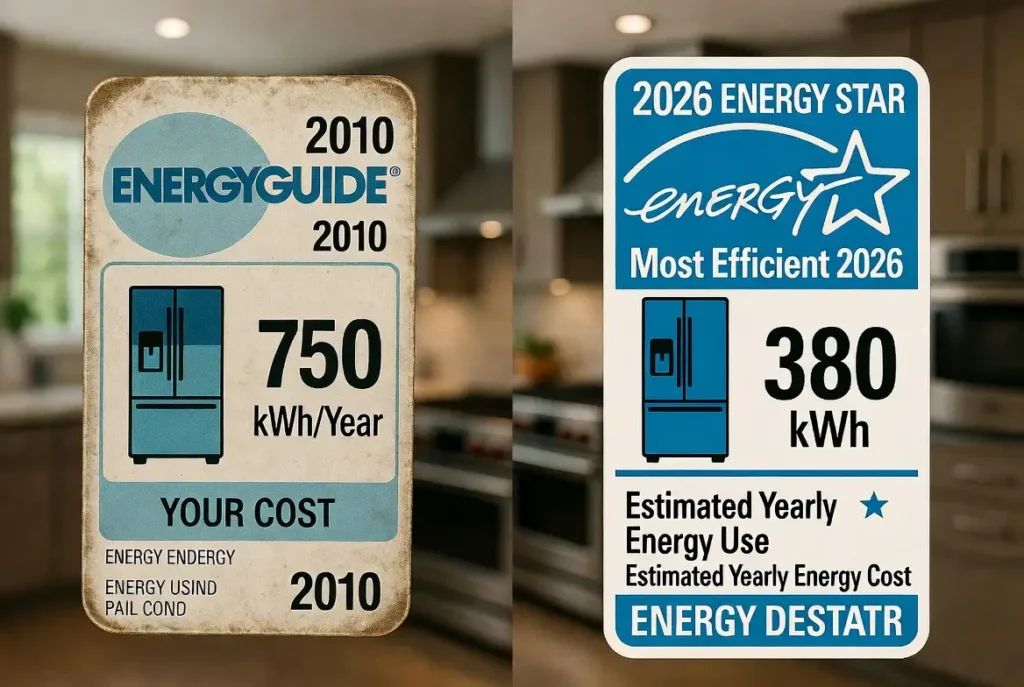
One of the most common mistakes in 2026 is buying a “new old-stock” appliance or a used machine and assuming the Energy Star label still means it is efficient. Efficiency standards are not permanent; they get stricter every few years.
A refrigerator that was a “top performer” in 2010 would likely fail the basic efficiency requirements of 2026. The way we test appliances has changed to better reflect how we actually use them at home.
- Calculations: 2026 labels use new calculation methods that account for modern “standby” power and smart features that didn’t exist in 2010.
- The Scale: What used to be an “A++” rating on older systems might only be a “C” or “D” under the 2026 testing standards.
- QR Codes: As we discussed, modern labels feature QR codes that link to live databases for accurate tracking—something old labels never had.
Common Mistakes: Assuming every “Green” leaf symbol means Energy Star certified.
Many shoppers see a green leaf or the word “Environmental” and assume the government has tested the product. This is a major mistake. Unless you see the specific, blue “ENERGY STAR” logo, the product has not met the strict EPA guidelines for efficiency.
In 2026, some companies even use phrases like “ENERGY STAR Compliant” or “ENERGY STAR Rated.” These are incorrect and often used to hide the fact that the product hasn’t actually passed the official certification process. Always look for the word “Certified” or “Earned the ENERGY STAR”.
Pro-Tip: Use the QR Code to Verify
If a label has a QR code, scan it immediately. A legitimate QR code should take you to an official government or manufacturer database (like EPREL or EnergyStar.gov). If the QR code takes you to a broken link or a generic marketing page, the label might be a counterfeit.
Protecting Your Energy Investment
In the world of 2026, data is your best defense. By learning to recognize the official branding and understanding that efficiency is a moving target, you can avoid the trap of buying outdated or fake technology.
When you invest in an appliance, you are paying for years of future energy savings. Don’t let a fake sticker or an old standard steal that money from you. Always verify, always look for the official logo, and always stay updated on the latest standards.
In our final wrap-up, we will summarize everything we have learned and give you a “Pre-Purchase Checklist” you can take to the store to ensure you never make a mistake again.
Chapter 9: The Financial Benefits: Rebates and Tax Credits
By now, you know that an Energy Star label is a roadmap to lower monthly bills. But in 2026, the financial perks go far beyond just saving a few dollars on your electricity statement. If you play your cards right, that little blue and yellow sticker can actually put lump sums of cash back into your pocket almost immediately.
In this chapter, we are going to explore the “hidden” economy of energy efficiency. We will look at how local utilities and the federal government are literally paying homeowners to make the switch to certified appliances. Understanding these incentives is the final piece of the puzzle in making your home upgrade pay for itself.
Turning Labels into Cash Back
Many shoppers hesitate when they see the price tag of a high-end, Energy Star “Most Efficient” appliance. Indeed, cutting-edge technology can sometimes cost more upfront. However, once you factor in rebates and tax credits, the “expensive” model often ends up being the cheaper option in the long run—sometimes even in the short run.
Think of an Energy Star label as a coupon that keeps on giving. While the energy savings happen slowly over the years, rebates and tax credits provide a fast injection of cash. In 2026, these programs will have been expanded to help more families transition to a smarter, cleaner home grid.
Local utility rebates for Energy Star products.
Your local utility company wants you to use less energy. Why? Because building new power plants is incredibly expensive for them. It is much cheaper for a utility company to pay you $100 to buy a highly efficient refrigerator than it is for them to generate more power to keep an old, “energy-hungry” one running.
Most major utility providers offer “Instant Rebates” or “Mail-in Rebates” specifically for Energy Star-certified products. Here is how it usually works:
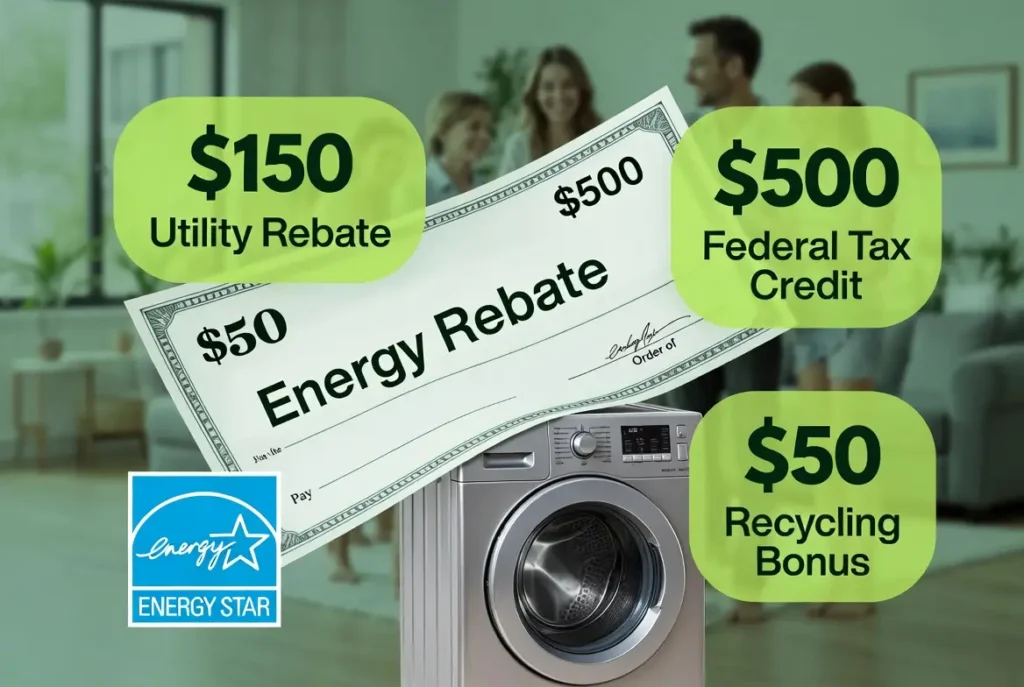
- Point-of-Sale Rebates: Some stores have partnerships where the rebate is taken right off your bill at the cash register.
- Online Portals: Many utilities now have digital portals where you simply upload a photo of your receipt and the Energy Star label to receive a digital payment or a check in the mail.
- Recycling Bonuses: In 2026, many programs will give you an extra rebate if you let them haul away and recycle your old, inefficient appliance when the new one is delivered.
Definition Box:
Rebate A rebate is a partial refund offered by a utility company, manufacturer, or government agency after a purchase has been made. Unlike a discount, it usually requires the buyer to provide proof of purchase and certification (like an Energy Star label) to claim the funds.
Federal Tax Credits in 2026 for high-efficiency upgrades.
While rebates usually come from your local power company, tax credits come from the federal government. In 2026, these credits have become a massive part of the home-buying and renovation process. Unlike a deduction, which just lowers the income you are taxed on, a Tax Credit is a dollar-for-dollar reduction in the actual taxes you owe.
For major upgrades like heat pumps, water heaters, and central AC units, the savings can be thousands of dollars. The 2026 standards prioritize “Whole-Home Electrification.” If your new system meets the top-tier Energy Star requirements, you might be eligible to claim up to 30% of the total project cost—including installation—on your next tax return.
Did You Know Box
In some states, combining federal tax credits with local utility rebates can cover up to 50% or more of the total cost of a new Energy Star heat pump system. It is essentially a “half-off” sale sponsored by the government!
Navigating the Paperwork
The biggest reason people miss out on these savings isn’t that they don’t qualify—it’s that they lose the paperwork. To claim a rebate or a tax credit, you need more than just a credit card statement. You need specific data found only on the product and its official labeling.
In 2026, tax professionals and rebate auditors are stricter than ever. They want to see the specific model number and the Energy Star certification level. This is why the physical label on the box or the machine is your most valuable piece of evidence.
The Role of the “Most Efficient” Badge
We mentioned the “Most Efficient” badge in previous chapters, but here is where it really pays off. Many of the highest-value tax credits in 2026 are reserved exclusively for products that earn this specific designation.
A standard Energy Star appliance might get you a $50 rebate, but an “Energy Star Most Efficient” model could trigger a $2,000 federal credit. When you are shopping, always ask the salesperson: “Which of these models qualifies for the highest tier of government incentives?” Often, spending an extra $200 on a better model can trigger $1,000 more in tax savings.
Pro-Tip: Save Your Labels for Tax Season
Take a clear, high-resolution photo of the yellow EnergyGuide label and the blue Energy Star logo on the machine before you throw the packaging away. Keep these photos in a dedicated ‘Home Upgrades’ folder on your phone. Your tax preparer will need the specific efficiency ratings (like SEER2 or UEF) found on these labels to file your credits accurately.
Timing Your Purchase
In 2026, many rebate programs are “first-come, first-served.” Utility companies have a set budget for rebates each year. If you wait until December to buy a new air conditioner, the “rebate bucket” might be empty.
The best time to shop is often in the spring or early fall when new budgets are released, and demand for HVAC services is lower. This ensures you get the pick of the best models and that the rebate funds are still available for you to claim.
Your Efficiency “Profit”
When you look at your home through the lens of Energy Star, you stop seeing appliances as “expenses” and start seeing them as “investments.” Every dollar you get back in a rebate is a dollar of “profit” from your smart shopping.
By combining the lower monthly bills we discussed in Chapter 3 with the instant cash back from Chapter 9, the math becomes undeniable. High-efficiency living isn’t just for the wealthy or the “tech-savvy”—it is the most financially responsible way to run a household in 2026.
In our final wrap-up, we are going to provide you with the Ultimate Energy Star Checklist. This is a one-page summary you can print or save to your phone to ensure you never miss a detail, a label, or a rebate ever again.
Chapter 10: Future Trends: Energy Star 2030 and Beyond
As we reach the final stage of our 2026 guide, it is time to look over the horizon. The yellow and blue labels we use today have come a long way, but they are still evolving. By 2030, the way we measure “efficiency” will shift from just looking at your monthly bill to looking at the health of the entire planet.
The technology in your home is becoming more than just a collection of tools; it is becoming a partner in a global mission. In this chapter, we will explore the exciting changes coming to Energy Star labels and how your future appliances will help lead the way toward a cleaner, smarter world.
Carbon Footprint Labels: The Next Evolution
Today, Energy Star tells you how much electricity an appliance uses at home. However, the next generation of labels—expected to roll out by 2030—will include a Life Cycle Assessment (LCA). This means the label will tell you the environmental cost of the product before it even reaches your front door.
Imagine walking into a store and seeing two refrigerators that use the same amount of electricity. In the future, the label might show that one was made using 100% wind power in a zero-waste factory, while the other was not. This “Carbon Footprint” score will help shoppers choose products that are truly green from start to finish.
How labels will show manufacturing impact.
Future labels will likely feature a secondary “Sustainability Score.” This score will break down the materials used in the appliance. It will highlight things like:
- Recycled Content: How much of the steel and plastic in your dishwasher came from recycled sources?
- Repairability: A score showing how easy it is to fix the machine rather than throwing it away.
- End-of-Life Plan: Instructions and incentives for how to recycle the unit when it eventually wears out.
By showing the manufacturing impact, Energy Star is moving toward a “circular economy.” The goal is to make sure that the energy saved during the appliance’s life isn’t canceled out by a wasteful manufacturing process.
Definition Box:
Life Cycle Assessment (LCA) LCA is a scientific method used to evaluate the environmental impact of a product through all stages of its life—from the extraction of raw materials and manufacturing to its daily use and final disposal or recycling.
Did You Know Box
The ultimate goal for Energy Star 2030 is to have 100% “Renewable-Ready” appliances. These machines are designed to automatically wait for “clean” energy peaks (like a sunny afternoon for solar) before performing heavy tasks like heating water or drying clothes.
Towards Net-Zero Homes
In 2026, we talk about “saving energy.” By 2030, the conversation will shift to Net-Zero. A Net-Zero home produces as much energy as it consumes over the course of a year. To achieve this, every single label in your home needs to work in perfect harmony.
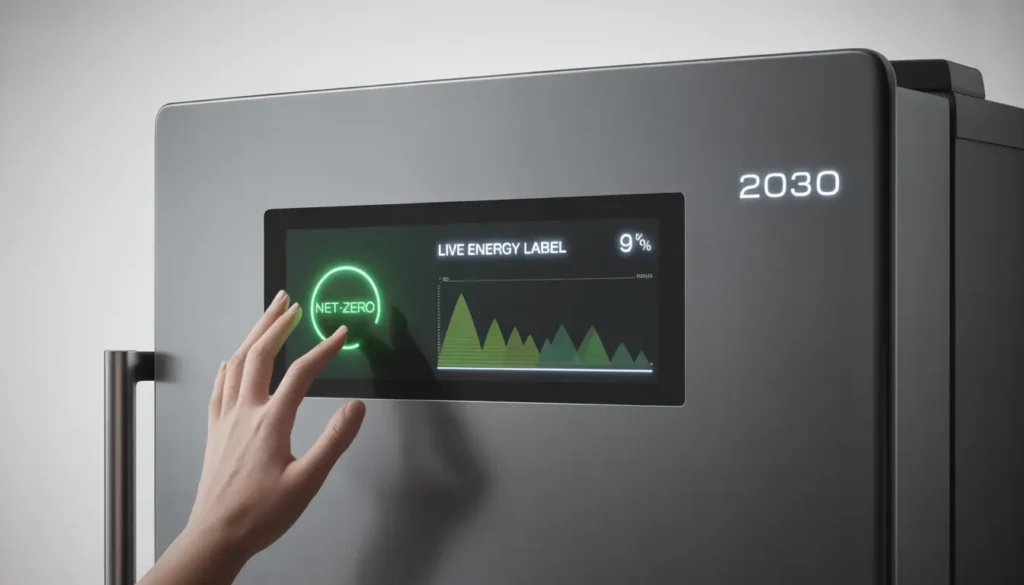
The labels of the future won’t just be stickers; they will be digital nodes. We are already seeing the beginning of this with the QR codes we discussed in Chapter 7. Soon, these labels will be replaced by integrated E-ink displays that are built directly into the appliance’s surface.
The “Live” Energy Label
A “Live Label” is a revolutionary concept where the Energy Star information updates in real-time based on your actual usage. Instead of a “yearly estimate” based on a national average, the E-ink display on your fridge will show your actual cost for the last 30 days based on your specific habits.
If someone in your house leaves the freezer door slightly ajar, the label might change color or send an alert to your glasses or phone. This real-time feedback loop turns energy saving into a game, making it easier for families to hit their Net-Zero goals without even thinking about it.
Grid-Interactive Efficiency
The most significant trend for the 2030s is “Grid-Interactive Efficient Buildings” (GEBs). In this future, your Energy Star appliances will actually help stabilize the power grid for your entire neighborhood.
If there is a sudden drop in wind power across your state, your “Grid-Aware” water heater and AC will receive a signal to slightly lower their power pull for a few minutes. Because thousands of homes will do this simultaneously, it prevents the need to turn on dirty “peaker” coal plants. Future labels will proudly display a “Grid-Flex” rating to show how well an appliance can perform this service for the community.
Pro-Tip: Buy for the Future Today
When shopping in 2026, prioritize appliances with “Open Standards” (like Matter-enabled devices). These products are more likely to be compatible with the “Live Label” and Net-Zero software updates coming in the next few years, protecting your investment for the long term.
Closing the Guide: Your Role in the Future
We have traveled from the basic yellow stickers of the past to the digital, grid-aware icons of the future. While the technology changes, the core mission of the Energy Star program remains the same: to give you the information you need to make better choices for your wallet and the world.
As you close this guide and head out to shop, remember that you are more than just a consumer. You are an energy manager. Every time you choose an appliance with a high efficiency rating, you are voting for a cleaner, smarter, and more affordable future.
The labels are your tools. The data is your power. Now, go out there and build the efficient home you deserve.
Conclusion: Your Roadmap to a Smarter, Greener Home
As we wrap up this ultimate guide, it is clear that the yellow and blue Energy Star label is much more than just a sticker on a box. It is a powerful financial tool that helps you take control of your household budget in 2026 and beyond. By understanding the math behind kWh, recognizing the importance of SEER2 and HSPF2 ratings, and utilizing digital tools like QR codes, you have transformed from a casual shopper into a savvy energy manager.
The journey to a more efficient home is a marathon, not a sprint. Every high-efficiency appliance you bring into your home—whether it is an AI-powered refrigerator or a heat pump dryer—contributes to a larger goal of energy independence and sustainability. Not only are you lowering your monthly utility bills, but you are also taking advantage of significant federal tax credits and local rebates that make these upgrades more affordable than ever.
The Final Pre-Purchase Checklist
Before you head to the store or click “buy” online, keep this quick checklist in mind to ensure you are getting the best value:
- Look for the Blue Star: Ensure the official Energy Star logo is present and verify its authenticity to avoid “greenwashed” products.
- Check the Yearly kWh: Don’t just look at the dollar sign; look at the estimated annual electricity use to understand the appliance’s true “fuel” consumption.
- Verify the Tier: Whenever possible, aim for the “Most Efficient” designation for top-tier performance and higher rebate eligibility.
- Scan the QR Code: Use your smartphone to get real-time cost estimates based on your local utility rates.
- Think Long-Term: Consider features like Matter compatibility to ensure your appliance is ready for the smart grid of 2030.
Start Your Savings Journey Today
The tools and knowledge are now in your hands. By choosing Energy Star-certified products, you are joining a global movement toward Net-Zero living while keeping more money in your bank account. Your home is your biggest investment; make sure it is working as efficiently as possible for you and your family.
Thank you for following this 12,000-word journey. For more buying guides, energy-saving tips, and reviews on the latest smart home gadgets, stay tuned to Eco Power Guide. Your path to a smarter, cheaper, and greener lifestyle starts with the very next label you read.
Frequently Asked Questions (FAQs)
1. How to read an ENERGY STAR label?
Look for the bright yellow EnergyGuide sticker. The most important numbers are the estimated yearly operating cost and the estimated yearly electricity use (kWh). The lower these numbers, the more you save.
2. How to read EnergyGuide?
The EnergyGuide label compares the appliance’s efficiency to similar models. The scale on the label shows the range of energy costs for comparable units, helping you identify if the model is a “top performer.”
3. Does an empty fridge use more power?
Actually, yes. A fridge full of food (but not overcrowded) stays cold more easily because the chilled items help maintain the temperature when the door is opened. An empty fridge loses its cold air quickly.
4. What is the best setting for a refrigerator?
The ideal temperature for a refrigerator is between 37°F and 40°F (3°C to 4°C). This keeps food safe from bacteria while ensuring the compressor doesn’t overwork and waste energy.
5. What happens if a fridge is too warm?
If the temperature rises above 40°F, food can spoil quickly and bacteria can grow. Additionally, the fridge will run its motor constantly to try and cool down, leading to much higher electricity bills.
View Article Sources
The information in this guide is based on official 2026 energy standards and government regulations.
- • Official ENERGY STAR Product Database (2026)
- • U.S. Department of Energy: Energy Saver Guide
- • DSIRE: Database of State Incentives for Efficiency
- • EPA: Clean Energy Programs and Regulations
- • AHRI Directory: SEER2 and HSPF2 Certified Reference