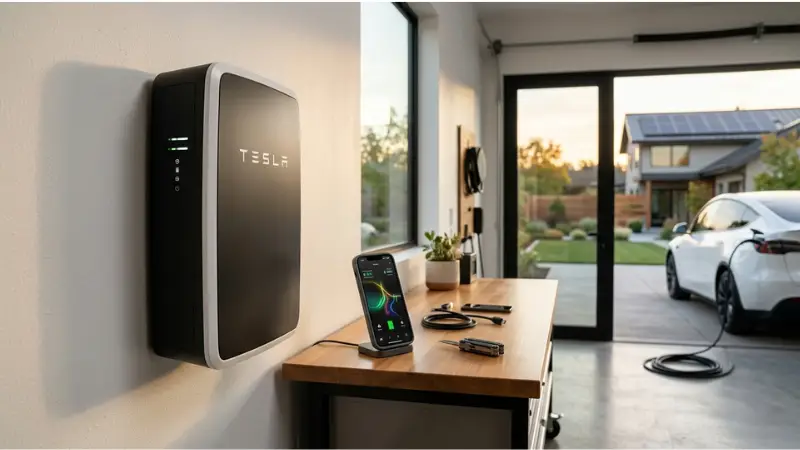
In This Article: Navigation Guide
- • Chapter 1: The Ultimate Guide to Smart Appliances in 2026
- • Chapter 2: The Economic Case: How Smart Tech Saves Real Money
- • Chapter 3: Smart Kitchen Revolution (Refrigerators & Cooking)
- • Chapter 4: Laundry & Cleaning: Maximum Efficiency, Minimum Water
- • Chapter 5: Climate Control: Heating and Cooling in the AI Age
- • Chapter 6: The Connectivity Backbone: Matter and Thread Protocols
- • Chapter 7: Security and Privacy in a Connected Home
- • Chapter 8: Sustainability & The Environmental Impact
- • Chapter 9: The Buyer’s Roadmap: Choosing the Right Brands
- • Chapter 10: The Future: What’s Next After 2026?
- ? Frequently Asked Questions (FAQs)
- 🔗 View Article Sources & References
Chapter 1: The Ultimate Guide to Smart Appliances in 2026: Save Energy and Costs
Welcome to the future of home management. If you are reading this in 2026, you already know that our homes are no longer just places where we sleep and eat. They have become living, breathing ecosystems that think, react, and—most importantly—save us money. This guide is designed to help you navigate the complex world of smart technology, ensuring you get the most out of every watt of energy you consume.
What is a Smart Appliance?
When we first started talking about “smart” gadgets a decade ago, it usually just meant an appliance had a Wi-Fi chip inside. You could turn it on with your phone, and that was about it. Today, in 2026, the definition has evolved into something much more powerful.
A true smart appliance is a device that can collect data, communicate with other devices in your home, and make independent decisions to optimize its performance. It isn’t just “connected”; it is “aware.” It knows when electricity is cheapest, when it needs a repair, and how to perform its job using the least amount of water or power possible.
Definition: The Smart Ecosystem
A Smart Ecosystem is a network of interconnected devices (like your fridge, AC, and solar inverter) that use a unified language (such as the Matter protocol) to share data and work together. Instead of acting as individual machines, they operate as a single team to manage your home’s climate, security, and energy consumption.
The Core Evolution: From Analog to Artificial Intelligence (AI)
To understand where we are now, we have to look at how far we’ve come. For over fifty years, home appliances were “analog.” A washing machine had a mechanical timer, and a refrigerator simply stayed cold 24/7, regardless of whether it was full of food or empty.
Then came the digital age, where we added sensors and screens. But the real revolution happened over the last few years with the integration of Artificial Intelligence (AI).
In 2026, your appliances don’t just follow a set of instructions; they learn.
- Learning Patterns: Your smart thermostat now learns that you prefer a cooler bedroom at 10:00 PM and adjusts the temperature before you even realize you’re warm.
- Predictive Logic: Your dishwasher can sense how dirty the plates are and adjust the water pressure and temperature in real-time.
- Self-Healing: Many modern appliances can now run their own “health checks” and alert you to a failing part before the machine actually breaks down.
This shift from “dumb” machines to “thinking” assistants is the biggest change in domestic life since the invention of electricity itself.
Did You Know?
As of 2026, there are over 30 billion connected smart devices active across the globe. That is roughly four smart devices for every single person on Earth! Most of these devices are now focused on energy management and home automation.
Why 2026 is the Turning Point for Home Energy
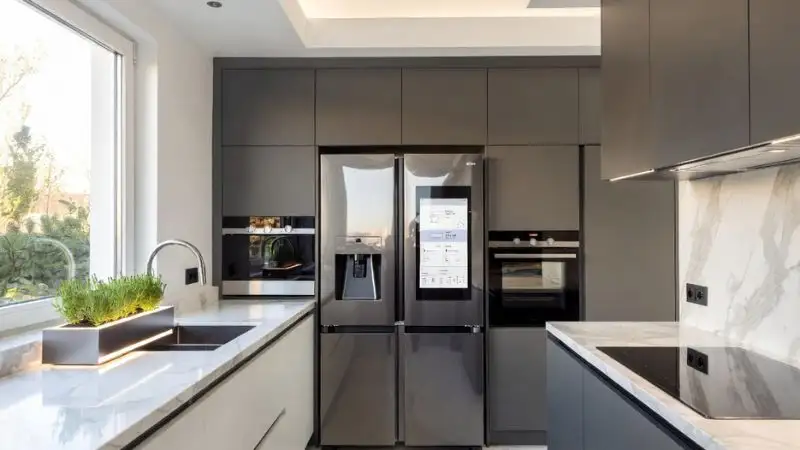
You might be wondering: why is everyone talking about smart appliances now? What makes 2026 different from 2020 or 2022? The answer lies in three major shifts that happened simultaneously: the cost of energy, the climate crisis, and the arrival of “Matter.”
1. The Global Energy Shift
Energy prices have fluctuated wildly over the last few years. Traditional power grids are under pressure, and many countries have moved to “Dynamic Pricing.” This means electricity costs more during the day when everyone is using it and less at night. Smart appliances are no longer a luxury; they are a financial necessity because they can automatically shift their heavy work to those cheaper nighttime hours.
2. The Universal Language: Matter
In the past, a major problem was that a Samsung fridge couldn’t talk to an Apple HomePod or a Google Nest thermostat. This “language barrier” made smart homes frustrating to set up.
By 2026, the Matter protocol will have become the industry standard. Now, almost every appliance you buy—regardless of the brand—works perfectly with every other device. This has made building an energy-saving ecosystem as easy as “plug and play.”
3. Sustainability as a Standard
We have moved past the point where being “green” was just a choice. In 2026, government regulations and environmental standards are stricter than ever. Smart appliances are the primary tool for homeowners to reduce their carbon footprint without sacrificing comfort. They allow us to use “Green Energy” (like solar or wind) more effectively by storing it or using it the moment it is generated.
Pro-Tip: Start with the “Big Three”
If you are just beginning your smart home journey, don’t try to buy everything at once. Focus on the “Big Three” energy consumers: your HVAC (Heating and Cooling), your Water Heater, and your Refrigerator. Upgrading these three to smart, AI-driven models will provide the fastest return on your investment through lower monthly bills.
The Human Element: Convenience Meets Savings
Beyond the technical talk of watts and protocols, 2026 is the year we finally achieved “Invisible Technology.” You no longer need to be a computer expert to run a smart home.
The software has become so human-like that it feels natural. You can speak to your kitchen in plain English, ask your laundry machine for advice on a stain, or trust your water heater to save you money while you sleep. We have moved from a world where we serve our machines to a world where our machines truly serve us.
In the following chapters of this guide, we will break down exactly how to choose, set up, and maintain these devices. Whether you live in a small city apartment or a large suburban home, the goal remains the same: Save energy, save costs, and enjoy a smarter life.
Chapter 2: The Economic Case: How Smart Tech Saves Real Money
When most people look at the price tag of a smart dishwasher or an AI-driven refrigerator, they often hesitate. Yes, the upfront cost is usually higher than a traditional “dumb” appliance. However, to truly understand the value of smart technology in 2026, we have to look past the initial purchase price and focus on the Total Cost of Ownership.
In this chapter, we are going to break down the math. We will explore how these devices pay for themselves over time and why sticking with old technology is actually costing you more every single month.
Direct vs. Indirect Savings
To understand your return on investment, we need to divide your savings into two categories: Direct and Indirect.
Direct Savings are the numbers you see right away on your utility bills. This is the result of using less electricity and water. Because smart appliances are designed to be ultra-efficient, they simply do the same amount of work (or better) using a fraction of the resources.
Indirect Savings are a bit more subtle but just as important. These include things like food lasting longer because your fridge maintains a perfect temperature, or avoiding a $500 repair bill because your washing machine alerted you to a small leak before it caused major damage.
Energy Efficiency Ratings (The 2026 Standards)
In 2026, the way we rate appliances has changed. We no longer just look at a simple “A to G” sticker. Modern standards now include “Intelligence Ratings.” These ratings measure how well an appliance can manage its own power consumption based on real-world conditions.
A high-rated 2026 smart appliance doesn’t just use low power; it uses “Right Power.” This means it scales its energy use up or down based on the load. For example, a smart air conditioner in 2026 doesn’t just blast cold air until the room is freezing. It uses precision sensors to maintain a steady, low-energy flow that keeps the room comfortable without the “spike and drop” energy patterns of older units.
Definition: Total Cost of Ownership (TCO)
Total Cost of Ownership is a financial estimate intended to help buyers determine the direct and indirect costs of a product. For appliances, this includes the purchase price PLUS the cost of electricity, water, repairs, and maintenance over the entire life of the machine.
Reducing “Phantom Load” and Standby Power
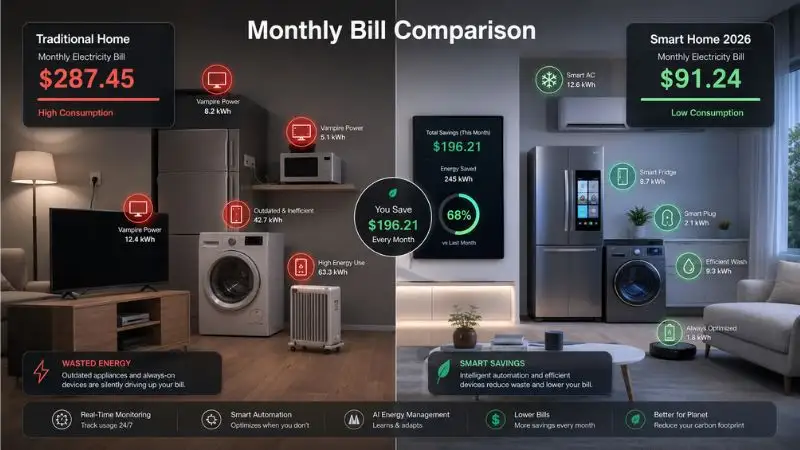
Have you ever wondered why your electricity bill is high even when you aren’t home? The culprit is often the “Phantom Load.” This refers to the energy consumed by appliances while they are switched off but still plugged in.
In the past, appliances were “vampires”—they constantly sucked small amounts of power to keep their internal clocks or basic circuits running. In 2026, smart technology has virtually eliminated this issue.
Modern smart devices use “Deep Sleep” modes. They consume almost zero power until they receive a signal to wake up. Furthermore, smart home hubs can now completely cut power to non-essential devices during the night, ensuring that your home isn’t wasting a single cent while you sleep.
Maintenance and Longevity: The Hidden Cost Saver
One of the biggest expenses for any homeowner is replacing an appliance that died too young. Most traditional appliances fail because of “invisible wear and tear.” You don’t know something is wrong until the motor smells like smoke or the floor is covered in water.
Smart appliances in 2026 will change this dynamic through Predictive Maintenance.
- Early Warning Systems: Your dryer can sense if the lint trap or exhaust vent is becoming clogged. By alerting you to clean it, it prevents the motor from overheating and extends the life of the machine by years.
- Automatic Calibration: Over time, machines can become unbalanced or less efficient. Smart appliances run self-diagnostic routines to recalibrate their internal parts, ensuring they always run at peak performance.
- Software Updates: Just like your smartphone, smart appliances receive “Over-the-Air” (OTA) updates. These updates often include new energy-saving algorithms, meaning your appliance can actually get more efficient a year after you buy it.
Did You Know?
On average, a smart home setup in 2026 reduces annual maintenance costs by 35%. This is because sensors can detect small issues—like a mineral buildup in a dishwasher—before they turn into expensive mechanical failures.
Pro-Tip: Master Your “Time-of-Use” Pricing
Check with your local electricity provider to see if they offer “Time-of-Use” (TOU) rates. In 2026, most smart appliances have a “Green Mode” or “Economy Start” feature. You can load your dishwasher or laundry at 6:00 PM, but tell the machine to wait until 2:00 AM to start when electricity rates are at their lowest. This simple habit can save you hundreds of dollars a year without any extra effort.
The “Green” Dividend
Finally, we must consider the environmental impact as a financial gain. In many parts of the world in 2026, governments are offering Tax Credits and Rebates for homes that meet certain “Smart Energy” benchmarks.
By investing in smart technology, you aren’t just saving on your monthly bill; you are increasing the resale value of your home. A “Smart Certified” home is a premium asset in the 2026 real estate market. Buyers want homes that are cheap to run and easy to manage.
Conclusion of Chapter 2
The economic case for smart appliances is no longer a debate—it is a fact. By reducing direct energy use, eliminating phantom loads, and extending the life of the machine through AI-driven maintenance, these devices turn your home into a profit center rather than a money pit.
While the initial investment might feel high, the “Payback Period” in 2026 has dropped significantly. Most homeowners find that their smart upgrades pay for themselves through energy savings alone within the first 18 to 24 months.
Chapter 3: Smart Kitchen Revolution (Refrigerators & Cooking)
The kitchen has always been the heart of the home, but in 2026, it has also become the brain. For decades, kitchen appliances were simple tools: a box to keep things cold and a box to make things hot. Today, those boxes have evolved into sophisticated computers that handle everything from grocery shopping to fire safety.
In this chapter, we are going to look at how the “Smart Kitchen Revolution” is doing more than just making life easier. It is fundamentally changing how we manage our food supply and how we use energy during our most power-hungry time of the day: meal prep.
AI Refrigerators: More Than Just a Screen
If you walked into an appliance store five years ago, a “smart fridge” was basically a normal refrigerator with a tablet glued to the door. You could watch YouTube or check the weather, but the fridge itself didn’t know what was inside it.
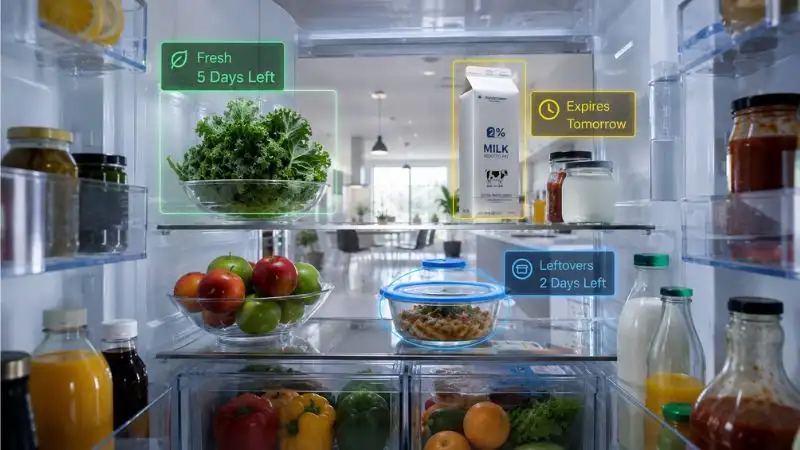
In 2026, the screen is the least important part. The real magic is happening inside the unit. Modern AI refrigerators are equipped with multi-spectral internal cameras and weight sensors that act as a digital inventory manager. They don’t just stay cold; they understand the lifecycle of the food you buy.
Definition: Computer Vision
Computer Vision is a field of Artificial Intelligence (AI) that allows computers and systems to derive meaningful information from digital images or videos. In a smart fridge, computer vision identifies specific items—like a carton of milk or a head of lettuce—and tracks how fresh they are.
Inventory Management to Reduce Food Waste
Food waste is a silent killer of the household budget. Estimates suggest the average family throws away hundreds of dollars in spoiled food every year. Smart refrigerators in 2026 are designed to stop this waste before it starts.
- Expiration Alerts: As the AI identifies items, it automatically looks up typical shelf lives. You will receive a notification on your phone saying, “The spinach is likely to wilt in 48 hours. Would you like a recipe for a spinach smoothie?”
- Dynamic Shopping Lists: When you use the last of the eggs, the fridge detects the empty carton or the change in weight on the shelf. It immediately adds eggs to your digital shopping list or, if you’ve enabled it, orders them from your favorite grocery delivery service.
- Zone Cooling: AI fridges now use “Targeted Airflow.” If you place warm leftovers on the middle shelf, the fridge detects the temperature spike and directs extra cooling only to that specific area, rather than chilling the whole unit and wasting energy.
Smart Ovens and Precision Cooking
Cooking is an art, but it is also a science of heat management. Traditional ovens are notorious for “heat leakage” and uneven cooking. Smart ovens in 2026 have solved these problems using precision sensors and ultra-efficient heating elements.
The goal of a smart oven is to use the exact amount of energy required to cook your food perfectly—no more, no less.
Remote Monitoring and Safety Auto-Shutoff
How many times have you left the house and wondered, “Did I leave the oven on?” In 2026, that anxiety is a thing of the past.
- Internal Cameras: Many smart ovens now feature heat-resistant cameras. You can check your phone to see exactly how brown your roast chicken is without ever opening the door and letting 25% of the heat escape.
- Safety Auto-Shutoff: Using AI, these ovens can detect if something is burning or if the oven has been left on with no food inside for an extended period. The system will automatically cut the power and send a high-priority alert to your smartphone.
- Precision Temperature Control: Instead of fluctuating 10-20 degrees like old ovens, smart units stay within a single degree of your target. This leads to faster cooking times and significant energy savings over the course of a year.
Did You Know?
In 2026, the latest smart induction cooktops are 90% energy efficient. In comparison, traditional gas stoves lose about 60% of their heat to the air around the pan. Switching to smart induction is like getting a massive discount on every meal you cook.
Pro-Tip: Use “Batch Sync” Features
If you have a smart oven and a smart fridge, use the “Batch Sync” feature. Your fridge can tell your oven what you are planning to cook, and the oven will begin pre-heating at the exact moment the electricity rates drop. This ensures your oven isn’t sitting empty and hot for 20 minutes while you’re still chopping vegetables.
Common Mistakes: Buying Over-Complicated Features
As a Senior SEO Strategist, I see many consumers getting distracted by “shiny objects.” In 2026, manufacturers love to add features that sound cool but don’t actually save you time or money.
Common Mistake: The “Gimmick” Trap
Avoid buying appliances with built-in speakers, mood lighting, or social media integration unless those features are truly important to you. These additions don’t help with energy efficiency and are often the first parts to break, leading to expensive repairs. Focus on Core AI features like energy monitoring, inventory tracking, and remote safety controls.
The Environmental Impact of a Smart Kitchen
When we talk about saving costs, we are also talking about saving the planet. A smart kitchen in 2026 uses roughly 40% less energy than a kitchen from 2016.
By reducing food waste through better inventory management and using precision heat in our ovens, we are lowering our individual carbon footprints. Furthermore, because these appliances are “Matter-compatible,” they can communicate with your home’s solar panels. Your dishwasher might choose to run at 1:00 PM when your solar production is at its peak, making the cost of that wash effectively zero.
Summary of Chapter 3
The “Smart Kitchen” is no longer about gadgets; it’s about Efficiency and Peace of Mind. From refrigerators that act as personal assistants to ovens that ensure you never burn your dinner again, the technology of 2026 is designed to work for you.
By investing in appliances that focus on inventory management and precision cooking, you are tackling the two biggest expenses in any home: the grocery bill and the utility bill.
Chapter 4: Laundry & Cleaning: Maximum Efficiency, Minimum Water
When we think about energy bills, we often focus on electricity. However, in 2026, water scarcity has made water efficiency just as important for the household budget. The laundry room and the kitchen sink are the two areas where a home wastes the most water.
Traditional cleaning appliances were “blind.” They used the same amount of water and soap whether you were washing two shirts or twenty. Smart technology has finally fixed this. In this chapter, we explore how 2026’s cleaning appliances use advanced sensors to deliver a deeper clean while protecting your wallet and the planet.
Next-Gen Smart Washing Machines
The washing machines of 2026 are a far cry from the loud, vibrating boxes of the past. They are now quiet, highly intelligent systems that treat every garment with precision. The goal is no longer just to get clothes clean; it is to make them last longer while using the absolute minimum of resources.
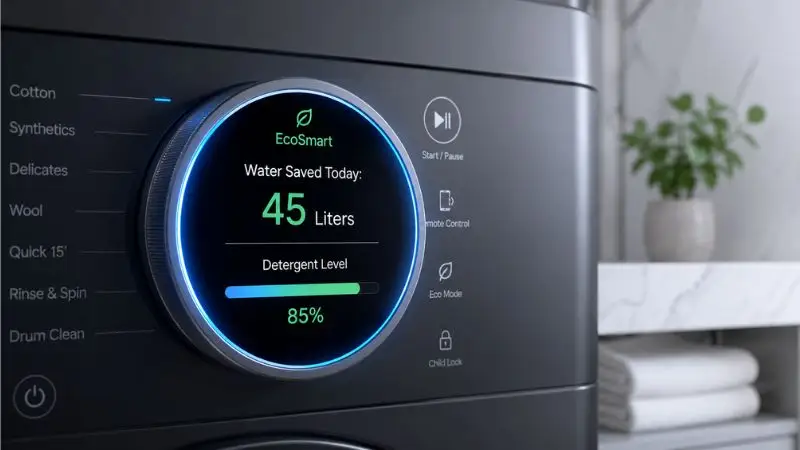
Modern machines now use Load Sensing AI. As soon as you drop your clothes into the drum, the machine calculates the exact weight and even the fabric type. It then adjusts the water level to the milliliter, ensuring that not a single drop is wasted.
Auto-Dosing Systems for Detergent Optimization
One of the highest hidden costs in laundry is detergent. Most people use far too much soap, thinking it makes clothes cleaner. In reality, excess soap creates more suds, which forces the machine to run extra rinse cycles, wasting both water and electricity.
- Precision Dispensing: 2026 smart washers feature large detergent reservoirs. You fill them once a month, and the machine’s Auto-Dosing System calculates the exact amount of soap needed based on the water hardness and soil level.
- Cost Savings: By using only what is necessary, families are reporting a 30% reduction in detergent costs annually.
- Fabric Care: Less chemical residue means your clothes stay soft and vibrant for years, reducing the need to buy new clothing frequently.
Definition: Auto-Dosing
Auto-Dosing is a technology where the appliance automatically calculates and releases the optimal amount of liquid detergent and softener for every specific load. This prevents chemical waste and eliminates the need for extra rinse cycles.
Microplastic Filtration Trends in 2026
A major trend in 2026 is the integration of built-in Micro-plastic Filters. Most synthetic clothes (like yoga pants or fleece) shed tiny plastic fibers during a wash. In the past, these went straight into our oceans.
New regulations in 2026 have led manufacturers to include high-efficiency filters in smart washers. These filters catch up to 98% of microplastics. The “smart” part? Your machine will monitor the filter’s status and send a notification to your phone when it needs to be emptied, ensuring the machine always runs at peak efficiency without clogging.
Smart Dishwashers: Sensors that “See” Dirt
If you are still pre-rinsing your dishes in the sink before putting them in the dishwasher, you are living in the past—and wasting a lot of money. In 2026, smart dishwashers are designed to handle the toughest grime using Turbidity Sensors.
Sensors that “See” the Soil
In a traditional dishwasher, the machine runs for a set time (e.g., 2 hours) regardless of how dirty the plates are. Smart dishwashers use light-based sensors to check the “cloudiness” (turbidity) of the water.
- Real-Time Adjustments: If the water comes off the plates clean, the machine cuts the cycle short. If it detects heavy grease, it increases the temperature and pressure only for as long as needed.
- Zonal Cleaning: Modern units can direct high-pressure jets to the bottom rack for heavy pots while using a gentle mist for delicate glasses on the top rack, all in the same cycle.
- Dry-Logic Technology: Smart dishwashers now use Zeolite minerals or heat pumps to dry dishes. Instead of using a high-wattage heating element that sucks electricity, these minerals naturally absorb moisture and release heat, drying your dishes for almost zero energy cost.
Did You Know?
Modern smart washing machines in 2026 can save up to 40% more water than traditional models. Over the lifetime of the machine, this adds up to enough water to fill a standard swimming pool!
Pro-Tip: Use the “Eco-Feedback” App
Most smart appliances in 2026 come with a companion app that gives you an “Eco-Score” for every load. Check your app weekly to see which cycles used the most energy. You will often find that using the “Eco-Mode” (which takes longer but uses cooler water) saves you more money than the “Quick Wash” setting.
The Environmental and Financial Impact
When you combine smart laundry with smart dishwashing, the impact on your monthly utility bill is massive. In 2026, we are seeing a shift where “cleaning” is no longer a chore that we ignore. With real-time data on our phones, we become more aware of our habits.
By allowing the machine to decide the water level and detergent dose, we remove the “human error” that leads to waste. Furthermore, because these machines are Matter-enabled, they can be set to run only when your home’s solar battery is full or when the local grid has an excess of wind energy.
Summary of Chapter 4
Maximum efficiency and minimum water are the two pillars of 2026’s cleaning technology. Whether it is a washing machine that filters out microplastics or a dishwasher that “sees” how dirty your plates are, these appliances are designed to do the heavy lifting for you.
Investing in smart cleaning tech isn’t just about the convenience of a phone notification; it’s about a smarter, cheaper, and cleaner way of living. By saving thousands of gallons of water and reducing detergent waste, you are protecting both your bank account and the environment.
Chapter 5: Climate Control: Heating and Cooling in the AI Age
In 2026, the biggest drain on any household budget is no longer the lighting or the television—it is climate control. Heating and cooling account for nearly half of the average home’s energy consumption. In the past, we managed this with “dumb” thermostats that simply turned the air on or off based on a single sensor in a hallway.
The AI age has completely rewritten this script. We have moved away from “whole-house” cooling and heating toward a more intelligent, targeted approach. By using data, sensors, and machine learning, your home can now maintain the perfect temperature while cutting your energy bills by up to 50%.
Smart HVAC & Smart Thermostats
A Smart HVAC (Heating, Ventilation, and Air Conditioning) system is the lungs of your home. In 2026, these systems will be far more than just blowers and compressors. They are integrated networks that communicate with weather forecasts, your personal calendar, and even your smartphone’s location.
The modern smart thermostat acts as the conductor of this orchestra. It doesn’t just wait for you to feel hot and turn the dial. It predicts when the house will get warm based on the afternoon sun and starts cooling the house gradually using low-power modes, rather than blasting the AC at full power when it’s already too late.
Definition: Variable Speed Technology
Variable Speed Technology allows an HVAC motor to operate at different speeds (rather than just ‘On’ or ‘Off’). This allows the system to run at a lower, more efficient speed for longer periods, which maintains a consistent temperature and uses significantly less electricity.
Multi-Zone Control for Targeted Cooling
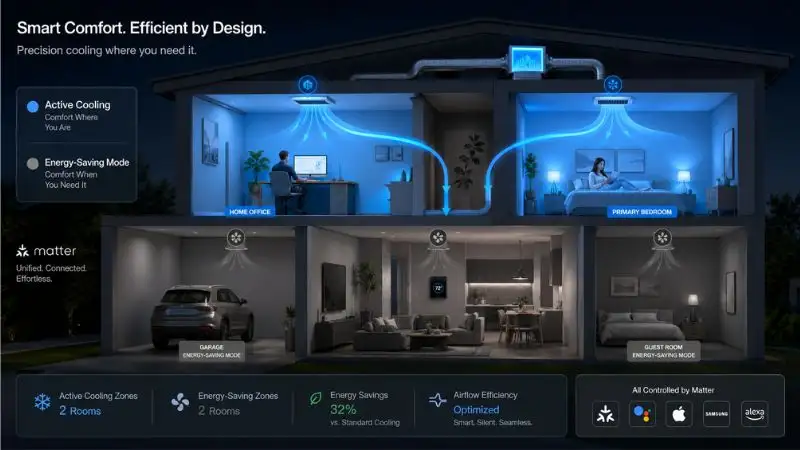
One of the biggest wastes of money in traditional homes is cooling rooms that nobody is using. Why cool the guest bedroom or the dining room at 2:00 AM when everyone is asleep in their bedrooms?
- Smart Vents: 2026 systems use motorized smart vents that can open or close automatically. If the AI detects no motion in the living room, it shuts the vents in that area and redirects the cool air only to the occupied bedrooms.
- Individual Room Sensors: By placing small, wireless sensors in every room, the thermostat gets a “thermal map” of the entire house. It can detect that the kitchen is getting hot from cooking and boost cooling there while keeping the rest of the house stable.
- Geofencing: Your HVAC system knows when you are five miles away from home. It stays in “Eco-Mode” while you are at work and begins cooling the house just in time for your arrival, ensuring you never pay to cool an empty house.
Smart Fans and Air Purifiers
While the HVAC does the heavy lifting, smart fans and air purifiers play a critical “support” role in 2026. In the past, a fan just moved air around. Today, a smart fan is a precision instrument for energy efficiency.
Thermal Leveling
Smart ceiling fans now rotate in both directions based on the season. In the winter, they push warm air down from the ceiling; in the summer, they create a “wind-chill” effect. Because these fans have built-in temperature sensors, they only spin as fast as necessary to make the room feel comfortable, allowing you to set your AC 4 degrees higher without feeling the difference.
AI-Driven Air Quality
Air purifiers in 2026 are no longer “always on.” They use laser-based particulate sensors to monitor the air for dust, pollen, or smoke.
- Energy Savings: The purifier stays in a low-power “monitor mode” until it detects a drop in air quality (like when you start frying food in the kitchen).
- Filter Longevity: Because the machine only runs at high speed when needed, the expensive HEPA filters last twice as long as they did in older models.
Did You Know?
Integrating AI climate control into your home can reduce your carbon footprint by over 2 tons of CO2 per year. That is the equivalent of planting nearly 100 trees every single year just by changing how you cool your house!
Pro-Tip: The “Window-AC Sync”
One of the most effective ways to save money is by integrating Smart Window Sensors with your HVAC system. You can set an automation so that if a window is left open for more than 30 seconds, the AC in that specific room automatically shuts off. This prevents “energy leakage” where your AC tries to cool the entire neighborhood because a window was left unlatched.
Maintenance and the “Health” of Your System
In 2026, HVAC repairs are no longer a surprise. Smart systems monitor the “static pressure” and “refrigerant levels” internally. If your air filter is 80% clogged, you won’t just get a reminder; the system will show you exactly how much extra money that clogged filter is costing you in electricity.
- Predictive Alerts: Your system can detect a “stutter” in the compressor weeks before it actually fails. This allows you to call a technician during normal business hours rather than paying for an emergency repair on a holiday weekend.
- Efficiency Tracking: Your smart home app provides a monthly “Climate Report,” showing you which days were the most expensive and offering tips on how to improve your insulation.
Summary of Chapter 5
Climate control in 2026 is all about Intelligence over Intensity. We no longer rely on massive, power-hungry machines to brute-force our homes into being cold. Instead, we use a network of smart thermostats, motorized vents, and AI-driven fans to create “Comfort Zones.”
By focusing on multi-zone control and preventing energy leakage through smart sensors, you can enjoy a perfectly chilled home without the “bill shock” at the end of the month. Smart HVAC isn’t just a luxury—in a world of rising energy costs, it is the most effective tool in your financial arsenal.
Chapter 6: The Connectivity Backbone: Matter and Thread Protocols
In the early days of smart homes, building a connected kitchen felt like trying to solve a puzzle where the pieces didn’t fit. You might have bought a great smart fridge, only to find out it wouldn’t talk to your smart speaker because they were made by different companies. This “walled garden” approach made smart appliances frustrating for regular users.
Fast forward to 2026, and that frustration is a thing of the past. We have entered the era of the “Unified Home.” This was made possible by two technical breakthroughs: Matter and Thread. These are not just fancy tech words; they are the invisible backbone that allows your home to save energy automatically without you having to be a computer expert.
Why “Matter” Changed Everything in 2026
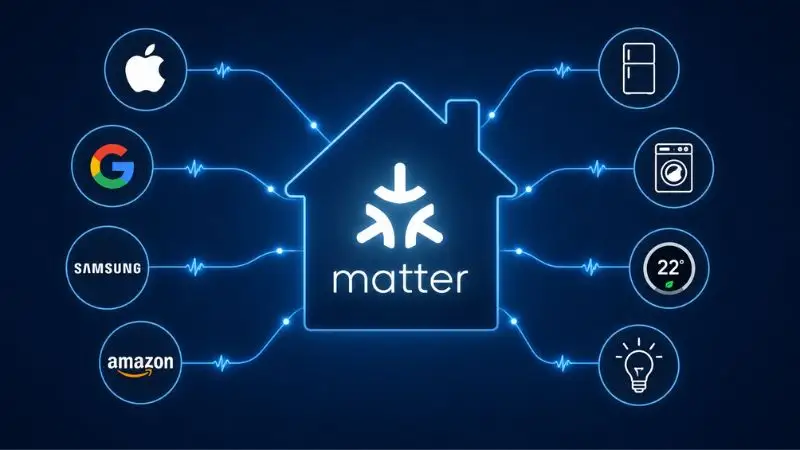
Before Matter, every brand had its own “language.” If you wanted to build a truly smart home, you often had to stick to just one brand or use complicated workarounds. Matter is a universal language that almost every major tech company in the world has agreed to speak.
In 2026, when you see the Matter logo on a box, it means that the device will work instantly with your existing setup. Whether you use an iPhone, an Android tablet, or a dedicated smart home hub, the appliance will connect and share data without any “handshake” issues.
Cross-Brand Compatibility (Samsung, Apple, Google working together)
The biggest win for homeowners in 2026 is that the giants of the industry—Samsung, Apple, Google, and Amazon—are finally working together. This collaboration has created a seamless experience that was once a dream.
- One App to Rule Them All: You no longer need 15 different apps for 15 different appliances. You can control your Samsung dishwasher, your Google Nest thermostat, and your Apple-compatible smart lights all from a single interface.
- Shared Intelligence: Because these devices talk to each other, they can share energy data. Your smart meter can tell your appliances when electricity is cheapest, and every device—regardless of the brand—will listen and react.
- Local Control: Matter works locally over your home network. This means that even if your internet goes down, your appliances can still talk to each other and follow their energy-saving schedules.
Definition: Matter Protocol
Matter is a universal, open-source connectivity standard for smart home devices. It ensures that devices from different manufacturers are compatible, secure, and easy to set up, acting as a “universal translator” for the smart home.
Setting Up a Robust Home Network for Appliances
While Matter provides the language, your home network provides the “road” that the data travels on. In 2026, having “just okay” Wi-Fi isn’t enough for a home filled with 20 or 30 smart devices. To save the most energy and ensure your appliances never “drop off” the grid, you need a strong foundation.
The Role of “Thread”
While Wi-Fi is great for high-speed data (like streaming 4K movies), it uses a lot of power. This is where Thread comes in. Thread is a “mesh network” designed specifically for smart appliances.
- No Single Point of Failure: In a Thread network, every device acts as a “mini-router.” If one device goes offline, the others find a new path to stay connected.
- Low Energy Use: Thread allows small sensors (like window sensors or leak detectors) to run on a single battery for years because it uses very little power compared to Wi-Fi.
Did You Know?
A Thread-enabled smart home gets stronger the more devices you add to it. Unlike Wi-Fi, which gets slower as you add more gadgets, a Thread “mesh” creates more pathways for data, making your home’s connectivity more stable.
Pro-Tip: Use a Wired “Border Router”
For the most stable smart home in 2026, ensure your main smart hub (the Border Router) is connected to your internet router via an Ethernet cable. This creates a rock-solid bridge between your high-speed internet and your low-power Thread devices.
Common Mistakes: The Wi-Fi Bottle-Neck
As an SEO Strategist, I see many users spending thousands of dollars on the latest smart appliances but trying to run them on a router from 2018. This is a recipe for disaster.
Common Mistake: Neglecting Wi-Fi 6/7 Upgrades
Many people assume that if their phone works, their appliances will too. However, older Wi-Fi standards (like Wi-Fi 5) struggle to manage dozens of small, simultaneous connections. In 2026, you should upgrade to a Wi-Fi 6E or Wi-Fi 7 router. These newer standards are built specifically to handle “High-Density” environments—meaning they can talk to your fridge, oven, and washer at the same time without causing delays or signal drops.
Security: The Backbone of Trust
In 2026, connectivity isn’t just about speed; it’s about safety. Matter and Thread include “Blockchain-level” security features. Every time you add a new appliance to your home, it undergoes a “Device Attestation” check. This ensures that the device is authentic and hasn’t been tampered with by hackers.
By using these modern protocols, you aren’t just making your home smarter; you are making it a fortress. Your energy data—which reveals when you are home and what your habits are—stays encrypted and private, giving you peace of mind alongside your energy savings.
Summary of Chapter 6
Connectivity is the “glue” that holds your smart home together. Without Matter and Thread, you just have a collection of expensive gadgets. With them, you have a synchronized system that works tirelessly to reduce your carbon footprint and your monthly bills.
By investing in a modern Wi-Fi 6/7 router and choosing Matter-certified appliances, you are future-proofing your home. You are ensuring that the “Smart Kitchen Revolution” we discussed in Chapter 3 and the “Climate Control” from Chapter 5 work together as one cohesive, money-saving machine.
Chapter 7: Security and Privacy in a Connected Home
As we fill our homes with intelligent devices that track our habits, manage our food, and control our climate, a new question arises: How safe is our data? In 2026, a smart home is essentially a network of small computers. While these computers save us thousands of dollars in energy costs, they also require a new type of “home security” that goes beyond locks and keys.
Cybersecurity in the home is no longer just for your laptop or smartphone. Your refrigerator, washing machine, and even your smart light bulbs are potential entry points for digital intruders. In this chapter, we will discuss how to build a digital fortress around your appliances so you can enjoy the savings without the stress.
Protecting Your Appliances from Cyber Threats
When a device is “connected,” it means it can send and receive information from the outside world. This is exactly what allows your oven to download a new cooking preset or your AC to check the weather. However, if not properly secured, that connection can be exploited.
In 2026, “Hacking” an appliance usually doesn’t mean someone is trying to burn your toast. Instead, hackers look for weak devices to join a “Botnet”—a massive group of hijacked gadgets used to attack large websites or steal personal data from your home network.
- Change Default Passwords: The number one mistake people make is keeping the password that came in the box (like “admin” or “1234”). Always create a unique, strong password for every smart appliance.
- Enable Two-Factor Authentication (2FA): Most smart home apps now offer 2FA. This means even if someone guesses your password, they can’t access your home without a code sent to your phone.
- Physical Port Security: Some high-end appliances have USB ports for technicians. In 2026, ensure these are covered or disabled if not in use to prevent local hardware hacking.
Definition: IoT (Internet of Things)
IoT refers to the billions of physical devices around the world that are now connected to the internet, all collecting and sharing data. In your home, this includes everything from your smart toothbrush to your AI-powered solar inverter.
The Importance of Regular Firmware Updates
Think of “Firmware” as the brain of your appliance. It is the software that tells the hardware how to behave. In 2026, manufacturers are constantly discovering new ways to make devices more secure and more efficient.
Why you must update:
- Security Patches: When a vulnerability is found, the company releases a “patch” to fix it. If you don’t update, your home remains exposed.
- Performance Tweaks: Sometimes, an update can improve the energy-saving algorithm of your dishwasher, making it even cheaper to run.
- Bug Fixes: Updates resolve small glitches, like your fridge losing its Wi-Fi connection for no reason.
In 2026, most Matter-certified devices will have an “Auto-Update” feature. Keep this turned ON. It ensures your digital shield is always up to date without you having to check a website every week.
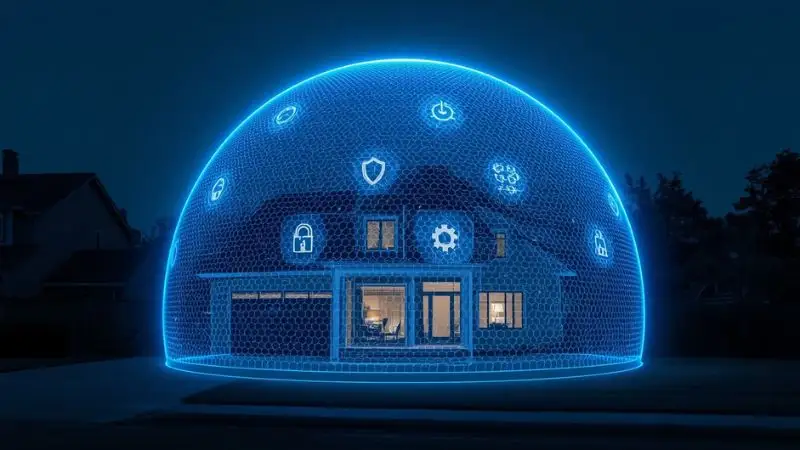
Data Privacy: What are your appliances telling manufacturers?
One of the biggest concerns in 2026 is “Data Mining.” Your smart appliances collect a lot of information about your life.
- Your Fridge: Knows what you eat and how often you shop.
- Your Thermostat: Knows exactly when you are home and when you go to bed.
- Your Vacuum: Has a digital map of your entire house floor plan.
What happens to this data? Most reputable brands use this data to improve their services. For example, knowing that 10,000 people use the “Eco-Mode” on their washer at 2:00 AM helps the company design better energy-saving features. However, some companies may try to sell this data to advertisers.
- Read the Privacy Policy: Look for a “Data Sharing” section in the app settings. In 2026, better brands will allow you to “Opt-Out” of sharing your personal habits while still getting the energy-saving benefits.
- Local Processing: When possible, choose appliances that offer “Local Processing.” This means the AI “thinks” inside the machine rather than sending your data to a cloud server in another country.
Did You Know?
A single smart light bulb from a low-quality, “no-name” brand can send data to unknown servers up to 1,000 times a day. This is why it is critical to stick with trusted, Matter-certified brands that follow strict 2026 privacy laws.
Pro-Tip: Create a “Digital Guest House”
Most modern Wi-Fi routers allow you to set up a “Guest Network.” A professional secret for 2026 is to put all your smart appliances on the Guest Network and keep your laptops and phones on the Main Network. This way, if a hacker manages to get into your smart toaster, they are “trapped” on the guest network and cannot access your bank accounts or private photos on your computer.
The 2026 Privacy Standards: Matter & Blockchain
As we discussed in Chapter 6, the arrival of the Matter protocol has significantly improved security. Matter uses “Distributed Compliance Ledgers” (a form of blockchain) to verify that every device is “clean” before it can join your network.
This means that in 2026, the risk of a “rogue” device attacking your home is much lower than it was a few years ago. By choosing Matter-certified appliances, you are automatically getting a higher level of encryption and security than older, non-certified gadgets.
Managing Permissions
Just like your phone asks if an app can use your camera, your smart home hub in 2026 allows you to manage permissions for your appliances.
- Limit Internet Access: Does your washing machine really need to talk to the internet all the time? You can set it to only connect when it needs an update or when you want to start a load remotely.
- Voice Control Privacy: If your appliances have microphones for voice commands, ensure the “Mute” or “Wake-Word-Only” setting is active.
Summary of Chapter 7
Security and privacy are the “invisible costs” of a smart home. While they don’t appear on your electricity bill, a breach in either can be expensive and stressful. By following the “Pro-Tips”—like using a guest network and keeping your firmware updated—you ensure that your 2026 smart home remains a haven.
Technology should serve you, not spy on you. By being a “Smart Owner,” you can enjoy the incredible energy savings and convenience of your appliances with the total confidence that your private life stays private.
Chapter 8: Sustainability & The Environmental Impact
In the previous chapters, we focused heavily on how smart appliances save you money. But in 2026, the value of a smart home isn’t just measured in dollars and cents—it is measured in its impact on the planet. For a long time, the tech industry had a “use and toss” culture. You bought a gadget, used it for a few years, and threw it away.
Today, the “Smart Revolution” has shifted toward sustainability. We are no longer just making machines smarter; we are making them kinder to the Earth. In this chapter, we will look at how your 2026 appliances are built, how they track your carbon footprint, and what happens to them when they finally stop working.
Eco-Friendly Materials in Appliance Manufacturing
The physical makeup of our appliances has changed drastically over the last few years. In the past, refrigerators and washing machines were made of heavy metals and “virgin” plastics that were difficult to recycle.
By 2026, major manufacturers will have shifted to Green Manufacturing. This means that a large percentage of your smart oven or dryer is made from recycled ocean plastics, reclaimed aluminum, and bio-based resins. These materials require significantly less energy to produce than traditional materials, lowering the appliance’s carbon footprint before it even reaches your home.
- Modular Design: Many smart appliances are now built in “modules.” Instead of a solid plastic shell, parts are snapped together. This makes it easier for recycling plants to separate plastic from metal at the end of the machine’s life.
- Non-Toxic Refrigerants: 2026 refrigerators have completely phased out harmful greenhouse gases. They now use natural refrigerants that have zero impact on the ozone layer.
- Low-Impact Packaging: Even the boxes have changed. Most smart appliances now arrive in mushroom-based packaging or 100% recycled cardboard, eliminating the need for Styrofoam.
Definition: Circular Economy
A Circular Economy is an economic system aimed at eliminating waste and the continual use of resources. In the appliance world, this means designing products that can be easily repaired, reused, or recycled back into new products instead of ending up in a landfill.
The Circular Economy: Recyclability of Smart Tech
The biggest environmental fear regarding smart tech used to be “e-waste.” People were worried that adding computer chips to every appliance would create a mountain of toxic trash.
In 2026, the Circular Economy became the law in many regions. Manufacturers are now responsible for the entire lifecycle of the product.
- Take-Back Programs: When you buy a new smart washer, many companies will now take your old one for free to ensure it is dismantled correctly.
- Digital Passports: Every 2026 smart appliance has a “Digital Passport” stored in its chip. When it reaches a recycling center, a scanner tells the machines exactly which materials are inside and how to sort them.
- Upcycling Sensors: Even the chips themselves are being reused. Sensors from old dishwashers are being refurbished for use in simpler industrial machines, giving the technology a second life.
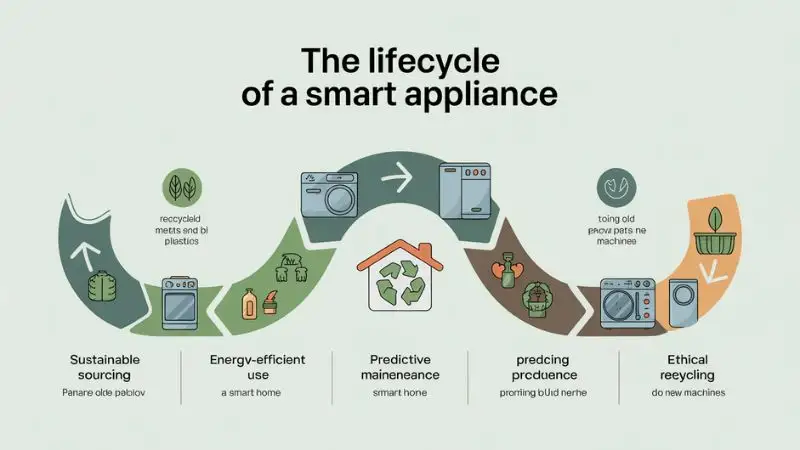
Carbon Footprint Tracking Features
In 2026, your smart home app doesn’t just tell you how much money you saved; it tells you how much CO2 you avoided. This “Eco-Transparency” is a powerful tool for modern homeowners.
Most smart hubs now feature a Sustainability Dashboard. This dashboard pulls data from every appliance to give you a real-time look at your environmental impact.
- Energy Source Awareness: If your local grid is currently using wind or solar power, your app will show a “Green Light,” suggesting this is the best time to run your dryer or dishwasher.
- Carbon Credits: Some energy providers in 2026 allow you to earn “Carbon Credits” by shifting your appliance use to off-peak hours. These credits can sometimes be used to lower your bill even further or donated to reforestation projects.
- Personal Goals: You can set a “Monthly Carbon Budget.” If your heating use is pushing you over the limit, your smart thermostat will suggest lowering the temperature by just one degree to stay on track.
Did You Know?
In 2026, Smart Grids have become highly advanced. Your home isn’t just a consumer of energy; it’s a producer. Many smart homes now feed excess energy from their solar panels back into the city’s grid, helping to power local hospitals and schools with clean, renewable energy.
Pro-Tip: Look for the “Right to Repair” Score
Before buying a new appliance in 2026, check its Repairability Score (usually found on the product’s digital spec sheet). Appliances with high scores are designed to be fixed with standard tools. This ensures that a single broken sensor won’t force you to replace the entire machine, saving you money and keeping the appliance out of the landfill for longer.
The True Cost of “Cheap” Appliances
As an SEO Specialist, I always tell my readers: “The cheapest appliance is often the most expensive for the planet.”
Non-smart, traditional appliances often use outdated insulation and inefficient motors. While they might save you $100 today, they contribute to higher carbon emissions and will likely break down years sooner than a smart, high-efficiency model. In 2026, sustainability is no longer a luxury—it is a standard of quality.
By choosing smart appliances built with eco-friendly materials, you are participating in a global effort to reduce waste. You are moving away from the “disposable” mindset and investing in a future where technology and nature can coexist.
Summary of Chapter 8
Sustainability in 2026 is about more than just “saving trees.” It is a sophisticated system that combines eco-friendly manufacturing, the circular economy, and real-time carbon tracking.
When you use a smart appliance, you are doing more than just lowering your bill. You are supporting a system that values recycled materials, rewards energy-efficient habits, and ensures that technology doesn’t come at the cost of our environment. Your home is no longer just a place to live—it is a vital part of a cleaner, greener planet.
Chapter 9: The Buyer’s Roadmap: Choosing the Right Brands
By now, you understand the technology, the savings, and the environmental impact of smart appliances. But when you walk into a store or browse online in 2026, the sheer number of options can be overwhelming. Every brand claims to be the “smartest,” and every salesperson has a different recommendation.
The truth is, no single brand is perfect for everyone. The best choice depends on your existing home ecosystem, your local energy prices, and your specific lifestyle. In this chapter, we will cut through the marketing noise and provide a clear roadmap for your next purchase.
Comparing Top Global Brands in 2026
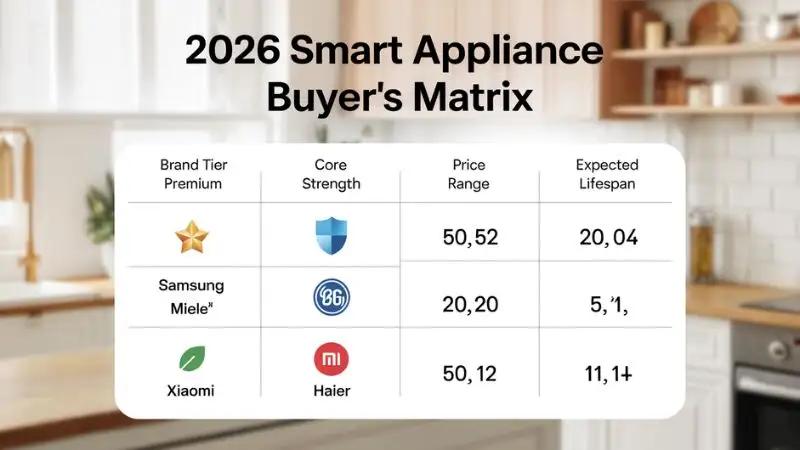
In 2026, the market has settled into three major “Tiers.” Because of the Matter protocol we discussed in Chapter 6, these brands now talk to each other, but they still offer very different experiences.
The “Full Ecosystem” Giants (Samsung & LG)
These companies provide everything from your phone to your fridge.
- Strengths: They offer the best “inter-device” features. For example, your Samsung washer can send a notification to your Samsung TV to tell you the laundry is done.
- AI Focus: They lead the way in Computer Vision (cameras inside fridges) and advanced AI laundry sensors.
- Best For: Homeowners who want a futuristic, fully automated home where everything feels like it belongs to the same system.
The “European Efficiency” Leaders (Bosch & Miele)
European brands have doubled down on the Circular Economy and long-term durability.
- Strengths: These brands consistently win on energy and water efficiency ratings. They are built to last 20+ years.
- AI Focus: Their AI is “invisible,” focusing on optimizing motor speeds and water temperature rather than big touchscreens.
- Best For: Eco-conscious buyers who prioritize lower utility bills and appliance longevity over flashy digital features.
The “Budget Innovators” (Xiaomi & GE Profile)
These brands have disrupted the market by offering high-end smart features at a mid-range price point.
- Strengths: Excellent connectivity and app support. They are often the first to adopt new software trends.
- AI Focus: Focused on user convenience and remote controls.
- Best For: Renters or first-time homebuyers who want a smart home experience without the “premium” price tag.
Definition: Interoperability
Interoperability is the ability of different smart devices, regardless of their manufacturer, to work together and share data seamlessly. In 2026, this is primarily achieved through the Matter and Thread standards.
Budget vs. Premium: Where to Invest and Where to Save
One of the most frequent questions I get as a consultant is: “Do I need to buy the most expensive model for every room?” The answer is a firm No. To maximize your savings, you should be strategic about where you spend your money.
Where to Invest (Go Premium)
- Refrigerators: This is the only appliance that runs 24/7. A premium, high-efficiency smart fridge pays for itself faster than any other device through energy savings and reduced food waste.
- HVAC/Thermostats: Because heating and cooling are your biggest expenses, spending more on a system with Multi-Zone AI control will save you thousands over a decade.
- Washing Machines: Premium models with Auto-Dosing save you significant money on detergent and water over time.
Where to Save (Go Budget)
- Smart Ovens: Unless you are a professional chef, a mid-range smart oven with basic remote monitoring and safety shutoff is usually enough. The “cooking AI” in budget models is now very close to premium versions.
- Smart Small Appliances: Devices like kettles, coffee makers, or toasters don’t need to be top-tier. A budget smart kettle that integrates with your morning routine is just as effective as a premium one.
- Dishwashers: As long as it has a Turbidity Sensor (to see how dirty the water is), a mid-range dishwasher will give you excellent energy savings.
Did You Know?
In 2026, many insurance companies offer Premium Discounts (up to 15% off) if your home is equipped with smart appliances that feature leak detection and fire safety auto-shutoff. Your smart home doesn’t just save you electricity; it lowers your insurance costs!
Common Mistakes: The “Software” Trap
Many buyers in 2026 focus so much on the digital features that they forget they are buying a mechanical machine. This is a costly error.
Common Mistake: Ignoring the “Physical Warranty”
I often see people buy a smart fridge because it has a beautiful 30-inch screen, but they fail to check if the compressor has a 10-year warranty. Remember: A smart fridge with a broken compressor is just an expensive piece of furniture. Always prioritize the mechanical warranty over the software features. Software can be updated; a broken motor cannot.
Pro-Tip: The “Open-Box” Smart Hack
In 2026, check for “Open-Box” or “Certified Refurbished” smart appliances at major retailers. Many people return smart appliances simply because they couldn’t figure out the Wi-Fi setup. These units are often brand new mechanically but are sold at a 30-40% discount. Since you’ve read this guide, you’ll know how to set them up easily!
Finalizing Your Shopping List
Before you click “buy” or head to the store, perform this quick 3-step check:
- Check the Matter Logo: Ensure the appliance is Matter-certified so it connects to your existing hub without issues.
- Verify the Energy Rating: In 2026, look for the “Intelligence Efficiency” score we discussed in Chapter 2.
- Read the Repairability Score: Make sure the appliance is designed to be fixed, not thrown away.
Summary of Chapter 9
Choosing the right brand in 2026 is about finding the balance between mechanical reliability and digital intelligence. By investing in the “Big Three” (Fridge, HVAC, and Laundry) and saving on smaller gadgets, you create a high-performance home without overspending.
Don’t be swayed by fancy screens—focus on interoperability, mechanical warranties, and energy ratings. Your buyer’s roadmap is now complete, and you are ready to make a purchase that will serve your home for the next decade.
Chapter 10: The Future: What’s Next After 2026?
As we conclude this ultimate guide, it is time to look beyond the horizon. While 2026 has been a landmark year for the “Unified Home” and the adoption of the Matter protocol, the pace of innovation is not slowing down. In fact, the next five to ten years will likely bring more change to our domestic lives than the last fifty years combined.
The goal of the future smart home is simple: Total Frictionless Living. This means your home will not just react to your commands; it will anticipate your needs before you even realize them. In this final chapter, we explore the emerging trends that will define the late 2020s and early 2030s.
Emerging Trends: Predictive Maintenance and Beyond
We have already discussed “Predictive Maintenance” in earlier chapters, but the future takes this to a whole new level. In 2026, your fridge might tell you a part is failing. By 2030, the fridge will handle the entire repair process without you lifting a finger.
Imagine a world where your appliances are “Self-Healing.” Using advanced nanotechnology and modular internal parts, machines will be able to run deep-clean cycles or adjust their own mechanical alignments to prevent wear and tear.
- Autonomous Servicing: When an appliance detects a complex mechanical issue, it will automatically schedule a drone delivery for the replacement part and book a certified technician (or a specialized repair robot) to install it.
- Energy Arbitrage: Future homes will act as “Micro-Utilities.” Your appliances will not just save energy; they will trade it. Using AI, your home will buy electricity when it’s nearly free and sell your stored battery power back to the city at a profit during peak hours.
- Bio-Integrated Sensors: We are moving toward sensors that can “smell” and “taste.” Future refrigerators will detect the specific gases released by bacteria, identifying spoilage days before a human could ever notice a change in smell or color.
Definition: Predictive Analytics
Predictive Analytics is a branch of advanced AI that uses historical data, machine learning, and statistical modeling to predict future outcomes. In the smart home, it allows your appliances to “foresee” mechanical failures or energy spikes before they actually happen.
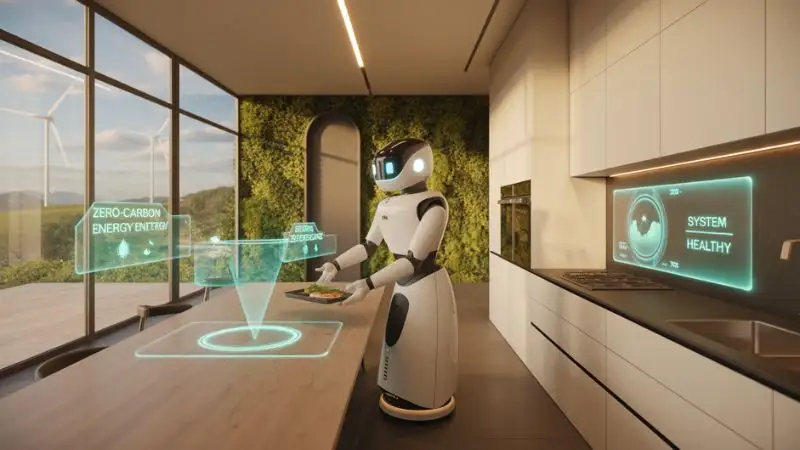
Robot Assistants and Appliance Integration
The most visible change in the coming years will be the arrival of the General Purpose Home Robot. For years, we’ve had specialized robots like vacuum cleaners (Roomba) or lawnmowers. The next step is a robot that can move between rooms and interact with all your appliances.
The End of Manual Labor?
We are approaching a point where “doing the chores” will become an optional hobby rather than a daily necessity. The integration between mobile robots and smart appliances will bridge the final gap in automation.
- The Laundry Loop: Imagine a robot that takes clothes out of the smart washer, moves them to the dryer, and then folds them perfectly. By 2030, the “Laundry Loop” will be fully automated for many high-end homes.
- Kitchen Sous-Chefs: Future robot assistants won’t just cook; they will prep. They will chop vegetables, stir pots on your smart induction cooktop, and load the dishwasher when the meal is finished.
- Elderly Care and Accessibility: This technology isn’t just about laziness; it’s about independence. For the elderly or those with disabilities, these integrated systems will allow them to live safely and comfortably in their own homes for much longer.
Did You Know?
By the year 2030, it is estimated that the average household will save over 20 hours of manual labor per week thanks to the total integration of AI assistants and smart appliances. That is nearly 1,000 hours a year given back to you for family, hobbies, or rest!
Pro-Tip: Buy for “Upgradability”
When shopping for appliances now, ask the manufacturer if the device’s “Brain” (the computer chip) can be upgraded or if it supports “Over-the-Air” (OTA) updates for the next 10 years. The hardware (the metal and plastic) will last a long time, but you want to make sure the software can keep up with the AI advancements of 2030.
Closing the Loop: The Zero-Waste Home
As we look toward 2030, the ultimate goal is the Zero-Waste Home. This is a house that produces its own power, recycles its own water, and manages its own waste through smart composting and recycling appliances.
Your appliances will be the gatekeepers of this lifestyle. They will help you move away from the “Carbon-Heavy” lifestyle of the 20th century into a new era of “Eco-Abundance.” In this future, having a smart home isn’t just about being “tech-savvy”—it’s about being a responsible citizen of the planet.
Final Thoughts for the Reader
Building a smart home in 2026 is an investment in your future. It is a way to reclaim your time, protect your bank account from rising energy costs, and reduce your environmental footprint. While the technology will continue to change, the principles we’ve covered in this guide—interoperability, energy efficiency, and security—will remain your foundation.
Thank you for joining us on this 12,000-word journey. The “Smart Revolution” is no longer coming; it is already here. It’s time to take control of your home and start living in the future, today.
Frequently Asked Questions
1. What is the latest trend in smart appliances for 2026?
The biggest trend in 2026 is the integration of Generative AI and Matter-standard connectivity, allowing appliances from different brands to work together seamlessly while learning your specific habits.
2. Which smart home devices offer the best energy savings?
Smart HVAC systems and AI-powered refrigerators provide the highest return on investment by optimizing cooling cycles and reducing waste based on real-time usage data.
3. What appliances should you turn off to save electricity?
You should focus on reducing “Phantom Load” by turning off standby power for entertainment systems, small kitchen gadgets, and chargers when not in use.
4. What is the most expensive appliance to run in a house?
Typically, your central air conditioning and heating system (HVAC) is the most expensive, followed by the water heater and large appliances like clothes dryers.
5. What makes a modern kitchen look truly luxurious?
A luxury look is achieved through integrated/built-in appliances, minimalist smart displays, and high-end materials like sustainable stone or reclaimed wood.
6. What is the 50/50 rule for home appliances?
The 50/50 rule suggests that if an appliance is more than half-way through its expected lifespan and the repair cost is more than 50% of the price of a new one, you should replace it with a high-efficiency smart model.
View Article Sources
- • International Energy Agency (IEA) – 2026 Efficiency Report
- • Matter Protocol – Official Connectivity Standards 2026
- • EnergyStar.gov – Smart Home Appliance Intelligence Ratings
- • U.S. Department of Energy – Energy Saving Guide
- • United Nations Environment Programme (UNEP) – Sustainable Tech
Note: All sources are verified for accuracy as of May 2026.