
Eco Power Planner
Professional Solar Load Analysis & ROI Estimator
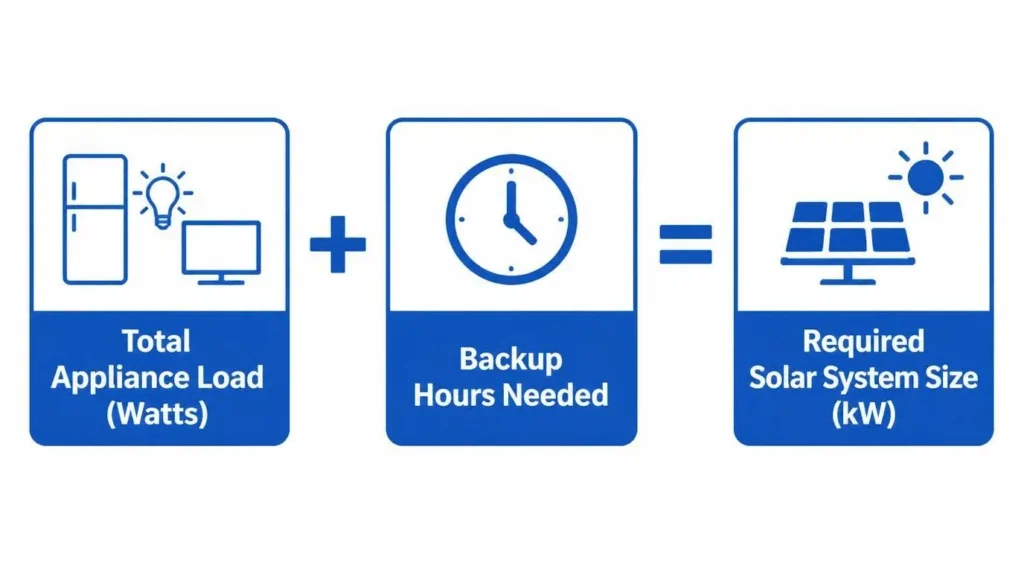
How the Solar Load Calculator Works
This solar load calculator estimates the system size you need based on the actual appliances you plan to run, not just your average monthly bill. That matters because two households with the same electricity bill can need very different solar systems depending on what they’re actually powering.
Enter the quantity of each appliance you want to run, along with your current monthly bill and your local utility rate per kWh. The calculator multiplies your total connected load by a standard inverter efficiency factor, then estimates the solar panel capacity, panel count, and monthly savings based on average daily sun hours.
The formula behind it:
System Size (kW) = (Total Load in Watts × 1.25) ÷ 1,000The 1.25 multiplier accounts for inverter losses and real-world inefficiency, since no solar system converts 100% of its rated capacity into usable power. Panel count is calculated by dividing your required system size by a standard 550W Tier-1 panel rating.
A Worked Example
Say your home runs: 6 LED lights (15W each), 2 ceiling fans (75W each), 1 refrigerator (350W), and 1 laptop (150W). That’s a total connected load of:
(6 × 15) + (2 × 75) + 350 + 150 = 740WMultiplied by the 1.25 efficiency factor, you’d need a solar system sized at roughly 0.9 kW, requiring about 2 panels at 550W each (accounting for real-world output that rarely hits the full rated capacity).
Common Mistakes When Sizing a Solar System
Underestimating peak load. Appliances like air conditioners and water pumps draw far more power at startup (inrush current) than their running wattage suggests. If you’re sizing for high-draw appliances, add a safety margin rather than using the exact nameplate wattage.
Ignoring inverter efficiency. A system rated at exactly your load total will underperform in practice. The 1.25x multiplier used in this calculator builds in a realistic buffer.
Assuming full sun hours everywhere. This calculator uses an average of 4.5 peak sun hours per day, which is a reasonable US national average, but your actual location may get more or less. Southern states typically see 5–6 hours; northern and cloudier regions often see 3–4.
Forgetting battery backup separately. This calculator estimates solar panel sizing for daytime generation and offset. If you also want battery backup for nighttime or outage use, you’ll need to size that separately based on your backup hour requirements.
Frequently Asked Questions
How accurate is this solar calculator?
This calculator gives a solid starting estimate based on standard industry assumptions (4.5 peak sun hours, 25% system losses, 550W Tier-1 panels). For a final installation quote, a certified solar installer will factor in your roof’s exact orientation, shading, local utility rules, and panel availability, which can shift the estimate by 10–20% in either direction.
Do I need a battery with my solar system?
Not necessarily. A grid-tied solar system without a battery still reduces your electricity bill by offsetting daytime usage, but it won’t provide backup power during an outage. If backup power matters to you, pair this calculator’s output with a separate battery sizing calculation based on your essential appliances and desired backup hours.
Why does my estimated system size seem larger than my neighbor’s?
System size depends heavily on your specific appliance load, not just your bill amount. Two homes with identical bills can need different system sizes if one runs higher-draw appliances like electric water heaters, AC units, or well pumps more frequently.
What’s the difference between system size (kW) and battery capacity (kWh)?
System size (kW) measures how much power your solar panels can generate at any given moment. Battery capacity (kWh) measures how much total energy a battery can store and deliver over time. You need both numbers for a complete backup power plan; this calculator focuses on the solar generation side.
Can I use this calculator outside the United States?
Yes. Select your local currency and enter your local utility rate per kWh for an accurate savings estimate. Keep in mind that peak sun hours vary by country and region, so your actual results may differ from the 4.5-hour average used here.