Chapter 1: The Kitchen Revolution of 2026
In 2026, the heart of the home looks very different from what it did even five years ago. We are living in an era where energy costs and climate consciousness drive every purchase we make. The “big oven” is no longer the default for a Tuesday night dinner. Instead, two countertop champions—the air fryer and the microwave—are battling for the top spot on our granite surfaces. By the end of this guide, you will have a clear answer to the question of air fryer vs microwave energy efficiency 2026, and you will know exactly which appliance to use for every meal.
Introduction to Modern Cooking Efficiency
The way we cook has undergone a massive transformation. For decades, the traditional thermal oven was the king of the kitchen. But as we move deeper into 2026, efficiency is the new luxury. People are looking for ways to get a hot, delicious meal on the table without “heating the whole house” or worrying about the energy drain of an air fryer vs microwave.
Today’s consumers are smarter. We aren’t just looking for the fastest way to cook; we are looking for the most resourceful way. With the rise of smart homes and real-time energy tracking, every watt matters. This chapter sets the stage for our deep dive into which appliance truly deserves the air fryer vs microwave efficiency crown this year.”
Definition: Energy Efficiency in Cooking
In the world of kitchen appliances, Energy Efficiency is the ratio of “Energy In” versus “Heat Out.” It measures how much of the electricity pulled from your wall socket actually goes into heating your food, rather than escaping as wasted heat into your kitchen air.
The Shift from Traditional Ovens to Countertop Appliances
Why is everyone ditching their full-sized ovens for smaller units? The answer is simple: scale.
A standard wall oven has a massive cavity—often 60 to 90 liters. When you want to roast a single chicken breast or reheat a slice of pizza, you are essentially paying to heat a vast amount of empty air. It’s like driving a 50-passenger bus to the grocery store just to buy a carton of milk. It works, but it’s incredibly wasteful.
In 2026, countertop appliances have become “smarter” and more powerful. They offer:
- Near-Zero Preheating: Most modern air fryers and microwaves reach cooking temperatures almost instantly.
- Targeted Heating: These devices are designed to wrap heat directly around the food, reducing the “cook time” significantly.
- Better Insulation: 2026 models feature aerospace-grade insulation that keeps heat trapped inside the unit, ensuring your kitchen stays cool while your food gets hot.
Defining the Contenders: What is an Air Fryer vs. a Microwave?
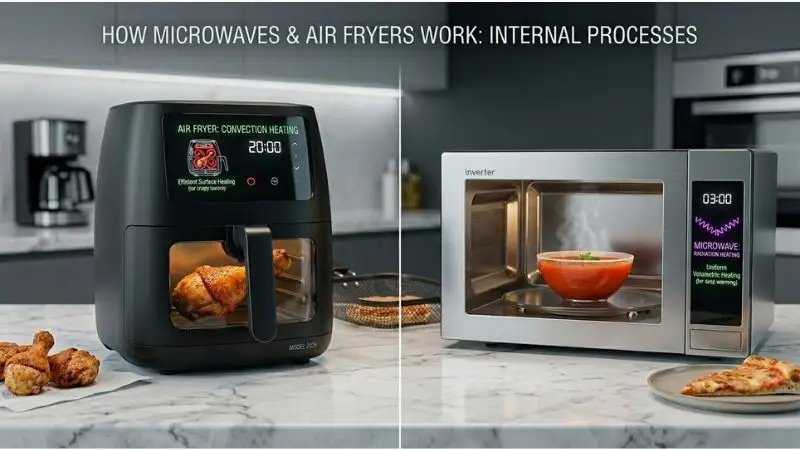
To understand which is more efficient, we first need to understand how they actually work. Even though they both sit on your counter, they use completely different “engines” to heat your food.
The Air Fryer: The Convection Specialist
Think of an air fryer as a supercharged, miniature convection oven. It uses a high-powered fan to circulate scorching hot air at high speeds around your food. This creates the “Maillard reaction”—that crispy, golden-brown crust we all love—without the need for gallons of oil. In 2026, most air fryers use “Double-Stream” airflow technology, making them 20% faster than models from 2022.
The Microwave: The Molecular Mover
A microwave doesn’t use “hot air” at all. Instead, it fires invisible waves of energy (microwaves) that cause the water molecules inside your food to vibrate at incredible speeds. This friction creates heat instantly from the inside out.
By 2026, “Inverter Technology” will have become the standard in microwaves. Unlike old-school models that just turned “on and off” to simulate lower power, inverter microwaves provide a steady, low stream of energy. This prevents the dreaded “frozen in the middle, lava on the edges” problem while saving a significant amount of electricity.
Did You Know?
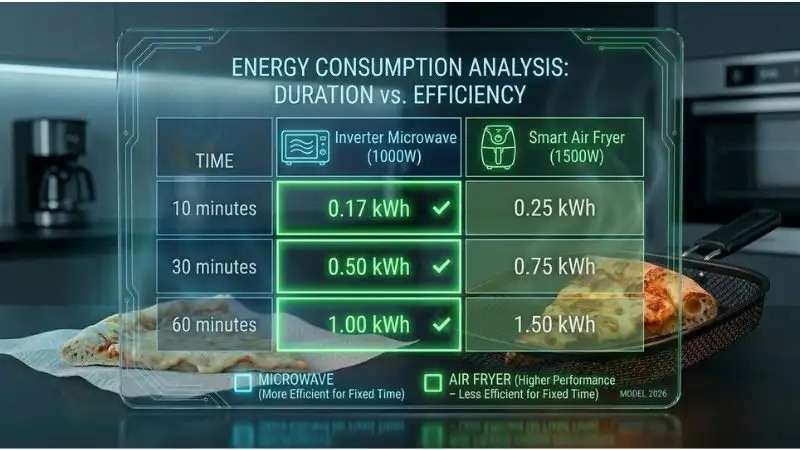
A standard 2026 air fryer uses about 1,500 watts, while a microwave uses around 1,000 watts. However, because a microwave often finishes the job in half the time, it frequently ends up using less total energy for simple tasks!
Practical Advice for the Modern Cook
Understanding the “Why” behind these appliances helps you make better choices for your wallet. If you are just heating a bowl of soup, the microwave is your best friend. But if you want that “just-fried” texture for your leftovers, the air fryer is worth the extra few cents of electricity.
Pro-Tip: To maximize efficiency in 2026, always match your appliance to your portion size. Use the microwave for liquids and high-moisture foods, and save the air fryer for proteins and starches that need a “crunch.” This simple habit can shave up to 15% off your monthly kitchen energy usage.
The Road Ahead
As we move through this guide, we will look at real-world testing. We will compare exactly how many Kilowatt-hours (kWh) it takes to cook a tray of fries versus a jacket potato. By the end of this journey, you will know exactly which appliance to reach for to keep your 2026 energy bills as low as possible.
Cooking in 2026 isn’t just about the recipe; it’s about the strategy. Let’s dive into the science of power in the next chapter.
Chapter 2: The Science of Heat – How They Use Power
To truly understand which appliance wins the energy battle in 2026, we have to look “under the hood.” It isn’t just about which one gets hotter; it’s about how that heat is created and delivered to your food.
Every watt of electricity you pay for enters these machines and undergoes a transformation. Depending on the technology inside, that electricity is either used with surgical precision or scattered like a blunt instrument. In this chapter, we explore the fascinating physics of convection and radiation.
Convection vs. Radiation: The Energy Mechanics
In the world of 2026 kitchen tech, we generally deal with two types of heat transfer: Convection and Radiation. While they both result in a hot meal, the “energy path” they take is worlds apart.
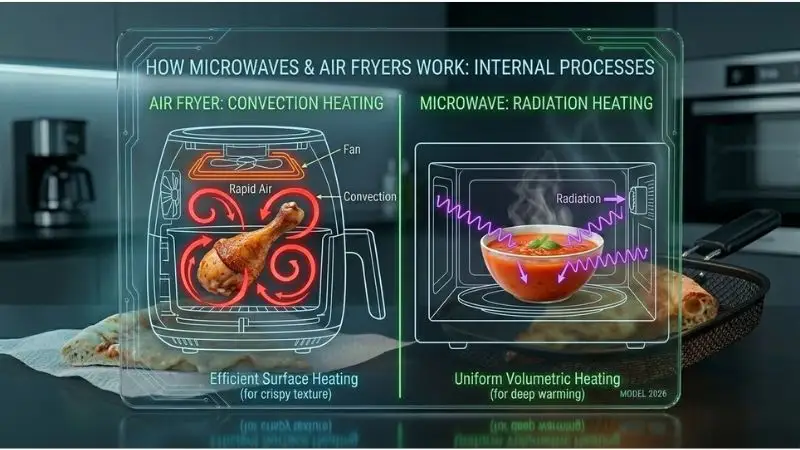
Air fryers rely on convection. This means they heat the air itself and move it around. Imagine a windy day in the desert; the wind makes the heat feel much more intense because it is constantly stripping away the “cool” air pocket around you. Air fryers do this to your food.
Microwaves, on the other hand, use electromagnetic radiation. Don’t let the word “radiation” scare you—in this context, it simply refers to waves of energy on the light spectrum. Instead of heating the air, these waves pass right through the air and go straight for the molecules inside the food.
Definition: Thermal Transfer Efficiency
Thermal Transfer Efficiency refers to how effectively an appliance moves heat from its source (the heating element or magnetron) into the food. The goal is to minimize “parasitic heat”—the energy that accidentally heats the appliance walls or the kitchen air instead of your dinner.
How Air Fryers Use Rapid Air Technology
The magic of the air fryer lies in its “Rapid Air Technology.” In 2026 models, this has been perfected to a science. Inside the top of the unit is a high-density heating coil, usually made of advanced ceramic or carbon fiber. Directly above that coil is a powerful, high-speed fan.
When you turn the machine on, the coil glows red hot, and the fan blasts air through it. This “superheated” air is then forced down into the cooking basket. Because the basket is perforated (full of holes), the air doesn’t just sit on top of the food. It swirls around it, under it, and through it.
- Boundary Layer Disruption: This constant movement breaks the “boundary layer” of cool moisture that normally surrounds cold food, allowing heat to penetrate much faster than a standard oven.
- The “Crunch” Factor: Because the air is moving so fast, it evaporates surface moisture instantly, giving you that fried texture using only air.
- Energy Density: Because the cooking chamber is so small, the air stays hot with very little effort from the heating element once the initial temperature is reached.
The Physics of Microwaves: Molecular Excitation and Heat
Microwaves operate on a principle that feels like science fiction: Molecular Excitation. Inside the microwave is a device called a magnetron. This part takes electricity and converts it into short-wavelength radio waves.
When these waves hit your food, they specifically target “dipole” molecules—most commonly water, but also fats and sugars. These molecules have a positive and a negative end, much like a magnet. The microwaves flip back and forth billions of times per second, causing the water molecules to spin and rub against each other.
- Frictional Heating: Just like rubbing your hands together creates heat, the friction of billions of vibrating water molecules creates heat directly inside the food.
- Volumetric Heating: Unlike the air fryer, which heats from the outside in, the microwave heats the entire volume of the food almost simultaneously.
- No Air Waste: This is the microwave’s biggest energy advantage. It does not waste energy heating the air inside the chamber. If you put a cup of water in a microwave, only the water gets hot; the air around it stays relatively cool.
Did You Know?
Modern 2026 kitchen appliances are roughly 15% more efficient than those made in 2020. This is largely due to “Smart Inverters” and better insulation materials. Older microwaves were “all or nothing,” but 2026 models can dim their “flame” to use exactly the amount of power needed, preventing energy spikes.
Why Physics Matters for Your Bill
When we look at these two methods, we see a clear trade-off. The air fryer is more “aggressive” with its energy because it has to keep a fan spinning and a large coil glowing. However, it provides a quality of heat that changes the texture of the food.
The microwave is a “sniper.” It uses its energy to hit the target (water molecules) and ignores everything else. This makes it incredibly efficient for “wet” foods like vegetables, soups, and pasta. However, because it relies on water vibration, it can never make food “crispy.” It actually makes food soggier as the water turns to steam.
Pro-Tip: If you are cooking something dense, like a large potato, use the “Physics Shortcut.” Microwave it for 3 minutes to heat the inside via molecular excitation, then move it to the air fryer for 2 minutes to crisp the skin via convection. You’ll save about 10 minutes of total electricity usage!
Common Mistakes: Fighting the Physics
Many people try to use these appliances in ways that go against their “Science of Heat.”
- Crowding the Air Fryer: If you stack food in layers, the “Rapid Air” cannot circulate. This turns your efficient convection machine into a very inefficient, slow oven.
- Microwaving Dry Foods: Trying to “cook” a dry piece of bread in the microwave is inefficient because there aren’t enough water molecules to vibrate. The energy is wasted, and the food becomes like rubber.
In 2026, being an “Expert Content Architect” in your own kitchen means knowing which physics engine to engage for the job. By choosing the right method for the right food, you aren’t just a better cook—you’re a more sustainable one.
In the next chapter, we will move from the “How” to the “How Much,” breaking down the actual wattage and costs you can expect to see on your energy statement.
Chapter 3: Kilowatts and Cents – The Direct Comparison
When you stand in your kitchen looking at the air fryer vs microwave units on your counter, you aren’t just looking at cooking tools. In 2026, you are looking at energy consumers. With global electricity prices fluctuating, understanding the “math of the meal” has become an essential survival skill for the modern household.
It is easy to get lost in technical jargon like “kilowatt-hours” or “voltage spikes.” However, when weighing the air fryer vs microwave efficiency for your daily cooking, all we really want to know is: How much is this specific meal going to cost me on my next bill? This chapter breaks down the raw numbers…”
Analyzing Wattage and Electricity Consumption
To understand energy efficiency, we first have to talk about “Wattage.” Think of wattage like the size of a water pipe. A larger pipe (higher wattage) can move more water (electricity) at once. While higher wattage often means faster cooking, it also means a faster-spinning electricity meter.
In 2026, manufacturers have made massive strides in “Power Management.” Many modern appliances no longer run at their maximum wattage for the entire cooking cycle. Instead, they use smart sensors to “pulse” the power, drawing only what is needed to maintain the temperature. This is why a 1,500-watt air fryer might actually use less energy than a 1,000-watt model if it reaches the target heat twice as fast.
Definition: Kilowatt-Hour (kWh)
A Kilowatt-Hour is the standard unit of measurement your energy company uses to bill you. It represents using 1,000 watts of electricity continuously for one hour. For example, if you run a 1,000-watt microwave for exactly 60 minutes, you have used 1 kWh.
Average Wattage of 2026 Kitchen Appliances
The “average” kitchen appliance in 2026 is much leaner than its ancestors from a decade ago. However, there is still a significant gap between our two main contenders.
- 2026 Inverter Microwaves: Most standard models now sit between 800W and 1,100W. Because of inverter technology, they can maintain a steady 200W or 500W stream for delicate tasks like melting chocolate or softening butter.
- 2026 Rapid-Air Fryers: These range from 1,200W to 1,800W. Larger, dual-basket models are on the higher end of that scale. While the number is higher than that of a microwave, remember that the air fryer is often replacing a 3,000W traditional oven.
Cost Per Hour: A Global Comparison (USD, EUR, GBP, PKR)
Electricity isn’t priced the same everywhere. Depending on where you live, the “efficiency winner” might change based on your local utility rates. In 2026, we see a wide range of costs per kilowatt-hour.
To give you a clear picture, let’s look at what it costs to run a high-power 1,500W Air Fryer for one full hour in different regions (based on average 2026 residential rates):
- United States (USD): At an average of $0.18 per kWh, one hour costs approximately $0.27.
- European Union (EUR): With rates around €0.24 per kWh, one hour costs roughly €0.36.
- United Kingdom (GBP): Under the current price caps (~£0.25 per kWh), one hour costs about £0.38.
- Pakistan (PKR): At roughly 65 PKR per unit (including taxes/adjustments), one hour costs about 98 PKR.
While these numbers seem small, they add up. If you use your air fryer for an hour every day, that’s nearly $100 a year in the US, or over 35,000 PKR in Pakistan. In comparison, a microwave used for 10 minutes a day would cost less than a quarter of those amounts.
Did You Know?
In 2026, some “Ultra-Efficient” air fryers now include a “Carbon Footprint Tracker” on their digital displays. It shows you exactly how many grams of CO2 were produced to cook your meal based on your local power grid’s current energy mix!
How to Take Control of Your Kitchen Costs
Knowing the averages is great, but every home is different. Maybe your air fryer is an older, “power-hungry” model, or perhaps your microwave’s door seal is leaking energy. This is where personal tracking comes in.
Pro-Tip: Use a “Kill-A-Watt” Meter If you want to stop guessing, buy a simple plug-in energy monitor (often called a Kill-A-Watt meter). You plug the meter into the wall, and then plug your appliance into the meter. It will show you the exact wattage being pulled in real-time and total kWh used over a week. This is the best way to see if your “Quick Snack” is actually costing you more than a full meal.See ENERGY STAR’s guide to home energy monitors at this link.
Common Mistakes: The “Standby” Drain
One of the biggest energy leaks in 2026 isn’t actually the cooking—it’s the Standby Power.
- The Glowing Clock: That little LED clock on your microwave might seem harmless, but it pulls power 24/7.
- Smart Features: Air fryers with Wi-Fi connectivity stay “awake” to listen for commands from your phone.
- The Solution: In many parts of the world, “Smart Plugs” are now used to completely cut power to these devices when they aren’t in use, saving an average household about $15–$30 (or 4,000+ PKR) per year.
Final Thoughts on Chapter 3
The numbers don’t lie: the microwave is the undisputed king of raw electricity savings per minute. However, the air fryer remains a massive upgrade over the traditional oven. If your goal is to save the most money possible, the microwave is your primary tool. If your goal is “Oven Quality” at a 50% discount, the air fryer is your winner.
In the next chapter, we’ll put these numbers to the test in the real world—starting with everyone’s favorite kitchen task: the perfect reheat.
Chapter 4: Performance Test – Reheating and Thawing
When we talk about energy efficiency in 2026, we aren’t always talking about roasting a four-course meal. Most of the time, the battle for efficiency happens in the small moments: the frantic Tuesday morning when you need to defrost chicken, or the late-night craving for yesterday’s pizza. These “quick tasks” are the most common ways we use our appliances.
While it’s tempting to think that a few minutes of power doesn’t matter, these short bursts of energy usage are the “hidden leaks” in your utility bill. In this chapter, we put the air fryer and the microwave head-to-head in a performance test to see which one handles these daily chores with the most grace—and the least electricity.
The Efficiency of Quick Tasks
Efficiency in quick tasks is a balance between speed, power draw, and the final quality of the food. If an appliance uses very little energy but leaves your food inedible, that energy was wasted. In 2026, we define “Efficiency” not just as low power consumption, but as the ability to achieve the desired result on the first try.
Microwaves have long been the kings of the “quick fix.” However, the modern air fryer has challenged this by offering a texture that microwaves simply cannot replicate. The question is: is that extra “crunch” worth the extra kilowatts?
Definition: Sensory Efficiency
Sensory Efficiency is a term used by 2026 food scientists to describe the ratio of energy used to the quality of the food’s texture and taste. High sensory efficiency means the food tastes “freshly cooked” rather than “reheated” while still using minimal power.
Reheating Pizza: Energy Used vs. Quality of Result
Reheating pizza is perhaps the ultimate test for any kitchen appliance. It is a complex task because you have three different textures to deal with: the crunchy crust, the gooey cheese, and the moist toppings.
The Microwave Method:
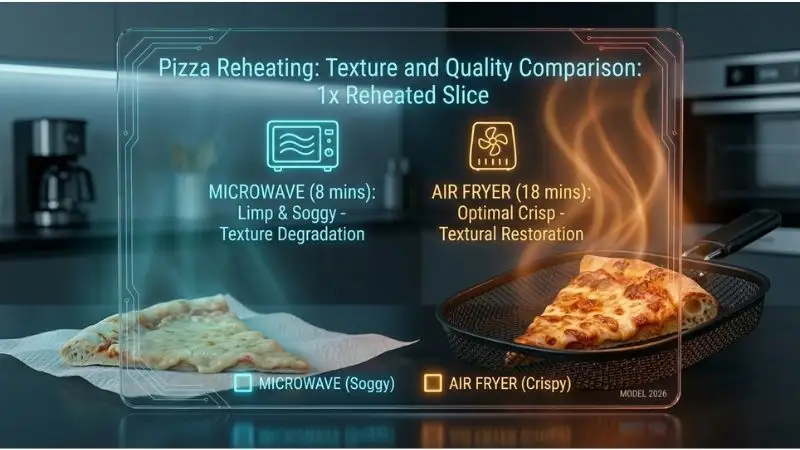
- Energy Use: Extremely low. A typical 2026 inverter microwave can reheat two slices of pizza in 45 to 60 seconds using roughly 0.015 kWh of energy.
- The Result: Often disappointing. The crust becomes rubbery or soggy because the microwave targets the water molecules in the dough, turning them into steam.
- Sensory Efficiency: Low. While it uses the least power, most people find the result subpar.
The Air Fryer Method:
- Energy Use: Moderate. It takes about 3 to 4 minutes at 350°F (175°C). This uses approximately 0.08 kWh—about five times more energy than the microwave.
- The Result: Near perfection. The “Rapid Air” tech crisps the bottom of the crust while gently melting the cheese. It tastes like it was just delivered.
- Sensory Efficiency: High. Even though it uses more electricity, the “re-cook” quality is so high that users are less likely to throw away food, reducing overall waste.
Defrosting Meat: Which Method Saves More Power?
Defrosting is a high-stakes game. If you do it wrong, you end up with “grey,” partially cooked edges and a frozen center, which is both unappetizing and a safety risk.
The Microwave Strategy: In 2026, “Inverter Defrost” changed the game. Instead of blasting the meat with full power, the microwave uses a consistent 10% power stream. For a 500g block of ground beef, this takes about 5–7 minutes.
- Power Pros: It is incredibly fast and uses very little total energy.
- Power Cons: If you aren’t careful, the edges will begin to cook, which can change the texture of your final meal.
The Air Fryer Strategy: Many 2026 air fryers now come with a “Dehydrate/Defrost” setting. This uses the fan at high speeds with very low heat (around 100°F or 40°C).
- Power Pros: It defrosts very evenly because the air circulates around the entire piece of meat.
- Power Cons: It takes significantly longer—often 15 to 20 minutes. This means the fan motor is running for a long time, leading to higher energy consumption compared to the microwave’s quick pulse.
Did You Know?
Reheating bread-based items in a microwave with a cup of water next to them is a myth for efficiency. While it keeps the bread moist, it actually makes the microwave work harder because it has to heat the extra volume of water, increasing your energy usage by up to 20%!
Navigating the “Quick Task” Minefield
The data shows a clear trend: for speed and raw energy savings, the microwave is unbeatable. However, for “quality-critical” tasks like reheating fried chicken or pizza, the air fryer is the winner. To get the best of both worlds, many 2026 households use a “Dual-Stage” approach.
Pro-Tip: The 80/20 Reheat Rule To save energy and keep quality, use the microwave for the first 80% of the time to heat the core of the food. Then, pop it into the air fryer for the last 20% (usually just 60 seconds) to crisp the outside. This reduces air fryer “run time” by half while still giving you that perfect crunch.
Common Mistakes: The Efficiency Killers
In our research for 2026 kitchen habits, we’ve found that the biggest waste of energy comes from using the wrong tool for the wrong “moisture profile.”
- Air Fryer for High-Moisture Foods: Never use an air fryer to reheat things like pasta with sauce, stews, or soups. The fan will actually blow the sauce around, making a mess, and the convection heat will dry out the moisture before the center is hot. This wastes energy and ruins the meal.
- Microwaving “Stacked” Leftovers: If you pile leftovers in a big heap in the microwave, the center stays cold while the edges overcook. You’ll end up running the microwave for 3 or 4 cycles, eventually using more energy than if you had just spread the food out on a flat plate for one 2-minute cycle.
- Forgetting the Pre-Heat: In 2026, most air fryers don’t need a 5-minute pre-heat for reheating. Many people still do this out of habit, essentially throwing away 0.05 kWh of energy before the food even enters the basket.
Summary of Chapter 4
When it comes to “Quick Tasks,” the microwave is the economy car—it gets you there for the lowest price. The air fryer is the luxury SUV—it uses more fuel, but the ride is much better. In 2026, the smartest move is to look at your plate: if it’s “wet,” go microwave. If it’s “dry or crispy,” go air fryer.
In the next chapter, we move beyond the snacks and look at the “Big Cook”—how these appliances handle raw ingredients to create full meals from scratch.
Chapter 5: Performance Test – Full Meal Preparation
Moving beyond simple reheating, we now enter the “Big Leagues” of kitchen efficiency: cooking raw ingredients from scratch. In 2026, the question isn’t just about speed; it is about whether these countertop devices can actually replace your main oven for a family dinner.
When you cook raw proteins or dense vegetables, the energy requirements skyrocket. Unlike reheating a slice of pizza for 60 seconds, roasting a chicken or steaming a harvest of garden vegetables requires sustained power. This chapter puts the air fryer and microwave through a “Full Meal Challenge” to see which one delivers the best balance of nutritional value, taste, and energy savings.
Cooking from Scratch: Poultry, Vegetables, and Grains
Cooking raw food requires a process called “denaturation,” where heat changes the structure of proteins and fibers to make them safe and pleasant to eat. This process takes time and a consistent application of energy.
In 2026, air fryers have become mini-powerhouses for roasting, while microwaves have evolved into precision steamers. However, when we look at the raw data, the “efficiency winner” depends entirely on the type of food you are preparing.
- Air Fryers excel at dry-heat cooking (roasting and frying).
- Microwaves excel at wet-heat cooking (steaming and poaching).
- Energy Consumption varies wildly based on how long the appliance must stay active to reach a safe internal temperature.
Definition: Specific Heat Capacity
In cooking, Specific Heat Capacity is the amount of energy required to raise the temperature of a specific food item by one degree. Foods with high water content (like vegetables) have a high heat capacity, meaning they require a lot of energy to heat up—but they also hold onto that heat very well.
Roasting a Whole Chicken: The Energy Gap
Can you really roast a whole chicken in a countertop appliance? In 2026, the answer is a resounding “Yes.” But the energy cost might surprise you.
The Air Fryer Approach: Roasting a 1.5kg chicken in a 2026 air fryer takes about 45 to 55 minutes.
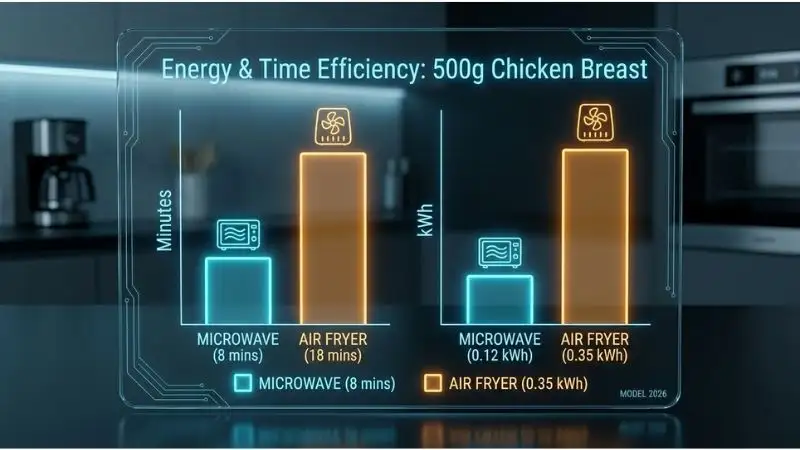
- The Energy Draw: Because the air fryer must keep a high-wattage heating element active and a fan spinning for nearly an hour, it consumes approximately 1.1 to 1.3 kWh.
- The Result: The skin is crispy, the fat is rendered, and the meat is juicy. This is a 60% energy saving compared to a full-sized electric oven, which would take 75 minutes and use nearly 3.0 kWh.
The Microwave Approach: Believe it or not, you can cook a chicken in a microwave, though few people choose to.
- The Energy Draw: Using a modern inverter microwave on medium-high power, a chicken can be fully cooked in about 20 to 25 minutes. This uses only 0.4 to 0.5 kWh.
- The Result: While safe to eat, the chicken looks pale and “boiled.” There is no crispy skin and no roasted flavor.
- The Verdict: While the microwave is the clear winner in raw energy savings, the “Quality Gap” is so large that most users consider the air fryer’s energy cost a worthy investment.
Steaming Vegetables: Why the Microwave Wins on Speed
When it comes to vegetables, the tables turn completely. If you are looking for the most energy-efficient way to get your greens, the microwave is the undisputed world champion of 2026.
The Microwave Advantage: Since vegetables are mostly water, the microwave’s ability to target water molecules directly is incredibly efficient.
- Speed: You can steam a bowl of broccoli or carrots in 3 minutes using about 0.05 kWh.
- Nutrition: Because the cooking time is so short, more vitamins are preserved compared to other cooking methods.
The Air Fryer Limitation: Air fryers work by removing moisture to create a “crunch.”
- Speed: “Roasting” vegetables in an air fryer takes 10 to 15 minutes.
- Energy Use: It uses roughly 0.25 kWh, five times more than the microwave.
- The Trade-off: You get a roasted, charred flavor that is delicious, but for simple daily nutrition, you are paying a high “energy tax” for that flavor.
Did You Know?
In 2026, specialized “Microwave-Safe Pressure Cookers” have become a trend. They allow you to cook dry grains like brown rice or quinoa in just 12 minutes, using 70% less energy than a traditional stovetop or an air fryer’s “bake” setting!
Optimizing Your Cooking Strategy
In 2026, the most energy-efficient kitchen isn’t one that uses just one appliance. It uses the “Hybrid Method.” This is a strategy used by professional chefs and energy-conscious home cooks to get the best of both worlds.
Pro-Tip: The “Hybrid Method” When cooking dense foods like thick chicken breasts or root vegetables (potatoes, beets), start them in the microwave for 4–5 minutes. This “pre-heats” the core of the food using ultra-efficient radiation. Then, transfer them to the air fryer for the last 5 minutes to get the roasted texture. This reduces your total energy usage by up to 40% compared to using the air fryer alone!
Common Mistakes: The “One-Tool” Trap
One of the biggest mistakes we see in 2026 is the “all-in-one” mentality. Just because you can cook everything in an air fryer doesn’t mean you should.
- Cooking Grains in an Air Fryer: Attempting to cook rice or pasta in an air fryer is a massive waste of energy. It requires heating a large volume of water using air convection, which is incredibly slow and inefficient. Always use a microwave or a dedicated electric kettle/cooker for water-based tasks.
- Overloading the Basket: If you cram a raw meal into an air fryer basket until it’s full, the air cannot circulate. This forces the machine to run twice as long to cook the food in the center, doubling your energy cost and leaving you with unevenly cooked meat.
- Ignoring the Lid: When using the microwave for full meals, people often forget to use a microwave-safe lid. A lid traps steam, which helps cook the food faster from the outside in, reducing your “on-time” by up to 2 minutes per meal.
Summary of Chapter 5
When preparing full meals from scratch, the air fryer is your “Oven Replacement”—it provides the quality you want at a fraction of the cost of a large range. However, the microwave remains the “Efficiency Specialist.” For the ultimate 2026 kitchen experience, use the microwave for your “wet” sides (veggies and grains) and the air fryer for your “dry” mains (proteins).
In the next chapter, we will look at how the “Smart Technology” of 2026 is making these efficiency decisions for you, and how AI is helping us save even more on our utility bills.
Chapter 6: Impact of 2026 Smart Technology
As we navigate through 2026, the appliances in our kitchens have graduated from “dumb” boxes that just get hot to highly sophisticated computers that happen to cook food. In previous years, energy efficiency was mostly about the hardware—how thick the insulation was or how powerful the fan could spin. Today, efficiency is a software game.
The “Smart Kitchen” revolution of 2026 isn’t just about controlling your microwave from your phone while you’re in the garden. It is about how Artificial Intelligence (AI) and advanced sensors are making real-time decisions to save you money. In this chapter, we look at the invisible technology that is quietly slashing our energy bills.
How Smart Features Reduce Energy Waste
In the past, cooking was a game of guesswork. You would guess the time, guess the power level, and often guess wrong, leading to overcooked food and wasted electricity. 2026, technology has removed the “human error” from the energy equation.
Modern air fryers and microwaves are now equipped with “Energy-Adaptive Logic.” This means the appliance is constantly communicating with your home’s smart meter. If your local power grid is under high stress, your appliance can actually “throttle” its own power usage slightly without affecting the quality of your meal, helping you avoid “peak hour” pricing.
- Precision Timing: Smart appliances now calculate the exact second food is done, preventing that extra 2 minutes of “just in case” cooking that wastes watts.
- Optimal Heat Curves: Instead of running at 100% power for 20 minutes, AI calculates a “heat curve” that uses high power to start and slowly tapers off as the food’s internal temperature rises.
- Predictive Maintenance: Sensors can tell when a fan is struggling due to grease buildup, alerting you to clean it before it starts pulling 20% more power to compensate.
Definition: Energy-Adaptive Logic
Energy-Adaptive Logic is a software system used in 2026 appliances that automatically adjusts power consumption based on real-time factors like food temperature, moisture levels, and even current electricity prices from the grid.
AI-Driven Sensors: Adjusting Power Based on Food Weight
One of the biggest energy savers in 2026 is the integration of high-precision weight and moisture sensors. In the old days, you would press “Potato” on your microwave, and it would run for a pre-set 5 minutes, whether you had one small potato or three large ones.
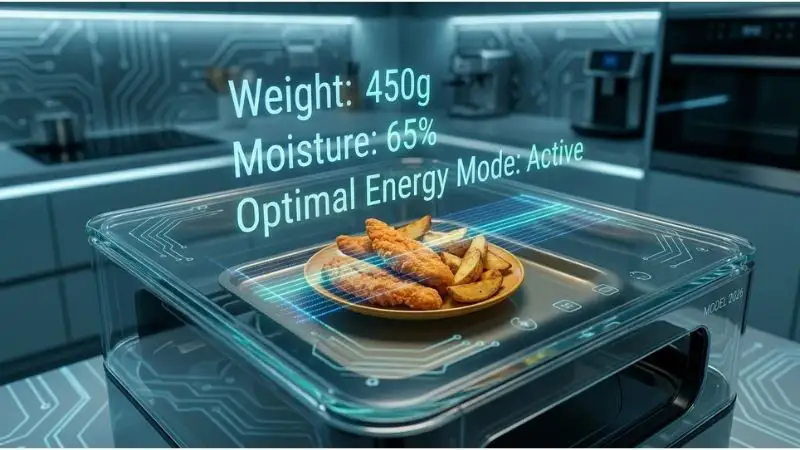
How it works in 2026: When you place food in a modern microwave or air fryer, the internal “Smart Scale” weighs the item. Simultaneously, infrared sensors and “Electronic Noses” (gas sensors) detect moisture and steam levels.
- Weight-Based Calibration: The AI knows exactly how many joules of energy are required to heat 400g of chicken versus 600g. It adjusts the wattage output to match the mass perfectly.
- Dynamic Shut-off: The moment the sensors detect a specific steam profile, the appliance knows the food has reached its safe internal temperature. It shuts off immediately, often saving 15-20% of the energy used by traditional “timer-based” cooking.
- Inverter Precision: In microwaves, this AI works with the inverter to provide a steady, low-energy stream that is far more efficient than the “on-and-off” pulsing of 2020-era models.
Eco-Modes and Standby Power Consumption
We’ve all seen the “Eco-Mode” button on our appliances, but in 2026, this feature actually does more than just dim the display. Modern Eco-Modes are designed to tackle the two biggest energy thieves: the heating cycle and the “standby” state.
The “Real” Eco-Mode: When you activate Eco-Mode on a 2026 air fryer, the machine prioritizes a longer, lower-wattage cook. While it might take 3 minutes longer to finish your fries, it avoids the “peak draw” that can be expensive on some modern digital electricity tariffs. It’s like driving your car at 55 mph instead of 80 mph; you still get there, but you use much less fuel.
The Standby Evolution: Historically, appliances were “vampires”—they sucked power even when they were off just to keep the clock glowing or the Wi-Fi connected. In 2026, new regulations have forced manufacturers to implement “Deep Sleep” technology.
- Low-Power Wi-Fi Chips: Modern appliances use “BLE” (Bluetooth Low Energy) to stay connected to your phone while using 90% less standby power than older Wi-Fi models.
- Capacitor Clocks: Some high-end 2026 models now use small internal capacitors to keep the clock running during short outages without pulling “phantom” power from the wall.
Did You Know?
“Phantom Energy” (also known as Vampire Power) accounts for roughly 5% to 10% of total residential electricity use globally. In a typical home with a microwave, air fryer, toaster, and coffee maker all plugged in, you could be paying for an extra 150 kWh per year just to keep your appliances “asleep.”
Practical Smart-Tech Strategies
Even if you don’t have the latest 2026 “AI-Powered” unit, you can use the same logic to save power. Efficiency is a mindset as much as it is a technology.
Pro-Tip: The “Master Switch” Strategy If your appliances don’t have a “Deep Sleep” mode, use a smart power strip. These strips can be programmed to completely cut the physical power to your microwave and air fryer between 11 PM and 6 AM. This eliminates “Phantom Energy” entirely and can save you enough money over the year to pay for a month’s worth of groceries.
Common Mistakes: Over-Reliance on Automation
While smart tech is brilliant, it isn’t perfect. We see two common mistakes that users make when relying on 2026 automation:
- Ignoring Sensor Obstruction: If you don’t keep the internal sensors (usually located near the top or side of the chamber) clean, the “Smart Cook” feature will fail. A smudge of grease on an infrared sensor can make the AI think the food is still cold, causing it to overcook and waste energy.
- Leaving the “Keep Warm” Mode On: Many 2026 air fryers automatically switch to “Keep Warm” once they finish. This uses a constant 200–300 watts. If you aren’t ready to eat immediately, it’s much more efficient to let the food sit in the insulated chamber (which holds heat for 10-15 minutes) rather than letting the machine pull more power.
- The “Double-Dip” Reheat: Using the “Auto-Reheat” sensor for a second time because the food isn’t “piping hot.” Smart sensors are calibrated for food safety, not necessarily for your personal preference of “lava-hot” soup. Every extra cycle is a 100% waste of the energy needed for that specific task.
Summary of Chapter 6
The kitchen of 2026 proves that the smartest way to save energy is to stop using it where it isn’t needed. Through AI-driven sensors and smarter standby modes, we are finally moving away from the “one-size-fits-all” cooking times of the past. By letting the appliance “think” for us, we ensure that every penny spent on electricity results in perfectly cooked food.
In the next chapter, we look at the “Hidden Heat”—how your appliances don’t just heat your food, but also change the temperature of your entire home, and what that means for your cooling bills.
Chapter 7: Hidden Energy Factors – Heat Gain and Ventilation
When we calculate the energy efficiency of a kitchen appliance, we usually look at the digital display on the machine or our monthly utility bill. But in 2026, experts are looking at something much bigger: the Total Home Ecosystem.
Efficiency isn’t just about how much power the machine uses to cook your food. It’s also about how much heat that machine “leaks” into your home. This is what we call “Secondary Energy Costs.” If your appliance heats your kitchen so much that your air conditioning has to work harder to cool it back down, your “efficient” meal just became very expensive.
The Thermodynamic Impact on Your Home
Thermodynamics is a fancy word for how heat moves. In a perfect world, 100% of the heat generated by your appliance would stay inside the food. In the real world of 2026, no machine is perfect.
Every time you cook, your kitchen becomes a small laboratory of heat exchange. This is especially important for those living in warmer climates like Pakistan, the Southern United States, or Mediterranean Europe. During a hot summer, a “cool” kitchen is an energy-saving kitchen. If your cooking methods are fighting against your cooling system, you are paying for the same energy twice.
- Radiation vs. Convection Leakage: Microwaves and air fryers handle “waste heat” very differently.
- The Insulation Factor: 2026 models are better insulated than older units, but they still need to “breathe” to prevent internal damage.
- The Humidity Variable: Cooking often releases steam. Managing that steam is a hidden part of the energy equation.
Definition: Thermal Runaway and Efficiency Loss
Thermal Runaway in a kitchen context occurs when an appliance’s internal temperature rises uncontrollably due to poor ventilation or a technical glitch. This leads to Efficiency Loss, where the machine consumes massive amounts of power to maintain heat that is rapidly escaping into the room rather than entering the food.
Kitchen Ambient Temperature: Air Fryers vs. Microwaves
How much does your kitchen actually heat when you make dinner? The answer depends on the “ventilation profile” of your appliance.
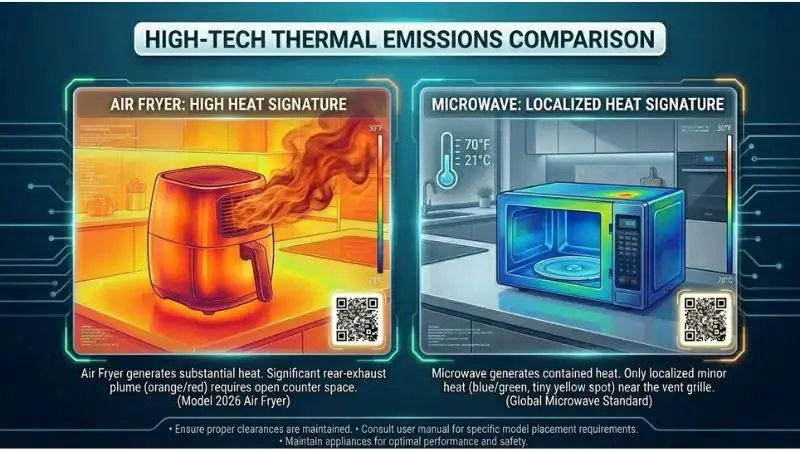
The Air Fryer’s Heat Signature: An air fryer is essentially a high-powered heater with a fan. To keep the pressure from building up inside the unit, it must constantly exhaust hot air out of the back.
- Exhaust Temperature: The air coming out of a 2026 air fryer can be as hot as 200°C (400°F).
- The Impact: If you run an air fryer for 30 minutes, it acts like a small space heater. In a small kitchen, this can raise the ambient temperature by 2 to 4 degrees Celsius.
- Heat Waste: This is energy you paid for that is now literally “vanishing into thin air” (and making you sweat).
The Microwave’s Heat Signature: Because microwaves target water molecules rather than heating the air, they are naturally “cooler” operators.
- Exhaust Temperature: The exhaust from a microwave is mostly just warm air from the cooling fan that prevents the electronics from overheating. It rarely feels “hot” to the touch.
- The Impact: Even after 10 minutes of use, a microwave has almost zero effect on the temperature of your kitchen.
- The Winner: For keeping your home cool, the microwave is the undisputed champion.
Secondary Energy Costs (Air Conditioning/Ventilation)
This is the “Hidden Tax” on your energy bill. In 2026, with the rise of smart homes, we can now track how appliances trigger other systems.
The AC Struggle: If you live in a hot region, your Air Conditioning (AC) is likely your biggest energy expense. Every unit of heat your air fryer puts into the room must be removed by the AC.
- The 1:1 Rule: For every 3 watts of heat an appliance adds to a room, a typical AC unit uses about 1 watt of electricity to remove it.
- The Math: If your air fryer uses 1.0 kWh and leaks 30% of that as heat, your AC has to use an extra 0.1 kWh just to balance the room. This makes the “true cost” of your air fryer 10% higher than what the display says.
The Ventilation Fan: Many people run an overhead stove vent or an exhaust fan when using an air fryer to get rid of the smell and heat.
- Extra Watts: A standard kitchen exhaust fan pulls about 50 to 100 watts.
- Total Cost: If you run the fan for the duration of the air fryer cook plus 10 minutes afterward to clear the air, you’ve added another 0.05 kWh to the meal’s energy footprint.
Did You Know?
In 2026, some “Passive House” building standards actually ban high-heat exhaust appliances that aren’t directly connected to a heat-recovery ventilation (HRV) system. This is because the heat loss is so significant it can ruin the energy rating of a modern eco-home!
Pro-Tips for Thermodynamic Efficiency
You don’t have to stop using your favorite appliances just to keep the kitchen cool. You just need to be strategic about where and when you use them.
Pro-Tip: Use the “External Ventilation” Trick If it is a hot summer day, place your air fryer near an open window or under your stove’s range hood before you turn it on. By venting the hot exhaust directly outside, you prevent the kitchen temperature from rising. This saves your AC from kicking into high gear and can lower the “secondary cost” of your meal to almost zero.
Common Mistakes: Blocking the Airflow
The biggest enemy of efficiency in 2026 is poor placement. We often treat appliances like furniture, but they are thermal engines that need space.
- Corner Crowding: Pushing your air fryer deep into a corner or under a low cabinet traps the hot exhaust air. This creates a “heat pocket” that makes the internal sensors think the food is hotter than it is, often leading to uneven cooking and wasted power.
- The “Towel” Mistake: Never place a kitchen towel or decorative mat under or behind your air fryer. These materials can trap heat or, worse, block the intake vents at the bottom. This forces the motor to work harder, leading to Thermal Runaway and a shorter lifespan for the appliance.
- Ignoring Microwave Vents: While microwaves stay cooler, they still have vents for the magnetron. If you pile cookbooks or mail on top of your microwave, the cooling fan has to run longer and faster, which uses more electricity and wears out the internal parts.
Summary of Chapter 7
True energy efficiency in 2026 requires looking beyond the appliance itself. While the air fryer is a miracle of modern cooking, it is a “leaky” heat source compared to the microwave. By understanding the thermodynamic impact on your home, you can make smarter choices—like using the microwave for heavy steaming on hot days and saving the air fryer for when the weather is cooler.
In the next chapter, we will look at how the physical condition of your machine—grease, dust, and wear-and-tear—can secretly double your energy consumption without you ever noticing.
Chapter 8: Maintenance and Longevity vs. Energy Use
Most people think that an appliance’s energy efficiency is “set in stone” the day they buy it. They believe that if the box says 1,500 watts, it will always use that amount. However, in 2026, we know that an appliance is a living system. As it ages—and as it gets dirty—its efficiency starts to slip.
A neglected air fryer or a dirty microwave doesn’t just look bad; it actually costs more to run. When your machine has to fight against layers of grease or a struggling motor, it pulls more electricity from the wall to get the same job done. In this chapter, we look at how proper maintenance can keep your “energy bills” low and your “appliance life” long.
How Cleanliness Affects Efficiency
The link between a clean kitchen and a lower power bill is stronger than you might think. In 2026, many high-end appliances will come with “Efficiency Sensors” that alert you when performance drops. Most of the time, the culprit isn’t a broken part—it’s just dust and grime.
Think of it like a car. If you never change the oil or clean the air filter, the engine has to work harder to maintain speed. In the kitchen, a dirty appliance has to run longer to reach the same temperature. This “extra time” is where your energy is wasted.
- Heat Obstruction: Grease acts as an unintended insulator, trapping heat away from your food or reflecting it into the heating element.
- Airflow Resistance: Dust in the vents forces fans to spin faster, which consumes more “mechanical energy.”
- Sensor Interference: Dirt on internal sensors causes the machine to “misread” the temperature, leading to overcooking.
Definition: Parasitic Power Draw
Parasitic Power Draw in maintenance refers to the extra electricity an appliance uses to overcome internal resistance. This includes things like a fan motor working harder because of a clogged filter or a heating element staying on longer because it is covered in burnt-on food.
The Impact of Grease Buildup on Air Fryer Heating Elements
The air fryer is a “high-flow” machine. It survives on moving air. However, because it often deals with fats and oils, it is a magnet for grease buildup. In 2026, the most common reason for an air fryer losing its efficiency is a “carbonized” heating element.
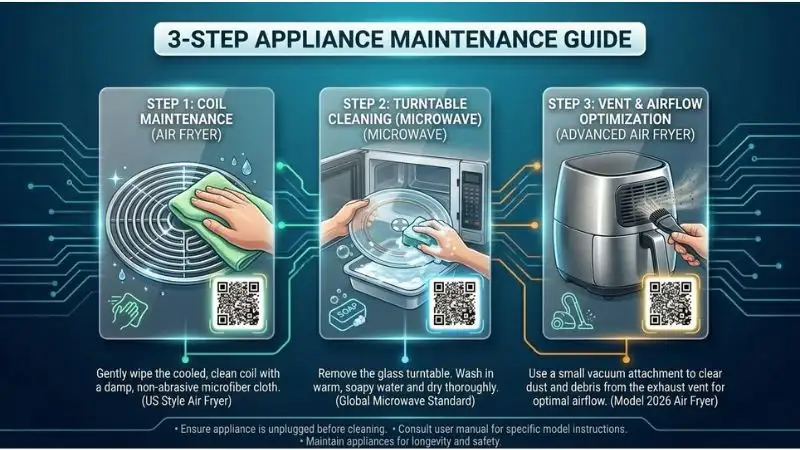
The Grease Shield Effect: When oil spatters onto the heating coil (located at the top of the unit), it eventually bakes on and turns into a hard, black crust. This crust acts like a thermal blanket. Instead of the heat radiating directly into the air, it has to struggle to penetrate that layer of carbon first.
- The Result: Your air fryer might take 5 minutes longer to crisp your fries than it did when it was new.
- The Energy Cost: That extra 5 minutes represents a 25% increase in your energy usage for that specific meal.
Clogged Air Paths: Modern air fryers use intricate “vortex” designs to move air. If the intake vents at the back or the exhaust vents at the top are dusty, the fan can’t move the air effectively. The motor will draw more amps to try to maintain the “Rapid Air” speed, which can lead to overheating and a higher electricity draw.
Microwave Turntable Friction and Magnetron Efficiency Over Time
Microwaves are often seen as “maintenance-free,” but that is a myth. While they don’t have exposed heating coils, they have mechanical parts that are vital to their efficiency.
The Turntable Struggle: The turntable is there to ensure “Even Heating.” If the ring rollers underneath the glass plate are sticky with spilled soup or crumbs, the motor has to exert more force to turn the plate.
- Friction Loss: While a struggling motor doesn’t use massive amounts of energy, it generates heat inside the electronics compartment.
- The Chain Reaction: This heat causes the internal cooling fan to run longer after the cooking is finished, wasting “post-cook” energy.
Magnetron Aging: The magnetron is the heart of the microwave. Over 5 to 10 years, a magnetron’s ability to convert electricity into waves slowly degrades. However, this process is accelerated by “spattered” walls.
- Wave Reflection: If the inside walls are covered in food spots, the microwaves can bounce back into the magnetron instead of into the food. This is called “Back-Reflected Energy,” and it significantly lowers the efficiency of the machine while shortening its lifespan.
Did You Know?
A single millimeter of dust on an appliance’s intake vent can reduce its airflow efficiency by up to 10%. In an air fryer, this forces the heating element to stay “on” longer to compensate for the slower-moving air, directly increasing your bill.
Practical Maintenance for 2026 Efficiency
You don’t need expensive chemicals to keep your appliances efficient. In fact, in 2026, “Green Cleaning” is the preferred method to avoid damaging sensitive electronic sensors.
Pro-Tip: The “Steam Clean” Shortcut To clean a microwave without scrubbing, place a bowl of water with a few lemon slices inside. Run it for 3 minutes until it steams, then let it sit for 5 minutes. The steam will loosen all the grease and reflected-wave “hot spots,” allowing you to wipe it clean with one pass. This restores the internal reflectivity and keeps your magnetron running at peak efficiency.
Common Mistakes: The “Hidden” Filters
The biggest mistake we see in 2026 is the “Set it and Forget it” attitude toward high-end air fryers.
- Neglecting Air Intake Filters: Many 2026 premium air fryers now come with HEPA or carbon filters on the air intake to prevent kitchen smells from circulating. If you don’t change or wash these filters every 3 months, the machine becomes “choked,” and its energy consumption can double as it struggles to pull in fresh air.
- Using Abrasive Scrubbers: Never use steel wool on the inside of a microwave or an air fryer. Scratching the reflective surface of a microwave or the non-stick coating of an air fryer creates “micro-pockets” where grease can hide. This makes future cleaning harder and reduces the thermal efficiency of the chamber.
- The “Unplugged” Check: People often clean the basket but forget the “body” of the machine. Once a month, unplug the unit and use a soft brush to clear the dust from the power cord entry point and the rear vents. This prevents “heat buildup” in the electrical components.
Summary of Chapter 8
Efficiency is something you have to maintain, not just something you buy. By keeping the “heat paths” clear in your air fryer and the “wave paths” clear in your microwave, you ensure that every cent of electricity is going into your food. A clean machine is a fast machine, and in 2026, speed is the key to energy savings.
In the next chapter, we will look at the global labels and ratings—how to read the “fine print” on those yellow and blue stickers to pick a winner before you even get home.
Chapter 9: The Global Perspective – Energy Labels and Standards
If you walked into an appliance store today, you would see a colorful array of stickers on every air fryer and microwave. In 2026, these aren’t just decorations; they are the result of strict global laws designed to help consumers fight rising energy costs. However, a “Grade A” in London might not mean the same thing as a “5-Star” rating in Islamabad or a “Gold Star” in New York.
Understanding these global standards is the “secret weapon” of any savvy shopper. When you know how to read between the lines of an energy label, you can stop guessing and start saving. This chapter looks at how the world measures efficiency in 2026 and why the “voltage” coming out of your wall might be secretly changing how your appliances perform.
Understanding Energy Ratings in 2026
In the past, energy labels were often confusing. Some used letters (A+++), while others used stars or simple percentages. By 2026, the world will have moved toward more “honest” labeling. Regulators have realized that as technology improves, the old scales become obsolete.
The goal of a modern energy label is to show you exactly how much electricity an appliance will use under “normal” conditions over a year. This allows you to compare a high-end air fryer from one brand against a budget microwave from another on a level playing field.
- Transparency: Labels now include QR codes that link to real-time testing data.
- Standardized Testing: In 2026, every air fryer must be tested using the same “standard potato batch” to ensure the results are fair.
- Total Life Cost: Some forward-thinking labels now show the estimated “cost to run” over five years, not just the purchase price.
Definition: EER (Energy Efficiency Ratio)
The Energy Efficiency Ratio (EER) is a mathematical formula used to calculate how much “work” an appliance does compared to the energy it consumes. For a kitchen appliance, it measures the heat energy delivered to the food compartment divided by the electrical energy pulled from the wall. A higher EER means more of your money is going into the food and less is being wasted as heat or noise.
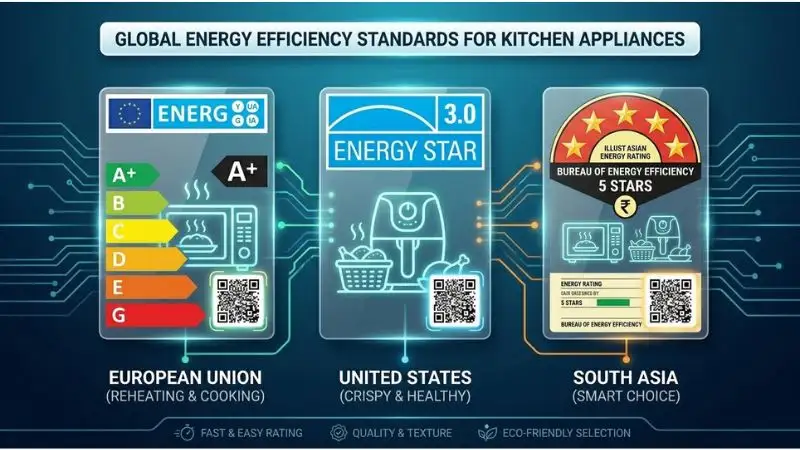
The New EU Energy Labels and Energy Star 3.0
The two biggest “trendsetters” in global energy standards for 2026 are the European Union (EU) and the United States (Energy Star). Most other countries model their labels after these two systems.“You can view the official EU energy label database at EU Energy Label.”
The EU “A-G” Rescale: If you haven’t bought an appliance recently, you might be surprised to find that the “A+++” rating is gone. The EU has “rescaled” its system.
- The Gap at the Top: In 2026, the “A” category is often kept empty on purpose. This encourages manufacturers to keep innovating. Most high-efficiency air fryers and microwaves currently sit in the B or C categories.
- The kWh/1000h Metric: EU labels now clearly display how many kilowatt-hours the unit uses per 1,000 hours of operation, making the math easy for consumers.
Energy Star 3.0 (USA & Global Partners): The “Energy Star” is a global symbol of efficiency. In 2026, the 3.0 standard is the strictest yet.
- Standby Power Focus: To get a 3.0 rating, a microwave must use less than 0.5 watts when it is plugged in but not running.
- Smart Grid Ready: Many 3.0 appliances must be able to “talk” to smart meters to shift energy use to cheaper times of day.
Global Voltage Variations and Their Impact on Efficiency
One thing most people forget is that electricity isn’t the same everywhere. The “pressure” of the electricity in your home (Voltage) can actually change how efficient your air fryer or microwave is.
110V vs. 220V Systems:
- The Americas (110V-120V): Appliances here pull more “current” (Amps) to get the same power. This can lead to slightly more heat being lost in the power cord itself.
- Europe, Asia, and Africa (220V-240V): These systems are naturally more efficient for high-heat appliances like air fryers because they can deliver more power with less resistance.
Voltage Fluctuations: In many developing regions, the voltage isn’t always steady. If your 220V outlet is only providing 190V, your air fryer’s fan might spin slower, and its heating element won’t get as hot.
- The Efficiency Drop: When the voltage drops, the appliance has to run significantly longer to cook the food. A 10-minute task might take 15 minutes. This doesn’t just waste time; it wastes energy because the heat is leaking out of the unit for an extra 5 minutes.
Did You Know?
In 2026, some countries have introduced a “Right to Repair” score on their energy labels. This tells you how easy it is to fix the appliance if it breaks. An appliance that lasts 10 years is much more “energy efficient” for the planet than two appliances that last 5 years each!
How to Be a Global Efficiency Expert
You don’t need an engineering degree to pick the best appliance. You just need to know what to look for when you are standing in the aisle (or scrolling online).
Pro-Tip: Look for the “Tested Volume” Always check the fine print on the energy label for the “Tested Volume.” Some air fryers look efficient because they were tested while only half-full. To get the best value, look for the “kWh per Liter” ratio. This tells you how much energy the machine uses relative to how much food it can actually hold. A large, efficient air fryer is often better than a small, inefficient one, even if the total wattage is higher.
Common Mistakes: Falling for “Marketing Green”
In 2026, “Greenwashing” is still a problem. Manufacturers sometimes use confusing language to make an appliance seem more efficient than it really is.
- Confusing “Eco-Mode” with “Energy Class”: Just because a microwave has an “Eco” button doesn’t mean it is a high-efficiency machine. The button might just turn off the clock, while the actual cooking engine is an old, power-hungry design. Always trust the official Energy Label over the marketing stickers.
- Buying for “Max Power”: Many people buy the 2,000-watt air fryer because they think it’s “better.” But if you only cook for one person, you are paying a massive energy penalty to heat a large, high-wattage chamber. Match the size of the appliance to your actual needs.
- Ignoring the Frequency (Hz): If you move an appliance from a 60Hz country (like the US) to a 50Hz country (like Pakistan), the internal motors and fans will run at the wrong speed. This can destroy the efficiency of an air fryer and may even be a fire hazard.
Summary of Chapter 9
The world of 2026 is more connected than ever, and energy standards have finally caught up. By understanding the EU A-G scale, the Energy Star 3.0 requirements, and the impact of your local voltage, you can move beyond the “Air Fryer vs. Microwave” debate and start looking at specific models that save you the most money.
In our final chapter, we will bring everything together—the science, the costs, the maintenance, and the labels—to give you the ultimate decision matrix. You’ll find out exactly which appliance you should use for your specific lifestyle and home.
Chapter 10: Final Verdict – Choosing for Your Lifestyle
We have traveled through the physics of heat, the math of kilowatts, and the smart sensors of 2026. By now, one thing is clear: there is no single “winner” that fits every kitchen. Instead, the most energy-efficient choice depends entirely on how you live, what you eat, and how many people you are feeding.
In this final chapter, we bring all the data together. We’ve looked at the technical specs and the global energy labels, but now it’s time to get practical. We are going to help you decide which appliance should be your “primary” cooking tool to keep your 2026 energy bills as low as possible.
Decision Matrix: Which One Should You Buy?
Choosing between an air fryer and a microwave in 2026 isn’t just about the price tag at the store. It’s about the “Total Cost of Ownership.” This matrix looks at your daily habits to see where you will save the most money over the next five years.
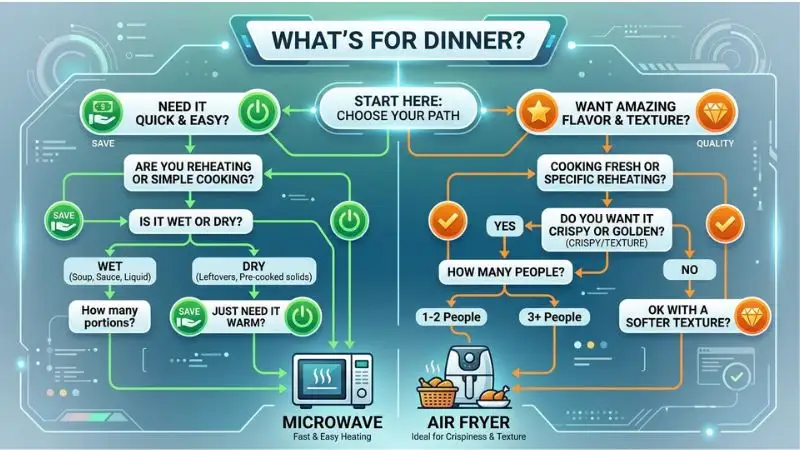
If your diet consists mostly of fresh vegetables, grains, and quick reheats, your energy profile leans heavily toward the microwave. If you are a fan of proteins, roasted veggies, and frozen snacks that need to be “crispy,” the air fryer is your best investment. The key is to match the appliance’s strength to your stomach’s needs.
- Frequency of Use: How many times a day do you cook?
- Food Type: Are you “steaming” or “roasting”?
- Time Constraints: Is a 5-minute difference worth the extra energy?
Definition: Lifestyle Energy Profiling
Lifestyle Energy Profiling is a 2026 method used by home economists to predict an appliance’s actual energy impact based on a user’s specific diet and schedule. It proves that the “most efficient” machine on paper can be the “most expensive” in practice if it doesn’t match the user’s cooking habits.
The “Energy Champion” for Solo Dwellers
For students, young professionals, or anyone living alone in 2026, the efficiency math is very specific. You are usually cooking small portions, and speed is often your top priority.
The Microwave Advantage: If you are living solo, the microwave is often your “Energy Champion.” Since you aren’t cooking for a crowd, the microwave’s ability to heat a single bowl of pasta or a mug of coffee in seconds is unbeatable. It uses roughly 80% less energy than any other method for these micro-tasks.
The Air Fryer Niche: However, the “Single-Basket” air fryer has become a 2026 staple for solo dwellers. Because these units are small (usually 2-3 liters), they heat up almost instantly. They are much more efficient for a single person than turning on a full-sized oven to cook two chicken wings.
- The Verdict for Solos: Use a high-end inverter microwave as your primary tool, and supplement it with a small, 1,200-watt air fryer for your “crunchy” meals.
The Efficiency King for Large Families
When you are feeding four, six, or eight people, the “small appliance” advantage starts to disappear. This is where many families in 2026 make their biggest energy mistakes.
The Air Fryer Struggle: For a large family, a standard air fryer can actually be less efficient than a modern electric oven. If you have to run three separate “batches” of fries to feed everyone, your air fryer is running for 45 minutes and pulling a constant 1,500 watts. In this case, a large oven could have cooked everything at once in 30 minutes.
The Microwave Secret: The microwave remains the “Efficiency King” for side dishes, even for families. Steaming a giant bowl of family-sized vegetables still only takes 6-8 minutes, saving a massive amount of power compared to boiling water on a stovetop.
- The Verdict for Families: Invest in a “Dual-Basket” or “Extra-Large” 2026 air fryer to avoid batch-cooking. For everything else, rely on a large-capacity microwave to handle the bulk of the side dishes.
Summary Table: Comparison Across the Board
To make your final choice easy, here is how the two contenders stack up across the most important categories in 2026.
| Feature | Inverter Microwave (2026) | Rapid Air Fryer (2026) |
|---|---|---|
| Cooking Speed | Ultra-Fast (Best for <5 mins) | Moderate (Best for 10-25 mins) |
| Energy Efficiency | Highest (Targets water only) | High (Replaces traditional oven) |
| Food Texture | Soft, Moist, Steamed | Crispy, Crunchy, Roasted |
| Running Cost | Lowest ($/£/PKR per use) | Low to Moderate |
| Best For… | Soup, Veggies, Reheating | Meat, Potatoes, Frozen Snacks |
Did You Know?
By the year 2026, nearly 35% of households in developed urban areas have completely removed their traditional full-sized ovens, replacing them with a high-end “Power Couple”: a large air fryer and a smart microwave. This shift alone has reduced average kitchen energy footprints by over 40%!
Final Pro-Tip for the Road
Regardless of which machine you choose, there is one trick that works for both and costs zero dollars.
Pro-Tip: The “Residual Heat” Finish Both appliances are incredibly well-insulated. In 2026, we suggest the “2-Minute Rule.” Turn your air fryer or microwave off two minutes before the timer hits zero. Let the food sit inside the closed chamber. The trapped heat will finish the cooking process perfectly without pulling a single extra watt from your wall. Over a year, this “ghost cooking” can save you enough energy to run your fridge for a week!
Common Mistakes: The “Old Habit” Cost
As we close this guide, remember that the biggest waste of energy isn’t the machine—it’s the habit.
- Preheating the Microwave: It sounds silly, but some people still “run” the microwave empty to “warm it up.” This does nothing but damage the magnetron and waste energy.
- Over-Cleaning with Heat: Using the “self-clean” or high-heat cycles on air fryers too often. Most 2026 baskets are non-stick; a simple soak in soapy water is 100% more energy-efficient than running a “clean” cycle at 400°F.
- Buying “Too Much” Machine: Don’t buy a 10-liter air fryer if you only ever cook for yourself. You are paying to heat 8 liters of empty air every single night.
Final Verdict
In the battle of Air Fryer vs. Microwave: 2026 Energy Efficiency, the winner is… Both.
For the most efficient kitchen possible, you should use the microwave as your “workhorse” for moisture-rich foods and quick heats. Use the air fryer as your “specialist” to replace your big oven for roasting and crisping. By using them together—and using them wisely—you can enjoy the best food of your life while keeping your energy footprint smaller than ever before.
Happy cooking, and even happier saving!