
The solar world changed fast in early 2026. Old PERC panels are now officially dead technology. Smart global buyers have moved to TOPCon vs HJT Solar Panels. This shift happened for one simple reason: more power. Old panels wasted too much sunlight as heat. New 2026 technology captures almost every ray.
TOPCon vs HJT Solar Panels now dominate every major solar market. Manufacturers stopped making old P-type cells last year. They now focus on N-type silicon wafers only. N-type silicon lasts longer and performs better. If you buy old stock now, you lose money. You must choose between TOPCon vs HJT Solar Panels today. This choice will define your energy savings for thirty years.
Many people ask why the shift happened so fast. Efficiency is the main driver for this 2026 revolution. TOPCon vs HJT Solar Panels offer much higher conversion rates. They turn more sunlight into usable home electricity. This means you need fewer panels on your roof. Fewer panels mean lower installation costs for you.
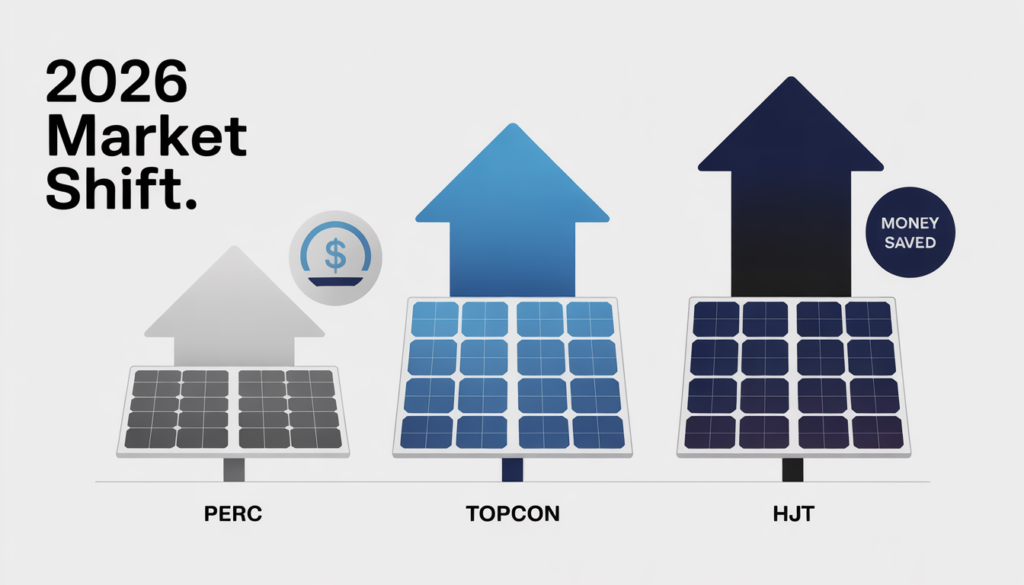
2026 Comparison: TOPCon Vs HJT Solar Panels
| Feature | Old PERC Tech | TOPCon (The Standard) | HJT (The Premium) |
| Max Efficiency | 20.5% | 24.5% | 26.2% |
| Price Status | Obsolete | Best Value | Premium Investment |
| Heat Resistance | Poor | Good | Excellent |
| Year 1 Degradation | 2.0% | 1.0% | 0.5% |
Choosing between TOPCon vs HJT Solar Panels depends on your goals. TOPCon is the king of mass production right now. It is affordable and very reliable for most homes. However, HJT is the heavy hitter for high-energy users. It performs best when the sun is very hot. Both options beat the old technology by a wide margin.
In 2026, the global supply chain will be fully committed. You will see TOPCon vs HJT Solar Panels in every quote. Do not let installers sell you old 2024 models. Demand the latest N-type technology for your home. This ensures your system is ready for future grid upgrades.
🛠️ Pro Fix: Identify Your “Energy DNA”
Before picking a panel, look at your roof’s daily sun pattern. If your roof gets hit by high heat after 2 PM, choose HJT. It handles “afternoon wilt” better than any other tech. If you have a huge roof with morning sun, TOPCon offers the fastest ROI.
💡 Did You Know?
In 2026, 80% of new solar factories use TOPCon production lines. This is because brands can upgrade old PERC machines to TOPCon very easily. This keeps the prices low for global consumers!
The TOPCon Revolution: How Tunnel Oxide Wires Your Home for Savings!
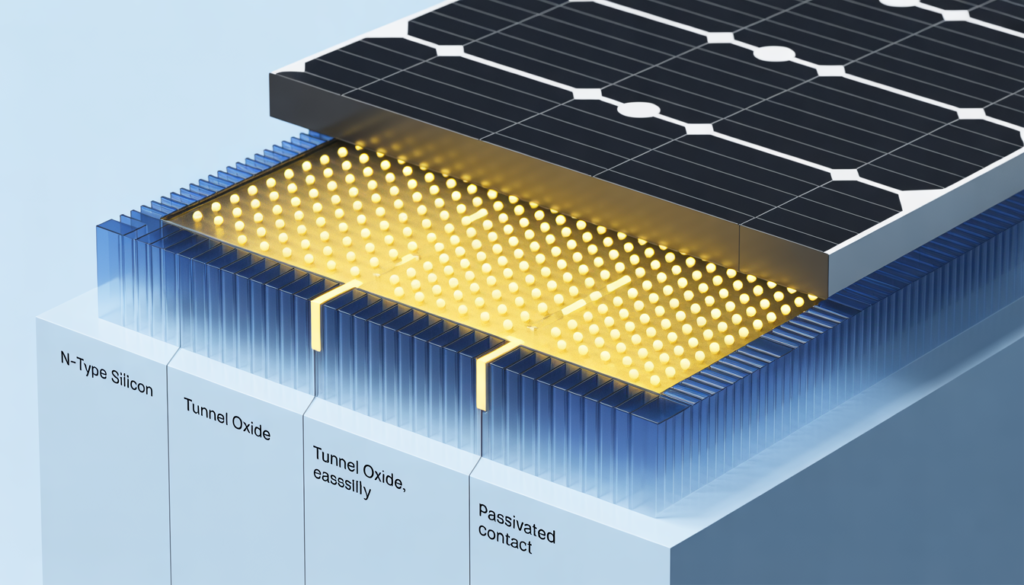
The secret to TOPCon Solar Panels lies in a microscopic layer. This layer is called “Tunnel Oxide.” It sounds like science fiction, but it is real. This thin layer stops energy leaks inside the solar cell. Old panels leaked electricity like a broken pipe. TOPCon Solar Panels fix this problem completely. This is why they are the standard for 2026.
The world has moved to “N-Type” silicon wafers now. Old panels used “P-Type” silicon. P-Type silicon had a major flaw. It lost power the moment sunlight hit it. This is called Light-Induced Degradation. TOPCon Solar Panels use N-Type silicon to stop this. Your panels stay powerful from day one until year thirty. This transition is the biggest jump in solar history.
MBB vs. SMBB: The 2026 Wiring Battle
| Feature | Multi-Busbar (MBB) | Super Multi-Busbar (SMBB) | Why it Matters |
| Wire Count | 9 to 11 thick wires | 16 to 20 thin wires | More wires catch more power. |
| Shading Loss | High shading on cells | Minimal shading | Thin wires let more sun in. |
| Reliability | Moderate stress points | High durability | SMBB prevents micro-cracks. |
| 2026 Status | Standard | Premium / Recommended | SMBB is the future of TOPCon. |
Modern TOPCon Solar Panels use Super Multi-Busbar (SMBB) technology. Look closely at the panel surface. You will see very thin silver lines. These lines carry the electricity. In 2026, more lines mean better performance. SMBB reduces the distance electrons must travel. This keeps the panel cool and efficient. It is a small detail that makes a huge difference.
Choosing TOPCon Solar Panels is about long-term trust. These panels handle low-light conditions very well. They start working earlier in the morning. They keep working later in the evening. This “extra time” adds up to big savings. Over one year, it equals weeks of free electricity. This is why TOPCon Solar Panels are the best value in 2026.
🛠️ Pro Fix: Spotting “Pseudo-TOPCon” Scams
Some cheap brands sell “TOPCon-Like” panels. Always check the LID (Light Induced Degradation) rating. A true TOPCon Solar Panel must have a Year 1 degradation below 1%. If the datasheet says 2% or higher, it is a fake. It is likely an old PERC panel with a new label. Always demand a certified flash test report.
💡 Did You Know?
The efficiency limit of TOPCon Solar Panels is mathematically much higher than PERC. While PERC gets stuck at 24%, TOPCon can reach nearly 29%. This means your roof can produce much more power without adding more panels!
HJT: Decoding the Hybrid Powerhouse Dominating 2026!
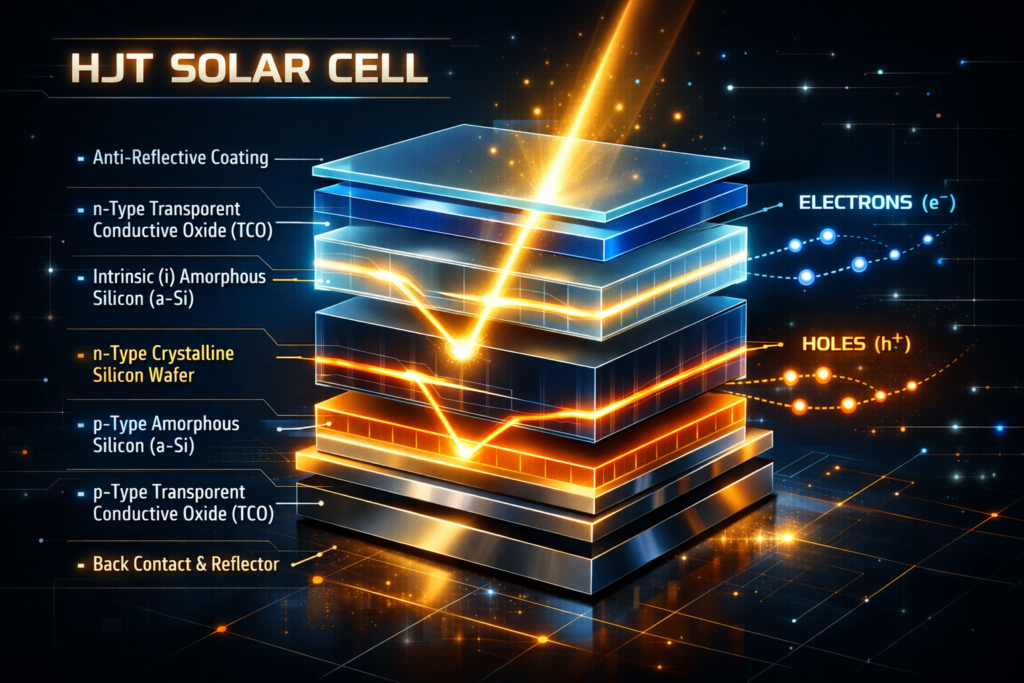
The solar market in 2026 has a clear premium champion. HJT Solar Panels represent the perfect marriage of two technologies. This “Hybrid” design combines crystalline silicon with thin layers of amorphous silicon. Think of it as a high-tech sandwich. The core provides strength, while the outer layers trap extra sunlight. This unique structure makes HJT Solar Panels the most efficient choice for modern homes.
Traditional panels lose too much energy at the surface. HJT Solar Panels solve this with “Passivation” layers. These layers stop electrons from being wasted. This means more power flows into your battery. In 2026, efficiency is no longer a luxury. It is a necessity to lower your energy bills. HJT Solar Panels offer a future-proof solution for high-energy users. They outperform every other technology in the long run.
The 2026 Outlook: HJT vs. Tandem Cells
| Feature | HJT (Present King) | Perovskite Tandem (2026 Early) | Why HJT Wins Now |
| Current Efficiency | 25.5% – 26.5% | 27.0% – 29.0% | HJT is proven and stable. |
| 30-Year Stability | Excellent | Developing | Tandems still face moisture issues. |
| Market Availability | Mass Production | Limited / Luxury | You can buy HJT today easily. |
| Bifacial Output | 95% (Highest) | 60% – 75% | HJT catches more ground light. |
One major benefit of HJT Solar Panels is their symmetrical design. They look the same on both sides. This allows them to capture 95% of reflected light from the ground. This is the highest “Bifacial” rating in 2026. If you have a light-colored roof, HJT Solar Panels are a goldmine. They generate significantly more kilowatt-hours than standard panels. This leads to a much higher return on investment.
Many buyers worry about the higher upfront cost. However, HJT Solar Panels degrade much more slowly than others. They lose only 0.25% of power each year. Most other panels lose twice that amount. By year 20, HJT Solar Panels will still produce massive power. This durability makes them the safest bet for the future. In 2026, smart money goes toward HJT.
🛠️ Pro Fix: Why HJT Needs High-Frequency Inverters
HJT Solar Panels produce a very clean, high-voltage DC signal. To keep this efficiency, you must use a High-Frequency (HF) Hybrid Inverter. Standard old-school inverters can cause “Current Ripples.” These ripples can slightly damage the sensitive HJT layers over time. Always pair HJT with a modern 2026 “Tandem-Ready” inverter for max safety.
💡 Did You Know?
HJT Solar Panels were originally a patented technology by Panasonic (Sanyo) called “HIT.” After the patents expired, the whole world started using the tech under the name HJT. This is why the technology feels so mature and reliable today!
The Heat War: Why HJT is the Ultimate Desert King in 2026!
Solar panels love light, but they hate heat. In 40°C+ climates like the Middle East or Australia, panels suffer. High temperatures cause standard solar cells to lose voltage and efficiency. This phenomenon is called the “Heat Wilt.” In 2026, comparing TOPCon vs HJT Solar Panels reveals a clear winner in the sun. HJT technology handles extreme heat better than any other mass-produced panel. Choosing the right tech can save you 20% in lost energy every summer.
The key metric to watch is the Temperature Coefficient. It measures how much power a panel loses for every degree above 25°C. TOPCon vs HJT Solar Panels show a significant gap here. TOPCon panels lose about 0.30% of their power per degree. However, HJT panels only lose around 0.24%. This small decimal adds up to massive energy gains in real-world heat. When the air is 45°C, the panel surface can reach 70°C. In these conditions, TOPCon vs HJT Solar Panels perform very differently.
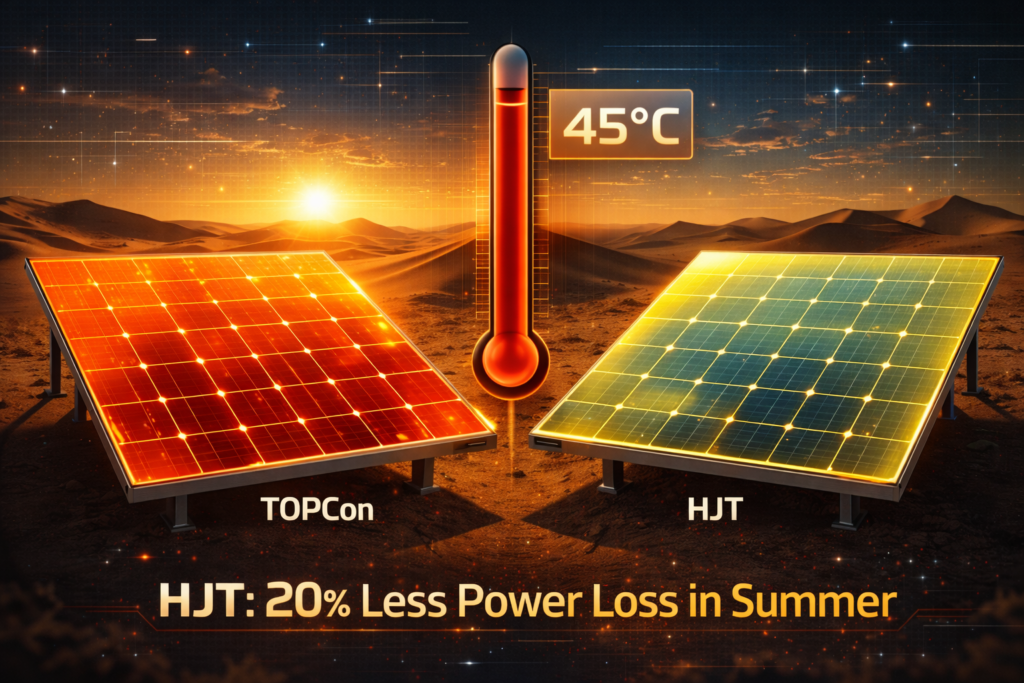
Heat Battle: Energy Loss at 45°C Ambient Temp
| Metric | TOPCon Panel (2026) | HJT Panel (2026) | Real-World Impact |
| Temp. Coefficient | -0.30%/°C | -0.24%/°C | HJT stays 20% more stable. |
| Power Loss at 70°C Cell Temp | ~13.5% Loss | ~10.8% Loss | HJT produces more kWh. |
| Annual Heat Yield Gain | +2% to +3% | +4% to +6% | HJT is better for hot zones. |
| Cooling Speed | Moderate | High (Glass-Glass) | HJT sheds heat faster. |
In regions like Phoenix or Dubai, TOPCon vs HJT Solar Panels are tested to the limit. HJT uses a specialized amorphous silicon layer that acts as a thermal buffer. This layer keeps the electrons moving even when the silicon gets hot. Most TOPCon vs HJT Solar Panels in 2026 are “Glass-Glass” modules. This design helps pull heat away from the cells more effectively. If you live in a hot climate, HJT is the superior choice for consistent power.
When you analyze the total cost, heat performance is critical. A panel that loses less power in summer pays for itself faster. TOPCon vs HJT Solar Panels both beat old PERC tech, but HJT is the premium king. It ensures your air conditioner runs on solar power, not the grid, during July. In 2026, don’t just look at the wattage. Look at how that wattage holds up when the sun gets angry.
🛠️ Pro Fix: Use “Gapless” Mounting for Airflow
Even the best panels need to breathe. When installing HJT Solar Panels, ensure a minimum “Air Gap” of 100mm between the panel and the roof. Avoid “flush mounting” which traps heat. This simple mounting trick allows HJT cells to stay 5°C cooler, boosting your daily energy yield by another 2-3%.
💡 Did You Know?
HJT technology loses almost 20% less power in summer than TOPCon. This is why HJT is the #1 choice for solar farms in the Sahara Desert and Western Australia in 2026. It turns midday heat into pure profit!
Bifaciality: The Secret 20% Extra Power Hidden Under Your Panels!
In 2026, the best solar systems do not just look at the sky. They look at the ground too. This is the power of Bifacial Solar Panels. Traditional panels have a dark, solid back. They waste any light that hits the rear side. Modern Bifacial Solar Panels use a transparent glass back. This allows them to capture “Albedo” or reflected light. This “Secret Power” can boost your total energy yield by 20% or more.
When comparing Bifacial Solar Panels, technology choice is critical. TOPCon panels offer a great bifaciality factor of 80% to 85%. This means the back produces 80% of the front’s power. However, HJT panels are the natural kings of this category. HJT cells are symmetrical by design. They offer a massive bifaciality factor of 90% to 95%. In 2026, HJT is the elite choice for maximizing rear-side gains.
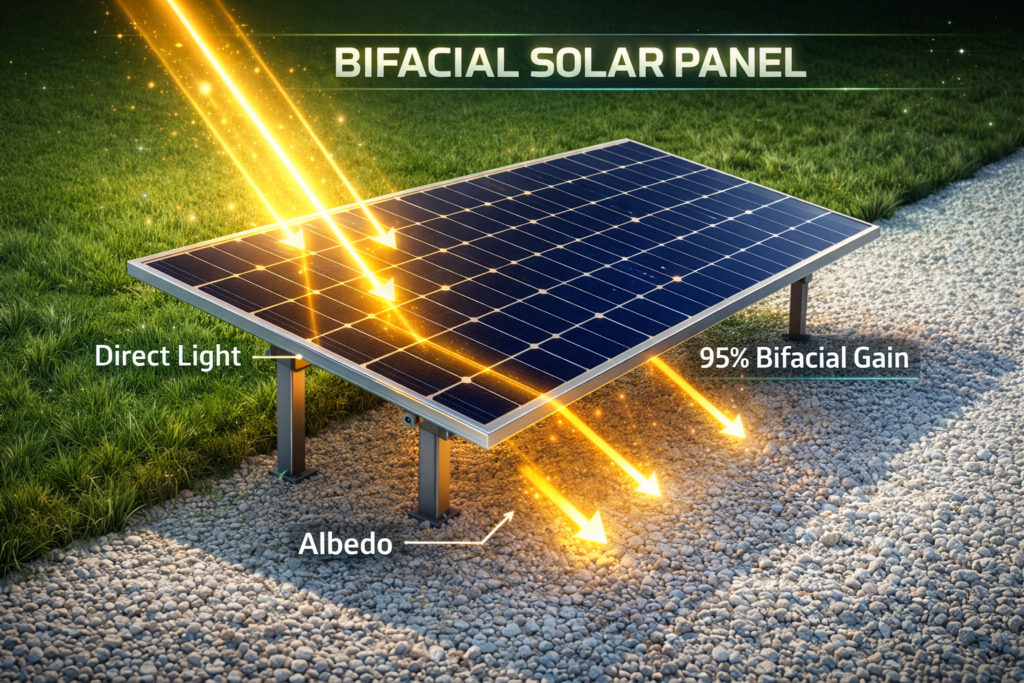
2026 Albedo Gains: Ground Surface Impact
| Surface Type | Reflection (Albedo) % | Energy Boost (Typical) | Best Panel Match |
| Green Grass | 15% – 25% | 5% – 10% | TOPCon |
| White Gravel | 50% – 60% | 15% – 22% | HJT |
| White Concrete | 70% – 85% | 25% – 35% | HJT (Elite) |
| Dark Asphalt | 5% – 10% | Minimal (1-2%) | Any |
To get the most from Bifacial Solar Panels, the environment matters. If you install them on a dark roof, you gain almost nothing. But on white gravel or near a pool, they explode with power. HJT panels turn that reflected “wasted” light into pure savings. In 2026, smart installers always check the ground color before choosing a panel. This simple step defines your ROI for the next three decades.
Ground-mounted systems benefit the most from Bifacial Solar Panels. Even on a standard residential flat roof, you can see big gains. Using a white TPO or PVC membrane on your roof is a game-changer. It creates a “Mirror Effect” for your Bifacial Solar Panels. This makes HJT panels worth the premium price. You get more kilowatt-hours from the same number of panels.
🛠️ Pro Fix: The 2026 “Height Hack”
Rear-side light needs space to travel. Never mount Bifacial Solar Panels too close to the ground. For a ground mount, keep the bottom edge at least 1 meter high. This “Height Hack” allows more reflected light to reach the center of the panel. It can increase your bifacial gain by an extra 5% compared to low-to-ground setups.
💡 Did You Know?
HJT has a natural bifaciality of nearly 95%. This is because the cell structure is identical on both sides. While other panels are “built” to be bifacial, HJT is born that way!
30-Year Solar Survival: Will Your Panels Still Power Your Home in 2056?
Buying solar is a long-term commitment. You want power for decades, not just years. In 2026, Solar Panel Durability is the most important factor. Old panels died slowly from the first day of the sun. This happened because of Light Induced Degradation (LID). Modern Solar Panel Durability has fixed these old problems. Both TOPCon and HJT use N-type silicon wafers. These wafers do not react to oxygen like old P-type cells. This change ensures your investment stays safe for thirty years.
Solar Panel Durability depends on how well the cells handle stress. TOPCon panels are very strong and reliable. They lose only about 1% of power in the first year. However, HJT panels are the true champions of aging. They have the lowest degradation rate in the solar industry. An HJT panel might still give you 90% power after 30 years. This long-term strength makes Solar Panel Durability a key selling point in 2026. You pay for quality once, but you save for a lifetime.
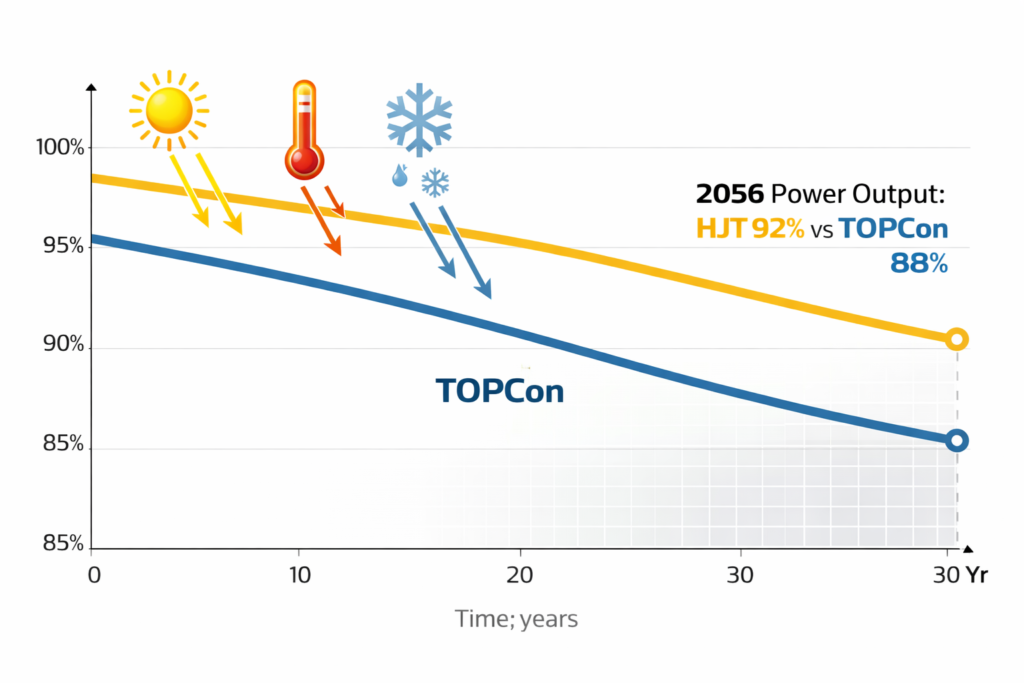
2026 Long-Term Power Retention: TOPCon vs. HJT
| Year Milestone | TOPCon Power Output | HJT Power Output | Old PERC (For Context) |
| Year 1 | 99.0% | 99.5% | 98.0% |
| Year 15 | 93.4% | 95.6% | 89.0% |
| Year 30 | 87.4% | 91.8% | 80.0% (Or Dead) |
| Annual Drop | 0.40% | 0.25% | 0.55% |
Modern Solar Panel Durability also protects against LeTID. This is degradation caused by light and high temperatures. TOPCon handles this very well for a mid-range price. But HJT panels use a symmetrical “Sandwich” structure. This design reduces internal stress on the silicon. It makes Solar Panel Durability a natural feature of HJT tech. In 2026, most top brands offer a 30-year warranty. Always check the annual degradation number on the datasheet. Lower numbers mean more money in your pocket later.
If you live in a harsh climate, durability is everything. High humidity and salt air can destroy cheap panels. Solar Panel Durability in 2026 often includes “Glass-Glass” protection. This means glass covers both the front and back. It seals the solar cells from moisture and wind. Both TOPCon and HJT use this dual-glass design now. It is the gold standard for Solar Panel Durability this year. Don’t settle for plastic backsheets in 2026.
🛠️ Pro Fix: Read the “Linear Warranty” Fine Print
Do not just look at the “30 Year” label. Look for the Linear Performance Warranty graph. A high-quality 2026 panel should guarantee at least 87% power at year 30. If the warranty has big “steps” or drops, avoid it. This means the company does not trust their own Solar Panel Durability.
💡 Did You Know?
N-type wafers are completely immune to Light Induced Degradation (LID). This is because they contain zero Boron. Boron was the main cause of power loss in old solar panels!
The 2026 ROI Truth: Stop Waiting for Subsidies to Save Money!
In 2026, you do not need government help to buy solar. The Global Solar ROI is now stronger than ever before. Prices for high-tech panels have dropped significantly this year. You must look at the “Levelized Cost of Energy” (LCOE). This shows the true cost of every kilowatt-hour you produce. Global Solar ROI is about long-term math, not just the upfront price. TOPCon offers a low entry cost for most families. HJT costs more now but saves more over thirty years. Both options beat the rising cost of grid electricity.
Calculating your Global Solar ROI requires a 25-year view. A cheap panel might save money today, but fail early. A premium panel produces more power during hot summer afternoons. This extra power increases your total savings every single year. In 2026, the average payback period is under five years. After that, your electricity is essentially free for decades. Global Solar ROI has reached a tipping point for homeowners. Investing in quality tech is the fastest way to wealth.
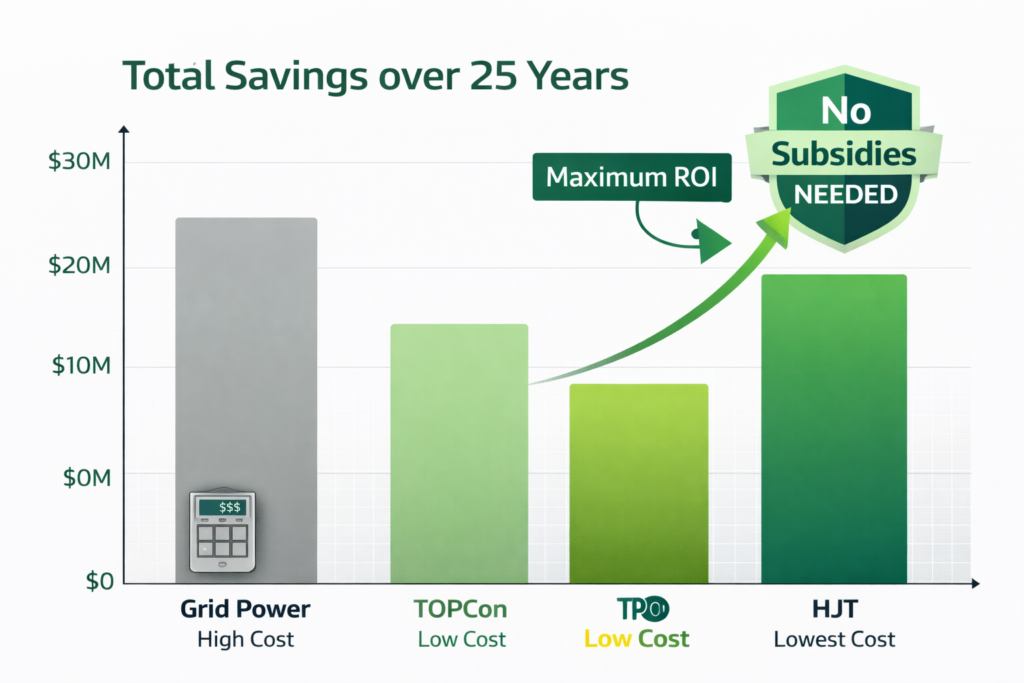
2026 Global Payback: 5kW System Analysis
| Financial Metric | Standard TOPCon | Premium HJT | Old PERC Tech |
| Upfront Cost (Avg) | $4,500 – $5,500 | $6,000 – $7,500 | $4,000 (Avoid) |
| LCOE (Cost per kWh) | $0.05 / kWh | $0.04 / kWh | $0.08 / kWh |
| Payback Period | 4.2 Years | 5.1 Years | 6.5 Years |
| 25-Year Net Profit | High | Highest | Low |
Your Global Solar ROI depends on local energy prices. If your grid power is expensive, solar pays back even faster. HJT panels generate more electricity per square meter of roof. This makes them the best choice for small, high-value roofs. TOPCon is the winner for large roofs on a budget. Both technologies ensure a positive Global Solar ROI without any tax credits. The 2026 market is built on real performance, not government promises.
Maintenance also plays a big role in your total profit. Modern panels require very little cleaning or repair. This keeps your Global Solar ROI high for the entire lifespan. Always choose an inverter that matches your panel’s high efficiency. A bad inverter can ruin your potential savings very quickly. In 2026, the path to energy independence is clear and affordable.
🛠️ Pro Fix: The “Silicon Surplus” Buying Hack
Solar prices move in cycles based on raw material supply. To maximize your Global Solar ROI, time your purchase during a “Silicon Surplus.” This usually happens at the end of Q2 or start of Q4. Manufacturers often drop prices to clear their warehouse stock. Buying during these windows can save you an extra 10% on hardware.
💡 Did You Know?
HJT is more expensive to manufacture because it requires high-purity silicon. However, because it produces 15% more total energy, it is actually cheaper per kilowatt-hour over 25 years!
Future-Proof Your Roof: Is Your 2026 Solar Setup Ready for 2028?
The solar race does not stop in 2026. A new technology is coming fast. It is called the Perovskite Tandem cell. This tech will push efficiency past 30% very soon. To protect your investment, you need Tandem-Ready Solar Panels. Buying the wrong panels today means missing out tomorrow. Both TOPCon and HJT are good for now. But only one is the perfect partner for future upgrades. Tandem-Ready Solar Panels will enhance your home’s resale value. You must plan for the 2028 energy shift today.
Perovskite layers sit on top of standard silicon cells. They capture blue light that silicon usually misses. Tandem-Ready Solar Panels like HJT are the best base for this. HJT cells have a flat, clean surface structure. This makes it easy to add a Tandem layer later. TOPCon is also moving toward this high-efficiency future. In 2026, you are buying a platform, not just a panel. Choosing Tandem-Ready Solar Panels ensures your roof stays modern. Don’t buy technology that becomes a dinosaur in two years.
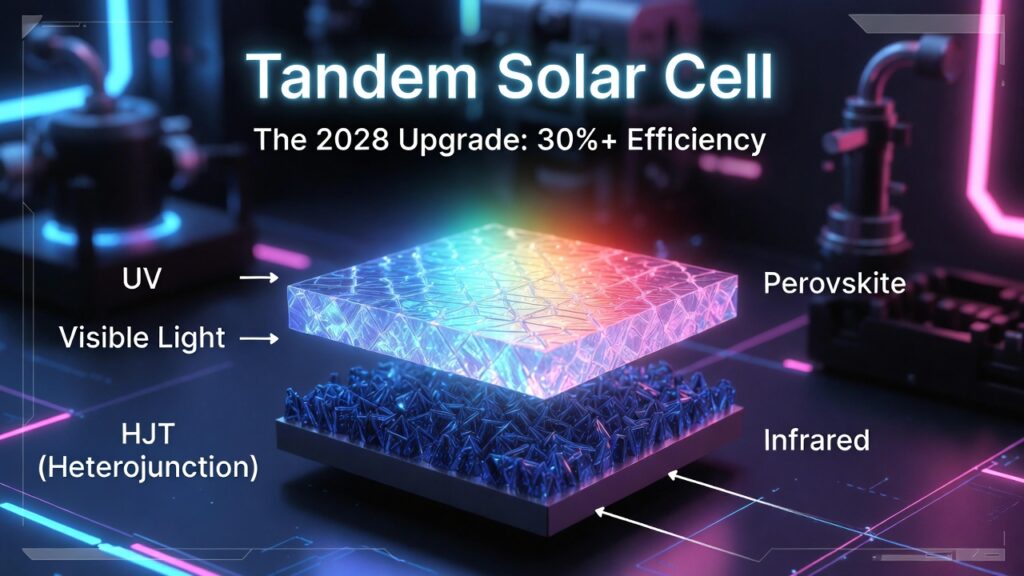
Upgrade Path: HJT vs. TOPCon for 2028
| Feature | TOPCon (Standard) | HJT (Tandem-Ready) | Why it Matters |
| Surface Finish | Textured / Rough | Flat / Symmetrical | Flat surfaces bond better with Tandem layers. |
| 2028 Potential | 27% – 28% Efficiency | 30% – 32% Efficiency | HJT + Perovskite is the ultimate combo. |
| Process Temp | High Heat (800°C) | Low Heat (200°C) | Low heat preserves sensitive Tandem layers. |
| Upgrade Ease | Moderate | High | HJT is the natural “base” for future tech. |
The move to Tandem-Ready Solar Panels is about maximizing every ray of sunlight. In 2026, manufacturers are already testing these hybrid designs. HJT is winning the race because of its low-temperature process. High heat can damage the delicate Perovskite material. Since HJT is made at lower temperatures, it is safer. Your Tandem-Ready Solar Panels will produce more power in the same space. This is vital if you have a limited roof area. Smart buyers are already asking installers about “Tandem Compatibility.”
Energy prices will likely keep rising through 2028. Having Tandem-Ready Solar Panels gives you an escape route. You can upgrade your system’s output without adding more weight. The solar industry is moving toward “Plug and Play” efficiency. By choosing the right base now, you save thousands later. Tandem-Ready Solar Panels are the gold standard for long-term thinkers. Secure your energy future by picking the right technology today.
🛠️ Pro Fix: Buy “Tandem-Ready” Inverters Now
Your panels are only half the story. To support 30%+ efficiency in 2028, you need a high-spec inverter. Look for inverters with a wide MPPT Voltage Range and high amperage input. 2026 “Hybrid” inverters are usually the best choice. They can handle the massive power surge from future Tandem upgrades without blowing a fuse.
💡 Did You Know?
HJT is the perfect “base” for the next 30% efficiency jump. Because its structure is so simple and clean, scientists call it the “Ideal Bottom Cell” for Perovskite Tandem research!
Final Verdict: TOPCon vs. HJT (2026 Summary)
| Feature | TOPCon Solar Panels | HJT Solar Panels | Winner |
| Best For | Budget-conscious homeowners with large roofs. | High-energy users and hot climates. | Tie (Depends on Goal) |
| Efficiency | High (Up to 24.5%) | Ultra-High (Up to 26%+) | HJT |
| Price | More Affordable | Premium Pricing | TOPCon |
| Heat Performance | Good | Best-in-Class | HJT |
| Degradation | 0.40% annually | 0.25% annually | HJT |
| Future Readiness | Moderate | Tandem-Ready (2028) | HJT |
Frequently Asked Questions (2026 Solar Edition)
| Question | Expert Answer |
| Which is better for hot climates, TOPCon or HJT? | HJT is the winner for hot regions. It has a lower temperature coefficient (-0.24%/°C), meaning it loses less power as the heat rises compared to TOPCon. |
| Are TOPCon panels cheaper than HJT in 2026? | Yes. TOPCon remains more affordable because it uses existing factory lines. HJT is a premium technology and usually costs 10% to 15% more upfront. |
| Which panel has a longer lifespan? | Both are durable, but HJT typically offers better long-term stability. HJT panels often come with a 30-year warranty and a higher power retention rate (over 91% at year 30). |
| What is the efficiency limit for TOPCon? | Mathematically, TOPCon can reach nearly 29% efficiency. In 2026, most commercial TOPCon panels offer between 22.5% and 24.5% efficiency. |
| Can I upgrade TOPCon or HJT to Tandem cells later? | HJT is much easier to upgrade to Perovskite Tandem tech in the future. Its flat surface and low-temperature process make it the ideal “base” for 2028 upgrades. |
| Do these panels work on cloudy days? | Yes. Both use N-type silicon, which performs significantly better in low-light and cloudy conditions than old PERC technology. |