
In This Article: Quick Navigation
Decode Your 2026 Energy DNA Before Buying
You must understand your energy use first. We call this your Energy DNA. In 2026, solar is about efficiency, not just size. Many homeowners buy systems that are too large. This wastes thousands of dollars.
First, look at your modern appliances. Today’s smart devices use very little power. Older machines are “energy hogs.” You should audit your home before signing a solar contract. A learner’s home needs a smaller, cheaper solar array.
Check your smart meter data daily. This reveals your “baseload” power. This is the energy used while you sleep. High baseloads mean you have “vampire” appliances. Kill these leaks to save on solar buying costs.
2026 Efficiency Comparison: The Solar Impact
| Appliance Type | Legacy Consumption (Watts) | 2026 Smart Efficiency (Watts) | Potential Solar Savings |
| Central AC / Heat Pump | 3,500W – 5,000W | 1,200W – 1,800W | 60% Less Panels |
| Refrigeration Units | 400W – 600W | 100W – 150W | Smaller Battery Need |
| Washing Machines | 800W – 1,200W | 300W – 450W | Lower Peak Demand |
| Dishwashers | 1,500W – 2,000W | 600W – 900W | Better Grid Offset |
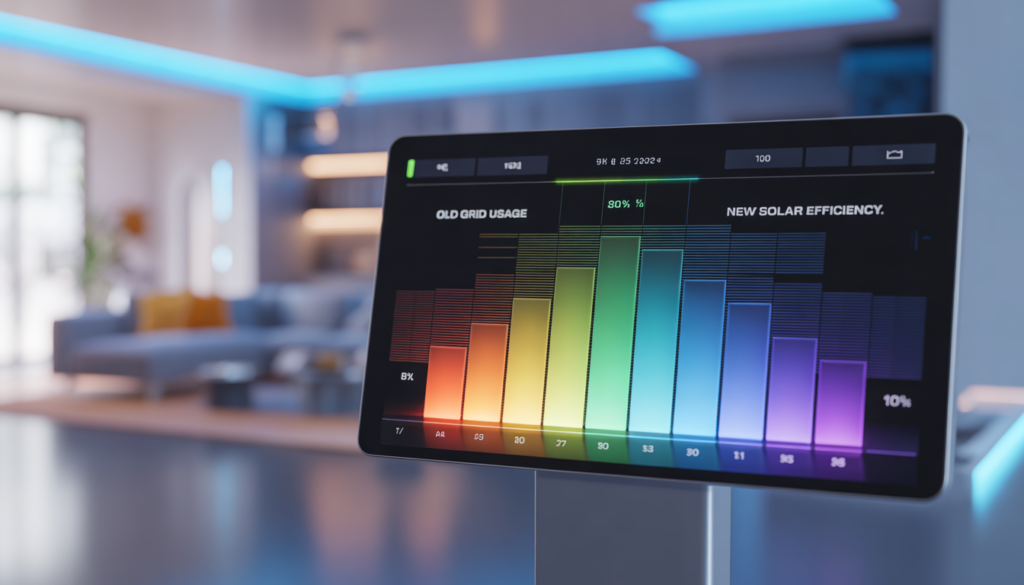
🛠️ Pro Fix: Smart Meter Mastery
Access your utility portal’s Green Button data. Look for your usage at 3:00 AM. If it is above 0.3kWh, you have vampire drains. Unplug old DVRs, printers, or non-smart chargers. Reducing this “always-on” load by 200W can save you the cost of two premium solar panels!
💡 Did You Know?
Modern AI-driven homes in 2026 use predictive algorithms to shift loads. These systems can reduce your total solar buying requirement by 15% by running heavy tasks only during peak sun hours.
Step 2: Choose 2026 High-Tech Solar Cells for Max Savings
The solar world changed fast in 2026. Basic P-Type panels are now obsolete. You must choose N-Type technology for solar buying success. These cells last longer and produce more power.
Three main technologies dominate the global market in 2026. These are TOPCon, HJT, and IBC cells. Each has a different price point. Your choice affects your long-term ROI.
TOPCon is the most common 2026 standard. It offers great value for most homes. HJT is better for very hot climates. IBC looks the best on modern roofs. Let’s compare their technical specs for 2026.
“In 2026, don’t just buy efficiency; buy longevity. While TOPCon is the current market leader, ensure your panels have a degradation rate of less than 0.4% annually to truly future-proof your investment.” — Marcus Thorne, Senior PV Consultant
2026 Technology Comparison: TOPCon vs. HJT vs. IBC
| Feature | N-Type TOPCon | Heterojunction (HJT) | IBC (Interdigitated Back Contact) |
| Peak Efficiency | 22.5% – 24% | 24% – 26% | 23% – 25% |
| Year 25 Output | 89% Guaranteed | 92% Guaranteed | 90% Guaranteed |
| Relative Cost | Baseline Price | 15% Premium | 20% Premium |
| Best Use Case | Best Value / Budget | High Heat Areas | Aesthetic Roofs |

🛠️ Pro Fix: Avoid “All-Black” Heat Loss
All-black panels look great on your 2026 home. However, black backsheets trap excessive heat. This can lower efficiency by 4% in summer. For solar buying savings, choose “Black on White” panels. This keeps the cells cooler and yields more total energy for less money!
In 2026, we also see Perovskite tandem cells. These are the future of the industry. They layer different materials to catch more sun. But for now, stick to proven N-Type tech.
Check the “Temperature Coefficient” before you buy. This number tells you how heat kills power. Lower numbers are always better for your wallet. A low coefficient means more money in the summer.
Reliability is key for solar buying in 2026. N-Type cells have lower degradation rates. This means your system stays strong for decades. It protects your investment against rising grid prices.
💡 Did You Know?
Heterojunction (HJT) cells perform best in 2026 heatwaves. They lose less power as temperatures rise. This makes them the ultimate choice for global buyers in tropical zones.
Step 3: Master the Temperature Math to Stop Solar Wilt
Heat is a silent killer for your solar panels. Most buyers forget to check the temperature coefficient. This number determines how much power you lose in summer. High heat makes panels less efficient and lowers your ROI.
In 2026, global temperatures are reaching record highs. You must choose panels that handle extreme heat well. This step will save you thousands over the system’s life. We will now decode the math behind solar buying decisions.
Standard panels are tested at $25^\circ C$. However, roofs often reach $45^\circ C$ or higher. A poor panel “wilts” and loses significant power. You need a low temperature coefficient for the best results.
Real-World Output: $25^\circ C$ vs. $45^\circ C$ (Top 2026 Brands)
| 2026 Solar Brand | Rated Power at 25∘C | Real Output at 45∘C | Total Power Loss % |
| Maxeon 7 (IBC) | 450W | 428W | -4.8% |
| REC Alpha (HJT) | 440W | 418W | -5.0% |
| Jinko Tiger (TOPCon) | 430W | 402W | -6.4% |
| Standard P-Type | 400W | 362W | -9.6% |
📊 Solar Math: Calculate Your Savings
| 📈 Simple ROI Formula | ⚡ What is LCOE? (Levelized Cost of Energy) |
|---|---|
| Definition: ROI tells you how many years it takes to recover your invesذآtment through bill savings. | Definition: This is the “Real Price” of your energy over a 25-year period. It depends on technology and durability. |
| The Formula: | Comparison: |
| ROI (Years)=Annual Electricity SavingsTotal System Cost | • 🔋 High-Tech Panels (TOPCon/HJT): These have a Lower LCOE because they last longer and produce more power over time. • 💰 Cheap Panels: These have a Higher LCOE because they degrade faster, making your energy expensive in the long run. |
| Example: | The Bottom Line: |
| If your system costs $10,000 and you save $2,500 yearly, your ROI is 4 Years. After that, your electricity is 100% Free! | While high-tech panels might cost more upfront, they are friendlier to your wallet in the long term because the energy they produce is cheaper per unit. |
🔑 Key Takeaway: ROI tells you when you get your money back, while LCOE tells you which technology is cheaper in the long run. Use both to make the smartest investment!
“Note: Solar ROI and LCOE calculations can vary significantly based on your country’s electricity rates, net metering policies, and available government incentives. Always consult with a local solar expert for a precise financial breakdown in your region.”
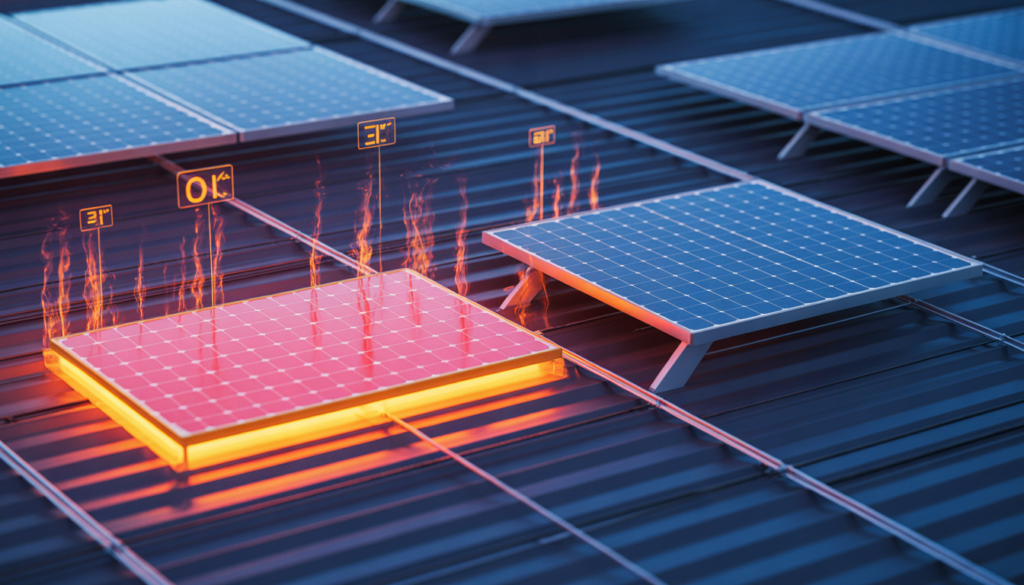
🛠️ Pro Fix: The 4-Inch Airflow Rule
To maximize solar buying value, never mount panels flush to the roof. Ensure a minimum 4-inch gap between the roof and the panels. This creates a “chimney effect” that naturally cools the cells. A cooler panel can produce 5% more energy on hot days!
When you compare quotes, look for the Pmax rating. This is usually found on the technical spec sheet. A rating of $-0.29\%/^\circ C$ is excellent for 2026. Avoid anything higher than $-0.39\%/^\circ C$ for modern homes.
This math is vital for your global solar buying strategy. In regions like Australia or Texas, this is critical. Your panels will stay productive while others fail. Always prioritize thermal stability over the initial low price.
Investing in HJT or IBC technology helps here. These cell types have better intrinsic heat resistance. They keep your home powered during the hottest afternoons. This is when your AC needs power the most.
💡 Did You Know?
A panel with a -0.24%/°C rating saves 10% more energy than a standard -0.37%/°C panel over time. This efficiency gap adds up to thousands in solar buying savings.
Step 4: Master the 2026 Global Solar Warranty Maze
Solar warranties reached a massive 40-year milestone in 2026. You must look past the big numbers when buying solar. Many “fake” protections exist in the global market today. A long warranty is useless if the company goes out of business.
Always separate the product warranty from the performance warranty. Product coverage handles physical defects and broken parts. Performance coverage ensures the panels still produce high energy. In 2026, premium brands lead with total peace of mind.
Check for labor and shipping coverage in your contract. Some warranties cover parts but not the actual repair work. This hidden cost can ruin your solar buying ROI. Let’s compare the top 2026 manufacturers side-by-side.
2026 Warranty Comparison: Maxeon vs. REC vs. LONGi
| Manufacturer | Product Warranty | Performance (25 Years) | Labor & Shipping |
| Maxeon (40-Year) | 40 Years | 88.3% Guaranteed | Full Coverage |
| REC (Alpha Pure) | 25 Years | 92.0% Guaranteed | Certified Only |
| LONGi (Hi-MO) | 15 – 25 Years | 88.9% Guaranteed | Parts Only |
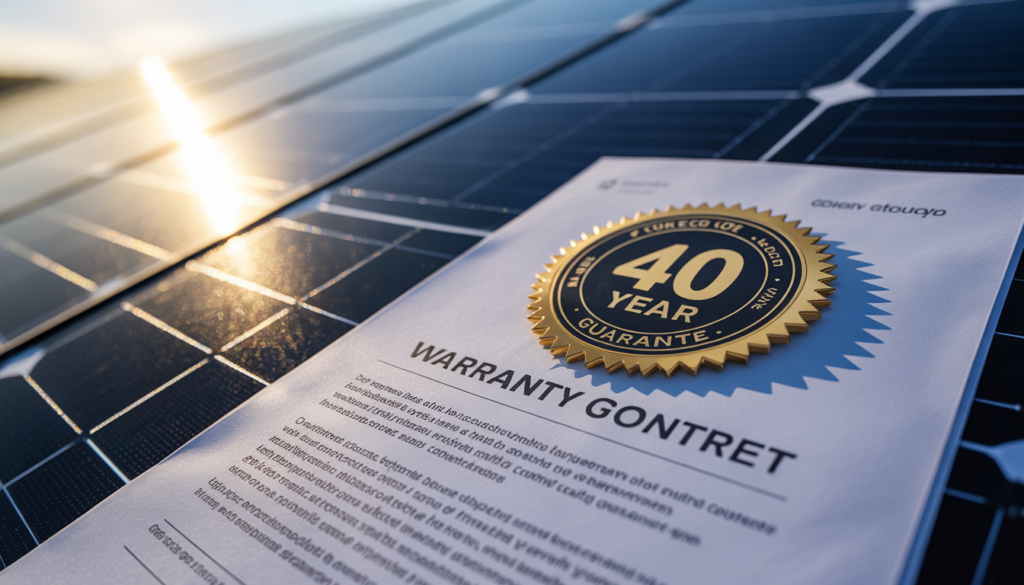
🛠️ Pro Fix: The “Local Entity” Test
Before your solar buying final payment, ask for the manufacturer’s local registration number. If they don’t have a registered office in your country, claiming a warranty is nearly impossible. A “global” warranty only works if there is a “local” legal person to sue!
Watch out for “Bankability” scores from 2026 research firms. A bankable brand is financially stable and safe. Tier 1 status is the minimum requirement for buyers. This status ensures the company will survive until 2066.
Read the fine print regarding “extreme weather” events. Many 2026 warranties exclude damage from record-sized hail. You may need separate insurance for these risks. Smart solar buying means protecting the physical hardware.
Finally, register your system online immediately after installation. Many brands require registration within 90 days for full coverage. Do not leave this task to your installer. Secure your future energy today with a solid contract.
💡 Did You Know?
Most performance warranties in 2026 now guarantee 92% output after 25 years. This is a massive jump from the 80% standard seen in 2020. Your solar buying investment now stays stronger for much longer.
Step 5: Future-Proof Your Solar System for 2028 Upgrades
Do not build a system only for today. Your energy needs will grow by 2028. Think about Electric Vehicles (EVs) and heat pumps now. Smart solar buying requires long-term planning.
Most homeowners underestimate their future power usage. An EV can double your daily electricity demand. Adding panels later is very expensive. It is cheaper to install extra capacity today.
In 2026, energy prices remain volatile globally. A larger system protects you from future grid spikes. You must size your array for your 2028 lifestyle. This ensures the best solar buying return on investment.
System Size vs. ROI: Planning for Growth
| System Size (kW) | Major Loads Covered | Estimated ROI (Years) | 2028 Future Readiness |
| 5kW System | Lights, Fridge, TV | 4 – 6 Years | Low (No EV Support) |
| 10kW System | 5kW + 1 EV + AC | 5 – 7 Years | Medium (1 EV Ready) |
| 15kW System | 10kW + Heat Pump + 2 EVs | 6 – 8 Years | High (Full Autonomy) |
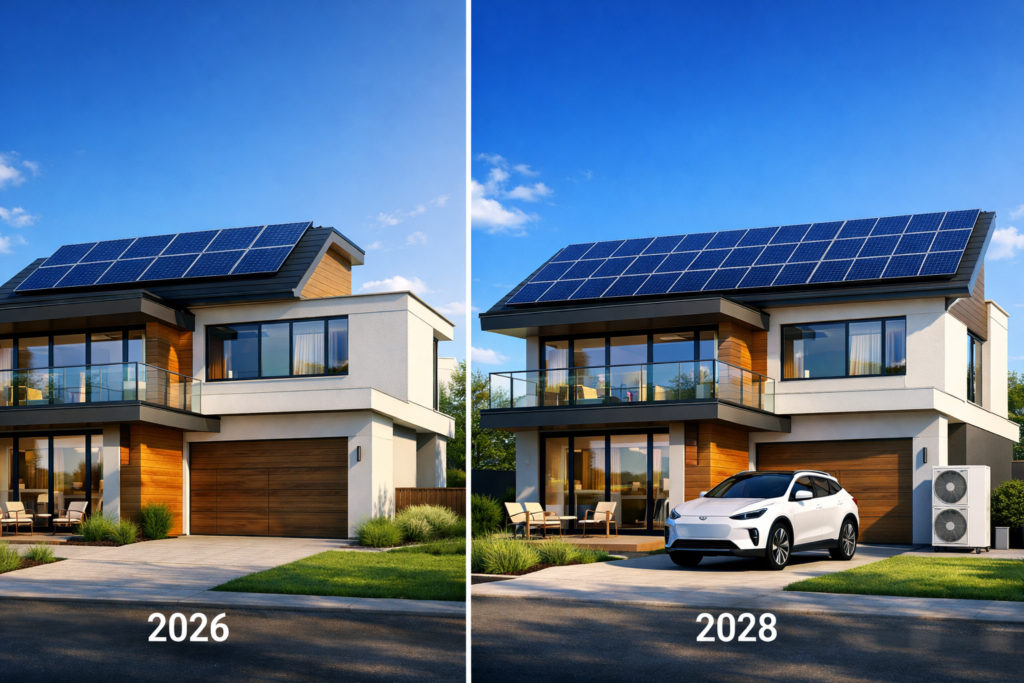
🛠️ Pro Fix: The Hybrid Inverter Secret
When solar buying, choose an inverter larger than your current panel array. If you have 6kW of panels, buy an 8kW or 10kW Hybrid Inverter. This allows you to plug in more panels later without replacing the most expensive part of your system!
Retrofitting old systems often requires new permits. It also involves high labor costs for small additions. You save 40% By installing those panels now. This is a critical solar buying hack for 2026.
Consider your roof space for future expansion. Leave the best southern-facing spots open for high-efficiency panels. Talk to your installer about “modular” system designs. This makes adding 2028 battery tech much easier.
Your goal is “Energy Independence” by 2030. Larger systems generate more surplus for battery storage. This surplus keeps your home running during grid outages. Plan big today to save big tomorrow.
💡 Did You Know?
Retrofitting a system later is 40% more expensive than adding two extra panels now. Labor and permitting fees make small additions inefficient for your solar buying budget.
Step 6: Slash Costs by Avoiding 2026 Middleman Markups
In 2026, the solar buying landscape has shifted significantly. You no longer need to pay massive sales commissions. Direct-to-consumer models are now very popular globally. Cutting out the middleman can save you 20% more.
Many national installers have high marketing overheads. They pass these costs on to you during solar buying. Local artisans often provide better quality and lower prices. You must vet every installer with modern 2026 tools.
Always ask who will actually install the panels. Many big companies use cheap, third-party subcontractors. This can lead to poor roof seals and leaks. Expert solar buying requires knowing your actual labor team.
2026 Procurement Comparison: Finding the Best Value
| Feature | National Installers | Local Artisans | Direct-Purchase DIY |
| Average Cost | High (Premium) | Medium (Fair) | Low (Wholesale) |
| Support Quality | Call Center | Personal / Local | Self-Managed |
| Warranty Speed | Slow Process | Fast Response | Manufacturer Only |
| Project Control | Very Low | High | Absolute |
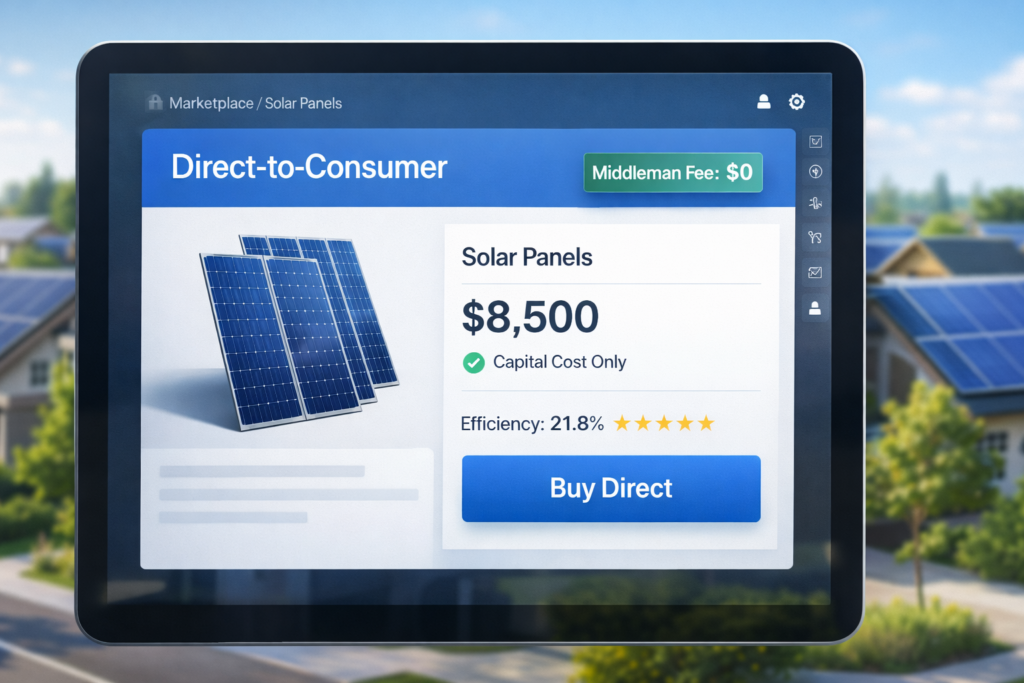
“The biggest mistake homeowners make is focusing on the ‘sticker price’ rather than the LCOE. A cheaper system that fails in year 7 is infinitely more expensive than a premium system that lasts 40 years.” — Sarah Jenkins, Renewable Energy Financial Analyst
🛠️ Pro Fix: Spotting Hidden Fees
To master solar buying, get exactly three quotes. Look for “Permitting & Administrative” fees above $500. Some installers hide their sales commission in these lines. Ask for an itemized list to reveal the true equipment cost!
Check for wholesale-only brands that now sell to individuals. This is a major 2026 trend in the industry. You buy the hardware, then hire an electrician. This “split” model is the ultimate solar buying hack.
Verify the installer’s license through your local government portal. Never rely on verbal promises or glossy brochures. A true expert will provide a detailed shading report. This report proves they studied your specific roof.
In 2026, transparency is your best financial weapon. Avoid any company that refuses to list equipment brands. High-quality solar buying depends on specific, high-efficiency hardware. Keep your money by choosing transparency over marketing.
💡 Did You Know?
Software now allows you to get 99% accurate roof shading reports for free. Use LiDAR-based tools to verify your roof’s potential before talking to sales reps.
Step 7: Calculate True ROI (No 2025 Subsidies Needed)
Many federal solar subsidies ended in 2025. But this is not bad news for solar buying. Panel prices dropped by 85% since 2020. Your return on investment (ROI) is actually faster now.
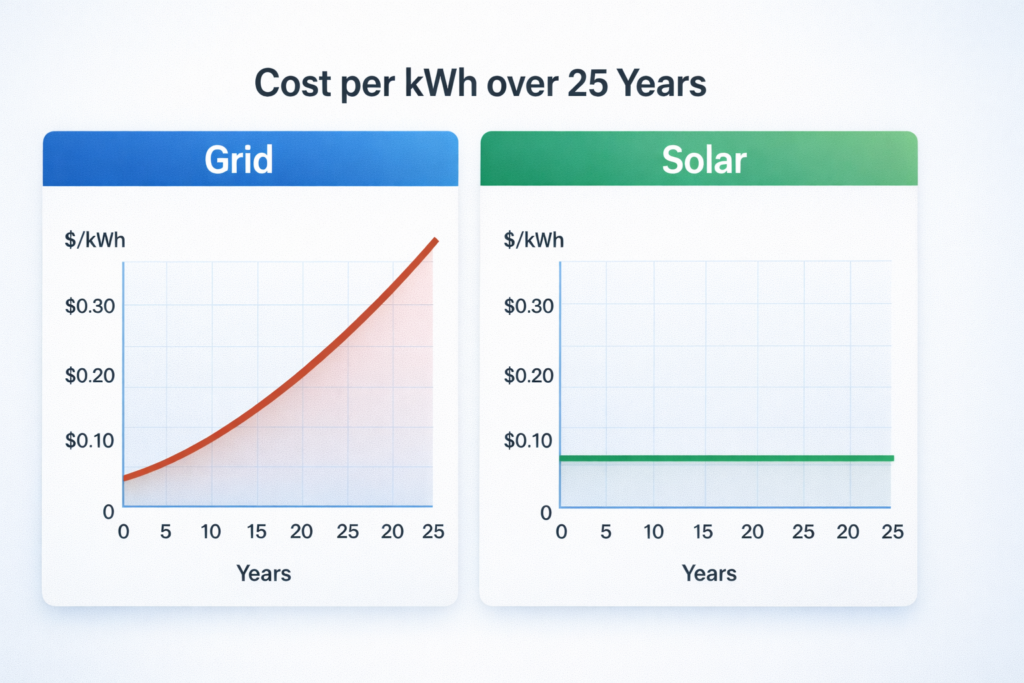
We now focus on the Levelized Cost of Energy (LCOE). This metric shows the true cost of solar electricity. It helps compare solar to your grid bill. LCOE is crucial for smart solar buying decisions.
Calculate your LCOE by dividing the total system cost by the total energy produced. Always use a 25-year projection for accuracy. This includes maintenance and degradation. Let’s compare grid electricity to modern solar LCOE.
2026 Energy Cost: Grid vs. Solar (per KWh over 25 Years)
| Energy Source | Average Cost (Year 1) | Average Cost (Year 10) | Average Cost (Year 25) |
| Grid Electricity | $0.20 / kWh | $0.35 / kWh | $0.55 / kWh |
| Solar (5kW System) | $0.10 / kWh | $0.11 / kWh | $0.13 / kWh |
| Solar (10kW System) | $0.08 / kWh | $0.09 / kWh | $0.10 / kWh |
🛠️ Pro Fix: Maximize Self-Consumption
In regions with poor “net-metering” rates, implement a **Zero-Export** system. This means panels only produce power for your direct home use. Add a small battery to store excess for evening. This boosts solar buying ROI by avoiding low export rates!
Always account for electricity rate increases. Grid prices rose by 5-7% annually since 2020. Solar LCOE is stable and predictable. This makes solar buying a hedge against inflation.
Look for local or state incentives still available. Some regions offer property tax exemptions for solar. Others provide small upfront grants or rebates. These can further sweeten your solar buying deal.
Your goal is to “beat the grid”. Solar lets you generate power for less than you buy it. This financial independence is the true value. Calculate your LCOE carefully for maximum savings.
💡 Did You Know?
Solar ROI in 2026 is actually faster than in 2020. Panel prices dropped 85% in that window. This makes upfront costs lower and payback periods shorter, boosting your solar buying advantage.
Step 8: Power Through the Night with 2026 Smart Storage
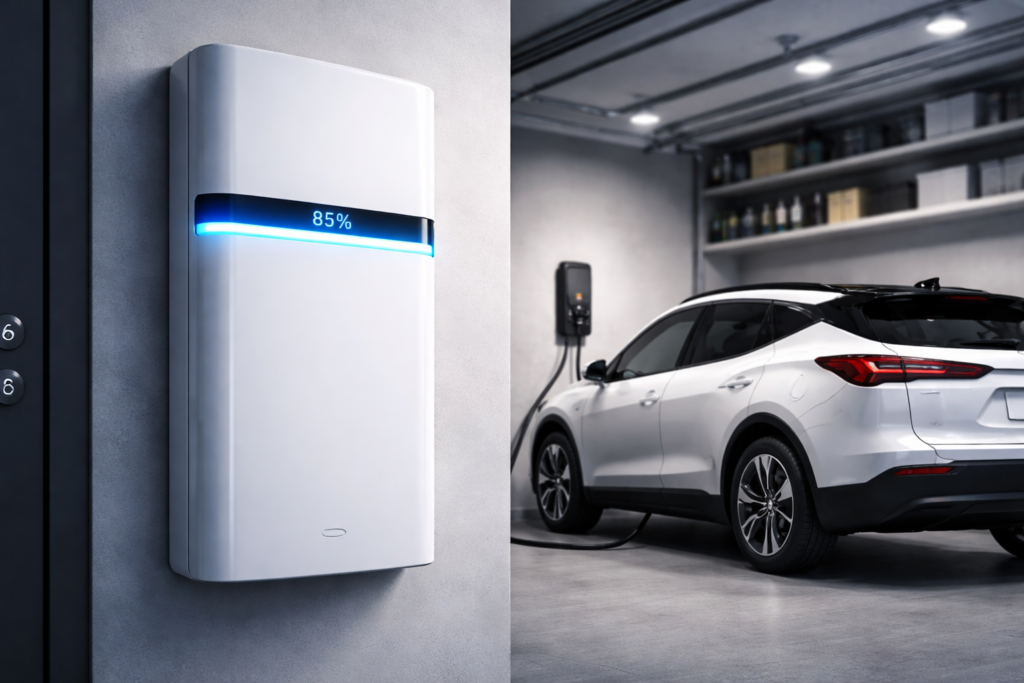
Solar without a battery is now a half-measure. In 2026, storage is essential for total energy independence. You must choose between LFP and new Solid-State tech. Smart solar buying means picking the right battery chemistry.
Lithium Iron Phosphate (LFP) remains the 2026 industry standard. It is very safe and lasts for thousands of cycles. However, Sodium-Ion is the new budget champion this year. It offers great performance for a much lower price.
Solid-State batteries are also entering the premium 2026 market. They pack more power into a smaller, lighter box. Your solar buying goal is to cover your evening peaks. Let’s compare the top three battery types for 2026.
2026 Battery Comparison: LFP vs. Sodium-Ion vs. NMC
| Feature | LFP (Lithium Iron) | Sodium-Ion (New) | NMC (High Density) |
| Safety Level | Ultra High | High | Moderate |
| Cycle Life | 6,000+ Cycles | 3,000+ Cycles | 2,000+ Cycles |
| Relative Cost | Medium | Low (Budget) | High |
| Best Use Case | Home Reliability | Extreme Cold | Mobile / Space Saving |
🛠️ Pro Fix: Activate Peak Shaving
To optimize your solar buying ROI, set your battery to “Peak Shaving” mode. This instructs the system to discharge only when grid prices are highest. By avoiding expensive “Time-of-Use” rates, you can save an extra $400 annually without changing your lifestyle!
Sodium-ion batteries perform better in freezing temperatures. This makes them perfect for northern global regions. They do not require expensive cobalt or lithium. This sustainability is a huge plus for solar buying.
Always check the “Depth of Discharge” (DoD) rating. Modern 2026 LFP batteries allow for 100% DoD.meaning you can use the full capacity without damaging the battery.
Pair your battery with a smart energy management app. This allows you to track your savings in real-time. Successful solar buying is about hardware and software working together. Protect your home from blackouts with a 2026 smart battery
🔗 View Article Sources
NREL: National Renewable Energy Laboratory — Solar Efficiency Data 2026
IEA: International Energy Agency — Global Photovoltaic Outlook
SEIA: Solar Energy Industries Association — Residential Solar Buying Guide
Energy.gov: U.S. Department of Energy — Solar Investment Tax Credits and ROI Analysis